Agencies
AI Answering Service: Evaluate Coverage and Handoffs
Evaluate AI answering service coverage, handoff evidence, exception ownership, and reporting with a practical service acceptance procedure.
By James Hill, Founder, RizzDial ·
Evaluate an AI answering service by requiring evidence that it handles each agreed coverage window, passes requests to an accountable recipient, and exposes unresolved exceptions. Approve a defined service scope only after the caller experience, receiving team's acknowledgement, and operational report agree about what happened.
Key takeaways: Separate answering availability from recipient availability. Require proof of accepted handoffs. Give failed transfers and unfinished requests an owner before approving coverage.
This guide is for agencies and GoHighLevel resellers assessing a client's answering service. It provides a proposed evaluation method, not reported test results. Use it alongside the Retell alternative evaluation page when preparing your shortlist and demonstration brief.
What does coverage need to mean in the service agreement?
Define coverage as a set of permitted outcomes for a particular business schedule. An available answering line does not establish that a dispatcher, department, or duty manager has accepted responsibility for the request. Your agreement should specify both layers.
Consider a hypothetical commercial facilities maintenance company. It accepts routine maintenance requests during office hours, has a rotating duty manager after closing, and uses different contacts for different properties. This example is a purchasing exercise, not a claim about any platform's existing configuration.
For that company, distinguish collecting a request from confirming that someone will attend the property. A caller may need acknowledgement immediately even though a site visit still needs review. Write the words the service is allowed to use at each stage, including when no recipient accepts the request.
Create a coverage register with these fields: property, local time zone, active schedule, request category, permitted action, intended recipient, unavailable-recipient fallback, and policy owner. Add the schedule version and effective date. Avoid a single generic field labeled “after hours” when different sites have different arrangements.
Include holiday closures, temporary schedule changes, and the moment a duty roster changes. Specify whether a request that starts before closing retains its original owner after closing. Make the boundary rule explicit so a caller cannot disappear between shifts.
Which coverage arrangements should you compare?
Compare proposed service scopes against the business's actual availability. The table below describes arrangements to request and verify; it does not assign capabilities to any vendor.
| Evaluation area | Overflow during office hours | After closing intake | Continuous intake with duty escalation |
|---|---|---|---|
| Entry condition | Office cannot answer under the agreed rule | Published office schedule has ended | Calls enter the agreed intake flow across schedules |
| Permitted commitment | Explain the next step or seek an available colleague | Record a request with an approved callback expectation | Seek an authorized duty recipient without promising attendance |
| Recipient evidence | Intended desk acknowledges the request | Next opening queue has an assigned owner | Current duty recipient accepts responsibility |
| Unavailable recipient | Return to the approved fallback | Preserve a pending request for review | Use the approved alternate or report an unresolved exception |
| Boundary test | Office becomes available during intake | Call crosses closing or opening time | Duty roster changes during a handoff |
| Reporting requirement | Separate overflow from ordinary office calls | Distinguish captured requests from completed callbacks | Separate connected calls from accepted escalations |
| Approval condition | Office team can recover every pending item | Callback ownership and queue visibility are demonstrated | Failed escalation remains visible until acknowledged |
Choose the scope whose obligations your client can sustain. Continuous intake creates a requirement for continuous exception ownership if the service promises an active response. If nobody is available to act overnight, the approved wording should say what will happen next without implying immediate intervention.
Use the calling platform alternatives hub to assemble candidates, then give each the same coverage register. Keep unknown items marked unverified. A polished demonstration for office overflow cannot establish after closing acceptance.
What evidence proves a handoff actually happened?
Require evidence at distinct stages: the service decided to transfer, the destination connected, a suitable recipient accepted the request, and the resulting work item gained an owner. Your operational definition of completion should identify which stage satisfies each service obligation.
Retell's official webhook documentation distinguishes transfer initiation, a bridged transfer, cancellation or failure to connect, and the end of the transfer leg. These are useful technical distinctions to ask about in a demonstration. Retell webhook event documentation
For this evaluation, a bridge event alone is insufficient proof of business acceptance. Ask the receiving person to confirm the property, caller's reason, requested action, and any commitment already made. Then inspect the proposed work record. Decide in advance how you will capture that acknowledgement and who can review it.
In the facilities example, a receptionist at the correct building might answer but lack authority to arrange maintenance. The number was correct; responsibility remains unresolved. Your acceptance sheet should show that distinction instead of recording every connection as a completed escalation.
Request an evidence packet containing the test identifier, schedule version, intended destination, observed connection outcome, recipient acknowledgement, work reference, and unresolved status. Where recordings or transcripts are proposed as evidence, verify their availability, access controls, retention, and deletion arrangements. Do not assume those records exist or are retained by default.
How should you evaluate exceptions without hiding them in averages?
Define an exception as a request that cannot reach its authorized next state. Examples in this proposed evaluation include a recipient who declines responsibility, a stale duty number, an unknown property, and a disconnected caller whose request remains incomplete.
Write an exception card for each case. Specify the trigger, permitted response, destination owner, deadline chosen by the client, and evidence required to close it. Use named roles with named backups. “Support handles it” is incomplete unless the agreement says which support team receives the case and what it owns.
A caller correction deserves its own card. Suppose the caller initially names one property and then corrects the location after a transfer attempt begins. Require the provider to demonstrate how the revised information reaches the correct recipient and how the earlier attempt is represented. The exercise should establish whether an old destination can still receive a misleading request.
For a request outside the approved service area, evaluate the explanation and exit path. For an unavailable recipient, evaluate the fallback and unresolved record. For a failed work-record update, require the caller's next step to reflect that uncertainty. Do not permit a success statement based solely on an attempted action.
Group defects by obligation: inaccurate promise, lost request, wrong recipient, missing context, or missing evidence. Review each blocked obligation before aggregate performance. A reassuring overall result should never override an unresolved defect in a required service path.
What numbered procedure tests service acceptance?
Use this proposed boundary-and-acknowledgement procedure with controlled test contacts and a provider-approved test setup. The scenarios are instructions for an evaluation, not measurements or claims of successful tests.
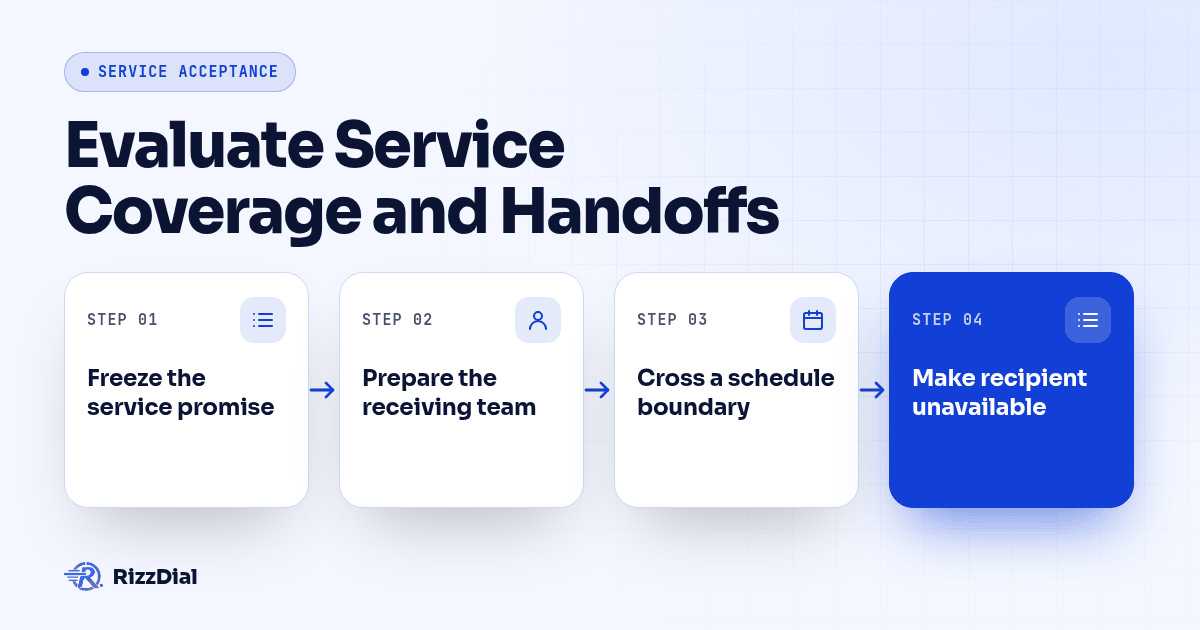
Freeze the service promise. Select a property, coverage arrangement, roster version, and request category. Record what the caller may be told and who may accept responsibility. Have the client approve those definitions before observing the demonstration.
Prepare the receiving team. Give the intended recipient and backup their roles, but keep the caller's exact phrasing unknown. Establish how they will acknowledge acceptance or decline the request. Include an observer who can inspect the resulting work queue.
Cross a schedule boundary. Start a routine maintenance request under the office schedule and continue it across closing in the test configuration. Compare the actual owner with the written boundary rule. Check that the caller receives a consistent explanation after the schedule changes.
Make the primary recipient unavailable. Use the agreed simulation for an unanswered destination. Observe the caller experience, alternate path, and unfinished work record. Require the provider to show who sees the unresolved request and how that person knows it needs attention.
Connect someone who cannot accept. Have the destination answer but decline ownership. Check whether the report distinguishes connection from acceptance. Continue through the approved fallback and verify that nobody silently closes the request because a telephone connection occurred.
Change a material detail. Correct the property or reason during the handoff exercise. Ask the eventual recipient to repeat the accepted details. Inspect the work record for the correction and any earlier destination that must be withdrawn or marked superseded.
Interrupt the reporting path. Ask the provider to simulate a delayed or unavailable downstream update in its test environment. Require a visible pending state and an assigned recovery owner. When the update is restored, verify the final record without assuming a repeated event should create another request.
Reconcile and sign off by scope. Compare caller observations, recipient acknowledgements, and queue records using the same test identifiers. Record observed outcome, missing evidence, defect owner, corrective action, and retest decision. Approve only the coverage cells whose required evidence is complete.
Repeat affected scenarios after a correction. If a roster fix changes office and after closing behavior, both arrangements need review. Preserve the earlier result so reviewers can tell what changed and why a previous approval no longer applies.
Who owns implementation and ongoing changes?
Separate business policy from configuration and operational review. The client should approve acceptable promises, coverage boundaries, and recipient authority. The implementation owner should translate those decisions into the proposed setup. An operational reviewer should inspect exceptions and confirm that the service still follows the approved scope.
For agencies, document where your responsibility ends and the client's begins. Who supplies a holiday roster? Who updates a changed duty contact? Who checks the update before it takes effect? Who restores the agreed fallback if the change fails? Put those responsibilities in the acceptance record with an escalation contact.
RizzDial is voice AI and dialer infrastructure for new age companies. Its capabilities include direct GoHighLevel integration and custom integrations with a dedicated developer. For this buyer job, ask for a written implementation scope showing how the proposed coverage register, recipient acknowledgement, and exception review would be delivered. Those service requirements still need verification in your setup.
Use the RizzDial versus Retell comparison to organize product questions separately from the acceptance sheet. Evaluate the agreed deliverables, access your agency will receive, and ownership after launch. A feature description alone cannot assign responsibility for your client's unresolved requests.
If the proposed fallback includes written follow-up, consider Beam for business messaging in that part of the evaluation. Specify the recipient, allowed content, reply owner, and unresolved-message handling before treating a message as an accepted handoff.
What reporting should you accept before expanding coverage?
Require a report that can reconcile individual calls with the business obligations they created. Start with coverage window, property, request type, attempted destination, connection outcome, acceptance status, assigned owner, and final disposition. Ask which fields are directly observed and which are inferred from conversation analysis.
Retell documents call completion and completed call analysis as separate events; its call-ended payload excludes call analysis. That distinction supports asking when each proposed report becomes complete. Retell call event documentation
Define report acceptance before reviewing a dashboard. Each controlled test should have a traceable entry. Pending requests should remain visible until an accountable person accepts or closes them under the agreed policy. If evidence is unavailable, mark the result unverified and record who will resolve it.
Agree on denominators before requesting rates. For handoff acceptance, use accepted eligible handoffs divided by eligible handoff requests. Keep callers who disconnect, recipients who decline, and unavailable destinations identifiable. Any exclusions need explicit definitions so a change in reporting cannot make a service improvement appear without changed behavior.
Use a coverage approval ledger as the final decision tool. Each row should identify the property and schedule, permitted outcome, evidence references, unresolved blocker, business approver, and approval status. Suggested statuses are approved, restricted, and pending evidence. A restriction should state exactly which caller promise or coverage window remains unavailable.
When reviewing the platform comparison hub, carry that ledger into the buying discussion. Request a demonstration against the blocked rows before expanding scope. The purchasing decision should identify the service you can responsibly promise today and the evidence needed for anything beyond it.
What FAQs help buyers evaluate coverage and handoffs?
What should an AI answering service evaluation prove?
It should prove that each agreed coverage window ends in an authorized outcome, an accepted handoff, or a visible unresolved request. Require evidence from the caller, the receiving team, and the resulting work record before approving that scope.
Does answering outside business hours mean someone will handle the request?
Treat answering availability and recipient availability as separate requirements. Specify who can accept each request outside business hours, what happens when that person is unavailable, and what the caller may be promised.
What counts as a completed handoff?
For service acceptance, require the intended recipient to acknowledge the request and its necessary context. Keep transfer initiation, connection, recipient acceptance, and eventual resolution separate in the report.
Who should own changes after implementation?
Assign a business policy owner, a configuration owner, and an operational reviewer. Record who approves schedule changes, tests revised handoffs, reviews unresolved requests, and restores the agreed fallback when a change fails.
About RizzDial
RizzDial is the AI outbound sales workspace for teams on GoHighLevel. Power dialing, AI voice agents, SMS automation, and CRM workflows in one platform. Book a demo.