AI Voice Agents
AI Answering Service for Property Management: Automate First
Plan property management AI answering with routine intake, live escalation, a five-step rollout and a comparison of AI, human services and voicemail.
By James Hill, Founder, RizzDial ·
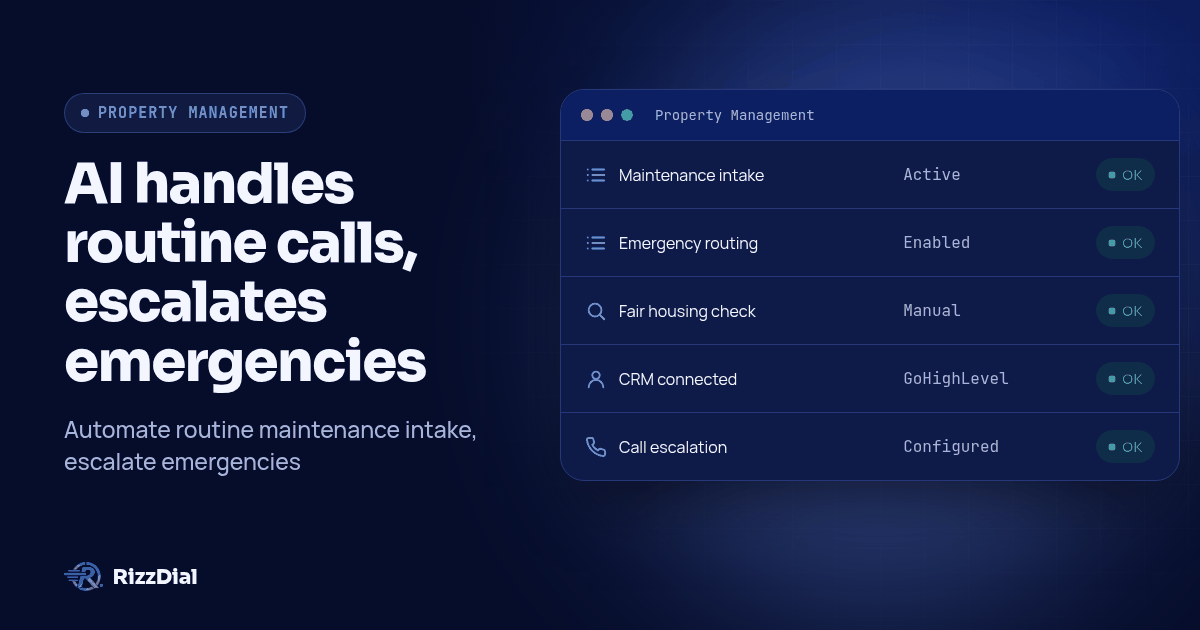
Let an AI answering service handle routine maintenance intake, after hours tenant questions, and prospective renter scheduling first. Escalate potential emergencies and fair housing sensitive questions to a trained person. Immediate danger needs emergency instructions before a manager transfer, so callers are not left waiting for help.
A property manager asking "can AI answer tenant maintenance calls" is really asking where the line sits between what a machine can triage and what a human has to hear directly. For an agency configuring this workflow for a property management client, the starting rule is: AI goes first on volume and routine triage, a person goes first on anything that smells like an emergency or a legal question.
What should an AI answering service handle first for a property management company?
Start with the calls that are high volume, low ambiguity, and already costing you tenants or leads when nobody picks up. Use your own unanswered-call records to establish the problem before choosing coverage. Haven's after hours maintenance guide discusses this use case, but vendor figures should not become assumptions about your portfolio. Review when callers reach voicemail, which calls produce a callback, and which requests remain unassigned the next morning.
Three call types belong on an AI answering service from day one. Routine maintenance intake (a dripping faucet, a loose cabinet door, a request to replace an air filter) needs a ticket created and a contact tagged, not a conversation with a manager. After hours tenant questions (rent portal access, published office hours, parking policy) can be approved lookups. Account-specific information needs identity checks and authorized access before disclosure. And prospective renter calls that come in while your leasing staff is already with a walk in prospect are simply calls you would otherwise lose; an AI voice agent that can answer, qualify, and offer a showing time can preserve a next step when a call would otherwise reach voicemail. Confirm that the calendar connection actually works before promising bookings.
Treat maintenance intake and maintenance completion as different outcomes. A record with an address, callback number and issue description is useful only when someone owns the next action. Give residents an accurate next step, avoid promising repair times without approval, and make an unresolved request visible to the property team.
What must stay with a live person?
Anything where the wrong answer puts someone at risk or exposes you legally has to escalate to a human, every time, with no exceptions carved out for "it sounded minor." That list is short but non-negotiable: active water leaks or flooding, a gas smell, no heat during a freeze or no air conditioning during extreme heat, a reported fire or electrical spark, a tenant locked out with a safety concern, and a sewer backup. It also covers anything that touches fair housing: a caller asking about the ethnic makeup of a building, a disability accommodation request, or a question that sounds like it is testing whether you will discriminate. None of those belong to a voice agent's judgment.
For a gas smell, the script must not ask the caller to wait through a transfer queue. National Grid's gas emergency guidance tells people to go outside and report the issue immediately to emergency services or the utility. Have the property team approve locally appropriate emergency instructions before testing. An on-call manager notification supplements that response.
HUD's fair housing overview identifies protected classes, including disability and familial status. That is why accommodation requests and sensitive screening questions should go to a trained reviewer. The agent can record a request without deciding eligibility, denying an accommodation, or improvising a policy.
A caller who is already angry, or a call from an attorney, a code enforcement officer, or a reporter, also needs a human on the line immediately rather than a polite AI deflection. The goal of the AI answering service is to take the easy, repetitive share of call volume off your team's plate, not to replace the manager who has to make a judgment call at 2am about whether a tenant's described symptoms mean "send a plumber tonight" or "add it to tomorrow's list."
How does an AI answering service compare to a traditional answering service and plain voicemail?
Property managers usually have three real options for the calls their own staff cannot pick up: an AI answering service, a traditional human answering service, or plain voicemail. Here is how they compare on the factors that actually decide whether a call turns into a kept tenant or a lost lease.
| Factor | AI answering service | Traditional human answering service | Voicemail |
|---|---|---|---|
| After hours coverage | Can answer outside office hours when routing, capacity and service availability are configured | Coverage depends on contracted hours and available operators | Records messages while enabled; staff must retrieve and act on them |
| Emergency triage | Requires tested escalation rules, emergency instructions and an unanswered-transfer fallback | Requires trained operators, current instructions and reachable escalation contacts | Does not conduct a live triage conversation |
| Leasing or showing scheduling | Can offer confirmed availability if the calendar connection supports it | Can schedule when operators have authorized calendar access | Requires another contact to confirm a time |
| Cost of a missed call | Assess unresolved requests and failed handoffs, not just answered calls | Assess queue abandonment and incomplete messages | Assess delayed callbacks and prospects who leave no message |
This is a workflow comparison, not a measured vendor ranking. Test each option against the same calls and staffing plan. AI coverage depends on configuration and availability; a human service depends on training and staffing; voicemail depends on someone reviewing messages promptly. Trillet's property manager answering-service overview also addresses the category, but a vendor article cannot establish the financial cost of a missed call for your properties. Use your own inquiry and maintenance records for that decision.
What are the five steps to roll out an AI answering service without losing an emergency call?
A rollout that skips straight to "turn it on" is how a water leak call gets a friendly voicemail message instead of a live transfer. Work through these five steps in order, and do not go live until each one has a named owner.
- Separate tenant maintenance calls from prospective renter calls at the point of entry. Before you write a single script, decide how the system will know which bucket a caller falls into: an existing tenant versus a prospect calling about a listing. You can separate calls by routed number (a maintenance line and a leasing line) or by the AI voice agent's first qualifying question ("are you a current resident, or calling about a vacancy?"). Get this sorted first, because every downstream rule, from CRM tagging to who gets alerted, depends on this one branch.
- Define the emergency trigger language that forces a live transfer, in writing, before you test anything. Do not leave this to the AI's general judgment. Write the actual phrases a tenant is likely to say, grouped by category, and require a forced transfer the moment any of them appears:
- Water or flooding: "leak," "flooding," "water coming through," "ceiling is wet"
- Heat or cooling failure in extreme weather: "no heat," "furnace is out," "AC is not working" (escalate when conditions are dangerous or uncertain; do not assume a weather feed exists)
- Gas or fire: "smell gas," "smoke," "sparks," "burning smell"
- Lockout with a safety concern: "locked out," "can't get in," paired with any mention of being outside, a child, or a pet alone inside
- Sewer or structural: "sewage," "backing up," "ceiling collapsed," "door won't close" These phrases are examples, not an exhaustive detector. Test paraphrases, interruptions and ambiguous descriptions, and escalate uncertainty rather than requiring an exact word match. This list is a starting template; add the phrasing your own tenants actually use once you start reviewing calls in step five.
- Connect the voice agent and the dialer to your existing CRM or GoHighLevel sub-account. GoHighLevel's Call Details workflow trigger can enroll a contact automatically based on a system recorded Call Status (busy, voicemail, no answer, completed) or a Custom Disposition you define yourself, such as "maintenance," "leasing," or "escalated" (help.gohighlevel.com). Define separate outcomes for maintenance, leasing and escalation. Confirm that your integration writes the intended outcome into HighLevel; a direct connection does not prove that every external call populates a Custom Disposition. Test the resulting task or notification against an actual call record before enabling the workflow.
- Test the handoff to an on-call manager with staged calls before a real tenant ever reaches it. Call your own test line and say the trigger phrases out loud. Confirm three things every time: the transfer actually connects to a live person (not a ring group that goes unanswered), the manager receiving the call gets context instead of a cold transfer, and there is a documented fallback (a second staffed on-call number and an immediate internal alert) for the case where the first manager does not pick up within a set number of rings. Do not treat a completed call status or a recorded message as proof that a person accepted responsibility. Log the recipient and the next action. An emergency test fails if the caller is stranded, even when a notification was successfully sent.
- Review call logs every week for missed emergency language, not just call volume. Review transcripts and dispositions for phrases the rules missed in step two. During the initial rollout, review daily and investigate a missed emergency immediately; do not wait for the weekly meeting. Pull every call tagged "maintenance" that did not escalate, skim the transcript, and ask one question: would a person reading this transcript cold have sent it to a live line? If the answer is yes, the word list from step two needs an update.
What should RizzDial actually do on these calls?
RizzDial provides AI voice agents, direct GoHighLevel integration, and direct carrier access to AT&T, Verizon and T-Mobile so calls ring real devices. Its built in predictive and power dialer can support outbound follow up, but a tenant's inbound request does not automatically authorize an unrelated automated marketing campaign. Keep the callback purpose and the client's approved calling rules attached to the workflow.
For agencies and resellers, RizzDial supports white label delivery, MCP and OpenAPI access, and custom integrations with a dedicated developer. Those capabilities give you ways to connect systems. They do not establish a ready-made connection to every property management platform. Before making a client promise, demonstrate the exact record, calendar and handoff actions in the client's test environment.
RizzDial's proprietary voicemail detection runs in 0.66 milliseconds and is built to connect reps to live humans faster. That product specification is not a guarantee of end-to-end transfer time or emergency response. The staged handoff in step four still needs to prove that a reachable person receives the context and takes ownership.
Use the MCP and OpenAPI connection to explore supported agent and workflow operations with your implementation team. Confirm available data and permissions before designing transcript reviews around it. The property manager remains responsible for approving escalation instructions, maintaining the contact roster and deciding which information a caller may receive.
What should you record during the test week?
Create a simple acceptance sheet with one row per staged call: caller scenario, expected route, actual route, saved record, receiving person and corrective action. Use fictional tenant details. Include routine maintenance, a leasing inquiry, a request outside approved policy, an interrupted emergency description and an unanswered manager transfer. These are proposed test cases, not results from an existing deployment.
Have the manager review the saved context without hearing the original call. If they cannot identify the property, issue and next action, revise the intake questions. Then test a repeat caller so the workflow does not create conflicting instructions or leave the earlier request unassigned. An agency should get the client's signoff on the actual test records before expanding coverage to more properties.
Compare AI dialer and voice agent alternatives and RizzDial vs other platforms before you commit a property portfolio's call volume to any one vendor. If you manage inbound calls through an AI receptionist setup, the same escalation and CRM mapping work applies. For the GoHighLevel side of this rollout, see RizzDial for GoHighLevel agencies.
Property management is not the only service business deciding who receives an inquiry. If your team also handles territory assignment and rep availability, see how a service business should assign new inquiries when territories, existing customers and rep availability conflict. Use that ownership plan to choose the person responsible after an AI call ends.
What FAQs do property managers ask before they switch?
How much does RizzDial's AI answering service cost for a property management company?
RizzDial charges per minute of talk time, from $0.06 to $0.20 per minute on a pay as you go basis, with flexible seat based options. Billing is for talk time only. Confirm the complete configuration and commercial terms for your agency before quoting a client.
How long does it take to get an AI answering service live for a property management company?
Plan time to approve emergency instructions, assign escalation owners and map call types to CRM fields. Integration effort depends on your existing systems and required actions. Run staged calls and a supervised pilot before expanding coverage. A test week is a proposed review window, not a guaranteed implementation timeline.
Does an AI answering service for property management need to integrate with our CRM or property management software?
A tracked workflow needs a destination for the call outcome and an assigned owner. RizzDial provides direct GoHighLevel integration, MCP and OpenAPI access, and custom integrations with a dedicated developer. Verify the particular property software connection and demonstrate that the expected record is saved before promising automated maintenance tickets or leasing updates.
Is it legal or compliant to let AI answer tenant and prospective renter calls?
There is no blanket compliance answer based on using AI. Have the property team review recording, disclosure, privacy and fair housing requirements for its locations. RizzDial is built with FCC and FTC compliance in mind, but that is not a certification or a substitute for reviewing the actual workflow. Keep sensitive decisions with a trained person.
What does it cost in time and effort to switch from a traditional answering service or voicemail to an AI answering service?
The switching cost is mostly the five step rollout in this article: separating call types, defining emergency language, connecting the CRM, testing the handoff, and reviewing logs weekly. Confirm number routing and CRM compatibility with the implementation team. Where the configuration permits, test on a separate line while retaining existing coverage. Keep a documented rollback path until the property manager accepts the test results.
How can RizzDial help with your calling workflow?
RizzDial is the AI outbound sales workspace for teams on GoHighLevel. Power dialing, AI voice agents, SMS automation, and CRM workflows in one platform. Book a demo.