GoHighLevel
AI Call Transfers When the Sales Rep Does Not Answer
Test AI call transfers for busy reps, no answer, personal voicemail and dropped calls with an acceptance sheet and a named callback owner.
By James Hill, Founder, RizzDial ·
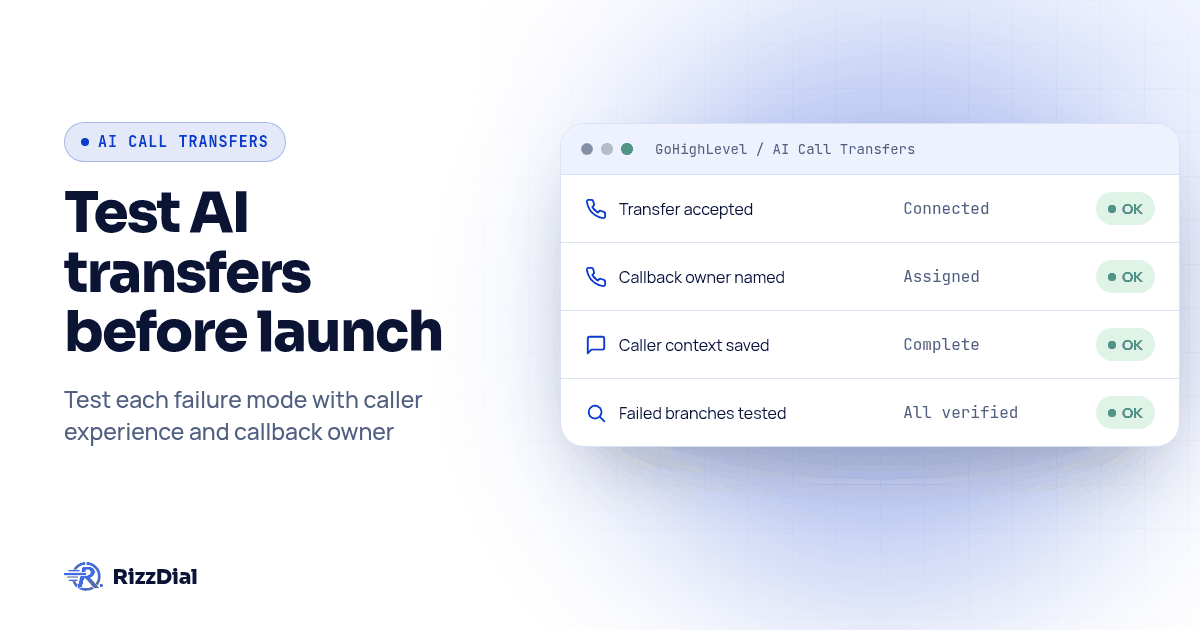
An agency should test busy reps, unanswered ringing, personal voicemail and dropped transfers separately, recording what the caller hears and who owns the next action. Define a pass for each branch before the demonstration, including the fallback message, CRM record and callback owner. Ask for evidence that the proposed AI workflow handles each outcome before promising automatic recovery to a client.
Key Takeaways
- A live handoff needs evidence that a person accepted the caller.
- Each failed transfer needs an agreed caller experience and follow-up record.
- Keep unsupported recovery behavior out of the client offer until demonstrated.
What does a transfer feature actually prove?
A transfer option alone does not establish what happens after the destination fails to answer. Start by identifying who controls the caller while the rep's phone rings and when that control ends.
HighLevel's Phone Dialer Overview describes a warm transfer as a consultation call before connecting the original caller. It describes a blind transfer as sending the caller directly to the destination without that consultation. This is documentation for the human-operated web dialer, not proof of an AI agent's ability to return to a waiting caller.
The Voice AI Warm Transfer request asks for unanswered transfers to return to the AI and describes callers reaching personal voicemail. Treat it as evidence of a buyer concern. A request and its comments do not establish current capabilities or prove how another provider behaves.
For a client using GoHighLevel AI calling, name the component responsible for each step: the AI conversation, the transfer destination, the receiving phone and the follow-up record. Test the proposed combination rather than borrowing a capability claim from another interface.
What should you prepare before testing the handoff?
Use test contacts and phones controlled by your team. Have someone play the caller, someone control the rep's device and an observer inspect the resulting records. Agree on the expected behavior before anyone places a call.
Write down the destination, transfer method, ring timeout, voicemail setting, business availability and fallback route. Use the client's intended configuration. An answered demonstration on a different destination does not resolve questions about the phone staff will actually carry.
Define success as a person accepting the handoff, hearing the caller and receiving enough context to continue. Define incomplete handoffs separately. Avoid treating a generic connected status as sufficient evidence that the rep spoke with the caller.
Decide what information the AI should confirm before attempting transfer. A practical proposal is the caller's name, reason for calling and preferred callback number. Check whether that information survives a failed handoff and appears where the callback owner works.
How should you build the branch-by-branch acceptance sheet?
Use the sheet below as proposed acceptance criteria, not as a description of features already configured. Agree on the caller experience first, then ask the provider to demonstrate whether the setup can deliver it.
| Test branch | Controlled test | Proposed caller experience | Evidence required for a pass |
|---|---|---|---|
| Rep accepts | Answer and accept the handoff | Caller reaches the rep with working audio | Rep confirms receipt; record shows a live handoff |
| Rep busy | Put the receiving device on a call, then attempt transfer | Agreed fallback follows the unsuccessful attempt | Actual phone response, fallback heard and callback owner recorded |
| No answer | Let the destination ring without answering | Waiting ends at the agreed limit with a clear next step | Measured wait, final caller destination and follow-up task |
| Personal voicemail | Let the rep's personal greeting answer | Caller follows the approved voicemail policy | Greeting observed; outcome recorded separately from live acceptance |
| Transfer drops | End the receiving connection during handoff | Caller stays connected if supported; otherwise follow-up begins | Disconnect point, caller outcome and assigned recovery action |
For every row, add the test date, configuration used, expected result, observed result, evidence location, callback owner and retest decision. Mark it demonstrated, failed or unresolved. Leave an untested branch unresolved even if the accepted-call branch worked.
For a broader purchase review, attach this sheet to the AI voice agent reseller demo checklist. Keep these results specific to unanswered receiving reps rather than using them to approve unrelated calling tasks.
What should callers hear when a rep is busy or does not answer?
The caller should hear a truthful next step that the tested workflow can support. Choose the wording and maximum waiting period with the client before testing.
For illustration, a proposed message could be: "The sales team isn't available right now. Would you like someone to call you back?" Use that line only if the system can still speak with the caller at that point and capture the answer. If it cannot, approve a different path and revise the opening transfer message accordingly.
Test busy and no answer independently. On the receiving phone, deliberately create the intended condition and record what actually happens. If the device forwards to voicemail, label that observation accurately rather than assuming the busy branch was exercised.
Measure the wait from the transfer announcement to the final caller outcome. Have the observer note silence, repeated ringing, interrupted speech and any chance to request a callback. If an alternate rep is part of the proposal, also test what happens when that person is unavailable.
How should you test personal voicemail and a dropped transfer?
Treat personal voicemail as its own destination. Play a greeting from the actual test phone and observe whether the caller reaches it, whether the AI remains involved and whether anyone receives an actionable follow-up record.
Ask the client whether callers may leave messages there. If personal voicemail is unacceptable, require a demonstrated alternative before launch. Possible requirements include returning to the AI, trying an approved business destination or creating a callback task. These are options to verify, not assumed platform behavior.
For a dropped transfer, interrupt the receiving connection at different handoff stages: while it rings, after the rep answers and after the caller joins. Separately have the caller hang up while waiting. Record which participant disconnected and whether the other participant remained connected.
Acceptance rule: Do not mark an interrupted handoff recovered until you can show either a restored conversation or an owned follow-up action.
A later callback does not mean the original call stayed connected. Preserve that distinction in the test notes and client reporting. If the system cannot identify the failure automatically, document the manual review step and who performs it.
Which record should own the callback?
Choose the staff member and destination record before testing. "The sales team will handle it" is too vague to verify. Name the owner, backup and due time, then show how the owner finds the work.
Require enough context to act without replaying the entire interaction:
- Caller identity and confirmed callback details.
- Reason for calling and any promised next step.
- Attempted destination and observed transfer outcome.
- Assigned owner, backup and follow-up deadline.
- Latest contact attempt and completion status.
During the CRM integration review, ask where these details appear and which require configuration or manual entry. Have the future operator locate the record without coaching. Test reassignment when the intended rep is unavailable and inspect whether repeated attempts create competing callback tasks.
If the proposed fallback includes a text confirmation, evaluate Beam's iMessage API as a separate messaging step. Verify the trigger, recipient, message and reply owner. Do not assume a failed voice transfer automatically creates or sends that message.
Finish by testing completion: once staff reach the caller, check how they close the task and prevent another worker from acting on stale follow-up instructions.
What should agencies ask about unanswered AI transfers in the FAQ?
Does a warm transfer guarantee that the AI can recover the caller?
No. Require a demonstration of the exact AI transfer path, including what happens when the destination does not accept. A human dialer transfer description does not establish autonomous recovery.
Should personal voicemail count as a successful transfer?
For a live sales handoff, mark personal voicemail as an incomplete handoff. If the client intentionally accepts voicemail, define that as a separate outcome with a message owner and follow-up deadline.
Who should own the callback after a failed transfer?
Assign a named staff member and a backup before testing. The owner needs the caller's request, confirmed callback details, failed destination, due time and a record of any later contact.
What if the platform cannot return the caller to the AI?
Document the limitation and test an alternative the client accepts, such as an approved business mailbox or a staff callback process. Keep automatic recovery out of the client offer unless it has been demonstrated.
What should you bring to the demonstration?
Bring the completed acceptance sheet, test destinations, proposed caller wording and the name of the callback owner. Ask RizzDial to demonstrate each branch in the proposed setup and identify any behavior that requires configuration, manual work or further testing.
Approve only the behavior you observed and the fallback your client accepts. Retest affected branches when the receiving number, voicemail settings, transfer method or follow-up mapping changes.
James Hill, Founder, RizzDial
For the next step in this workflow, review the ai voice agent workflow guide and discuss implementation through the AI calling integrations.
How can RizzDial help with your calling workflow?
RizzDial is the AI outbound sales workspace for teams on GoHighLevel. Power dialing, AI voice agents, SMS automation, and CRM workflows in one platform. Book a demo.