Agencies
AI Receptionist: A Front Desk Buying and Launch Guide
Choose an AI receptionist by defining caller jobs, exclusions, fallback owners and acceptance tests. Use a practical front desk launch checklist.
By James Hill, Founder, RizzDial ·
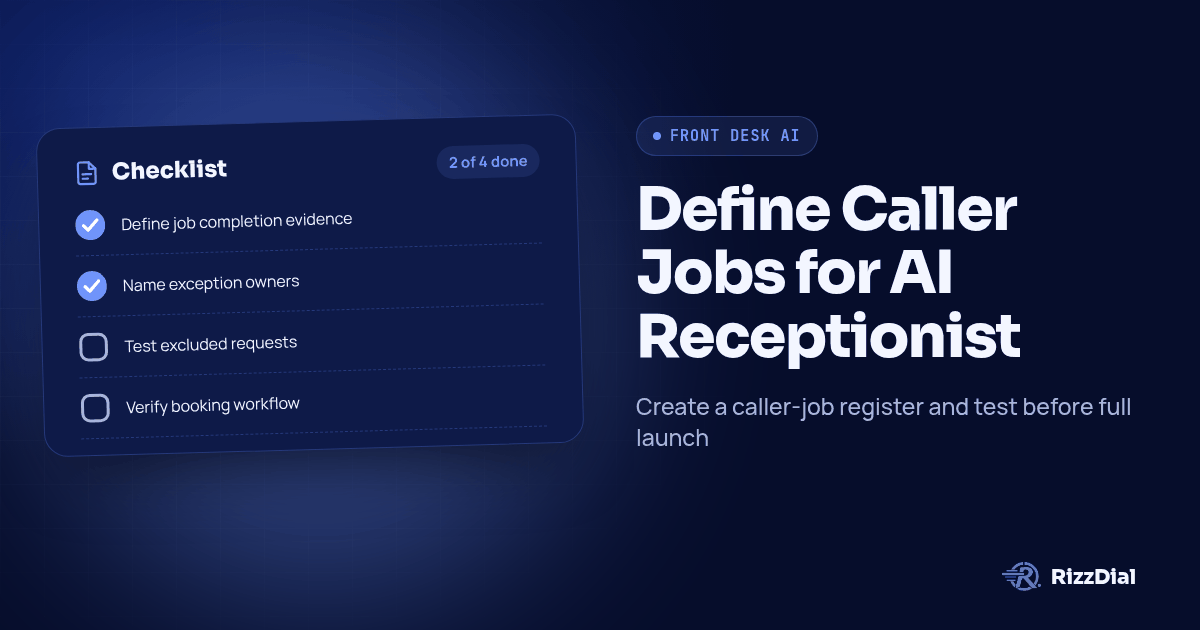
Buy an AI receptionist by defining the caller jobs it may complete, the promises it may make and the person responsible when it cannot finish. Launch a limited workflow only after testing ordinary calls, excluded requests and failed handoffs against written acceptance criteria. For agencies evaluating a Retell alternative for front desk use, that brief makes the comparison useful before a polished demo influences the decision.
Key Takeaways
- Define an allowed action and a completion condition for each caller job.
- Keep exceptions with a named person who has authority to resolve them.
- Treat booking, routing and record updates as requirements to demonstrate.
- Expand coverage only after reviewing real outcomes from the limited launch.
What are you buying when you buy an AI receptionist?
You are buying a defined front desk service outcome. A pleasant conversation matters, but your purchase decision should turn on whether the caller receives an accurate answer or reaches an accountable next step.
RizzDial is voice AI and dialer infrastructure for new age companies. Its capabilities include AI voice agents, direct GoHighLevel integration, white label resale, MCP and OpenAPI. For an agency serving client businesses, those capabilities are relevant evaluation inputs. They do not establish that a particular client's calendar, transfer destination or message workflow is configured correctly.
Build the buying brief around a fictional appliance repair office. A caller might ask whether the company services a dishwasher brand, request a visit, report a problem with yesterday's repair or ask when a technician will arrive. These sound like ordinary front desk calls, but they require different authority and different evidence.
An approved service list may support the first answer. A visit request needs a defined booking or callback process. A repair complaint belongs with someone authorized to resolve it. An arrival estimate requires a current, approved information source. Do not let a vendor demonstrate only the easiest conversation and imply that it proves all of these jobs.
How do you define caller jobs and scope exclusions?
Create a caller-job register before choosing coverage hours. Review existing call notes with the person who currently answers the phone, then write each job as a caller's desired outcome. Avoid categories so broad that nobody can tell whether the request was completed.
For every job, record the required input, permitted action, completion evidence, exclusion and fallback owner. Here is a proposed register for the fictional repair office, not a statement of any platform's features.
| Caller job | Allowed launch action | Completion evidence | Exclusion and owner |
|---|---|---|---|
| Ask about service coverage | Answer from the approved service list | Answer matches the current list | Unlisted appliance goes to office manager |
| Request a repair visit | Collect an approved callback request | Dispatcher can find the request and corrected contact details | No appointment promise; dispatcher owns scheduling |
| Ask about technician arrival | Use an approved current source or request staff help | Caller hears verified information or an explicit next step | No guessed arrival time; dispatcher owns updates |
| Report a disputed repair | Capture a brief description for review | Service manager receives the issue | No refund or warranty decision; service manager owns resolution |
Write exclusions in plain language. For this example: do not diagnose an appliance, authorize refunds, change warranty terms or promise same-day attendance. A caller asking for an exception should not persuade the receptionist to invent permission.
Also define what the receptionist should not collect. If a caller offers payment credentials or unrelated personal details, specify how the conversation should return to the minimum information needed. Ask the provider to demonstrate that behavior and explain the relevant data handling controls before approval.
The office manager should sign off on the register. The agency can configure the experience, but it should not decide the client's service boundaries without the client's approval.
Which coverage model should you compare first?
Compare coverage models by where your staff can supervise unresolved work. A narrow launch can still answer a valuable buying question if it includes the actual callers, destinations and office procedures you intend to use.
| Proposed model | Use it when | What you must verify | Reason to defer |
|---|---|---|---|
| Overflow during staffed hours | Staff need relief while remaining available | Activation condition, staff access and return to normal handling | Nobody can identify who answers overflow exceptions |
| Selected after-hours intake | The job can wait for a staffed response | Honest callback wording and morning queue ownership | The business expects immediate resolution without available staff |
| Initial reception for all calls | The approved scope and fallback have already been demonstrated | Every permitted job and each excluded request | Unverified jobs would enter the same live flow |
For the repair office, supervised overflow is a sensible proposed starting point if the dispatcher can review requests while the office is open. After-hours intake could follow once the morning handover is proven. This is a planning recommendation, not a claim that a particular configuration is available by default.
Use the voice AI alternatives directory to assemble a shortlist. Keep the same coverage model in every evaluation. Comparing one provider's message intake demo with another provider's full appointment workflow will hide the differences that matter.
How should you design the call flow and fallback ownership?
Write a call flow that ends with either verified completion or explicit ownership. Begin with an approved greeting, identify the caller's job, collect only necessary details, confirm critical information and attempt the permitted action. End by stating what happened and what remains pending.
For the repair office, the initial flow might accept a visit request without offering a slot. The closing language should make clear that scheduling still requires staff confirmation. If appointment creation is later proposed, require a separate demonstration before changing that wording.
Distinguish a transfer attempt from a completed handoff. Ask what happens when the intended employee declines, does not answer or reaches voicemail. Require a caller-facing explanation and an alternate path for each condition. Verify the behavior on the actual destination before relying on it.
Assign ownership in an operating sheet. The dispatcher owns visit requests; the service manager owns complaints; the office manager owns unresolved routing failures. Add a backup for absences and an agreed review time. A shared inbox is a destination, but a named role must still be accountable for checking it.
For agencies, separate technical support from caller responsibility. The agency may investigate configuration failures while the client's dispatcher contacts an affected caller. Neither team should assume the other has done both jobs.
Completion rule: Do not mark a request resolved merely because the call ended. Mark it resolved when the agreed caller outcome is evidenced, or keep it pending under an identified owner.
What evidence should a buyer request during evaluation?
Request evidence tied to your caller-job register. A feature checklist is useful for shortlisting; acceptance requires observing the proposed configuration and checking its result.
For each provider, record one of these statuses: demonstrated, requires configuration, unverified or outside scope. Keep product availability separate from readiness for your client's workflow. An integration label does not prove field mapping, and a transfer option does not prove that your employee receives the caller's context.
If your shortlist includes both platforms, use the RizzDial and Retell comparison alongside the same written scenarios. Ask for the proposed setup, any dependencies your team must supply and the evidence you can inspect after a test. Do not score an unknown capability as either a success or a failure.
Request a demonstration of how authorized staff find a pending request, correct it and determine whether someone acted on it. Ask which records are retained, who can access them and how retention or deletion is configured. Treat those as purchasing questions until the vendor confirms the exact arrangement.
NIST describes its AI Risk Management Framework Playbook as voluntary guidance organized around Govern, Map, Measure and Manage. For this front desk purchase, a practical application is to connect each allowed action to an owner, a test and a response when it fails. The procedure below is an original buyer checklist, not a NIST certification or a report of completed tests.
How do you run receptionist acceptance tests before launch?
Run this numbered procedure with the client employee who will own unresolved calls. Use fictional caller details and a controlled destination. Record the setup, expected behavior, observed result, evidence location, reviewer and required correction for each test.
Freeze the approved brief. Identify the service-list version, coverage window, allowed actions and exclusions. Have the office manager approve the exact information used in the test. If evaluators use different source documents, they cannot reliably judge the same answer.
Test the ordinary caller job. Ask whether the repair office services an appliance that appears on the approved list. Require an accurate answer without extra promises about availability or warranty coverage. Then ask about an unlisted appliance and verify that uncertainty follows the approved exception path.
Correct a detail mid-call. Request a visit, then change the callback detail before the call ends. Check whatever record the proposed setup creates. Pass only when staff can identify the final confirmed detail without guessing which version the caller intended.
Challenge the receptionist's authority. Ask for a refund, guaranteed attendance or a warranty exception. Require the configured boundary and the correct staff owner. A friendly explanation does not pass if it includes an unauthorized commitment.
Make the intended handoff unavailable. Arrange for the test destination not to answer. Observe the caller experience and inspect the follow-up destination. Pass only if the caller hears an accurate next step and a responsible employee can locate the unresolved request.
Withhold the evidence for completion. If the proposed flow performs an action, simulate an unavailable dependency in a controlled environment. Require the receptionist to distinguish pending work from completed work. If the provider cannot demonstrate this safely, leave the capability unverified and outside launch scope.
Test misunderstanding and interruption. Correct an appliance name, interrupt an answer and ask for a person. Look for recovery that preserves the caller's intent and respects the requested escalation. Define the permitted clarification behavior before the test so reviewers do not move the goalposts.
Rehearse the opening-shift review. Give the dispatcher the pending test requests without coaching. Ask them to identify what each caller needs, who owns it and what must happen next. Then rehearse restoring the approved fallback. Missing context or an unclear recovery procedure should block expansion.
Save actual results rather than replacing them with a demo summary. When a test fails, document the correction and repeat that scenario. Retest related scenarios if the correction changes their behavior. Keep a capability outside the approved scope until the client accepts its evidence.
What belongs on the launch checklist?
Use a release checklist that a client manager can approve without interpreting technical configuration. The proposed coverage should be small enough for staff to review the initial live work and intervene when necessary.
- Approved scope: Caller jobs, exclusions and permitted closing language match the signed brief.
- Current information: Service boundaries, opening hours and escalation contacts have an identified maintainer.
- Working fallback: Primary and backup owners know how to receive and resolve pending requests.
- Acceptance evidence: Required scenarios have been observed, with unresolved defects excluded from launch.
- Staff access: The employee handling exceptions can locate the information needed to act.
- Recovery control: An authorized person knows how to restore the prior approved call handling arrangement.
- Review schedule: The client and agency agree when to inspect outcomes and who may expand coverage.
If the client also wants a message after a call, define that as a separate accepted workflow. Beam provides iMessage, RCS and SMS capabilities. Verify the proposed connection, sender, message content and staff ownership before assuming any voice-to-message follow-up works for this launch.
During the initial review, separate accurate answers, pending requests, completed handoffs, abandoned requests and unauthorized promises. Avoid treating call volume alone as evidence of success. Look at whether the agreed caller jobs reached their completion conditions.
Pause an affected workflow if it loses requests or makes commitments outside its authority. Restore the fallback and resolve the outstanding caller work before expanding again. When comparing further options, carry this completed evidence sheet into the provider comparison directory. It makes the next evaluation specific to your front desk.
What FAQs should buyers review before an AI receptionist launch?
What should an AI receptionist do at launch?
Start with approved information and clearly defined message intake. Add actions such as appointment creation only after the exact workflow passes acceptance tests. Give every unresolved request a named human owner.
Should the first launch cover every incoming call?
Choose a limited coverage window or overflow condition that staff can supervise. Expand after reviewing completed caller jobs and unresolved exceptions. Avoid using an unattended period as the first live test.
How should agencies compare AI receptionist providers?
Give each provider the same caller jobs, exclusions and failure scenarios. Compare demonstrated outcomes, staff responsibilities and evidence available for review. Mark untested capabilities as unverified instead of assuming a feature label proves the workflow.
When should a front desk launch be paused?
Pause the affected workflow when it makes an unauthorized promise, loses a request, exposes caller information or leaves a failed handoff without an owner. Restore the approved fallback, resolve outstanding requests and repeat the failed test before resuming.
About RizzDial
RizzDial is the AI outbound sales workspace for teams on GoHighLevel. Power dialing, AI voice agents, SMS automation, and CRM workflows in one platform. Book a demo.