AI Technology
AI Voice Agents: Architecture and Acceptance Testing
Evaluate AI voice agents with architecture checks, latency boundaries, tool permissions, and a repeatable acceptance dataset before choosing a platform.
By James Hill, Founder, RizzDial ·
Evaluate AI voice agents by tracing a caller request from incoming audio to an authorized, verified outcome. Before choosing a platform, require defined latency boundaries, documented provider dependencies, and a repeatable acceptance dataset that includes failures. The procedure below gives agencies and technical buyers a way to compare configurations without treating a polished demo as acceptance evidence.
Key takeaways
- Measure the caller's wait for a useful answer separately from internal engine timing.
- Approve tool permissions and failure behavior alongside voice quality.
- Compare configurations using identical cases and preserve the evidence behind each verdict.
What architecture should buyers ask to see?
Ask for a diagram of the configuration you will actually use. It should identify telephony, audio processing, turn detection, response generation, tool execution, outgoing audio, and diagnostic records. Mark which company operates each boundary and which account your agency controls.
Use an equipment-rental extension request as the running hypothetical example. A caller wants to keep a rented generator longer, corrects the asset identifier, then asks whether the change succeeded. The acceptance question is whether the system uses the corrected identifier, requests the permitted action, and describes the recorded outcome accurately. Nothing in this example represents a tested product capability.
For a text-mediated design, ask where speech becomes text and when that text is treated as stable. Google's streaming speech documentation distinguishes interim recognition results from final results and explains that interim text can change. That makes a spoken correction a useful acceptance case. Google Cloud speech recognition documentation
For a speech to speech design, ask where audio enters and exits the engine, how tool requests appear in the trace, and how a reviewer checks what the agent understood. Require the same business outcome evidence regardless of the internal representation.
RizzDial is voice AI and dialer infrastructure for new age companies. Its capabilities include its own speech to speech voice engine, bring your own LLM, and bring your own Vapi or other voice provider accounts. Use the Retell alternative evaluation page to frame a shortlist, then ask for a demonstration of your selected configuration.
How should architecture options be compared?
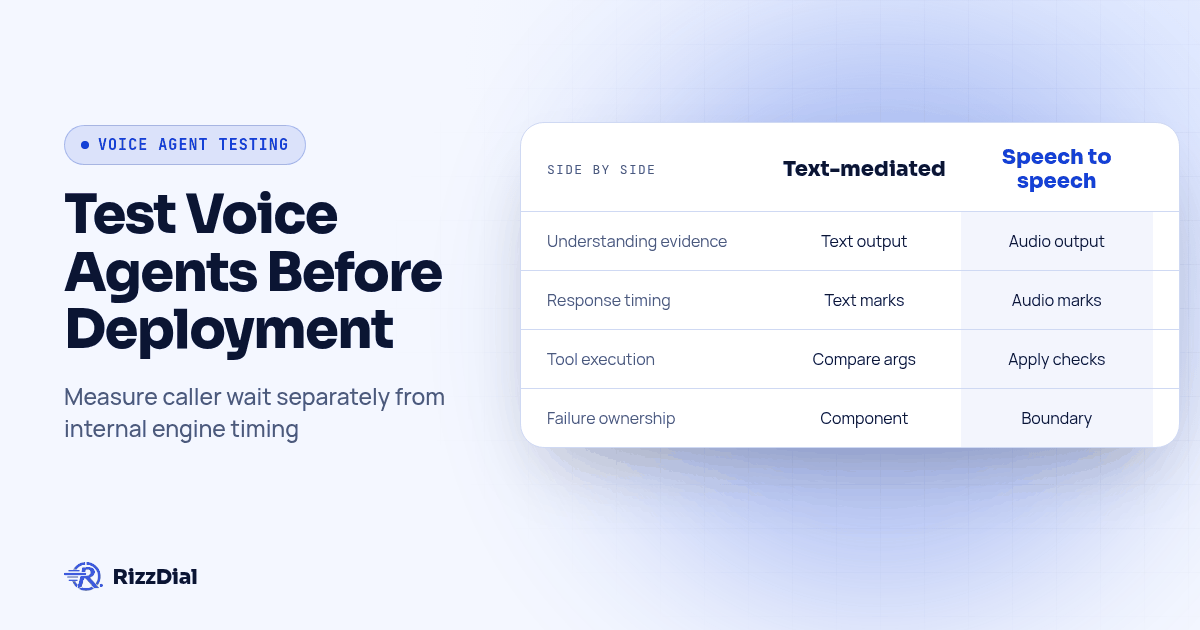
Compare what you can inspect, control, and reproduce. The following table is a buyer worksheet for possible configurations, not a benchmark or a claim that every platform implements each option.
| Evaluation point | Text-mediated configuration | Speech to speech configuration | Bring your own provider configuration |
|---|---|---|---|
| Understanding evidence | Request recognized text and correction history | Request audio evidence and interpreted intent | Confirm the evidence available from each provider |
| Response timing | Locate recognition, generation, and audio boundaries | Locate input audio, turn decision, and output audio boundaries | Trace timing across account and service boundaries |
| Tool execution | Compare tool arguments with confirmed caller details | Apply the same argument and outcome checks | Confirm which component owns execution and retries |
| Interruption handling | Check response cancellation and queued audio | Check response cancellation and queued audio | Test cancellation across provider boundaries |
| Change approval | Retest changed recognition, model, or voice settings | Retest changed engine and voice settings | Retest changed provider, model, and account settings |
| Failure ownership | Name the owner for each component | Name the owner for each exposed boundary | Document who investigates cross-provider failures |
Choose a configuration whose evidence your team can review. If a supplier cannot expose an internal stage, record it as unobservable and evaluate the complete path. Do not fill the missing measurement with an estimate presented as fact.
RizzDial's platform comparison directory can help organize the shortlist. Keep your completed worksheet separate from marketing feature summaries so a new model or provider does not silently inherit an earlier approval.
Where should conversation latency start and stop?
Define every timing field before the demonstration. For this acceptance procedure, use a recording captured at the caller endpoint as the reference for audible events. Associate internal events with that call and state how clocks are aligned; avoid subtracting timestamps from unrelated clocks.
Record these boundaries:
- Caller finishes: the last audible speech in the caller's completed turn.
- Turn accepted: the system decides it can respond.
- Tool begins and ends: the request leaves the application and its usable result returns.
- Audio arrives: the first response sound reaches the caller.
- Useful answer begins: the response starts addressing the request rather than merely acknowledging it.
- Interruption stops output: the prior response becomes inaudible after the caller interrupts.
Calculate conversational delay from caller finish to useful answer. Calculate acknowledgment delay separately. For the rental example, “Let me check” and “Your extension is confirmed” belong in different fields. A quick acknowledgment cannot establish that the extension was processed promptly or successfully.
Report the median and a tail percentile such as p95, meaning the observed delay at the ninety-fifth percentile, with the sample size and calculation method. Keep ordinary replies, replies requiring tools, and recovery replies in separate groups. List timeouts and missing responses explicitly instead of excluding them from the result sheet.
Set numeric acceptance limits before testing, based on the client's tolerance and representative calls. This article proposes a measurement method, not a universal latency target or a measured result. Have a reviewer listen for clipped words and premature interruptions as well as long pauses; timing alone cannot explain whether the exchange worked.
Why must voicemail detection have a separate test?
Voicemail classification answers who or what answered the call. Conversation latency answers how long a live caller waits during an exchange. Your acceptance sheet should keep those questions separate, even when both appear under a vendor's speed claims.
As a technical reference, Twilio's answering machine detection documentation distinguishes human, machine, and unknown outcomes and describes possible classification errors. Use that distinction to design reference labels, without assuming another system exposes identical fields. Twilio answering machine detection documentation
Build a separate set of consented test recordings with human greetings, recorded greetings, long silences, and ambiguous cases. Record the expected label, returned label, elapsed time from the agreed starting event, and subsequent action. Specify how an unknown result should be handled before running the test.
If a supplier quotes detector processing time, ask whether that interval includes collecting the greeting audio, waiting for silence, and delivering the result to the calling application. Preserve the supplier's stated boundary. Do not relabel an internal detector measurement as caller waiting time or conversational response speed.
What must bring your own LLM and provider support include?
Treat portability as a configuration review. Record the selected account, provider, model identifier, voice settings, allowed tools, and application version. Ask which settings your team can change and which changes require supplier involvement.
Before accepting a provider arrangement, require written answers about credential ownership, supported model interfaces, timeout behavior, rate limits, and responsibility for diagnosing a failed request. Ask what happens if the chosen account becomes unavailable. Any fallback provider should be disclosed and tested, including its permissions and data handling.
RizzDial supports MCP and OpenAPI connections, direct GoHighLevel integration, and custom integrations with a dedicated developer. These capabilities give buyers implementation options. They do not establish that a particular rental database operation, booking action, routing rule, or handoff works in a proposed account.
Require a data-flow review identifying where audio, transcripts, tool arguments, and diagnostic records would go. Ask the supplier to document storage, access, retention, deletion, and export for the proposed setup. Treat missing answers as unresolved requirements, not assumed features.
For a focused shortlist, use the RizzDial versus Retell comparison alongside this acceptance record. Apply the same cases to each offered configuration and document any differences that prevent a fair comparison.
How should tool permissions be tested?
Define permission outside the conversation prompt. For the hypothetical rental account, an availability lookup and an extension request should be separate actions with separate authorization rules. The application should reject an unauthorized change even if the agent asks for it.
The MCP tools specification requires servers to validate inputs and implement access controls. It also recommends client checks such as tool timeouts and logging. These are protocol design requirements and recommendations, not evidence that a particular deployment satisfies them. MCP tools specification
Write a permission record for every proposed tool: allowed account, permitted fields, required confirmation, expected result, timeout response, and retry policy. Include a caller who supplies another client's asset identifier and a tool result containing instruction-like text. Require both to leave authorization unchanged.
For a change request, require evidence that the application accepted the write before the agent claims success. If the reply is lost after a successful write, test how the application checks the existing outcome before retrying. Ask how duplicate requests are prevented and verify the answer with application records.
If the proposed workflow includes a text update, evaluate Beam's iMessage, RCS, and SMS capabilities as a separate messaging component. Verify recipient selection, message content, send authorization, and failure reporting in the proposed implementation. Voice acceptance does not automatically approve a messaging workflow.
What numbered procedure produces a defensible acceptance decision?
Use the following procedure as an original buyer test plan. These are proposed cases and evidence requirements, not results from testing RizzDial or another platform.
Freeze the configuration. Record the prompt revision, model, voice or engine, provider account, tool definitions, permission rules, and test environment. Assign a configuration identifier. Start a fresh record when a material setting changes.
Prepare the reference dataset. Give every case a unique identifier, caller script or audio reference, starting account state, expected intent, allowed action, forbidden action, and expected final state. Use synthetic rental records or properly authorized test data. Separate cases used for tuning from cases reserved for acceptance.
Include distinct failure families. Cover a routine extension, a corrected asset identifier, an interrupted answer, a request involving another client's asset, a denied write, a tool timeout, and a repeated request after an uncertain result. Add voicemail cases to their separate set. Adapt pronunciation and background noise to the intended callers.
Declare the pass rules. Require the correct asset and date, a permitted action, and truthful outcome language. Define acceptable timing by case group. Mark unauthorized writes and false success statements as blocking failures that cannot be offset by pleasant voice quality.
Run comparable trials. Use identical starting records and caller inputs for each configuration, resetting application state between runs. Plan repeat runs before testing and alternate configuration order. Record the actual trial count, connection conditions, and any departures from the script. Supplement scripted cases with supervised live conversation tests.
Capture a joined evidence record. Associate the case identifier with the audio reference, relevant transcript or interpreted intent, event timestamps, tool arguments, tool result, and final application state. Mark unavailable evidence as missing. A spoken confirmation alone cannot prove that a record changed.
Review failures before averages. Check forbidden actions and unsupported success claims first. Then review understanding, audible timing, interruption behavior, and completion by case group. Preserve disputed examples for a second reviewer and document why the final classification changed.
Approve a bounded scope. State which configuration, actions, caller conditions, and case groups passed. Assign unresolved defects and require retesting after fixes. Keep approval limited to the tested scope until new providers, tools, or client workflows complete the same review.
What should the final decision record look like?
Use a record that connects the architecture choice to a business outcome. A proposed rental case could read: “Caller corrects the generator identifier; extension tool denies the request; agent explains that the extension is unconfirmed; no rental record changes.” Leave observed values blank until the trial occurs.
| Decision field | Evidence to enter | Decision rule |
|---|---|---|
| Correct understanding | Confirmed asset identifier and requested return date | Reject a change against the wrong asset |
| Authorized execution | Permission decision and tool arguments | Reject any unauthorized write |
| Truthful response | Audio compared with tool outcome | Reject a claim of success after denial |
| Caller experience | Defined timing fields and listening review | Compare with the agreed case-group limits |
| Reproducibility | Configuration identifier and repeat trial references | Keep approval pending if the result cannot be reviewed |
Keep operational observations separate from purchase claims. A trial that passes this rental workflow establishes evidence for that workflow under the recorded conditions. It does not prove every integration, language, account, or call scenario will behave the same way.
Once the record is complete, use the calling platform alternatives directory to revisit options with unresolved requirements. Bring the dataset and acceptance rules to the next supplier demonstration so the purchase decision rests on inspectable evidence.
What FAQs help buyers evaluate AI voice agent acceptance testing?
What should an AI voice agent acceptance test prove?
It should prove that the configured agent understands the request, uses only permitted tools, reports the actual outcome, and meets agreed caller experience limits. Keep recordings, event traces, and application records together so another reviewer can reproduce the decision.
Does speech to speech remove the need to test latency?
No. Test the complete call path, including turn detection, tool waiting, audio delivery, and interruptions. An engine description does not establish how long a caller waits for a useful answer in your configuration.
Should voicemail detection and conversation latency share a score?
No. Score voicemail classification, classification delay, conversational response delay, and interruption stopping separately. Each measures a different event and needs its own reference labels or timestamps.
What needs retesting when we bring our own LLM?
Rerun the same acceptance cases for understanding, tool arguments, permission refusals, interruptions, and failure recovery. Record the provider and model version so approval applies to the tested configuration rather than every future model change.
About RizzDial
RizzDial is the AI outbound sales workspace for teams on GoHighLevel. Power dialing, AI voice agents, SMS automation, and CRM workflows in one platform. Book a demo.