Agencies
Answering Service: Choose Human, AI or Hybrid Coverage
Choose human, AI or hybrid answering coverage with a workload map, staffing responsibilities, overflow plan and procurement worksheet.
By James Hill, Founder, RizzDial ·
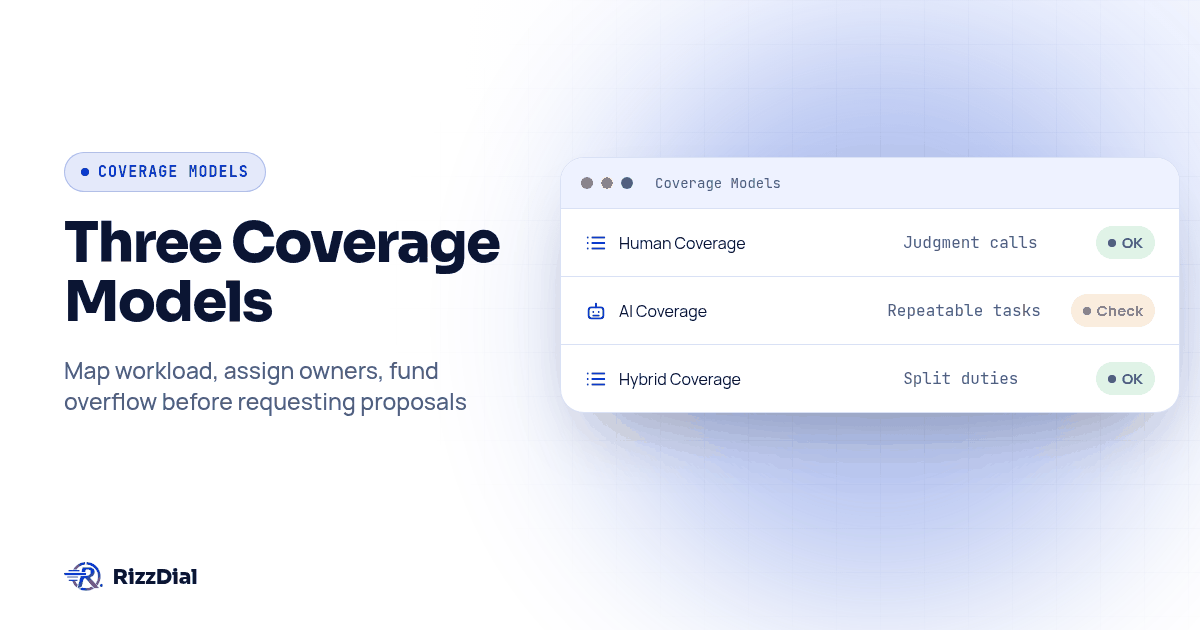
Choose a human answering service when callers need judgment or negotiation, evaluate AI for bounded requests, and use hybrid coverage when routine intake and exceptions need different owners. Before buying, map the workload, fund the staff who will finish unresolved requests, and compare proposals against the same coverage plan. The decision is who will do each part of the work, including during a busy shift.
Key takeaways
- Assign coverage by request type and staff availability.
- Require a named owner for work that remains after the call.
- Compare total operating effort alongside the supplier invoice.
What are you buying from an answering service?
You are buying an agreed response to incoming calls. Define whether that response means taking a message, answering an approved question, requesting staff attention or completing an authorized task. Those outcomes require different staffing, permissions and evidence.
This guide is a procurement framework, with proposed requirements rather than vendor test results. It compares human, AI and hybrid operating models. Use the voice platform comparison directory later, once you know which responsibilities the supplier must accept.
Consider a hypothetical commercial print shop served by a GoHighLevel agency. Callers ask about brochure specifications, artwork revisions, delivery delays and rush deadlines. The shop manager can approve exceptions, the production supervisor controls job feasibility, and the agency maintains the proposed answering setup.
A request for published file specifications could suit an approved answer. A request to change an accepted proof needs a different authority. A promise about a rush deadline belongs with someone who knows production capacity. Treat these as separate buying requirements even when they arrive on the same phone number.
How do human, AI and hybrid coverage compare?
Compare models against the decisions callers need, then verify each provider's actual scope. The table describes proposed assignments and diligence questions, not guaranteed features or measured performance.
| Buyer consideration | Human coverage | AI coverage | Hybrid coverage |
|---|---|---|---|
| Routine information | Require receptionists to use current approved material | Test answers against approved material | Assign routine questions to the agreed first responder |
| Negotiation and exceptions | Verify staff have authority or an escalation contact | Keep unsupported decisions outside scope | Reserve defined exceptions for authorized people |
| Internal workload | Budget briefings, review and unresolved requests | Budget configuration, review and corrections | Budget both supervision and exception staffing |
| Busy periods | Verify staffing commitments and queue policy | Verify configured capacity and fallback behavior | Verify capacity on both sides of the boundary |
| Outside office hours | Confirm who is actually staffed | Distinguish answering availability from resolution | State whether human help is immediate or deferred |
| Commercial comparison | Clarify billable activity and included work | Clarify usage units and maintenance responsibility | Identify overlapping charges and retained staff work |
| Evidence before purchase | Observe script adherence and escalation decisions | Demonstrate permitted actions and safe refusals | Demonstrate the division of responsibility |
Choose human coverage if a person must hear the caller's situation before the next action can be decided. An outsourced receptionist still needs permission limits and access to someone who can make business decisions. A human voice alone does not confer authority to change a delivery commitment.
Consider AI coverage for a narrow, repeatable workload where the response can be checked against approved information. If nobody can maintain that information or review errors, include managed operating help in procurement.
Consider hybrid coverage when the routine work and exception work are distinguishable. Specify whether the human layer comes from the supplier, the client or another contractor. An unanswered employee phone is not a funded human coverage plan.
How should you segment the workload before requesting proposals?
Create a call-work ledger from records you are authorized to review. Include ordinary shifts, busy periods and absences. Preserve unknowns instead of filling gaps with assumptions about caller intent or resolution.
For each request, record the reason for calling, arrival window, information needed, decision authority, expected result and remaining staff work. Distinguish a new inquiry from a repeat call about unresolved work. Otherwise, repeated attempts can look like fresh demand and distort both capacity planning and purchasing.
Use the print shop to make the boundary concrete:
- Published specifications: propose approved information delivery, with staff owning updates when production requirements change.
- New project inquiry: propose collecting requirements for an estimator, without promising a turnaround date.
- Artwork revision: reserve approval for the account owner because an existing production instruction may change.
- Delivery complaint: assign a named service owner who can investigate and agree on the next action.
- Rush deadline: require the production supervisor's decision before anyone commits the shop.
Tag each category as eligible for automation, human owned or still uncertain. Record the reason. “The business rule is unclear” requires a policy decision; “the supplier has not demonstrated it” requires evidence. Those are different procurement tasks.
Estimate human effort after answering separately from conversation duration. Reading notes, investigating a complaint and contacting production all belong in the staffing plan. Mark the source of each estimate as observed, proposed or unknown so finance can see where the model is fragile.
Who must own the work that remains?
Assign a business owner, an operating owner and a backup for each workload category. A shared inbox is a destination; it is not a person accountable for completing a request.
NIST's AI Risk Management Framework Playbook calls for documented roles and communication responsibilities, including differentiated responsibilities in human and AI arrangements. That supports making ownership explicit in an AI procurement brief. NIST Govern guidance
For the print shop, the client manager should approve service boundaries and commitments. The production supervisor should own deadline exceptions. The agency operator should maintain the approved configuration and investigate reported failures. The supplier should identify who handles service incidents under the proposed agreement.
Give the receptionist or AI operator an escalation instruction that the receiving employee has accepted. Specify what that employee must review, when they are expected to respond and who covers absence. Require the supplier to demonstrate any routing, notifications or record access needed to support this assignment.
When callers want written follow-up, evaluate Beam's iMessage, RCS and SMS capabilities as part of the messaging portion of the plan. Assign a person to own replies and verify the proposed connection to the answering workflow before promising it to a client.
What overflow plan should the buyer fund?
Fund overflow for each scarce resource: initial answering, specialist decisions and follow-up work. Adding answering capacity does not add a production supervisor who can approve rush orders.
Write a coverage card for each shift. Include the first responder, the exception owner, the backup, the caller-facing message during delay and the person who can temporarily narrow service scope. Put the actual availability of those people on the card.
Set triggers using your operating evidence. An unresolved queue growing beyond the team's ability to meet its promised response window should trigger action. Options to evaluate include additional staffed coverage, restricting intake to approved information, or changing the promised follow-up window. Agree on who may authorize each response.
Plan separately for a supplier outage. NIST's Govern guidance recommends contingency processes for failures involving third-party AI systems deemed high risk. Your procurement response should be proportionate to the consequences of losing the proposed answering service. NIST contingency guidance
In the print shop example, the buyer should require a demonstrated fallback that avoids unsupported production promises. Confirm how callers receive an accurate message, how pending requests remain accessible and who reconciles the backlog afterward. Treat fallback routing and access to stored records as acceptance requirements until verified.
How should you model cost without assuming savings?
Build a workload model before applying supplier quotes. Use the same call categories, coverage windows, completion expectations and staffing assumptions for every proposal. A message-taking offer and an offer that includes staffed resolution cannot be compared on the invoice alone.
Use this worksheet structure:
| Cost input | Evidence to collect | Assumption to challenge |
|---|---|---|
| Recurring commitment | Written proposal with included scope | Does the commitment cover every required shift? |
| Variable usage | Billing definition matched to your workload | What counts as billable activity? |
| Implementation | Quoted tasks plus internal staff estimate | Who prepares and approves business rules? |
| Retained human work | Observed escalation and follow-up effort | Does staff work disappear or move elsewhere? |
| Quality review | Named reviewer and scheduled capacity | Who checks changed scripts and disputed outcomes? |
| Corrections | Documented rework categories | Are repeat contacts counted as new success? |
| Exit and transition | Written ownership and transition terms | Can coverage continue while the supplier changes? |
Calculate total operating cost as supplier commitments plus usage, internal labor, review, correction and transition allocation. Compare that total with the cost of the current process for the same scope. Keep any expected sales benefit separate until you have evidence linking the change to completed business outcomes.
Model ordinary demand, a busy period and a staff absence. Change escalation volume and handling effort independently: a difficult complaint can consume substantial staff attention without creating a large call count. Mark these scenarios as planning assumptions, not predicted results.
Distinguish cash savings from released capacity. If an employee remains on payroll and spends less time answering, the direct result is time available for other work. Name that work and its owner. Do not count the same time as both a payroll reduction and added selling capacity.
Track cost per completed caller job alongside cost per answered call. Define completion by category before calculating it. Delivering approved specifications may complete an information request; recording a rush inquiry does not establish that production accepted it.
What numbered procedure turns the worksheet into a buying decision?
Use this procedure to produce comparable proposals and an accountable staffing decision. It is an original purchasing exercise, not a report of completed testing.
Freeze the workload brief. Select the call categories and coverage windows included in the purchase. List exclusions, unresolved policy questions and the evidence period used. Ask every bidder to respond to this same version.
Assign the proposed coverage model by category. Mark human, AI or hybrid beside each caller job. Add the reason, required authority and staffing dependency. Keep uncertainty visible rather than choosing automation simply because it is available.
Request a responsibility split. Require bidders to mark each task as supplier owned, client owned, agency owned or excluded. Cover setup, information updates, exceptions, review, incidents and departure. Resolve any task assigned to nobody.
Observe representative work. Ask each bidder to demonstrate the same print shop scenarios and approved responses. Include a request for an unauthorized rush commitment and an unavailable supervisor. Record evidence, limitations and remaining staff effort rather than awarding credit for a polished greeting.
Reconcile the proposed invoice with retained labor. Apply the written billing definitions to your workload. Add internal responsibilities from the previous steps. Ask for clarification when a quoted service assumes staff availability that your client has not funded.
Make a conditional award. Record the selected scope, staffing owner, unresolved acceptance requirements and circumstances that would change the decision. Approve expansion only when the responsible client manager accepts the measured workload and the required operating effort.
Keep the decision record short enough to use during a supplier discussion. Its essential fields are caller job, coverage window, proposed model, decision authority, overflow owner, evidence reference, cost assumption and approval status. A blank evidence field means the requirement remains unverified.
Where should RizzDial fit in the shortlist?
RizzDial is voice AI and dialer infrastructure for new age companies. Its capabilities include AI voice and texting agents, direct GoHighLevel integration, white label and resale support, and developer access through MCP and OpenAPI.
For an agency, those capabilities make it relevant to evaluating the infrastructure portion of an answering offer. Keep staffing procurement explicit: this positioning does not establish that a receptionist, production specialist or managed exception desk is included.
An integration also does not prove that a particular client workflow is ready. Require demonstrations of any proposed booking, routing, handoff, record storage or connected action before including it in the service agreement.
If Retell is already on your shortlist, use the Retell alternatives page to frame the alternatives and the RizzDial versus Retell comparison to organize follow-up questions. Apply the workload brief to the specific configuration and responsibilities being quoted.
Take the completed procurement worksheet to the answering infrastructure alternatives hub to choose the next supplier discussion. Request evidence for the work your client needs completed and a clear account of who will do the rest.
What FAQs help buyers choose answering service coverage?
Should a small business choose human or AI answering?
Choose by the work callers need completed. Consider human coverage for conversations requiring judgment or negotiation, and evaluate AI for bounded requests with approved answers. Use hybrid coverage when you can define the boundary and staff the exceptions.
Does hybrid answering require a person on every call?
No. A hybrid plan can divide calls by request type, time window or escalation need. The agreement should say when a person is available, who provides that person and what happens when nobody can respond.
How should buyers compare answering service costs?
Compare the same workload and service scope across proposals. Include recurring commitments, usage, setup, internal review, escalation work and correction effort. Separate cash savings from staff time reassigned to other work.
What should an agency require before reselling answering coverage?
Require an approved workload map, named client and agency responsibilities, a funded overflow plan and evidence for each promised workflow. Keep unverified booking, routing, record storage and integration behavior outside the service promise until demonstrated.
About RizzDial
RizzDial is the AI outbound sales workspace for teams on GoHighLevel. Power dialing, AI voice agents, SMS automation, and CRM workflows in one platform. Book a demo.