Agency Playbooks
Bring Your Own LLM or Voice Account? Agency Guide
Compare bringing your own LLM or voice account with RizzDial's built-in engine. Use an agency decision table and call test before choosing.
By James Hill, Founder, RizzDial ·
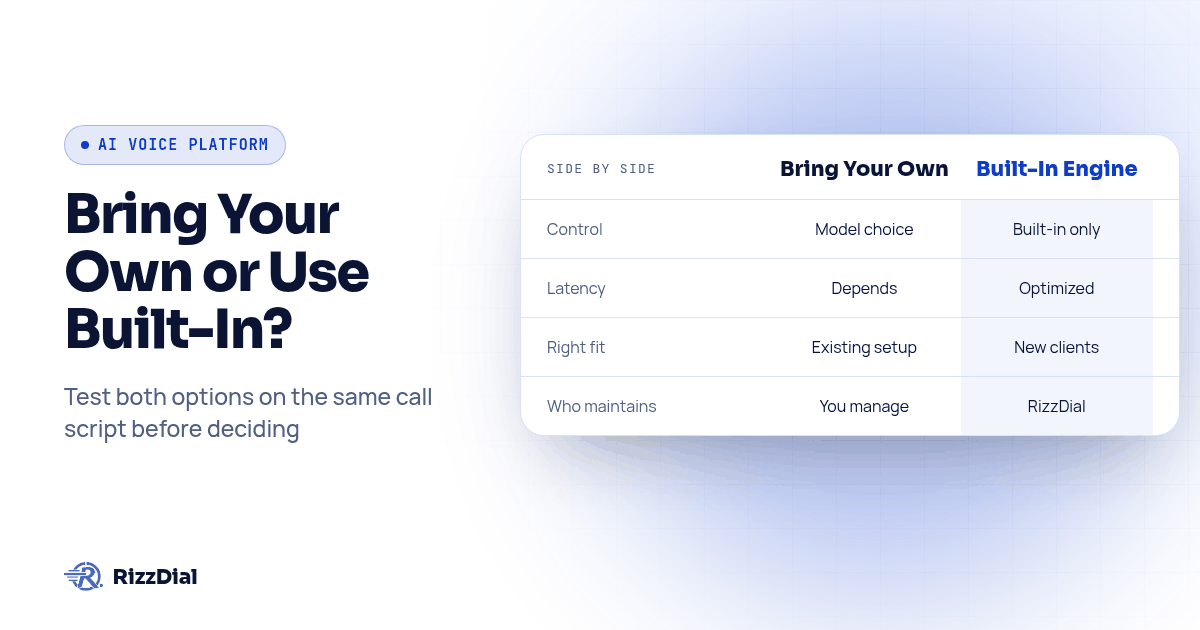
Bring your own LLM or voice provider account when an existing contract, tested configuration, or specific model requirement justifies the extra setup. Use RizzDial's built-in speech-to-speech engine when you want fewer provider accounts to manage. Test both against the same call script before choosing for a client.
This guide separates model ownership from voice account ownership, then gives agencies a comparison table and a repeatable pilot. The decision is about the client's requirements and your support responsibilities, not a universal winner. A provider name alone cannot tell you whether a caller will hear a natural response or whether a booking reaches the right CRM record.
Should an agency bring its own LLM to an AI calling platform?
Bring your own LLM when a client's contract or internal policy already names a model, or when your team has built prompt libraries and evaluation workflows around one provider that you do not want to abandon. RizzDial supports bringing your own LLM. Confirm which model and integration configuration supports the workflow you intend to run before promising a client that existing scripts or summaries will carry over. This matters most for agencies serving a client with an existing enterprise agreement, a legal or security team that has already approved one vendor, or a specific model they have tested against their own scripts and will not swap out on a whim.
It matters less for a brand new client with no existing AI stack. In that case you are choosing a model on the client's behalf anyway, so there is rarely a reason to add an extra account, an extra bill, and an extra point of failure before the first call even goes out.
What does "bring your own voice provider account" actually mean?
It means the voice layer, not just the reasoning layer, can be yours instead of RizzDial's. RizzDial supports bringing your own Vapi account and other voice provider accounts, so an agency can evaluate using its existing provider relationship. Inventory the call flows, voices, and account settings you want to retain, then confirm compatibility during the pilot. Account support does not by itself promise automatic migration of every configuration.
This is a different decision from the LLM question, and agencies sometimes mix the two: the model determines how a response is generated, while a voice account can include speech settings and conversation orchestration. Ask which combinations are supported for your intended deployment rather than assuming every model and voice engine can be mixed.
When does bringing your own LLM or Vapi account actually make sense?
Three situations justify evaluating an existing account:
- The client already pays for a specific model and will not approve a second AI vendor without a procurement review that could take weeks.
- The client's legal or compliance team has written a data residency or vendor requirement into the contract, and switching providers mid-engagement would break it.
- Your agency has already built and tuned prompts, scripts, or evaluation tests on a particular voice provider account, and rebuilding that on a new engine would cost more time than it saves.
None of those are about raw capability. They are about a contract, a policy, or sunk work that already exists before RizzDial enters the picture. If none of them apply to the client in front of you, that is a strong signal to skip bring-your-own and start with what is already built in.
When is RizzDial's built-in speech-to-speech engine the simpler choice?
Use the built-in engine when speed to launch matters more than vendor flexibility, and no existing provider requirement has been identified. RizzDial's own voice engine runs on speech-to-speech, built specifically for low latency and natural sounding voices, and it is already wired into the dialer, the carrier connections to AT&T, Verizon, and T-Mobile, and the built-in CRM. You do not need to choose a separate voice provider simply to evaluate that engine. You still need to configure the agent, review the calling workflow, and agree on a support process before launch.
For an agency reselling to multiple clients, this also keeps support simple. One engine, one place to look when a call sounds off, one place to tune a voice. Bring-your-own setups multiply that surface area per client, which is fine when the client is paying for the flexibility, and unnecessary overhead when they are not.
Why does a prospect notice a delay before the AI answers?
A delay can come from several parts of a voice conversation. In a staged pipeline, speech is transcribed, the model generates a response, and a voice component turns that response into audio. Vapi's core models documentation describes these components and its use of streaming and orchestration. That architecture is context for testing, not proof that a particular provider will be slow.
RizzDial's own engine uses speech-to-speech and is built for low latency. That approved design claim is not a measured guarantee against another stack. A provider account, prompt, tool call, network connection, and caller's speaking pattern can all affect what you observe. Measure the complete conversation rather than judging only the model's response in a text window.
Custom models are a documented option in Vapi's FAQ, including connecting a model hosted elsewhere. That supports treating model choice as a real configuration decision. It does not establish that a client's existing model meets every deployment requirement or that all combinations work in RizzDial. Confirm compatibility and run the same practical test on each proposed setup.
How do bring-your-own and the built-in engine compare side by side?
| Dimension | Bring your own LLM / voice account | RizzDial's built-in speech-to-speech engine |
|---|---|---|
| What you control | Model choice, your existing Vapi or voice provider configuration, your own provider contract terms | Built-in speech-to-speech engine; agent configuration still required |
| Latency | Depends on your chosen LLM, voice provider, and how many hops sit between them | Built for low latency as one speech-to-speech engine |
| Setup | Connect your LLM key and your Vapi or voice provider account before the first test call | Configure the agent and test the calling workflow |
| Who maintains the stack | You own the API keys, rate limits, and any provider-side outages | RizzDial's own infrastructure |
| Billing | Confirm provider charges and applicable RizzDial usage terms | Pay as you go with flexible seat based options; confirm account scope |
| Right fit | An existing LLM or voice vendor contract, a required model, or a client data residency rule | A new client, a tight launch window, or no existing voice and LLM vendor to carry over |
How do you test bring-your-own against the built-in engine before committing a client?
Run this before you tell a client which engine their account will use, not after:
- Pick one real call script you already run, such as an appointment reminder or a lead qualification call, and treat it as a test case rather than a live client call.
- Confirm the proposed connection is supported, then configure two test versions of the same agent: once on the built-in speech-to-speech engine, and once with your own LLM and your Vapi or other voice provider account connected.
- Call both versions from the same phone, back to back, and note the gap between when you finish speaking and when the agent starts answering.
- Run each version through the same five objections, a price pushback, a flat "not interested," a request to be removed from the list, a scheduling conflict, and a wrong-number pickup, and write down where either one stumbles.
- Compare the applicable usage terms for both setups, including any separate provider billing. Record what is included and ask about anything unclear before estimating client margins.
- Confirm the GoHighLevel sync, call recordings, and CRM fields behave the same way on both setups, using test contacts rather than assuming an engine change preserves every mapping.
- Pick the version that wins on the dimension the client actually cares about, whether that is launch speed, a specific model requirement, or raw latency, and write down the reason so the next client's decision does not start from zero.
Keep that written reason somewhere your team can find it. A decision record lets the next operator distinguish a required configuration from a preference that can be reconsidered later.
What should you record during the test procedure?
Create one worksheet with a row for each scenario and a column for each configuration. Record the prompt version, selected model or engine, voice settings, test time, and expected outcome. Use invented test contact details so the evaluation does not expose a client's customer information. Keep the input script fixed while comparing configurations; otherwise you cannot tell whether a different result came from the engine or the instructions.
For each call, record more than whether the agent sounded pleasant. Did it wait for the caller to finish? Did it stop speaking when interrupted? Did it acknowledge the wrong number without continuing the pitch? Did the scheduling response match the actual available options? Give each outcome a pass, fail, or needs review status, with a short note identifying the exact turn that caused concern.
Repeat any failed scenario after changing one setting at a time. A single successful call is not sufficient evidence that an earlier failure is resolved. Keep the original result beside the repeat so another team member can follow the decision. This is a proposed agency acceptance procedure, not a published performance benchmark for either engine.
Who should own credentials, support, and a later switch?
Before connecting a provider account, name the person responsible for access and the person who receives service alerts. Decide whether the agency or client owns the account and who can revoke access when the engagement ends. Share credentials through the approved account connection process, not inside a call prompt or client worksheet. Document which team investigates an authentication failure and which team checks the CRM result.
Keep a recovery plan with the decision record. If a test configuration stops responding, pause that pilot and return to the last verified setup through the supported process. Do not send additional live calls simply to see whether the problem disappears. Before a later switch, review the same acceptance criteria, confirm the integration mappings, and identify who approves moving traffic. Provider flexibility is useful only when the agency can explain and operate the resulting system.
What's a fast way to decide for a new client?
Ask three questions before the kickoff call ends. Does the client already have an LLM or voice provider contract they are required to keep? Does their industry or legal team require a specific data residency or vendor approval? Has your own team already built working prompts or call flows on a particular voice provider account for a similar client? A "no" to all three means start on the built-in engine and revisit later if something changes. A "yes" to any one of them means evaluate bring-your-own before launch. A required provider still needs to pass the pilot; a familiar name is not a substitute for a working call flow.
Start the compatibility review with the RizzDial integrations page. RizzDial supports direct GoHighLevel integration, MCP, OpenAPI, and custom integrations with a dedicated developer. If you are running this decision for a GoHighLevel sub-account, the GoHighLevel setup guide walks through how the calling and CRM pieces connect once the engine choice is made. And if the client is also comparing RizzDial against other voice AI platforms before settling on an engine at all, the comparisons hub lays out those side by side breakdowns.
A related decision shows up one level above calling, in how much of an agency's whole AI stack should be owned versus bought. MetaTechAi's AI infrastructure offering describes planning private workflows, connecting existing tools, and keeping company knowledge under business control. That broader ownership question can inform the voice account decision.
What FAQs should agencies resolve before choosing an engine?
Does bringing my own LLM cost extra on RizzDial?
RizzDial AI minutes range from $0.06 to $0.20 per minute, billed for talk time only, with pay as you go and flexible seat based options. Confirm the applicable RizzDial terms and any separate provider charges for your proposed setup before quoting a client.
How long does it take to set up bring your own LLM versus the built-in engine?
The built-in engine removes the need to select a separate voice provider account. Bringing an existing account requires confirming compatibility, credentials, and configuration. Neither path has a guaranteed setup time here; allow time for agent testing and CRM verification before launch.
Which integrations does RizzDial support if I bring my own voice provider account?
RizzDial supports bringing your own Vapi account, other voice provider accounts, and your own LLM. It also supports direct GoHighLevel integration, MCP, OpenAPI, and custom integrations with a dedicated developer. Confirm the specific combination and workflow before the pilot.
Is bringing my own LLM more compliant for a regulated client?
No engine choice establishes compliance by itself. An existing provider may be relevant to a client's vendor requirements, but the complete data flow and deployment still need review. RizzDial is built with FCC and FTC compliance in mind; that is not a certification.
What happens if I start on the built-in engine and later want to bring my own LLM?
Treat switching as a controlled configuration change. Confirm the supported migration path, save the working configuration, and repeat the call and CRM tests before moving live traffic. Do not assume voices, prompts, numbers, or field mappings transfer unchanged.
Ready to decide which engine fits your next client?
Book a demo and bring the client's existing LLM or voice provider contract, if there is one, plus the call script you want to pilot. Ask to compare the supported setups using that script, review the observed response delays, and confirm the account responsibilities before choosing an engine.
How can RizzDial help with your calling workflow?
RizzDial is the AI outbound sales workspace for teams on GoHighLevel. Power dialing, AI voice agents, SMS automation, and CRM workflows in one platform. Book a demo.