Strategy
Measuring AI Dialer ROI: Prove Your Results
Learn concrete frameworks for calculating AI dialer ROI including cost per lead, conversion rates, and time savings with real benchmark data.
By James Hill ·
Investing in AI dialer technology is a significant decision. Whether you're justifying the expense to stakeholders or optimizing your existing implementation, understanding exactly how to measure and maximize ROI is critical. This guide provides the frameworks, metrics, and benchmarks you need.
The ROI Framework for AI Dialers
Direct Cost Savings
The most straightforward ROI calculation compares AI costs to traditional methods:
Traditional Cold Calling Costs (Per Rep)
- Annual salary
- Benefits on top of salary
- Phone and software
- Training
- Management overhead
The loaded cost is salary plus those extras. This post does not cite a salary survey, so it does not quote a dollar total.
AI Dialer Costs
- Platform subscription
- Call minutes
- Setup or integration, often one-time
Compare that stack to a loaded rep using your own invoices. Current RizzDial plans are on the pricing page.
Potential Savings: The gap is the loaded labor you no longer need for first-touch calling, minus the platform and usage you do pay.
Revenue Impact
Beyond cost savings, AI dialers drive revenue improvements:
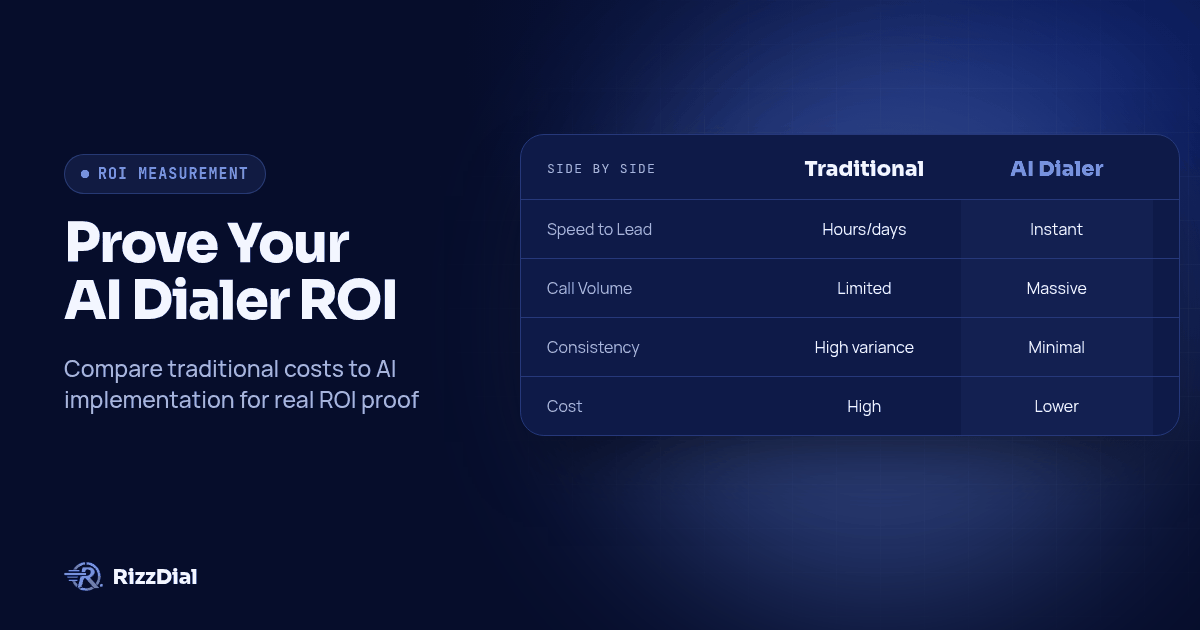
Speed to Lead
- Traditional response: Hours or days
- AI response: Instantaneous
- Impact: Higher conversion rates from rapid lead engagement
Call Volume Increase
- Traditional: Limited daily calls per rep
- AI: Massive daily call volume
- Impact: A dramatic increase in outreach capacity
Consistency
- Human performance variance: High
- AI performance variance: Minimal
- Impact: More predictable, optimizable results
Key Metrics to Track
Efficiency Metrics
Cost Per Dial
Cost Per Dial = Total Monthly Cost / Number of Dials
Benchmark: Significantly lower with AI compared to human reps.
Cost Per Connection
Cost Per Connection = Total Monthly Cost / Number of Connections
Track this to understand true efficiency of reaching decision-makers.
Cost Per Appointment
Cost Per Appointment = Total Monthly Cost / Appointments Set
This is often the most important metric for sales organizations.
Effectiveness Metrics
Connection Rate
Connection Rate = Connections / Total Dials × 100
Benchmark: Aim for steady improvement with optimization.
Appointment Set Rate
Appointment Rate = Appointments / Connections × 100
Benchmark: Varies by industry and offer; track for consistent performance.
Qualification Rate
Qualification Rate = Qualified Leads / Total Connections × 100
Track how many connections result in sales-qualified leads.
Quality Metrics
Appointment Show Rate
Show Rate = Appointments Held / Appointments Set × 100
Benchmark: Aim for high show rates through quality conversations and reminders.
Lead-to-Customer Rate
Customer Rate = New Customers / Qualified Leads × 100
Track end-to-end conversion to ensure AI quality.
Customer Lifetime Value of AI Leads Compare CLV of AI-generated customers vs. other sources.
Calculating Your AI Dialer ROI
Step 1: Establish Baseline
Before implementing AI, document:
- Current cost per appointment
- Current cost per customer acquired
- Average deal size
- Sales cycle length
- Team capacity (calls, appointments, closes)
Step 2: Measure Post-Implementation
After 90 days of AI implementation:
- New cost per appointment
- New cost per customer acquired
- Changes in deal size (if any)
- Changes in sales cycle
- New team capacity
Step 3: Calculate ROI
ROI = (Gain from Investment - Cost of Investment) / Cost of Investment × 100
Example Calculation:
Before AI:
- Team of sales reps
- Baseline appointments/week
- High monthly cost
- High cost per appointment
After AI:
- AI system + smaller team of closing reps
- More appointments/week
- Lower monthly cost
- Lower cost per appointment
Result: Significant monthly savings, higher efficiency (lower cost per appointment), increased capacity (more appointments), and a strong annual ROI.
Benchmarks by Industry
Real Estate
- Cost per appointment: Lower with AI vs. traditional methods
- Appointment-to-showing rate: Higher with qualified leads
- Expected ROI: Strong positive returns
Insurance
- Cost per quote request: Lower with AI vs. traditional methods
- Quote-to-bind ratio: Improved with consistent follow-up
- Expected ROI: Strong positive returns
B2B Services
- Cost per qualified meeting: Lower with AI vs. traditional methods
- Meeting-to-opportunity rate: Higher with effective qualification
- Expected ROI: Strong positive returns
Healthcare
- Cost per patient appointment: Lower with AI vs. traditional methods
- Appointment show rate: Higher with automated reminders
- Expected ROI: Strong positive returns
Optimizing for Maximum ROI
Script Optimization
A/B test different approaches:
- Opening lines
- Value propositions
- Objection handling
- Call-to-action language
Even small improvements compound at scale.
Timing Optimization
Test calling at different:
- Times of day
- Days of week
- Frequency intervals
Data shows optimal timing varies significantly by industry and audience.
List Quality
Your AI is only as good as your data:
- Prioritize verified contact information
- Segment lists for targeted messaging
- Regularly clean and update databases
Integration Optimization
Ensure connected data flow:
- CRM integration for automatic updates
- Calendar integration for appointment setting
- Analytics integration for reporting
Common ROI Pitfalls to Avoid
1. Measuring Too Soon
AI systems improve over time. Allow 60-90 days before making ROI conclusions.
2. Ignoring Indirect Benefits
Factor in:
- Time savings for sales team
- Improved data quality
- Faster market testing
- Scalability benefits
3. Comparing Apples to Oranges
Ensure you're comparing:
- Same time periods
- Same lead sources
- Same market conditions
4. Overlooking Quality Metrics
High volume with low quality destroys ROI. Always track downstream conversion.
Reporting ROI to Stakeholders
Executive Summary Format
- Monthly cost comparison (before/after)
- Efficiency metrics (cost per appointment, etc.)
- Revenue attribution
- Year-to-date ROI percentage
Visual Dashboards
- Trend lines showing improvement over time
- Comparison charts (AI vs. traditional)
- Goal tracking and forecasting
Narrative Context
- What's working well
- Areas for optimization
- Strategic recommendations
Conclusion
AI dialers deliver measurable, significant ROI for organizations willing to track the right metrics and optimize continuously. The companies seeing the right returns aren't lucky. They're systematic about measurement and improvement.
Start with clear baselines, track comprehensive metrics, and optimize relentlessly. The data will speak for itself.
Ready to measure your AI dialer ROI? Book a demo to see how RizzDial's analytics dashboard makes ROI tracking effortless.
For the next step in this workflow, review the power dialer and outbound workflow guide and discuss implementation through the dialer workflow demo.
About RizzDial
RizzDial is the AI outbound sales workspace for teams on GoHighLevel. Power dialing, AI voice agents, SMS automation, and CRM workflows in one platform. Book a demo.