Compliance
The Abandoned Call Safe Harbor for Predictive Dialers
A call is abandoned when no rep connects within two seconds after the completed greeting. The safe harbor, the right denominator, and what to fix first.
By James Hill, Founder, RizzDial ·
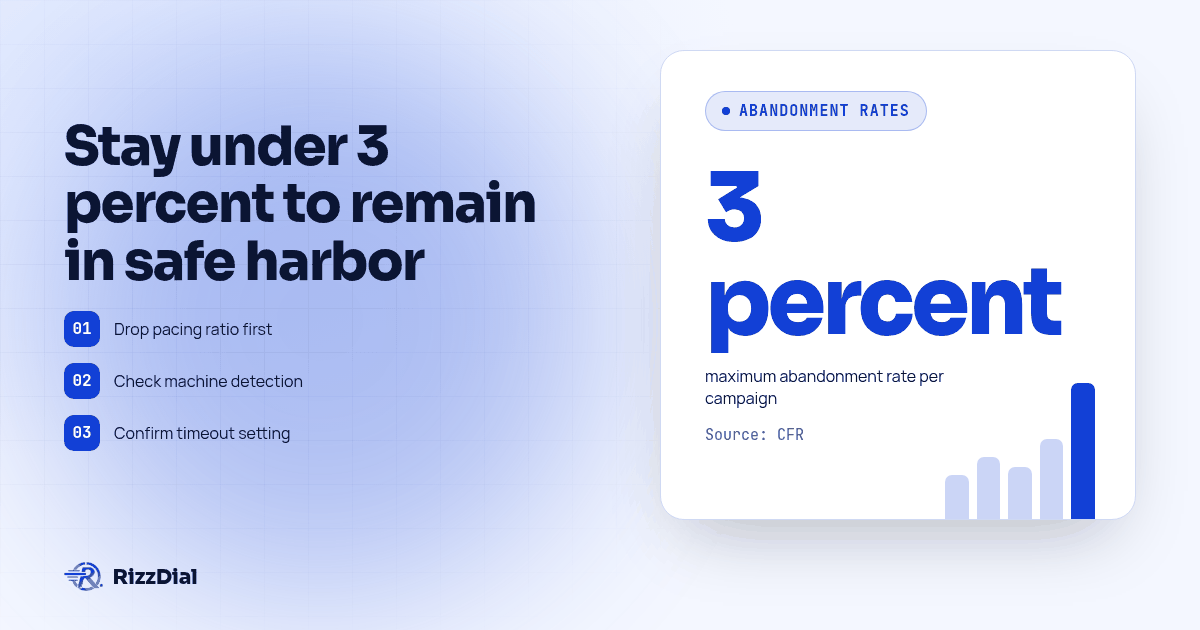
Under the Telemarketing Sales Rule, a call counts as abandoned when a person answers and no representative connects within two seconds after that person's completed greeting (16 CFR 310.4(b)). A predictive dialer stays inside the safe harbor only if abandonment holds at or under 3 percent of live-answered calls, measured per campaign, and only if the rest of the safe harbor conditions hold at the same time: a minimum ring time, a compliant recorded identification on every abandoned call, and records proving all of it. Miss any one of those and the 3 percent number stops protecting the campaign.
For the dialer workflow behind call classification, see our answering machine detection overview.
What Counts as an Abandoned Call Under the Telemarketing Sales Rule?
The rule text is specific on purpose. An outbound call is abandoned if a person answers it and the telemarketer does not connect that person to a sales representative within two seconds of the completed greeting (16 CFR 310.4(b)(1)(iv)). Two things follow. First, only a call a person answers can be abandoned; an answering machine pickup cannot, because no person greeted the line. Second, the clock starts at the end of the greeting, not at connection, which is what a predictive dialer's pacing engine has to react to the instant it detects a human voice.
What Else Has to Hold True Besides the Abandonment Rate Itself?
The 3 percent figure only works as a safe harbor if the rest of section 310.4(b)(4) holds at the same time, not as a standalone target (FTC, Complying with the Telemarketing Sales Rule). The full safe harbor requires abandonment at or under 3 percent of calls answered by a person, unanswered calls left ringing at least 15 seconds or four rings before the dialer gives up, a recorded identification message on every abandoned call, and records proving all three held. A campaign at 2 percent abandonment that skips the recorded identification, or lets a ring timeout run past the minimum, is not inside the safe harbor. It has just not been checked yet.
Which Denominator Do Most Teams Get Wrong?
The rule measures abandonment against calls answered by a person, not every number dialed. A campaign that places 10,000 calls and gets 1,000 live answers has a denominator of 1,000, not 10,000 (16 CFR 310.4(b)(4)(i)). Dividing abandoned calls by total dial volume always understates the rate, and the mistake usually surfaces only when a client, a carrier, or a regulator asks for the math. Fix the denominator before anything else here; every other number depends on it.
Why Does a Bad Monday Get Absorbed but a Bad Month Not?
The safe harbor measures abandonment per calling campaign, over the full run if it lasts less than 30 days, or separately over each successive 30-day period after that (16 CFR 310.4(b)(4)(i)). That structure absorbs a single rough day and does not forgive a rough month. One aggressive Monday gets diluted across the rest of that 30-day window and can land back under 3 percent by close. A pacing setting that runs hot for three or four weeks straight has no such room, because the whole 30-day window is the problem, not one bad session inside it.
How Do Pacing, Agent Count, Handle Time and Answer Rate Interact?
A predictive dialer's pacing engine decides how many lines to dial ahead of the agents it expects free, based on recent handle time and answer rate. Push that ratio higher and the system connects more live people than it has agents ready for, which is exactly the two-second window the rule is timing. Handle time and answer rate drift through the day, so a ratio safe during a slow hour can start abandoning calls as answer rate improves and more lines connect at once. RizzDial's AI dialer ties pacing to live agent and AI-agent availability rather than a fixed ratio left alone. For the broader case, see predictive dialer benefits for call centers.
Why Do Small Teams Hit the Limit Faster Than Large Teams at the Same Ratio?
A five-agent team has far less slack than a fifty-agent team running the same pacing ratio. One agent stepping away removes a meaningful share of capacity instantly, and the pacing engine lags for a few calls while it adjusts, which is exactly when a spike happens. A fifty-agent team barely notices the same agent stepping away. Agencies running a client's first small campaign should set pacing more conservatively than a ratio that worked fine on a larger account.
What Should You Change First When the Rate Climbs?
Work down this list in order rather than guessing at the whole configuration at once:
- Drop the pacing ratio first. It has the most direct effect on live-answer volume relative to agent availability.
- Check whether answering machine detection is misclassifying live answers as machines, or the reverse, since either error corrupts the denominator.
- Confirm the ring timeout and disconnect behavior actually match the 15 second or four ring minimum, rather than assuming the platform default is compliant.
- Recalculate handle time and answer rate from the period causing the spike, not a stale average from an earlier week.
- Re-run the campaign math against calls answered by a person, not total dials, before deciding the fix worked.
Where Does Answering Machine Detection Fit In?
Answering machine detection decides whether a connected call routes to a live agent or gets handled as a machine answer, inside the same window the abandonment rule is timing. A false positive, treating a live person as a machine, can hang up or miss connecting a representative in time, creating an abandoned call that has nothing to do with pacing. A false negative, treating a machine as a person, inflates the denominator with an answer that was never a person under 16 CFR 310.4(b)(1)(iv). Neither error shows up in a dashboard tracking only the final percentage; both need checking separately from pacing.
What Should a Weekly Abandonment Report Include?
A report an agency can hand a client should show, per campaign, not blended across every client:
- Total calls dialed and total calls answered by a person, kept as two separate numbers so the denominator is visible, not assumed.
- Abandoned calls for the period and the resulting percentage against the correct denominator.
- Ring timeout setting in effect and whether any unanswered calls were disconnected before the minimum.
- Confirmation that the recorded identification message played on every abandoned call during the period.
- Any pacing changes made during the period and why, so a spike has a documented cause.
RizzDial's built-in dialer reporting keeps these numbers at the campaign level automatically, which is the difference between noticing a problem in week two and finding it in a compliance review months later. If solving this also frees up agent time elsewhere in the funnel, MetaTechAi's guide on handling more inbound leads without hiring covers the demand side of that same capacity question.
What Questions Do Agencies Ask About the Abandoned Call Safe Harbor (FAQ)?
Does the abandoned call safe harbor apply to business-to-business calls?
Mostly no. Under 16 CFR 310.6(b)(7), a telephone call between a telemarketer and a business to induce a purchase by that business is generally exempt from the Telemarketing Sales Rule, which would include the abandoned call safe harbor in 310.4(b). The exemption does not remove the disclosure duties in 310.3(a)(2) and (4), and it does not cover calls that induce the retail sale of nondurable office or cleaning supplies, which stay inside the Rule. If a campaign mixes B2B and consumer numbers, or a called number turns out to be a residential or personal wireless line answered by an individual rather than a business decision maker, treat it as covered and hold the 3 percent line anyway.
Does an AI voice agent change how the two second clock works?
The rule was written around a human agent being connected to the line, not an AI agent speaking immediately. It does not spell out a separate standard for a synthetic voice that starts talking the instant the line picks up. The safest reading treats the AI agent's own response latency as the clock: if the agent takes more than two seconds after the person's completed greeting to start a real, on topic response, count that the same way a slow human handoff would count.
What records do we need to keep to prove the safe harbor held?
16 CFR 310.4(b)(4)(iv) requires records establishing compliance with the ring time, abandonment rate, and recorded message conditions, and the general recordkeeping rule in 310.5 sets a five year retention period for telemarketing records, including call records, call disposition, and do-not-call request logs. Keep per campaign abandonment math, not just a company wide average, since the safe harbor is measured per campaign. See RizzDial's DNC scrubbing guide for how do-not-call records and abandonment records fit into the same retention practice.
Does a call answered by voicemail or an answering machine count as abandoned?
No. The definition in 16 CFR 310.4(b)(1)(iv) only applies when a person answers the call. A machine answer never enters the abandonment calculation, which is why accurate answering machine detection matters for the denominator, not only for agent efficiency.
Ready to Run a Predictive Dialer Inside the Safe Harbor?
The 3 percent line is easy to state and easy to miscalculate. Get the denominator right, keep the ring time and recorded message conditions true at the same time, and measure every campaign on its own, not blended into a company average that hides which client is over the line. RizzDial's TCPA compliant dialer builds pacing controls, answering machine detection, and campaign level reporting around this rule, so an agency can show a client the math behind the number.
For the next step in this workflow, review the calling consent and tcpa review guide and discuss implementation through the calling workflow integrations.
Evaluate the software with the staffing plan
Use the predictive dialer software guide to compare calling modes and define a staffed pilot. If the conversation will be handled by an AI voice agent, review agency AI outbound calling guardrails as a separate workflow before launch.
About RizzDial
RizzDial is the AI outbound sales workspace for teams on GoHighLevel. Power dialing, AI voice agents, SMS automation, and CRM workflows in one platform. Book a demo.