Agencies
AI Agent Platforms: What an Agency Must Own to Resell
Compare AI agent platforms on resale ownership, not demo polish: call path, CRM write back, white label terms, integration surface and data exit.
By James Hill, Founder, RizzDial ·
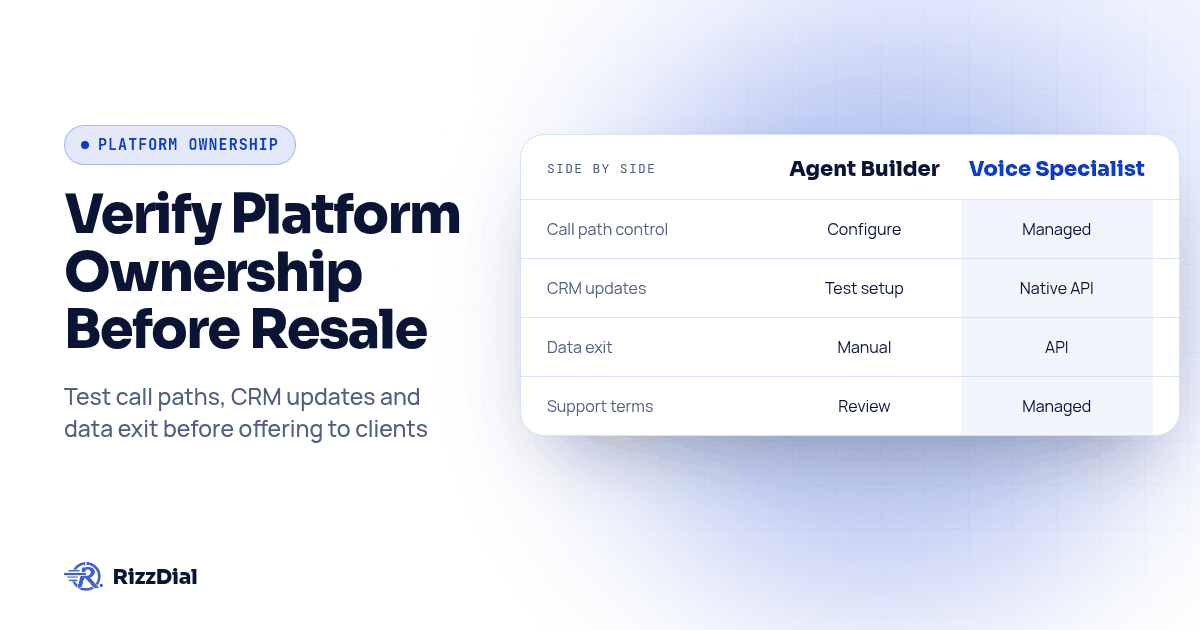
An agency comparing AI agent platforms for resale should verify control over the call path, CRM write back, white label terms, integration access and data exit. Get the responsibilities in writing, then test the same caller job on each platform before offering it to clients. A polished demo alone does not establish those rights or prove the workflow works.
This worksheet is for GoHighLevel agencies and resellers putting their own name on an AI calling service. It separates platform approaches, identifies the ownership questions that belong in a contract, and gives you a repeatable evaluation procedure. Ownership here means documented control and responsibility; buying software does not automatically transfer ownership of its infrastructure to your agency.
What categories are buyers actually comparing?
The labels below are evaluation lenses, not fixed vendor boundaries. Products can combine several approaches. Forrester's public summary of AI Agent Platform Selection describes overlapping platform categories and the need to match them to agent requirements. It does not establish a winner for agency resale.
General agent building platforms let teams assemble workflows across tools and channels. If you choose this approach for calling, identify which component provides telephony, transfer handling and CRM updates. Do not assume that support for a voice connector includes everything needed to operate a client's call queue. Ask which parts the agency maintains when that connector changes.
Voice specialist platforms focus on building and operating voice agents, but their integration capabilities differ. Retell's introduction documents managed phone numbers, custom telephony, CRM integrations and APIs. It would be inaccurate to assume every customer must build those pieces from scratch. Vapi's introduction describes a developer platform for voice agents that make and receive calls and integrate with existing systems and APIs. For either product, test your particular CRM fields and account setup instead of inferring ownership from the category name.
Packaged workflow platforms provide another approach to configuring an agent. Synthflow's documentation covers an agent editor, Flow Designer, integrations and call data export. Packaging does not by itself prove limited flexibility or complete portability. Request an export sample and the terms for your intended agency account before treating either as settled.
Dialing platforms combine calling operations with agent workflows. RizzDial supports AI voice agents, direct carrier access to AT&T, Verizon and T-Mobile, and direct GoHighLevel integration. For a reseller, the useful question is which responsibilities that combination covers in the proposed setup. Apply the same acceptance criteria to RizzDial that you apply to every other shortlisted vendor.
Which five ownership questions actually decide a resale?
Everything below is a question you should be able to answer in writing before you sign a platform contract, not after a client complains.
Who is the customer of record for the telephone traffic? Identify the account holder, who controls number administration and who handles a routing complaint. Ask what happens if the client leaves the agency or the agency changes platforms. Direct carrier access describes a connection path; it does not, by itself, prove the agency owns a number or has porting rights. Record those rights separately.
Do calls reach the intended devices through the proposed route? Ask for the carrier path and escalation process in writing. Use test numbers your team controls, observe the actual ring and answer, and compare that with the dashboard record. A dashboard status alone is insufficient evidence of the caller experience. Keep the timestamp and call identifier so support can investigate a failed attempt.
Does the platform write the outcome back into the client's CRM, or do you configure that? Check the exact fields, pipeline stage, contact matching and failure behavior you need. A native integration may handle part of this; a webhook or custom action may handle another part. Assign an owner for each mapping and for failed updates. Do not equate a connector logo with a completed workflow.
Can the agency bring its own model and its own voice provider? Confirm which dependencies are configurable, which credentials the agency controls and which settings are available on the proposed account. Bringing your own provider can offer options when requirements change, but swapping a model still needs regression testing. Save the approved prompt, model settings and test results together so the next change has a reference point.
What does the exit actually look like? Confirm how prompts, recordings, transcripts and contact records can leave the platform, subject to agreed retention and access rules. Request file formats, identifiers, retrieval limits and the offboarding process. An export button does not prove that another system can use the exported records. Open a sample outside the platform and check that the client and call references remain understandable.
Two more questions sit underneath those five: whether MCP or an OpenAPI schema supports your intended operations, and whether resale permissions and client billing responsibilities appear in the agreement. A logo change alone does not establish control of the commercial relationship. Name who invoices, who provides support, who can revoke access and who completes offboarding.
How do the platform approaches compare on ownership?
| Ownership criterion | General agent builder | Voice specialist, such as Retell or Vapi | Packaged workflow, such as Synthflow | RizzDial |
|---|---|---|---|---|
| Call path and number control | Identify the voice connector and account holder | Verify managed or connected telephony and number rights | Check telephony options for the proposed account | Direct AT&T, Verizon and T-Mobile access; confirm number rights separately |
| CRM write back | Test each workflow mapping | Check native integrations and any custom mapping | Test packaged actions against required fields | Direct GoHighLevel integration; validate client fields and exceptions |
| Resale and white label terms | Request written resale permission | Verify branding, billing and support terms | Verify agency account and offboarding terms | White label and resale supported; confirm the client's agreement |
| Integration access | Check the operations exposed to your tools | Review documented APIs and available connectors | Review actions, integrations and export tools | MCP and OpenAPI; confirm permissions for the intended operation |
| Data exit | Retrieve prompts and workflow records | Retrieve available call records and configurations | Test call export and configuration handover separately | Request and test the agreed export path before client launch |
| Agency work to verify | Voice setup, mappings and operational ownership | Client configuration, mappings and exception handling | Client configuration and gaps in packaged workflows | Client configuration, integration mapping and acceptance tests |
This is a comparison worksheet, not a benchmark result. The linked vendor documentation above supports the product examples; the checks are proposed evaluation tasks. Record the actual answer for each shortlisted account. Do not score an untested capability as a pass, and do not assume a missing answer means the vendor lacks the capability.
How should an agency run the evaluation, step by step?
Run this procedure once per shortlisted platform, in the same order, with the same inputs, so the comparison is actually a comparison and not five different experiences shaped by five different sales calls.
- Define one narrow caller job and write the acceptance criteria before any demo. Pick something specific your client actually needs, such as "confirm a service appointment and reschedule it if the caller asks," and write down what counts as pass and fail before you see a single vendor screen.
- Build the same agent on each platform using the same prompt and the same test contact list. If onboarding staff help, have your agency repeat the setup and explain each configuration choice before treating it as operationally ready.
- Place the same ten controlled test calls on each platform, using staff or other authorized test participants and no live prospect list, including a wrong number, a call that goes to voicemail, a request to transfer to a live person, and a caller who changes their request mid call.
- Record where the outcome landed for each platform and how many manual steps it took to get it into the CRM. Count clicks, not vendor claims. If getting a call outcome into the CRM took zero manual steps on one platform and four on another, write down the four steps specifically.
- Pull the raw recordings and transcripts out through each platform's documented export path, and note anything missing: a dropped call, a transcript that is not time-stamped, a recording that is not retrievable at all.
- Score each platform against the written acceptance criteria from step 1, not against how the sales conversation felt. A platform that nailed nine of ten calls but failed the transfer test should score as failing the transfer requirement, full stop.
These six steps are a proposed evaluation procedure, not a report of completed customer tests. Schedule enough time to resolve failed cases and repeat them. Keep a worksheet with the platform, account configuration, test case, expected outcome, actual outcome, evidence location and responsible owner. A launch date should follow the acceptance decision, not replace it.
Where does RizzDial fit against these criteria?
RizzDial supports white label and resale for agencies. Its direct carrier access to AT&T, Verizon and T-Mobile is relevant to the call-path discussion, while its direct GoHighLevel integration is relevant to CRM workflow testing. Those capabilities do not remove the need to verify number administration, field mapping and escalation ownership for the client you are onboarding.
Agencies can bring their own voice provider accounts, including Vapi, and their own LLM. RizzDial also has its own speech-to-speech voice engine. MCP and OpenAPI provide integration access for agency tooling. Custom integrations with a dedicated developer are available; identify the required work and acceptance criteria before promising a client a particular automation.
RizzDial's proprietary voicemail detection runs in 0.66 milliseconds and is built to connect reps to live humans faster. This is a RizzDial product specification, not a comparison with another dialer or a measurement of total call latency. RizzDial is built with FCC and FTC compliance in mind; that is not a compliance certification. AI minutes range from $0.06 to $0.20 per minute, billed for talk time only, with pay as you go and flexible seat based options.
If you are actively shortlisting against Retell specifically, our RizzDial vs. Retell comparison provides a focused starting point for that shortlist. Use it alongside each vendor's current documentation and your own recorded tests.
For a deeper architecture-level look at how to test the agent itself, not just the platform contract, see our guide to AI voice agent architecture and acceptance testing, which covers latency boundaries and a repeatable acceptance dataset in more depth than we can restage here. Our AI voice agents guide and integrations page cover the broader platform surface, and /mcp documents the MCP connection specifically if your agency wants to build against it directly.
What about the agent reaching a human through text, not just voice?
Voice is not the only channel a client's contact will use once an agent has them on the line. If a caller asks to be followed up by text instead, or the agent needs a confirmation sent after the call ends, that follow-up channel has its own ownership questions, separate from the voice platform decision. Beam's iMessage API is relevant to that follow-up evaluation. Beam supports iMessage, RCS and SMS, with MCP and OpenAPI access. Test the handoff, contact matching and response ownership as a separate workflow before including it in the client offer.
Microsoft's guidance on single-agent and multi-agent systems discusses the coordination and maintenance responsibilities that come with splitting a workflow across agents. If your proposed voice and text handoff uses several agents, record who owns each transition and how the next agent receives the correct context.
What FAQs should agencies resolve before choosing a platform?
What does an AI agent platform typically cost for an agency reselling to clients?
Compare the proposed billing model with the usage you expect, including any separate services in your design. RizzDial bills AI minutes from $0.06 to $0.20 per minute, talk time only, with pay as you go and flexible seat based options. Confirm how your agreement treats other services before quoting a client.
How long does it take an agency to get a reseller-ready agent live on a new platform?
There is no fixed launch timeline in this procedure. Complete the six evaluation steps, resolve failures and then repeat the client-specific setup checks. Prompt configuration, CRM mapping and transfer testing belong in that schedule. Ten test calls are a starting dataset, not ten days or a guarantee of production readiness.
Does the agency need its own CRM, or can it run entirely on the platform's built-in one?
Start with the client's required system of record and decide where each outcome must land. RizzDial has direct GoHighLevel integration and supports custom integrations with a dedicated developer. For any platform, verify required records and mappings in the proposed setup instead of assuming a built-in contact list replaces the client's CRM.
What compliance work does the agency still have to do even after choosing a platform?
A platform choice does not settle consent, identification or outbound calling requirements. The FCC's declaratory ruling on AI-generated voices confirms that they fall within the TCPA's artificial or prerecorded voice restrictions. Applicable consent requirements and exemptions depend on the call. Review the intended campaign and responsibility for required controls before launch.
How hard is it to switch AI agent platforms once a client is live on one?
That is exactly what the exit test in the evaluation procedure above is for: pull prompts, recordings, transcripts and contacts out through the platform's documented export path before you need to, not after a client asks you to leave. A platform that cannot produce that export on request is a platform you cannot safely resell on.
How can RizzDial help with your calling workflow?
RizzDial is the AI outbound sales workspace for teams on GoHighLevel. Power dialing, AI voice agents, SMS automation, and CRM workflows in one platform. Book a demo.