AI Voice Agents
AI Answering Service for Law Firms: What Stays Human
See what an AI answering service can handle for a law firm's calls, what needs lawyer review, and how to test conflict-check handoffs.
By James Hill, Founder, RizzDial ·
TL;DR: An AI answering service can take new-matter intake questions, log the caller's story, check for scheduling conflicts and book a consultation slot, any hour the phone rings. It should not independently accept or decline a matter or give legal advice. A lawyer must own conflict decisions and acceptance, even when staff or software assist with screening.
A firm that misses a 9 PM call from someone who just got served papers may lose that lead to another firm. A firm that lets an AI agent accidentally promise representation to a caller who conflicts out of the matter has a bigger problem than a missed lead. Both outcomes are avoidable, and the dividing line between them is not "turn AI on" or "turn AI off." It is which specific steps in the call stay with the agent and which ones move to a person before anything gets confirmed.
For an agency setting up a legal client, the answer to "can AI answer our firm's phones" has two halves. Intake gathering is a good fit for an AI voice agent. The decision that follows it is not, and bar ethics rules explain why.
What can an AI answering service actually handle on a law firm's calls?
Treat the AI agent as the intake clerk, not the lawyer. It can greet the caller, ask the practice area, collect the basic facts of the matter, take down names and dates, check the calendar for open consultation slots, and book the appointment. That is most of what a human answering service does on a routine new-matter call, and it is work an agent can do every hour a lead might call, not just during business hours.
Nextiva's rundown of AI receptionists for law firms lists the same category of tasks: answering after hours, routing calls, scheduling, and capturing the caller's intake details so nothing gets written on a sticky note and lost. For an agency reselling to legal clients, use this boundary: the agent's job ends at a clean, complete intake record and a booked slot. It does not extend to telling the caller whether the firm will take the case.
An AI agent can be configured to ask the same six or eight intake questions every single time, in the same order, so the attorney who reviews the call gets a complete record instead of whatever the caller happened to volunteer. That consistency is a real advantage, not just a coverage one.
What must always go to a licensed person, and why?
Two decisions never move to the AI agent, no matter how good the transcript is: whether the firm has a conflict of interest, and whether the firm accepts the matter. Both are legal judgments tied to the attorney-client relationship, not intake logistics.
ABA Formal Opinion 512 on generative AI tools does not ban AI in a law practice. It applies the existing duties, competence under Model Rule 1.1, confidentiality under Model Rule 1.6, and supervision of nonlawyer assistance under Model Rules 5.1 and 5.3, to whatever tool the firm uses. An AI answering service counts as exactly that kind of nonlawyer assistance. The opinion's framework means the firm, not the vendor, stays responsible for how the tool is supervised and for every output it produces, including a call transcript.
Supervision is the practical hook here. ABA Model Rule 5.3 addresses responsibilities for nonlawyer assistance. Apply that oversight principle when designing a receptionist workflow. You would not let an unsupervised paralegal tell a caller the firm will represent them. The same boundary applies to an AI agent, and it is the firm's job to enforce it in the agent's script and call flow, not the vendor's.
Confidentiality raises a second, separate concern most intake scripts never mention: the call itself may contain sensitive facts before anyone has decided to represent the caller. ABA Model Rule 1.18 addresses duties to prospective clients, including information learned even when no representation follows. A clear policy on who can access the recording and transcript, and how long it is retained, belongs in the setup conversation, not as an afterthought once a vendor is already live.
Where does conflict-of-interest screening fit in the handoff?
Conflict screening needs a documented owner before the firm relies on automated intake. Staff and software can assist with searching names, related parties and prior matters, but matching a name is not the same as resolving a conflict. A lawyer must evaluate the result under the rules that apply to the firm and decide what happens next.
Do not infer this capability from a vendor's promise to "handle intake." Ask which records the proposed connection can search, who reviews possible matches, and what happens when a record is incomplete. If the vendor cannot demonstrate that workflow, treat screening as a separate firm responsibility. Collect only the preliminary information the firm approves before screening, rather than encouraging an unrestricted account of sensitive facts.
The fix is not complicated, but it has to be explicit: build a hard stop into the call flow where the agent's job ends with a complete intake record, and a named person's job begins with running that record through the conflict check before any acceptance language goes out to the caller. Write that stop into the script itself, not into a policy document nobody rereads after the first week.
How does an AI answering service compare to a traditional legal answering service and plain voicemail?
| Intake task | AI answering service | Traditional legal answering service | Voicemail |
|---|---|---|---|
| After-hours intake | Yes, every hour, consistent intake questions | Yes, if staffed around the clock; coverage gaps possible on nights or weekends depending on the plan | No; caller leaves a message with no live interaction |
| Conflict-check risk | Requires an enforced handoff before acceptance; test for unauthorized promises | Requires staff training and the firm's conflict-review handoff | Still needs review; the greeting must not promise representation |
| Consultation booking | Yes, direct calendar booking during the call | Yes, if the service has calendar access; sometimes it is a message-only service instead | No interactive booking; a person must follow up |
| Call recording consent | Needs the same state-by-state consent review as any recorded call | Review the applicable rules if the service records calls | Records the message; review notice, access and retention |
The traditional service's biggest variable is staff training, not technology. A trained human can also improvise past a conflict-check boundary if nobody enforced the rule directly. The AI agent's boundary must be enforced and tested; a written prompt alone does not guarantee compliant behavior. Neither option replaces the licensed person who makes the accept or decline call.
How do you decide what to automate for your firm's calls?
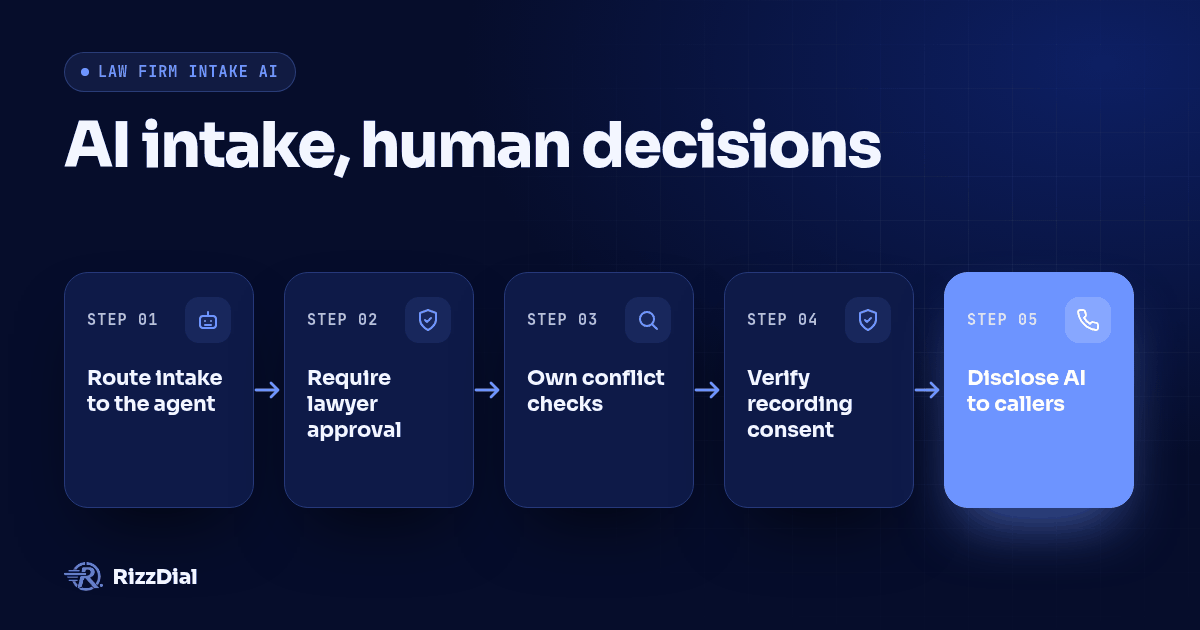
Use this five-step order, and do not skip ahead to turning on recording or publishing the number until the earlier steps are settled.
- Route new-matter intake questions to the agent. Build the script around the information your attorneys actually need to triage a call: practice area, basic facts, names involved, urgency, and contact details. Keep the question order fixed so every transcript looks the same.
- Require a licensed person for any accept or decline decision. Write this into the call flow as a hard stop, not a hope. The agent's output is a complete intake record handed to a named person; it is never a promise to represent the caller, even a tentative one.
- Flag conflict-of-interest screening as the gap you have to fill yourself. Ask the vendor to demonstrate any screening assistance it claims. Document who checks the results, which records are searched and where lawyer review happens; an automated name search must not become automatic acceptance.
- Confirm one-party or all-party consent for the jurisdictions involved before turning on call recording. Recording consent rules vary by state and by the call's circumstances, and the wrong assumption here creates exposure that has nothing to do with legal ethics and everything to do with wiretap law. RizzDial's state-by-state consent guide walks through the federal baseline and why a conservative, counsel-approved process is the safer default for any business that records calls, including a law firm's intake line.
- Disclose AI use to callers where it is required. Some states and some bar guidance call for telling a caller they are speaking with an AI system. Check your jurisdiction's specific rule before deciding your script's disclosure language, and do not assume silence on the point means disclosure is optional everywhere.
Run this order once, in writing, before the first real caller reaches the line. A firm that automates step one without locking in steps two and three has built a faster way to make the same mistake a human receptionist could make, just with less supervision attached to it.
What should you test before a real caller reaches the agent?
Testing an AI answering service for a law firm is not the same as testing one for a plumbing company. The stakes on a missed conflict flag or a premature acceptance statement are higher, so the test procedure needs to check for those specifically, not just whether the call connects.
- Call the agent yourself and give it a scenario the opposing party in an existing matter might plausibly describe. Confirm the agent collects the intake information and books nothing more than a consultation, without any language that sounds like acceptance.
- Listen for any phrase that could be heard as a promise of representation, "we'll take your case," "you're covered," or similar. Rewrite the script wherever that language appears, even if it seems harmless in context.
- Confirm the named person who reviews intake records before acceptance actually receives every call's transcript, not just the ones flagged as urgent, and knows the conflict check is their responsibility before anyone contacts the caller again.
- Test the recording consent flow in isolation: does the agent obtain any required consent before recording starts, and does the flow follow counsel-approved instructions if the caller refuses?
- Have a colleague play a caller with a genuinely urgent matter, like a deadline the next morning, and confirm the agent escalates to the designated person instead of treating an ordinary appointment as protection against a legal deadline. Test the fallback when that person does not answer.
- After the prelaunch tests pass, review one week of real transcripts with the person who owns conflict screening and ask directly: did anything in these calls almost slip past the hard stop you built in step two.
Keep a written log of each test and its result. If a prelaunch test fails, fix the script or handoff before live intake. If the first-week review finds a failure, pause the affected flow and retest it before resuming.
Is this general information or legal advice?
This is general information about how an AI answering service fits into a law firm's intake process, not legal advice. Bar rules differ by state, and ethics opinions like ABA Formal Opinion 512 set a framework that your state bar may apply differently. Confirm your specific obligations, including conflict-screening procedure, recording consent and AI disclosure requirements, with your firm's own counsel or ethics counsel before finalizing a script or a vendor.
Where does RizzDial fit for a law firm's intake line?
RizzDial provides direct carrier access to AT&T, Verizon and T-Mobile so calls ring real devices. The platform connects to GoHighLevel directly and offers MCP, OpenAPI and custom integrations, which matters for agencies managing a legal client's intake alongside everything else in that client's account. AI voice minutes run from $0.06 to $0.20 per minute of talk time, pay as you go, which is the only pricing detail we publish; nothing here changes who has to run your conflict check or sign off on accepting a matter.
If you are deciding between RizzDial and another AI calling platform for a legal intake line, our alternatives comparison and the side-by-side platform comparison page help you compare platform options. Use this guide separately to test the legal intake handoff; a platform comparison does not establish that a vendor can perform conflict screening.
What FAQs do agencies and firms ask about AI legal intake?
Is it ethical for a law firm to use an AI answering service for intake calls?
It can be, if the firm reviews the tool, protects caller information, supervises intake and retains lawyer responsibility for conflicts and acceptance. Local ethics rules and the specific workflow still matter. ABA Formal Opinion 512 applies existing duties of competence, confidentiality and supervision to generative AI tools rather than banning them, so the ethics risk sits in how the firm supervises the tool, not in using one.
How much does an AI answering service for a law firm cost?
RizzDial charges for AI voice minutes from $0.06 to $0.20 per minute of actual talk time, pay as you go, which is the only pricing detail we publish; a live person still has to run the conflict check and make the accept or decline call, so budget for that time separately from the per-minute AI rate.
How long does it take to set up an AI answering service for legal intake?
Set a launch date after the script, connections and handoffs pass testing. Writing the firm's own intake script, deciding the conflict-check handoff point, confirming the state's call-recording consent rule and running the six-step test procedure in this guide before the first real caller reaches the agent all take real time, so a quick technical connection is not a complete launch.
Does an AI answering service integrate with the case management software we already use?
Check this before buying, not after. RizzDial connects to GoHighLevel directly and offers MCP, OpenAPI and custom integrations, but a law firm's case management platform is a separate system and you should confirm the specific connection in a demo before counting on it.
What happens if we switch from a traditional legal answering service to an AI one?
Keep your intake script and your conflict-check handoff rule identical across the switch so you can compare apples to apples. The vendor-specific parts, call routing, after-hours coverage and consultation booking, change; the parts a bar would ask about, who makes the accept or decline call and how you screen for conflicts, should not change at all.
What should you do next?
Write down your firm's own hard stop before you evaluate a single vendor: who reviews intake records, who runs the conflict check, and who is allowed to say yes to a new matter. Once that is on paper, an AI answering service becomes a tool that feeds that process faster, not a replacement for it.
For the texting side of client intake, follow-up confirmations and consultation reminders carry their own consent and compliance rules; Beam's texting compliance guide covers the registration and consent mechanics for the messaging half of the same intake workflow.
How can RizzDial help with your calling workflow?
RizzDial is the AI outbound sales workspace for teams on GoHighLevel. Power dialing, AI voice agents, SMS automation, and CRM workflows in one platform. Book a demo.