Compliance
Call Recording Consent for AI Sales Calls
Review call recording consent for AI sales calls, interstate risks, CRM evidence and a practical agency test procedure before recording client calls.
By James Hill, Founder, RizzDial ·
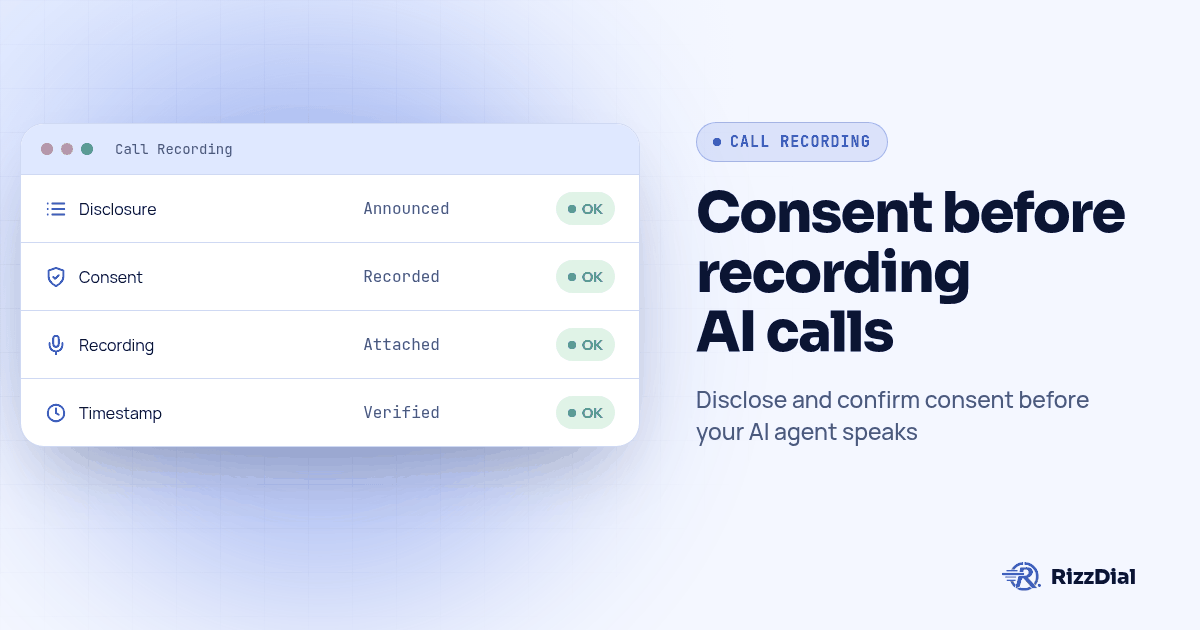
Federal law generally permits recording with one party's consent, but state law can require every participant's consent. For AI sales calls across states, use a counsel-approved all-party consent workflow as a conservative operating default: disclose recording, establish the required consent before capture, and keep the evidence with the call record. The exact legal rule depends on the jurisdictions and call circumstances, not just the dialer's location.
Does federal law let you record a sales call that your AI agent places?
Yes, with a condition. Under the federal Wiretap Act, a person who is a party to a call, or who has the prior consent of one party, may lawfully record it, as long as the recording is not made for a criminal or tortious purpose (18 U.S.C. § 2511). Do not assume that software placing a call automatically qualifies as the consenting party. Have counsel identify the participating person or business and the consent basis for your setup. The federal rule is a baseline. It is not the ceiling, because state law can and does require more.
This is a separate question from whether you were allowed to call the lead at all. The Telephone Consumer Protection Act's calling rules, including consent and disclosure requirements for certain call types, control when and how you may place the call (47 CFR 64.1200). RizzDial's guide on calling hours and consent covers that half of the compliance picture. Recording consent is the other half, and it runs on a different legal basis: state wiretap and eavesdropping statutes.
What does all-party consent actually require, and why is two-party consent the wrong name for it?
Where an all-party consent requirement applies, each participant must consent; statutory scope and exceptions still matter. The requirement is not limited to two participants. Add a third person, a supervisor listening in, or a warm transfer to another rep, and the requirement still applies to every one of them, not just the original two.
"Two-party consent" is the term most people reach for, and it is an imprecise nickname for the rule. It describes the typical two-person phone call, not the legal standard, which is about parties generally, not a headcount of two. A conference call with five people in an all-party state needs five consents, not two. Calling the rule "all-party consent" keeps the actual requirement in view instead of a number that only happens to match the most common call shape.
Washington State's eavesdropping statute is a commonly cited example of an all-party consent law in practice: it makes it unlawful to record a private communication without the consent of all parties, with specific exceptions written into the statute (RCW 9.73.030). State laws differ in their treatment of private conversations, telephone calls and exceptions. Use the Reporters Committee recording guide to locate the relevant statutes, then have counsel confirm how they apply to the campaign. A list of state labels cannot settle the whole question.
Washington also illustrates why notice and consent need a jurisdiction-specific review. Its statute provides that consent is considered obtained when a participant announces recording in a reasonably effective manner to everyone, and requires that announcement to be recorded when the conversation is recorded. That particular statutory mechanism should not be assumed to work identically elsewhere.
What happens when your dialer is in one state and the lead is in another?
Do not select the law solely from your call center, platform or client's office address. Interstate calls can raise a choice-of-law issue. In Kearney v. Salomon Smith Barney, California's Supreme Court applied California privacy protections to calls recorded by a Georgia business with California clients. This does not create one automatic nationwide rule. It shows why the recorder's home-state policy may be insufficient.
For operations, applying a counsel-approved all-party process to every campaign call avoids depending on a state-routing guess. Treat that as a conservative design choice, not a claim that the strictest state's law always governs every interstate call.
Lead lists rarely tell you where someone actually is. An area code reflects where a number was originally issued, not where the person carries their phone today, so it cannot establish a participant's current physical location. The honest fix is to treat area code as a starting signal, not a verified location, and to fall back to billing address, service address, or another maintained CRM location field as planning evidence. Those fields still do not prove where a traveling contact answers. When the signals disagree, or when you cannot confirm location at all, the safer default is to apply the all-party standard rather than guess in the direction that skips disclosure.
Why does the recording announcement collide with the AI agent's opening line?
If recording starts at connection while the AI launches into its sales greeting, the system may capture speech before the required consent exists. The control point is the start of capture, not a universal legal distinction between a greeting and substantive conversation. Putting the consent workflow ahead of the sales greeting is a practical way to make that boundary testable.
Use a fixed disclosure and a defined consent response before enabling recording, according to counsel's approved procedure. A prompt alone is not evidence that the caller heard the full notice or that recording waited. Test interruptions, silence and refusals. If the configured platform cannot enforce the approved order, keep recording disabled until the workflow is corrected.
Check any real-time transcription and audio processing in the same review. Disabling the downloadable recording does not establish that no interception or capture occurs; the federal definition covers acquisition through a device (18 U.S.C. § 2510). RizzDial's guide on AI voice agent disclosure requirements covers identifying the AI caller. Recording notice, consent to the call and AI identification are distinct requirements; verify each without assuming one sentence satisfies them all.
How do you keep the consent record attached to the right contact in the CRM?
A recording without a consent record attached to it is a liability, not an asset. An announcement log alone does not prove consent. The approved consent basis concerns a specific call at a specific time, and it needs to be logged as its own event, not inferred later from the fact that a recording exists. Store at minimum: the contact the call was placed to, the call ID, the timestamp the announcement played, the consent response or other approved consent basis, the time recording began, which script or audio clip version played, and a link or ID that ties that event to the recording file it covers.
Keep that event on the same contact record as the recording, not in a separate system that has to be cross-referenced by hand during an audit. If your CRM stores call recordings as attachments or embedded players on the contact timeline, the consent event belongs on that same timeline, next to the same call. For how access to those stored recordings should be scoped once they exist, see RizzDial's guide on client AI call review permissions, which covers who inside a client account should be able to open a recording at all.
How should an agency implement call recording consent for an AI calling campaign?
Run this original test procedure with agency-owned test numbers before a campaign goes live. These are acceptance criteria to verify in your configured stack, not claims that a particular product supplies every control.
- List the states your client's lead list actually covers. Pull the location field your CRM treats as authoritative for each contact, not just the area code, and build the real list of states this specific campaign will touch.
- Pick the stricter standard for any state on that list that requires all-party consent. If even one state on the list is an all-party state, build the campaign's recording flow around the all-party standard rather than splitting logic per state.
- Write the announcement text. Keep it short, plain, and unambiguous: explain the proposed recording and use the consent mechanism counsel approves. Define what silence, interruption and refusal mean before any audio is captured.
- Place the announcement ahead of the AI greeting in the call flow, as a fixed event the dialer or IVR triggers before handing the call to the AI agent, not as a line inside the agent's own prompt.
- Run a test call and listen back to the recording. Use consenting agency testers. Confirm the notice is audible and complete, and compare event timestamps with the recording start. Verify no audio was captured before the approved consent point. Where the law requires recording the notice itself, have counsel approve that capture sequence.
- Confirm the CRM stored the consent event and the recording against the same contact record, with a timestamp and a readable link between the two.
- Test what happens when the lead objects to being recorded mid-call. Confirm the system has a defined response, whether that is stopping capture, ending the call, or transferring to an unrecorded live rep, and confirm that response is actually documented, not improvised by whoever answers that day.
Which recording posture should your agency choose?
There is no single right answer for every client, but there are three postures worth comparing before you pick one for a given campaign.
| Posture | What it requires | Where it fits | Main tradeoff |
|---|---|---|---|
| Record after approved all-party consent on every call | Fixed notice, valid consent process and a recording-start gate regardless of location | Clients prioritizing a consistent recording workflow | Refusals and incomplete consent must prevent capture |
| Record only confirmed one-party-consent states | Reliable location data per contact, and a decision for what happens when location is unverified | Clients with a verified, state-tagged lead list and a QA team that wants recordings on most calls | Breaks down fast if location data is unreliable, and the unverified case needs a strict default |
| Disable stored audio and assess summaries separately | Counsel reviews transcription, real-time processing and retention before enabling summaries | Clients reducing retained audio while retaining approved call notes | A transcript or AI summary is not an automatic exemption from interception or consent rules |
Agencies recording inside client sub-accounts can use RizzDial's GoHighLevel integration as the starting point for reviewing their calling and CRM workflow. Ask the team to demonstrate the chosen consent sequence, call-data mapping and recording access in the actual configuration before accepting the setup.
Who may listen to a client's recorded calls?
Recording consent answers whether the call may be captured at all. It does not answer who may listen to it afterward, and those are two different controls that both need to be correct. Scope listening access by role, not by convenience: a client reviewer evaluating call quality is not the same access level as an agency operator debugging a routing problem, and neither should have standing access to another client's calls. RizzDial's guide on client AI call review permissions covers how to test that access boundary before inviting a client into a review role, including what happens when access is later revoked. For how stored recordings and other account data are protected at the platform level, see the security overview.
Agencies that also follow up by text should align suppression across channels when a lead asks not to be contacted further; Beam's guide on STOP and opt-out handling for business texting covers the text side of that same consent discipline.
Is this legal advice?
No. Everything above is an operational checklist for building and testing a recording consent workflow, not a legal opinion about any specific state, client, or call script. State wiretap statutes change, court interpretations differ, and a client's specific business, call types, and customer base can change which rule actually applies to them. Have the client's own counsel review the state list, the announcement wording, and the mid-call objection process before the campaign runs, and keep that sign-off on file alongside the consent events it governs.
What FAQs come up about call recording consent for AI sales calls?
Do you need consent from everyone on the call to record an AI sales call?
Where applicable law requires all-party consent, every participant must consent. Federal law generally allows one-party consent, but interstate calls need jurisdiction-specific review. An approved all-party workflow is a conservative operating default, not a substitute for determining which law applies.
Is two-party consent the same thing as all-party consent?
Usually it is used as a nickname for all-party consent, but the actual requirement in these states is that every participant on the call must consent, not just two people. A call with three or more participants still needs every participant's consent under an all-party consent law.
Does the recording announcement have to play before the AI agent's greeting?
Placing it before the sales greeting is a practical design choice. The legal issue is whether the required consent exists before capture under the applicable law. Test the notice, consent mechanism and recording-start event together; a prompt instruction alone does not prove that sequence.
Who may listen to a client's recorded AI sales calls?
Only the people the client agreement and the CRM role permissions actually authorize. Test that list before inviting a reviewer, rather than assuming a role label is enough.
Is this article legal advice?
No. This is operational guidance for building and testing a consent workflow. A client's own counsel needs to confirm the announcement wording and the state list before the campaign goes live.
How can RizzDial help with your calling workflow?
RizzDial is the AI outbound sales workspace for teams on GoHighLevel. Power dialing, AI voice agents, SMS automation, and CRM workflows in one platform. Book a demo.