Compliance
TCPA Calling Hours and Consent for Dialing Teams
Check federal TCPA calling hours, consent evidence and revocation rules before outbound calls. Use a scheduling and launch checklist for dialing teams.
By James Hill, Founder, RizzDial ·
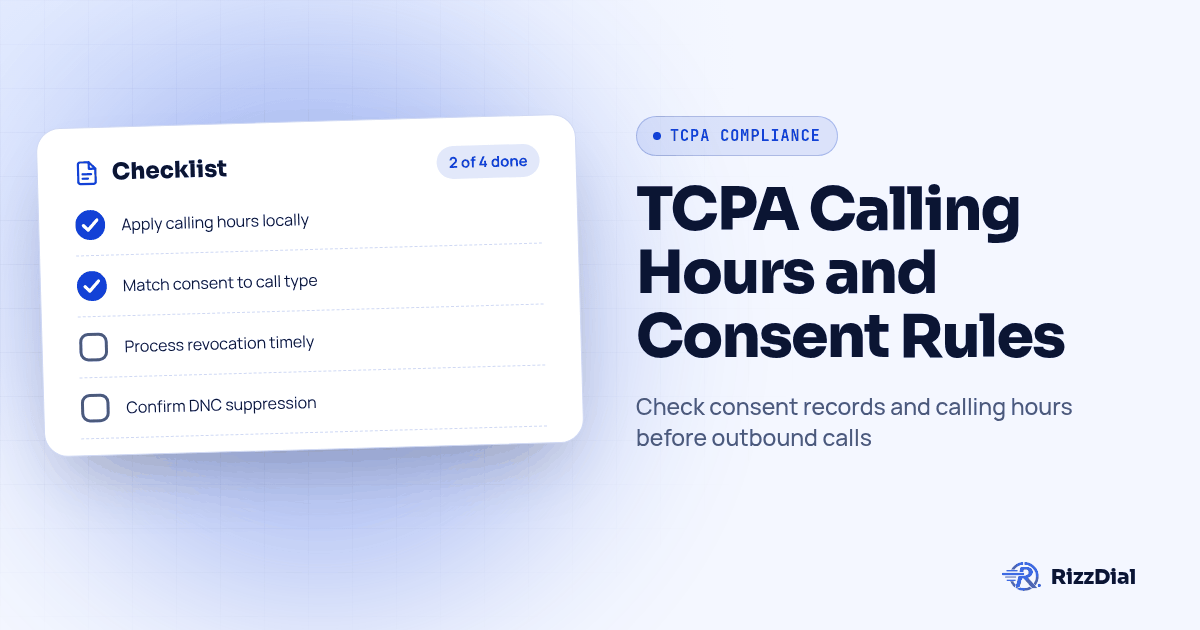
This page is general information, not legal advice. Talk to a qualified attorney about your calling program.
Apply calling hours at the recipient's location
The federal baseline for covered telephone solicitations is 8 a.m. to 9 p.m. local time at the called party's location under 47 CFR 64.1200(c)(1). The TSR has a related local-time restriction in 16 CFR 310.4(c). A campaign using your office time zone can therefore call someone too early or too late.
Use a verified recipient location in scheduling. As an operational precaution, hold records with uncertain locations for review instead of assuming a phone area code proves where someone lives. Check applicable state law with counsel and configure any narrower window it requires.
Match the consent record to the call
For telemarketing to wireless numbers, use of a legally defined autodialer or an artificial or prerecorded voice generally requires prior express written consent, subject to the rule's exceptions. See 47 U.S.C. 227 and 64.1200(a)(2). The written-consent definition requires a signed agreement that clearly authorizes the seller and identifies the telephone number. The disclosure must explain that consent is not a condition of purchase; see 64.1200(f)(9).
For covered prerecorded sales calls, the FTC's separate written agreement guidance requires the specific seller to obtain permission directly from the recipient. Do not assume a lead vendor's generic consent field satisfies every applicable rule.
Before import, ask the team to retrieve the actual disclosure and signature for a sample record. Store the collection date, page version, seller and intended call type with the record. These are practical evidence checks, not a universal consent template.
Do not rely on outdated one-to-one consent guidance
In DA 25-621, released July 14, 2025, the FCC removed consent language vacated by the court and restored the earlier rule text. Do not describe the vacated one-to-one rule as a current federal requirement. Existing TCPA consent standards and separate FTC requirements still need review.
Process revocation across your workflow
64.1200(a)(10) recognizes reasonable methods of revocation and requires action within a reasonable time, no more than ten business days. Do not insist that someone use only one designated method. Operationally, flag the record immediately and investigate whether a queued call or follow-up could still run.
The FCC's January 6, 2026 order extends a limited waiver until January 31, 2027 for treating a revocation responding to one informational message type as covering unrelated future robocalls and robotexts from the caller. It does not postpone all revocation requirements. These statements were checked September 2026; review changes before launch.
For offline consent-log validation while preparing your launch review, James Hill's TCPA compliance checklist is a free MIT starter with a CLI, not legal advice or a compliance guarantee.
A launch check for agency clients
- Identify the seller, recipient types, message purpose and calling technology for counsel's review.
- Test the earliest and latest call time for each recipient time zone with your own numbers.
- Retrieve the consent evidence for the permitted call type.
- Confirm the National DNC and company-specific suppression process described in the DNC scrubbing guide.
- Test an opt-out and ensure all relevant lists and queued follow-ups reflect it.
RizzDial's security page documents opt-in tracking, consent documentation and opt-out handling. It also warns that list settings can override contact DNC flags. Review these settings; this article does not claim automatic location-based calling-hour enforcement.
Plan your dialing workflow
Read the TCPA compliant dialer guide, the calling hours and consent checklist, and the DNC scrubbing workflow. Compare RizzDial vs Kixie and RizzDial vs Readymode against the same team requirements.
Book a RizzDial demo with your campaign, CRM and client onboarding requirements.
FAQ
What are TCPA calling hours?
For covered telephone solicitations, the federal baseline is 8 a.m. to 9 p.m. at the recipient's location. Review applicable state rules before setting campaign hours.
Is a CRM consent checkbox enough?
A checkbox value alone does not show the underlying disclosure or signed agreement. Review the actual evidence and the rules applicable to your call type with counsel.
Is the one-to-one consent rule a current requirement?
The FCC removed the vacated language in 2025. Existing TCPA consent requirements and separate FTC prerecorded-call requirements still apply where relevant.
Should we wait ten business days to stop calls?
No. The FCC requires a reasonable time with a ten-business-day maximum for covered requests. Our operating recommendation is immediate suppression.
Sources (checked September 2026)
- 47 U.S.C. 227: TCPA statute
- 47 CFR 64.1200: FCC delivery restrictions
- 16 CFR 310.4: FTC Telemarketing Sales Rule
- FTC guide to the Telemarketing Sales Rule
- FCC DA 26-12, January 6, 2026: limited revocation waiver
- FCC DA 25-621, July 14, 2025: removal of vacated consent language
- RizzDial security and consent tools
For the next step in this workflow, review the calling consent and tcpa review guide and discuss implementation through the calling workflow integrations.
About RizzDial
RizzDial is the AI outbound sales workspace for teams on GoHighLevel. Power dialing, AI voice agents, SMS automation, and CRM workflows in one platform. Book a demo.