Compliance
Do AI Voice Agents Have to Say They Are AI?
No single federal AI disclosure sentence is required yet. The FCC treats AI voices as artificial voices, and some states already require disclosure.
By James Hill, Founder, RizzDial ·
AI voice agents may have to disclose that they are AI, depending on the state and interaction. Federal TCPA rules already treat AI generated voices as artificial voices, while the FCC's separate AI disclosure proposal should not be confused with an adopted rule. For agencies reselling AI calling in the United States, a clear opening disclosure is a practical default alongside consent, identification and any additional state requirements.
Does federal law already treat an AI generated voice as an "artificial voice"?
Yes. In February 2024 the FCC adopted a declaratory ruling confirming that calls placed using an AI generated voice fall under the TCPA's existing restrictions on an "artificial or prerecorded voice" (FCC-24-17A1). Before that ruling, some callers argued a synthetic voice was not a "recording" and therefore sat outside the rule requiring prior express consent for calls to a residential or wireless line. The ruling closed that argument. If a campaign needs prior express written consent to use an artificial voice, it needs that same consent to use an AI voice agent.
The existing federal calling rule, 47 CFR 64.1200, also requires artificial or prerecorded voice messages to identify the responsible entity at the beginning and provide its telephone number during or after the message. Specified exempt residential calls and covered advertising or telemarketing calls must provide an automated opt-out mechanism within two seconds of identification. The requirements depend on the call and destination. Read this alongside RizzDial's TCPA calling hours and consent guide: disclosure does not replace permission to call.
Is there a federal rule requiring an explicit AI disclosure sentence yet?
The FCC issued FCC-24-84A1 as a proposed rule in August 2024. It proposed AI disclosure both when obtaining consent and at the beginning of covered voice calls. The current federal rule linked above does not contain that proposed AI-specific language. Check for a final rule and its effective date before changing client requirements; a proposal is not proof of a duty already in force. RizzDial's TCPA and FCC compliance rulebook provides related campaign planning context.
Which states already require an AI voice agent to disclose itself?
California's AB 2905 amended rules for automatic dialing-announcing devices. For calls subject to that provision, an unrecorded natural-voice announcement must identify the business and nature of the call, ask for consent to hear the prerecorded message, and disclose if that message uses an artificial voice. This is more specific than having an AI assistant introduce itself. Review the applicable device rules and exceptions before choosing a California call flow.
Utah's current required disclosures statute, effective May 7, 2025, requires suppliers using generative AI in consumer transactions to disclose it when clearly asked or prompted about whether the interaction is with AI or a human. For regulated services, proactive disclosure applies when the use constitutes a high-risk AI interaction. That disclosure must occur verbally at the start of a verbal interaction, or in writing before a written interaction. This current text is more useful for campaign review than relying on the original 2024 law alone. These examples are not a complete state survey.
Can a carrier or platform require more than the law does?
Check the terms for each carrier and platform involved in a campaign. Contractual requirements need a separate review from statutes, and a disclosure line does not guarantee delivery or prevent spam labels. Assign someone to check the applicable acceptable-use terms and escalation process before launch. RizzDial's security page is a starting point for reviewing security information and preparing vendor questions, rather than evidence that any particular script complies with the law.
What should the disclosure say, and where does it belong in the call?
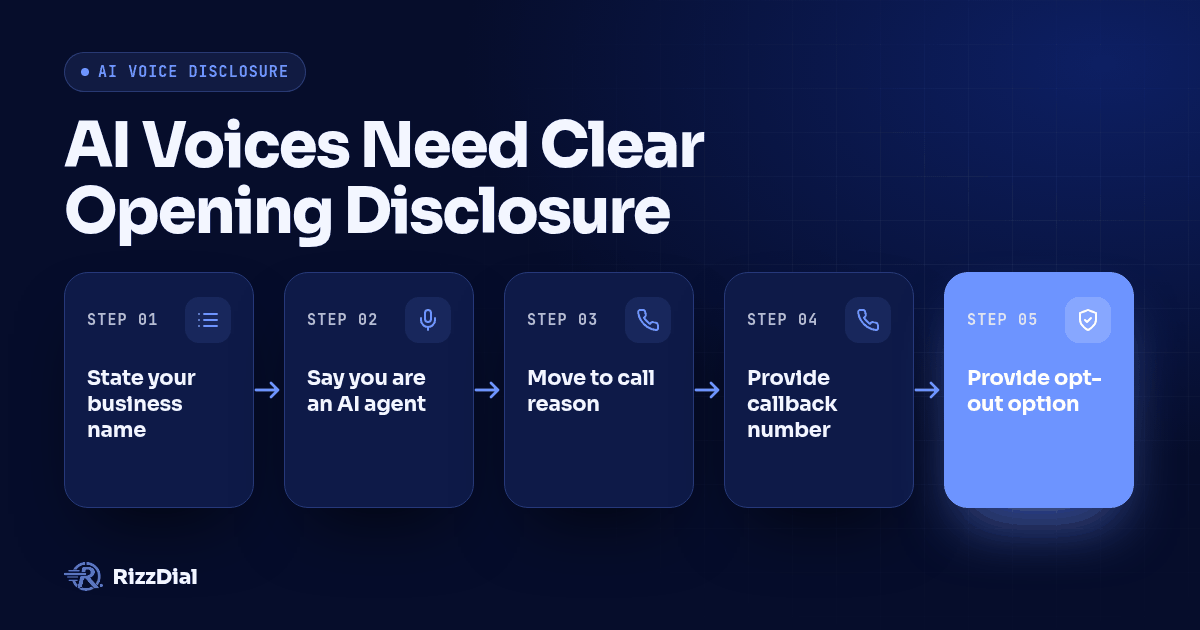
Put the disclosure inside the opening line, not after the pitch. Use this pattern as a starting point for script review, subject to any additional state-specific requirements:
- State the business name first, matching the existing identification requirement.
- Say plainly that the caller is speaking with an AI voice agent, in the same breath.
- Move directly into the reason for the call.
For example: "Hi, this is the AI assistant for [business name], calling about [reason]." This tells the listener who the assistant represents and that it is AI. It does not supply every required callback, opt-out or state-specific element, and it does not satisfy California's natural-voice requirement by itself.
Keep that sentence in the script for every campaign, not only the ones running in California or Utah. A caller in a state with no statute yet is not asking a different question than a caller in a state with one.
What if a caller asks mid-call whether they are talking to a person?
Answer directly and immediately as an operating practice. Utah's consumer-transaction rule specifically addresses clear questions or prompts about AI use; the FCC proposal is a different source and should not be described as an "if asked" rule. Build a fixed response into the call flow, such as "You're speaking with an AI voice agent for [business name]," followed by an offer to connect a live team member where that option exists. Do not let the agent change the subject or imply that it is human.
How should an agency manage disclosure templates and logging across client accounts?
Hold the disclosure sentence as one template, not a line every client sub-account rewrites from scratch. Store it with the campaign script, version it when the wording changes, and record which version ran on which campaign and on which date, the same way you would keep any other compliance record for a client account. When a state law changes or a federal rule moves from proposed to final, you update one template and can show exactly which live campaigns were on the old wording.
Put ownership of that decision in the client agreement. Identify who approves the disclosure wording and who reviews requested changes. A client request to remove legally required wording does not make removal permissible. Pause that change for review and keep the approval history with the campaign. MetaTechAi's guide on what to prepare before hiring an AI automation agency covers ownership questions from the buyer's side and can help agencies structure the handover discussion.
Before activating a client campaign, test an answered call, a voicemail, an interruption during the opening, a direct question about AI and a requested human handoff. Check that the opening plays fully and that the response stays truthful when the person interrupts. Keep a record of the script version and test result without collecting unnecessary personal information. For GoHighLevel resellers, repeat this review after copying a template into a different client account, since the business identity, callback details and available transfer destination can change.
What questions do agencies ask about AI voice disclosure (FAQ)?
Does the disclosure rule apply to inbound calls, or only outbound?
The rules have different scopes. Federal TCPA restrictions discussed here concern calls placed to recipients, while Utah's consumer-interaction disclosure text is not limited to outbound calls. Do not assume an inbound AI receptionist is exempt from every disclosure obligation. Review the interaction and jurisdiction, and use a clear introduction as an operating default.
Does a voicemail message left by an AI voice agent need the same disclosure?
Federal identification requirements apply to artificial or prerecorded voice messages, including messages left on voicemail. Include the responsible business identity and callback information, and check the applicable voicemail opt-out requirements. Adding an AI disclosure is a practical script choice and may be required under applicable state law.
If a human takes over the call partway through, does the disclosure still apply?
A later human handoff does not erase requirements that applied during the AI portion. As an operating practice, announce the transfer and make clear when a human joins. Review the opening independently rather than assuming that an eventual transfer cures an omitted disclosure.
Does consent to be called also cover consent to talk with an AI voice?
Check the actual consent language, call purpose and applicable requirements. The FCC ruling places AI voices within existing artificial-voice restrictions; covered telemarketing calls generally require prior express written consent unless an exception applies. It does not mean older consent is invalid solely because it omitted the word AI. Review the evidence before launching a new campaign.
Ready to run compliant AI voice campaigns for your clients?
Build the disclosure sentence into the opening of every script before launch. Use RizzDial's TCPA compliant dialer page to frame questions about campaign controls, then verify the consent records, opt-out behavior and call flow for each client. Treat disclosure as one part of that review, with an approved script and an accountable owner.
For the next step in this workflow, review the calling consent and tcpa review guide and discuss implementation through the calling workflow integrations.
About RizzDial
RizzDial is the AI outbound sales workspace for teams on GoHighLevel. Power dialing, AI voice agents, SMS automation, and CRM workflows in one platform. Book a demo.