GoHighLevel
Test Returning Caller Context in Client Voice Agents
Test AI receptionist recall with known callers, changed details, shared numbers and missing summaries. Trace each detail before approving a client rollout.
By James Hill, Founder, RizzDial ·
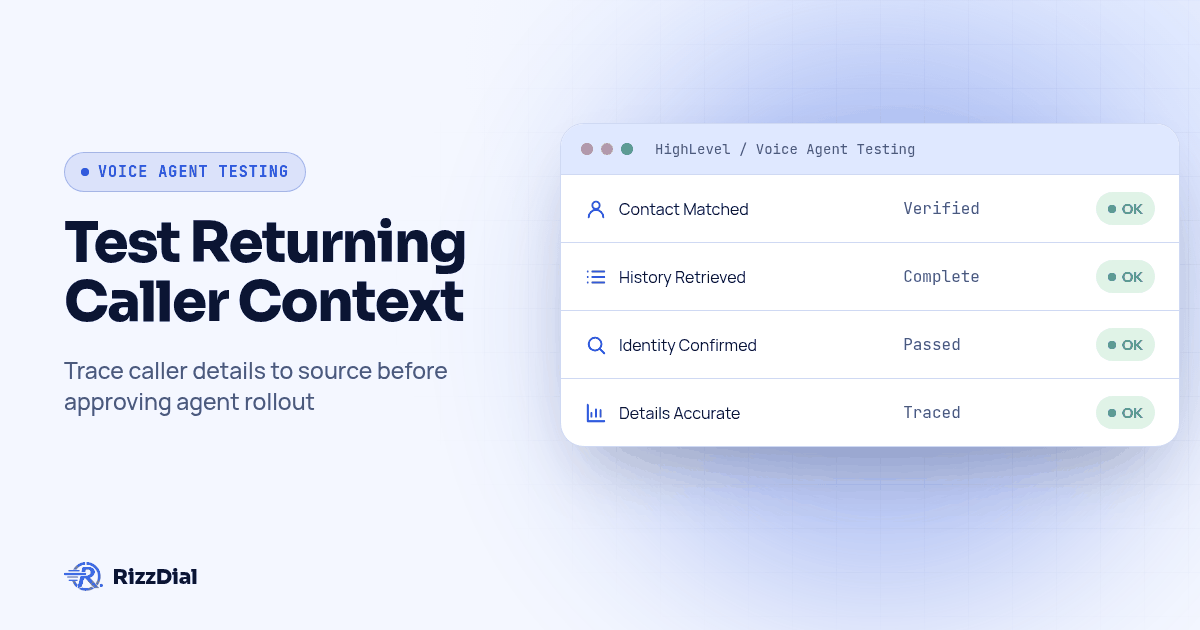
Test returning caller context by placing separate inbound calls against controlled contact records, then tracing every recalled detail to its source. Include known callers, changed contact details, shared phone numbers and missing prior summaries, with identity confirmation before customer-specific information is spoken. A correct name greeting alone does not establish persistent conversation memory.
Key Takeaways
- Separate contact lookup, history retrieval and identity confirmation in your test results.
- Record where each recalled detail came from and when it became available.
- Require the agent to pause or ask for a recap when identity or history is uncertain.
What does returning caller recognition actually prove?
Contact recognition means the system associates an incoming call with a stored contact. Conversation memory means information from an earlier interaction remains available to a later session. For agency acceptance testing, treat those as separate capabilities that need separate evidence.
HighLevel’s Returning Caller request asks for phone-number matching and personalized greetings. Its caller recognition discussion also contains requests and user suggestions about contact fields and earlier conversations. These pages document desired behavior and reported approaches, not a verified guarantee of persistent recall.
For resellers evaluating white label AI voice agents, define the exact promise under review: recognizing a contact, retrieving a prior summary, or continuing an unresolved request. Do not describe a contact-field greeting as proof that every previous conversation is remembered.
What should you prepare before placing test calls?
Use an isolated test setup with fictional records and phone lines your team controls. The examples below are hypothetical test fixtures, not reported customer results. Match the intended client call path, including the assigned agent, account and CRM connection.
Prepare a known contact with a prior request, a contact whose details will change, contacts sharing a number, and a contact with no accessible summary. Include an unknown caller as a control. Keep test facts out of the general agent instructions so the agent cannot pass by repeating information available to every caller.
Before dialing, agree with the client on which details require identity confirmation and how that confirmation works. A caller stating a name is not sufficient evidence for every disclosure. Use the client-approved verification process; if the agent cannot complete it, require a staff handoff before releasing restricted details.
Capture the agent configuration, contact identifiers, expected behavior and available logs. Save a starting copy of each test record so later corrections do not erase the evidence of what the agent could access.
How do you map the source of each recalled detail?
Build a provenance table: a record of the exact source behind each statement. Your CRM contact records are a useful starting point, but the test must also inspect what the voice session actually receives.
| Detail being tested | Expected source | Evidence to capture |
|---|---|---|
| Contact name | Matched contact field | Account and contact identifier |
| Earlier service request | Prior summary or transcript | Source call identifier and saved text |
| Corrected email | Approved contact update | Old value, new value and write time |
| Current appointment | Authorized calendar lookup | Booking record and retrieval time |
| Preferred follow-up channel | Stored preference | Field value and last confirmed context |
For every customer-specific statement, record the spoken wording, selected record, source value and identity-check status. Add when the source was written and when it was fetched. If you cannot see the retrieval input, ask the implementation owner for evidence; classify the result as unverified rather than assuming the model used the intended record.
Keep unrelated facts distinct in the fixtures. For example, give each fictional contact a different service request. That makes a wrong-record answer visible even when the greeting sounds plausible.
How should you test a known caller returning?
Start with a normal call that creates a distinctive, harmless request, such as asking about a gate repair. End the call and inspect the saved record before calling again through a fresh inbound session.
- Confirm that the request was attached to the intended contact and client account.
- Call back from the same controlled line and complete the agreed identity check.
- Ask, “Can we continue what I called about earlier?” without repeating the request.
- Compare the response with the prior summary and the retrieval evidence.
Then ask about something absent from the saved history. The agent should acknowledge that it lacks the detail or request clarification. It should not fill the gap with a plausible story.
A passing result requires accurate, appropriately disclosed context from the correct record. Score the name greeting separately. Also repeat the scenario after ending any browser demo or preview session, so a continuing test session cannot be mistaken for recall across independent calls.
What changes when the caller updates their details?
Test both the saved correction and its availability on the next call. HighLevel documents contact-field updates during a conversation or after it ends, with different confirmation behavior. That supports checking write timing; it does not establish how every later voice session retrieves those values. See Separate During-Call and Post-Call Actions in Voice AI.
In the hypothetical fixture, have the verified caller correct an email address. Check the transcript, configured update action and stored field. Call again after confirming the write completed. Ask the agent to follow the approved confirmation process without volunteering the replacement value.
Next, repeat with a changed phone number using another controlled line. Do not assume the new number will automatically resolve to the old contact. Require the configured identity and record-selection process before the agent retrieves prior details or updates a record.
Test a callback while the expected update is still pending, if that timing can be reproduced safely. Record whether the agent uses an older value, requests confirmation or hands off. Define that fallback explicitly instead of promising that every change is instantly available.
How do you test people who share a phone number?
Use fictional contacts with different requests and the same controlled number. If the CRM cannot represent that arrangement directly, test the supported household or shared-office structure and record its limits.
Have a different team member call from that line. The opening should avoid naming a customer or revealing a prior request until the approved identity check is complete. Ask the caller to identify themselves without reading private stored details aloud as hints.
After verification, inspect which contact was selected and whether the retrieved history belongs to that person. If the match remains ambiguous, the expected outcome is clarification or staff assistance. A confident answer from the wrong record fails the test even if the service request sounds reasonable.
Acceptance boundary: Accurate information disclosed to the wrong person is still a failed returning-caller test.
Also place an ordinary test call into another isolated client account containing a distinct fixture. Confirm that its response uses only that account’s authorized context. This checks account separation without using real customer information.
What should happen when the prior summary is missing?
The agent should acknowledge the missing context and keep the conversation useful. Remove or withhold the summary in the test fixture while preserving the contact name. Ask about the previous request after completing identity confirmation.
An acceptable response might be, “I don’t have the earlier details available. Could you briefly tell me what you need help with?” A staff handoff can also satisfy the agreed workflow. Claiming to remember a request that has no available source fails the test.
Inspect the whole path: summary creation, record association, storage, retrieval and inclusion in the new call. The post-call webhook and CRM guide provides related implementation context for checking the storage side. A successful write alone does not prove that a later agent session can read it.
If the workflow includes messaging after the call, apply the same identity and destination checks there. An optional integration using Beam’s iMessage API needs its own contact mapping and approved message content; adding a messaging channel does not establish voice memory.
What evidence should a reseller require before approval?
Keep a compact test record containing the scenario, call identifier, selected contact, expected source, actual response, identity-check result and pass or fail decision. Attach the relevant transcript excerpt and retrieval evidence where available. Mark inaccessible evidence as unverified.
Separate failures by cause: wrong contact, stale field, missing summary, unavailable retrieval or premature disclosure. Assign an owner and repeat the affected scenario after the correction. Recheck neighboring cases when a change alters contact matching or disclosure behavior.
Before offering returning-caller continuity to a client, review this evidence with the implementation owner. Describe only the behavior demonstrated in the configured call path, and record the fallback for anything the agent cannot safely retrieve or confirm.
What returning caller context questions belong in an agency FAQ?
Does a greeting by name prove conversation memory?
No. A greeting can come from a contact field. Test whether a separate inbound call retrieves a specific prior detail, then trace that detail to its stored source and contact record.
Can caller ID alone confirm the person speaking?
Treat the number as a lookup clue. For this test, require the client-approved identity check before the agent reveals customer-specific information, especially when people share a number.
What should happen when the previous summary is missing?
The agent should say it cannot access the earlier details, ask for a brief recap, or offer a staff handoff. It should not invent a prior request or borrow another contact’s history.
Does saving a post-call summary make it available next time?
Saving and retrieval are separate checks. Verify the summary reached the intended record, then inspect whether the next call actually receives that summary through the configured context path.
For the next step in this workflow, review the ai voice agent workflow guide and discuss implementation through the AI calling integrations.
How can RizzDial help with your calling workflow?
RizzDial is the AI outbound sales workspace for teams on GoHighLevel. Power dialing, AI voice agents, SMS automation, and CRM workflows in one platform. Book a demo.