GoHighLevel
Retest Client Voice Agents After a Prompt Change
Retest a client's AI voice prompt with saved instructions, fixed call scenarios, expected actions, a change owner and a clear rollback decision.
By James Hill, Founder, RizzDial ·
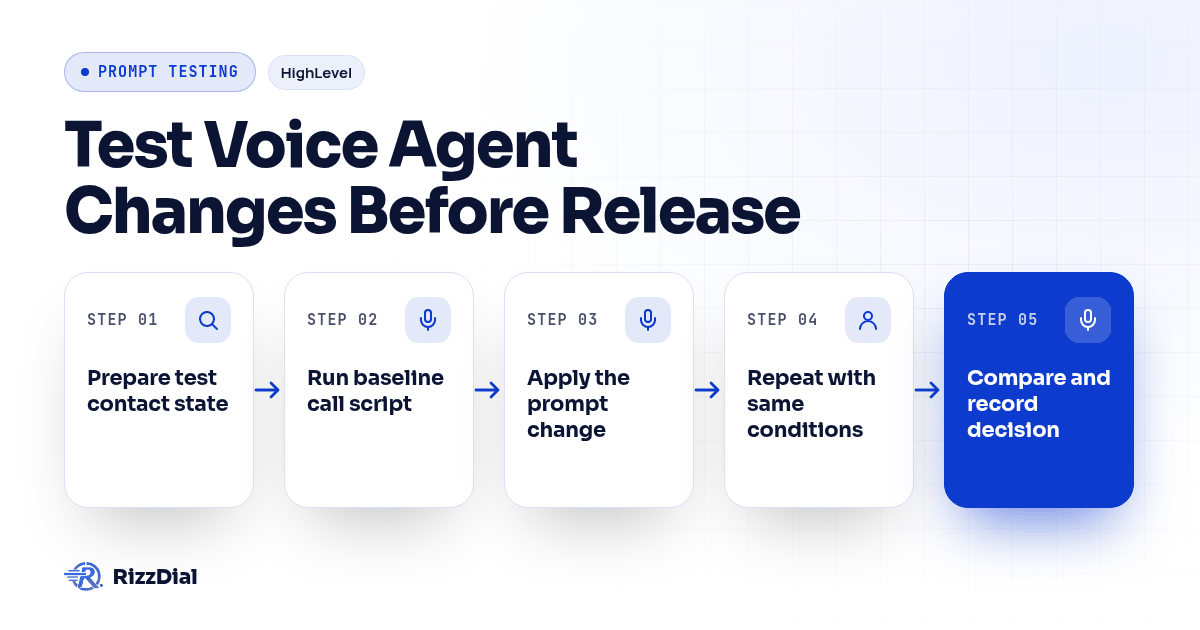
To check an AI voice prompt update, save the working instructions and run the same caller scenarios before and after the edit, comparing both spoken responses and completed actions. Assign a change owner, define which failures block release, and prepare a way to restore the previous setup. For an already deployed client agent, the test must protect working call paths as well as confirm the requested improvement.
Key takeaways
- Preserve the old instructions and record exactly what changed.
- Compare repeatable scenarios against written expectations.
- Separate conversation checks from phone routing and action evidence.
- Keep a named owner responsible for approval and recovery.
What should you save before editing the prompt?
Create a baseline record that another operator can understand without asking the editor what happened. Save the full active prompt, greeting, relevant knowledge content, configured actions and call settings. Identify the client account and agent so that a test cannot accidentally be credited to a different setup.
Give the saved copy a revision label and timestamp in your agency's own change register. Record the requested behavior, the reason for changing it and the person responsible. This is a proposed maintenance process, not a claim that RizzDial provides native prompt versioning or automatic rollback.
Write a narrow change statement. For example, in a hypothetical service-business workflow: “Ask for the service address before offering an appointment.” Preserve the existing requirements for qualification, human assistance and unsupported requests.
Confirm how edits become active before saving anything. Use an isolated test setup where available. If saving changes immediately affects live calls, arrange an approved maintenance window and continuity plan first. Keep the working agent available until the candidate can be tested safely.
For agencies maintaining white label AI voice agents, this record belongs with the client's ongoing service documentation. It should survive a staff handoff.
Which working call scenarios should you preserve?
Build the regression suite from the client's approved call flow. A regression is a previously working behavior that stops working after a change. Include ordinary successful calls, important exceptions and the specific issue the edit is intended to fix.
Use the acceptance criteria from your GoHighLevel AI calling pilot checklist as a starting point, then add scenarios learned after launch. Keep caller wording and starting conditions stable for the direct comparison. Explore alternative phrasing afterward as a separate check.
The following is an illustrative suite for an agent configured to qualify inquiries and arrange appointments. Adapt each row to actions actually enabled for that client.
| Fixed caller scenario | Expected behavior | Evidence to inspect |
|---|---|---|
| Caller requests a supported service | Collect required details and follow the approved booking path | Conversation and resulting calendar record |
| Caller corrects an address | Use the corrected address before taking action | Final stored address and spoken confirmation |
| Caller requests a person | Follow the configured handoff path | Phone outcome and receiving staff confirmation |
| Caller requests an unsupported service | Explain the limit and offer the approved next step | Transcript and any resulting task |
| Caller declines to book | Respect the decision without creating an appointment | Conversation and absence of a new booking |
| Caller provides incomplete information | Ask for the missing detail without inventing it | Transcript and stored fields |
Write down forbidden outcomes too. “No appointment created” is a valid expectation when the caller declines. Successful testing includes proving that an action did not occur when it should not have.
How do you run a fair before-and-after comparison?
Run the baseline scenarios against the saved working configuration before testing the candidate. Record the actual result, including failures already present. A remembered successful call is a weaker comparison than a documented run under known conditions.
Use these steps for each scenario:
- Prepare a controlled test contact with known field values and appointment state.
- Run the fixed caller script against the baseline and save the available evidence.
- Apply the isolated prompt change in the agreed test environment.
- Restore equivalent starting conditions and repeat the scenario against the candidate.
- Compare required behavior and downstream state, then record the decision.
Avoid unrelated edits to knowledge, actions or routing during this comparison. If they are necessary, record them as part of the change package. Otherwise, a different outcome may have several possible causes.
Reset test state carefully. A booking created during the baseline can make the same time unavailable during the candidate test. A previously populated contact field can hide a failure to collect information. Use controlled records and inspect their starting state before each run.
A practitioner discussion about voice service testing asks how to catch regressions after prompt and tool changes. It supplies a relevant operator question, not evidence of a particular vendor defect. The comparison method here is an agency workflow recommendation.
What do browser tests and phone tests actually prove?
Match each check to the path it exercises. HighLevel's testing guide, updated September 2026, describes Web Call as a way to test conversation behavior and supported actions. It states that Web Call trials do not support Call Transfer and do not validate the complete phone-number routing experience. Use phone validation for telephony-dependent behavior. These are documented HighLevel capabilities, not feature claims about another platform. HighLevel testing guide.
For a reseller, that means a browser pass cannot close a transfer test. Record “not exercised” when a method cannot validate the expected action. Then use the relevant phone path with controlled participants and inspect where the call actually arrives.
Also distinguish a test-panel phone call from an inbound call to the client's assigned number. To verify inbound routing, deliberately exercise that entry point. Check the call direction, account, agent and route in your review record so that a successful conversation is not mistaken for proof of an untested path.
The AI voice agent reseller demo checklist helps establish what a platform can demonstrate. During maintenance, keep that same evidence standard for the specific client's deployed setup.
How should you record outcomes and action evidence?
Maintain a comparison sheet beside the saved instructions. Use a row for every scenario and keep the evidence reference close to the verdict.
| Review field | What to record |
|---|---|
| Change identity | Client, agent, baseline label, candidate label and editor |
| Test conditions | Scenario, caller script, contact state and call method |
| Baseline outcome | Observed response, action and evidence reference |
| Candidate outcome | Observed response, action and evidence reference |
| Assessment | Pass, fail or unverified, with a specific reason |
| Ownership | Reviewer, release decision and rollback owner |
In HighLevel, the test-log guide directs reviewers to Dashboard & Logs and the Live/Test filter. Available call details can include recordings, transcripts and action activity. It recommends using recordings and transcripts together and reviewing tests after prompt or setting updates. HighLevel test-call log guidance.
Check the destination system separately when an action matters. A spoken booking confirmation should correspond to the intended calendar record. A promised callback should correspond to the approved task or handoff. Save enough evidence to distinguish “the agent said it” from “the configured action completed.”
Listen for changed meaning, skipped questions and confusing confirmations. Allow harmless variation in phrasing unless exact wording is a client requirement. Repeat uncertain cases and record inconsistent results instead of selecting only the successful attempt.
When should you approve, hold or roll back the change?
Approve the candidate when the intended improvement works, required existing paths pass and no critical evidence remains missing. Hold it when a result is inconsistent or unverified. Reject or roll back a change that creates a blocking failure, such as an incorrect booking or broken human handoff.
Define those blockers before reviewing results. Assign a release decision owner and a rollback owner, even if the same operator fills both roles. Have the client approve any changed business rule rather than treating it as a wording preference.
A rollback plan should identify the saved configuration, the steps for restoring it and the checks needed afterward. Restoring a prompt does not undo appointments, tasks or other records created while the candidate was active. Assign someone to review and correct those effects through the client's normal process.
After an approved update reaches the live path, run a controlled confirmation and review early call evidence. Keep the previous configuration available until the owner closes the change record. If your client needs help managing the connected sales workflow and its ongoing ownership, MetaTech's managed services provide a relevant implementation discussion.
What FAQ answers help resellers check prompt changes?
Should you retest after a small wording change?
Yes. Check the intended improvement and the existing paths that must keep working. Keep the change isolated so the before-and-after comparison remains useful.
What if the previous prompt also fails the scenario?
Record it as an existing problem, not a regression caused by the new prompt. Check the test setup and shared dependencies before assigning a cause. An existing critical failure still needs an owner.
Do you need identical wording for a passing result?
Usually no. Score the required meaning, collected information and completed action. Require exact wording only where the client has explicitly approved a fixed statement.
What if a required action cannot be verified?
Mark the scenario unverified and hold approval for that path. Record the missing evidence and who will obtain it. A confident spoken confirmation is not proof that a downstream action completed.
For the next step in this workflow, review the ai voice agent workflow guide and discuss implementation through the AI calling integrations.
How can RizzDial help with your calling workflow?
RizzDial is the AI outbound sales workspace for teams on GoHighLevel. Power dialing, AI voice agents, SMS automation, and CRM workflows in one platform. Book a demo.