GoHighLevel
AI Voice Call Capacity Questions Agencies Should Ask
Verify AI voice call capacity with a vendor questionnaire and a small agreed test for simultaneous callers, busy destinations, overflow and recovery.
By James Hill, Founder, RizzDial ·
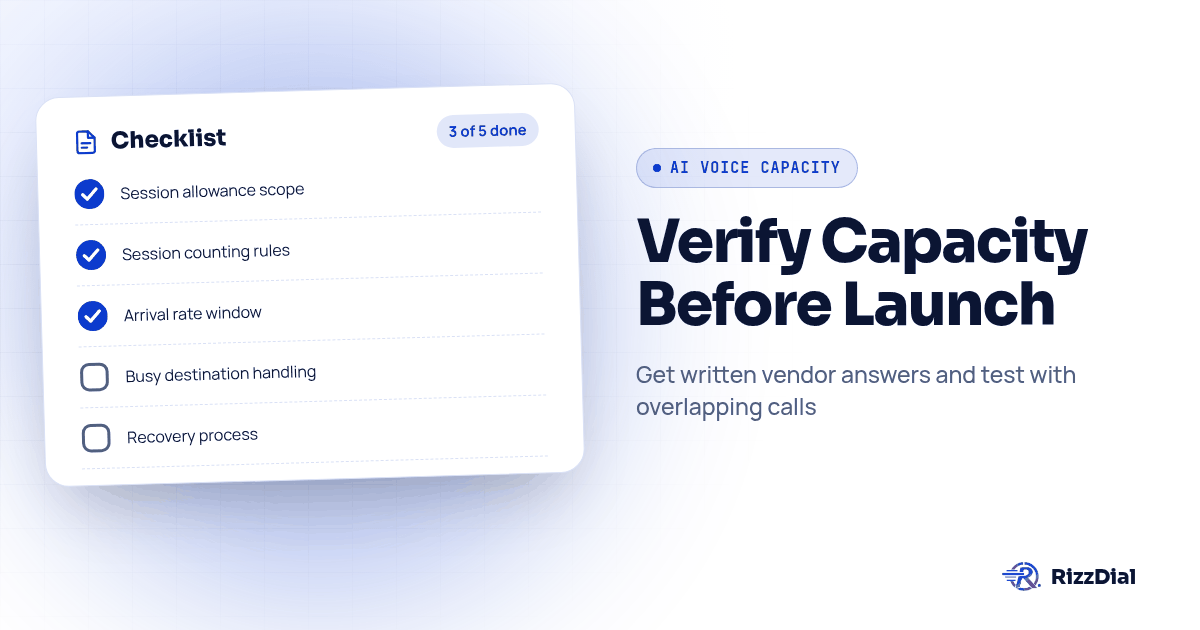
An agency should verify AI voice call capacity through written vendor answers for the client's exact setup, followed by a small, vendor-agreed check of overlapping calls, busy destinations, overflow and recovery. Separate active sessions from call arrival rate, inbound routing and outbound campaign capacity. Record what callers hear and what the system logs before making a client commitment.
Key Takeaways
- Ask what each limit measures and which account, agent or phone number it covers.
- Agree on expected caller outcomes before placing test calls.
- Keep the test small and within approved conditions; unresolved behavior stays unverified.
Which capacity questions need separate answers?
Treat capacity as a set of questions about different parts of the call path. A statement such as “supports concurrent calling” leaves too much undefined for a reseller's client agreement.
Use these distinctions in your evaluation worksheet:
| Area | What you need to establish | Question to send the vendor |
|---|---|---|
| Simultaneous sessions | Conversations active at the same moment | What active-session allowance applies to this setup? |
| Call arrival rate | Incoming attempts within a time window | How is arrival rate measured and enforced? |
| Inbound routing | Where an incoming call goes | Which route applies when the intended destination cannot answer? |
| Outbound campaign capacity | Calls initiated by campaigns or workflows | What outbound restrictions apply, and are any resources shared with inbound calls? |
HighLevel's inbound call rate documentation distinguishes arrival rate from concurrency. It does not publish a separate phone-based Voice AI concurrent-session ceiling there, and it distinguishes inbound phone traffic from browser voice and outbound calling. Those are HighLevel documentation boundaries, not confirmed RizzDial limits.
For a hypothetical service client, brief inquiries and longer booking conversations could produce different patterns of overlapping sessions. Ask the client for actual call records showing arrival times and durations. Use those records to describe the expected pattern to the vendor, without turning a rough forecast into a promised capacity.
Keep the AI dialer evaluation focused on outbound requirements when discussing campaigns. Add inbound acceptance criteria separately if the client also expects the business line to answer incoming calls.
What should an agency put in its vendor questionnaire?
Request answers tied to the account and configuration being proposed. Save the response with its date, author and supporting documentation so another agency employee can explain the commitment later.
Send this questionnaire before agreeing to client-facing capacity language:
- Scope: Does the session allowance apply per phone number, agent, client account or agency? Is any allowance shared across clients?
- Session counting: When does a session start and stop counting? How are ringing, hold, transfer and disconnected sessions treated?
- Arrival rate: What time window applies? Are limits evaluated by originating number, destination number or another scope?
- Resource sharing: Can outbound activity affect inbound answering? If so, what supported setting protects the agreed inbound service?
- Busy behavior: What happens when the AI destination or the human transfer destination cannot accept a call?
- Overflow: Is the configured outcome a queue, alternate destination, voicemail or rejection? Which choices are actually supported here?
- Caller experience: What greeting, hold message or failure message will the caller hear on each path?
- Visibility: Which records show the attempted route, final destination and reason a call was not answered?
- Recovery: Who can restore service, what evidence should the agency provide, and how is recovery confirmed?
- Change control: Which account or routing changes require the agency to reconfirm these answers?
Ask the vendor to label each answer as documented behavior, an account-specific confirmation or an unresolved item. A feature description alone should not close an account-specific question.
Include this worksheet in the broader white-label AI voice agent evaluation. It gives the reseller something concrete to carry from a sales conversation into client onboarding.
How can routing make a capacity problem look different?
Verify the intended call path before interpreting an unanswered call as a capacity failure. Sketch the path from the dialed business number to the answering destination, then add its fallback destination and schedule.
HighLevel's working-hours guide describes agent-level availability using all-hours or custom schedules. When evaluating native HighLevel Voice AI, check that schedule alongside the client's intended service hours. For another provider, ask for its equivalent availability rules.
Capture the dialed number, assigned agent, routing mode, applicable timezone, intended human recipients and fallback destination. Have the vendor confirm any unclear field. Do not assume that an agency template and the client's deployed configuration match.
A useful diagnostic question is: did the call reach the expected component? If the call record shows a different destination, investigate assignment and routing first. If the correct destination received the attempt but could not accept it, request the relevant status or error evidence.
Also distinguish an AI agent being unavailable from a human transfer recipient being busy. The client needs an agreed outcome for each, even when both eventually send the caller to the same fallback.
What should a small agreed test plan include?
Use a bounded acceptance check that the vendor and client approve in advance. Its purpose is to observe specified behavior under ordinary conditions, not discover a breaking point.
Write down the test environment, participating staff, test numbers, maximum overlapping calls, spacing between attempts and allowed call duration. Obtain the vendor's agreement to those values. Use staff participants and test records, and keep unrelated workflows from acting on the test contacts.
Assign an observer to compare caller notes with system records. Name the person who can stop the exercise and restore the previous configuration. Stop immediately if an unexpected rejection, service warning or effect on unrelated calls appears.
Use this proposed scenario sheet, adapting each row to supported behavior:
| Scenario | Agreed setup | Evidence required |
|---|---|---|
| Normal answer | Staff caller reaches the intended business line | Correct greeting, destination and call record |
| Overlapping conversations | Approved participants call while another test conversation remains active | Separate conversations, correct records and no mixed caller details |
| Busy transfer destination | An agreed test recipient is unavailable | Caller hears the approved explanation and reaches the specified fallback |
| Overflow path | Vendor demonstrates a supported overflow condition in an isolated setup | Expected alternate outcome and a record explaining the route |
| Recovery | Vendor restores the normal test configuration | A fresh ordinary call follows the intended route again |
Agree on the exact caller-facing wording where it matters. “Handled correctly” is too vague: specify whether the caller should wait, leave a message, reach a person or receive another supported outcome.
For overflow, ask whether the provider can demonstrate the condition through a supported test configuration. Do not generate excessive traffic to force it. If no safe demonstration exists, retain the written specification and mark the observed outcome as unverified.
Attach the scenario sheet to the GoHighLevel AI calling pilot checklist. This keeps the capacity check connected to the wider launch decision without making a small demonstration stand in for every operating condition.
How should the agency judge busy, overflow and recovery results?
Judge each scenario against the agreed outcome, using caller observations and system evidence together. An answered call alone does not establish that the intended route worked.
For every attempt, record the scenario name, timestamp and timezone, caller identifier, call identifier, expected destination, actual destination, audible result and final status. Note any missing record as an unresolved evidence gap.
Use clear verdicts:
- Pass: The expected outcome occurred and the available records support it.
- Fail: The observed outcome differed from the agreed outcome.
- Unverified: The scenario was not demonstrated or the evidence was insufficient.
Recovery needs its own acceptance result. Ask who owns restoration if a restriction occurs, and which ordinary call will confirm service afterward. HighLevel documents that rate violations can block calls and repeated violations can escalate to an account restriction requiring support involvement. This is another reason to stay inside agreed test conditions. HighLevel inbound rate guidance.
After a failure, stop and preserve the evidence. Request a specific explanation and correction before repeating the affected scenario. Do not repeatedly redial in an attempt to make an unexplained problem disappear.
What can a reseller responsibly promise after the check?
Promise only the behavior covered by the written confirmation and observed results. State which configuration was checked, what remains unverified and which changes require another review.
A proposed handover statement could read: “The agreed caller paths were checked using the attached setup and scenarios. Capacity commitments follow the vendor's written account confirmation. Untested conditions remain outside this acceptance record.” Adjust that wording to the actual evidence rather than treating it as a performance guarantee.
For service businesses that need help assigning ownership across call handling and sales follow-up, MetaTech's managed services provide a relevant implementation discussion. Bring the route map and unresolved questionnaire items to that conversation.
Before approving the client's rollout, send the vendor the completed worksheet and request confirmation of the remaining gaps.
What AI voice call capacity FAQ should agencies review?
Does a calls-per-minute limit prove simultaneous call capacity?
No. Call arrival rate measures incoming attempts over a time window, while concurrency measures active sessions. Request separate written answers for both, including the scope of each limit.
Should an agency promise unlimited simultaneous calls?
No. An unpublished ceiling is an unanswered capacity question. Base client commitments on written vendor confirmation for the actual account and routing setup.
Can a browser voice demo validate the client's phone line?
Use the actual assigned phone route for acceptance. A browser demonstration does not establish what an external caller hears when the business number is busy or unavailable.
What if the vendor cannot demonstrate overflow safely?
Mark overflow as unverified. Request a supported demonstration, written behavior specification and recovery procedure before promising that outcome to the client.
For the next step in this workflow, review the ai voice agent workflow guide and discuss implementation through the AI calling integrations.
About RizzDial
RizzDial is the AI outbound sales workspace for teams on GoHighLevel. Power dialing, AI voice agents, SMS automation, and CRM workflows in one platform. Book a demo.