GoHighLevel
GoHighLevel Missed Call Text Back vs AI Voice
A decision guide for GoHighLevel agencies comparing missed call text back and AI voice agents, with decision rules, staffing needs, and measurement.
By James Hill ·
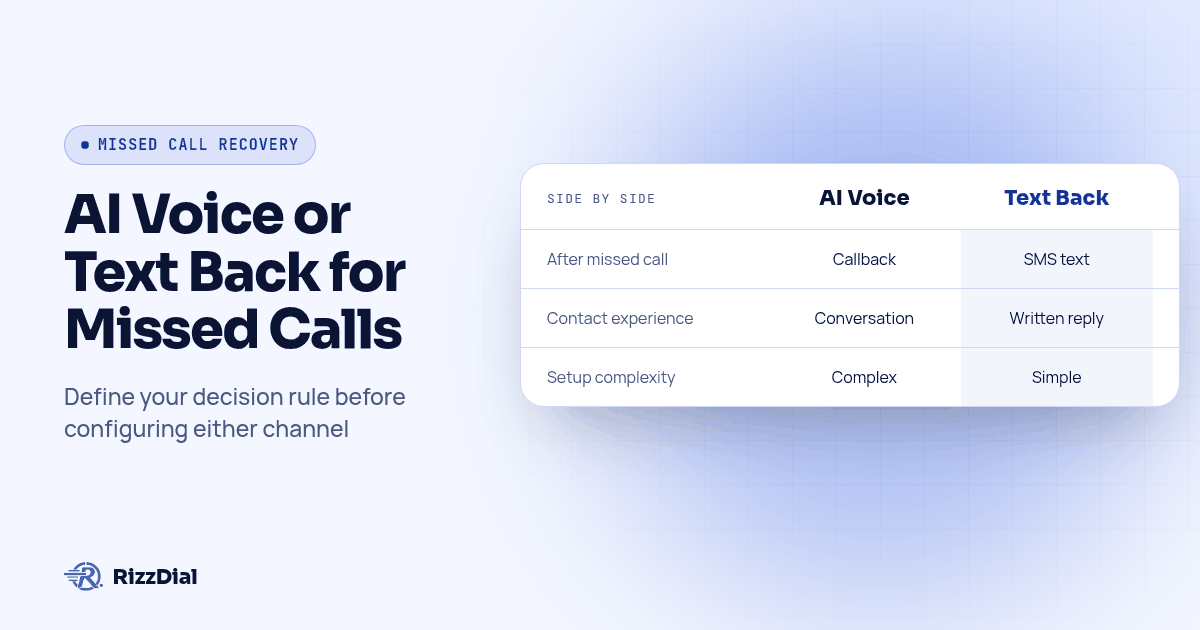
Use an AI voice agent when a missed caller needs a spoken qualification conversation, and missed call text back when a short acknowledgment plus staff replies can handle the request. GoHighLevel agencies can combine them, but should define which channel acts first and what stops further follow-up. Choose around the client's caller needs, staff availability, and verified workflow behavior.
Should an agency lead with AI voice or missed call text back?
Start with RizzDial AI voice when the client needs spoken qualification before staff take over. For example, an estimate request may need a conversation about the service needed and the caller's availability. A text acknowledgment alone does not collect that information. RizzDial provides AI voice agent calling and a built-in CRM, and also connects to a client's existing CRM, including GoHighLevel, through integrations, an API, and webhooks. Whether a missed call should trigger an AI voice callback, and what that callback is allowed to say and do, is a workflow your agency configures and confirms per client. It is a requirement to build and test, not a setting that arrives already switched on.
| Dimension | AI voice agent (RizzDial) | Native missed call text back (GoHighLevel) |
|---|---|---|
| What happens after a miss | An outbound callback, once the agency has built and connected that workflow | A written acknowledgment after an unanswered call |
| Contact experience | A spoken conversation; the contact can ask questions before a human is looped in | A written message; the contact must read and reply to keep things moving |
| Setup effort | Calling connection, CRM mapping, and trigger condition, configured per client | Message wording, reply ownership, and sending setup |
| Good fit for | Requests needing spoken qualification before staff follow-up | Requests that staff can resolve through written replies |
| Ongoing staff review | Needed, to confirm call outcomes and catch contacts who need a human | Needed, to handle replies and anyone who never responds |
Use the GoHighLevel integration steps to see how the calling and CRM pieces connect, and review RizzDial integrations if the client runs a CRM outside GoHighLevel.
How does GoHighLevel's missed call text back work?
HighLevel sends an SMS after a missed inbound call. Its documentation says repeated missed calls can generate repeated texts and recommends customizing a workflow recipe to control repetition. Setup is under Settings > Phone System > Voice > Voicemail & Missed Call Text Back. The sender may differ from the dialed number when another eligible sending number is needed. See HighLevel's missed call text back documentation.
Decide what the message should accomplish. An illustrative repair-business message could say: "Thanks for calling Cedar Repairs. We missed you. What service do you need, and when can our team reach you?" Use the client's real business name and a response expectation staff can meet.
Why are inbound answering and an outbound callback different?
An inbound AI agent answers while the caller is still on the line. An outbound callback starts a new call after the original attempt. Choose which job you are buying before comparing vendors or configuring a trigger.
HighLevel says answered calls do not trigger its native missed call text back. In a hypothetical plumbing workflow where an AI agent answers after hours, inspect the actual call record before assuming missed-call recovery will run. Follow-up for an unresolved answered conversation needs its own rule.
For custom routing, HighLevel's Call Details documentation describes filters for direction, status, phone number, number pool, and custom disposition. Status and disposition are separate fields. Use the logged values from your test calls to select the intended event; confirm how an external calling connection supplies those values.
What does a combined workflow look like?
A combined approach gives each channel a specific job. In a hypothetical garage door repair workflow, an eligible missed caller enters an AI callback sequence. If that attempt does not reach them, a custom follow-up workflow can send a written invitation to reply. If they request staff help, the next action belongs to a named person.
Do not leave an independent immediate text-back automation running and expect it to wait for the voice result. For this proposed sequence, have the implementer replace or disable competing sends and demonstrate the outcome check that controls the next message. Confirm the supported fields and actions in the connection, then use the GoHighLevel AI calling pilot checklist to verify the complete handoff. This is a design to test, not a default RizzDial or HighLevel sequence.
Some agencies also want a written channel on iMessage instead of SMS for extra context. RizzDial's built-in iMessage runs through Beam's iMessage follow-up, an additional, optional channel, not a replacement for GoHighLevel's native missed call text back; confirm it with the client before adding it to any workflow. Agencies packaging this as a standing offer can review the white label AI voice agent guide for how to structure it.
What decision rule should an agency actually use with a client?
Write the rule down before building anything, using the client's own situation rather than a general default:
- If a request needs qualification that is awkward over text, consider AI voice first, provided the caller is eligible for a callback.
- If staff can resolve most requests through written replies, start with text back. Paid advertising alone is not a reason to choose voice.
- If the client cannot staff timely review of call outcomes, hold off on a voice callback until that ownership question is answered.
- Confirm which contacts the client has approved for each type of follow-up before any workflow goes live.
What staffing does each approach require?
Text back mostly needs someone who monitors incoming replies and escalates the ones that need a person. An AI voice callback needs someone who reviews call outcomes, decides the next action for contacts the agent could not fully resolve, and handles exceptions such as a contact who asks to stop being called. A combined workflow needs both roles, plus someone who periodically reconciles the two systems' logs to see which channel actually reached a given contact. Name these owners in writing before launch.
How do you prevent duplicate follow-up?
Give each recovery attempt one owner and a clear stopping condition. Ask the implementer to demonstrate this sequence with controlled contacts:
- Record the caller, the originating event, and the recovery action already in progress.
- Check for an existing conversation, staff callback, or completed appointment before adding another attempt.
- Record the outcome and select either a staff task, a written follow-up, or no further action.
- Stop pending outreach when the client-approved contact rules require it.
- Repeat the test while the same caller rings again, replies by text, or reaches a staff member.
HighLevel documents that multiple workflows can independently qualify on one call. Review enrollment history, execution logs, and re-entry settings when testing overlapping sequences. A tag alone is not proof that duplicate actions have been prevented; ask to see the resulting calls and messages.
How should you compare results from the two approaches?
Start with the client's own contact records. After an agreed period, pull the contacts that came through as missed calls and confirm, for each one, what channel reached them, what the disposition was, and whether staff located the result and took the next action. Compare that against the acceptance criteria you agreed with the client before launch, not against outside numbers, and treat the client's own history in their CRM as the baseline for whether the combined approach is doing better than whichever single method they used before.
What are common missed-call recovery questions (FAQ)?
Does adding an AI voice agent replace missed call text back?
Not automatically. You can propose both, with written rules deciding which channel acts first. Give each channel a defined role and stop further outreach when the request is resolved.
Can we test this before rolling it out to a client's full number pool?
Yes. Run a limited pilot on numbers and contacts you control first, confirm entry conditions, timing, and results, and expand once the workflow behaves as agreed.
Does the AI voice agent book appointments automatically?
Do not assume it does. Confirm the exact CRM connection, fields, and actions your setup supports during configuration, and treat appointment creation as a separate item to verify rather than an assumed feature.
What if the client's CRM is not GoHighLevel?
RizzDial includes a built-in CRM and also connects to GoHighLevel, HubSpot, Salesforce, and other systems through integrations, an API, and webhooks. Confirm the exact fields and actions your missed call workflow needs in that CRM before including it in the client's service scope.
Ready to compare missed call recovery options for your own clients?
Book a demo and bring a specific client's call volume, current missed call handling, and the outcomes you want to measure. Use the meeting to work out whether AI voice, text back, or a combined workflow fits, and what needs confirming before it goes live.
James Hill, Founder, RizzDial
For the next step in this workflow, review the gohighlevel voice ai guide and discuss implementation through the GoHighLevel calling setup.
About RizzDial
RizzDial is the AI outbound sales workspace for teams on GoHighLevel. Power dialing, AI voice agents, SMS automation, and CRM workflows in one platform. Book a demo.