GoHighLevel
When Voice AI Passes a Test but Ignores the API Reply
Trace a GoHighLevel Voice AI custom action response from caller input to spoken answer, with a service-status test and failure diagnostic table.
By James Hill, Founder, RizzDial ·
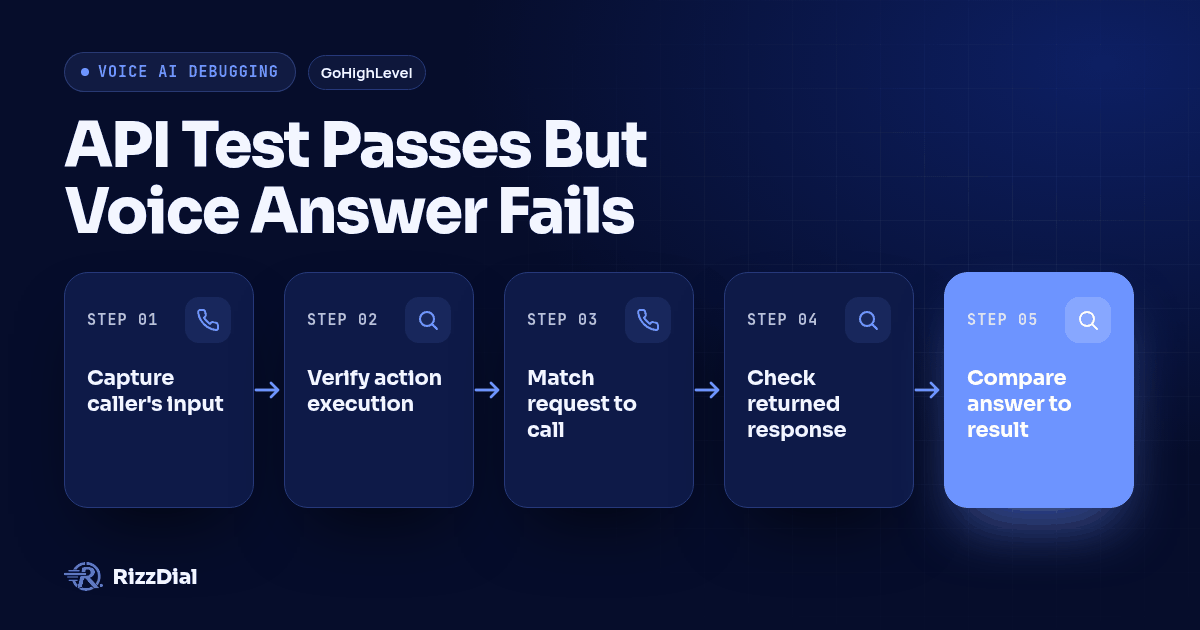
A passing webhook test does not, by itself, prove that a GoHighLevel Voice AI custom action response reached the live conversation and shaped the spoken answer. To find the failure, trace the caller's input, action invocation, outgoing request, returned response, audible answer and saved result. The cause remains unconfirmed until that evidence identifies where the expected information disappeared or changed.
Key takeaways
- Keep endpoint success, live response handling and spoken accuracy as separate acceptance checks.
- Use a distinctive service-status answer that the agent cannot simply repeat from its prompt.
- Require evidence for the supported response contract before promising a client integration.
Why can a passing action test leave the live answer unresolved?
The test and the call provide different evidence. HighLevel's Voice AI Custom Actions documentation describes a testing tool for inspecting requests and raw responses. It also describes actions that run during a conversation. Your acceptance test needs to connect those activities to the words the caller actually hears.
This question comes directly from an agency development problem. In a public GoHighLevel discussion, the author reports a working endpoint and successful built-in test, while the live agent fails to speak the returned value. That is demand evidence for this troubleshooting question, not a confirmed platform defect or a proven diagnosis.
A related user report describes speech that conflicts with the reported webhook result. These accounts justify testing the response handoff before selling a client agent. They do not establish how frequently the problem occurs or which change resolves it.
Treat the gap as a set of hypotheses: the live action may receive different inputs, return different data, expose insufficient evidence of response handling, or produce speech that fails to reflect the result. Keep each hypothesis open until the relevant checkpoint supports or excludes it.
What should an agency prepare before testing the response?
Use a test account and a harmless, read-only service-status lookup. Have an operator available who can inspect the endpoint's requests and responses, plus someone who can place the controlled call and review the recording where available. Keep credentials and real customer information out of the review packet.
The fictional service in this procedure is the Cedar document portal. Its expected test response is: “Cedar document uploads are paused. Viewing existing documents is available.” This is an invented fixture for a test you will run, not a report about an actual service or an experiment conducted for this article.
Prepare an alternate response that changes the meaning: uploads available, document viewing paused. Keep the returned status out of the agent prompt. Otherwise, correct speech could reflect information already supplied to the agent rather than the current lookup.
Write the acceptance rule before the call: the agent must describe the correct service and preserve the distinction between uploads and viewing. If the lookup cannot be verified, the agent should say it cannot confirm the current status. Do not require exact wording unless your client specifically needs verbatim delivery.
How do you run the numbered evidence-chain test?
Follow this original procedure to assemble evidence for the same call. It is a proposed diagnostic method, not a verified fix. When a checkpoint lacks evidence, mark it unknown and investigate there before making claims about later stages.
Capture the caller's exact input
Start with a neutral question: “What is the status of the Cedar document portal?” Record what was said and compare it with the transcript if one is available. Include any clarification the agent asks for before it attempts the lookup.
Then try a question that contains an assumption: “Cedar uploads are working again, right?” The returned status should remain the authority in your acceptance rule. This variation checks whether the agent preserves the lookup's meaning when the caller suggests a different answer.
Keep the service label consistent in the initial test. A later test can cover ambiguous names or corrections. Mixing those problems into the first run makes it harder to tell whether you are investigating input collection or response handling.
Establish which action actually ran
Record the agent, account, action name, saved configuration and prompt version used for the call. Preserve the configured trigger conditions and parameter descriptions. Compare the live setup with the setup used for the passing action test.
Look for evidence of invocation in the available call or action records and in the receiver's logs. An introductory phrase such as “I'll check that” is useful timing context, but should not be your sole proof that the intended request executed.
If the receiver shows no matching request, investigate invocation and routing before modifying the response body. If the platform does not expose the action event you need, record that visibility limit. Do not silently replace missing evidence with an assumption that the action ran.
Match the outgoing request to that call
Inspect the service name and other nonsecret inputs actually received by the endpoint. Compare them with the caller's question and the built-in test inputs. Save the method, destination path, redacted headers, request body and receiver timestamp.
HighLevel's current custom-action guide specifies POST and parameters collected from the conversation. Verify the configuration supported in your account rather than copying a different method from a forum example.
Use an available call identifier, or a test reference where the supported request configuration permits one, to connect the records. If neither is available, isolate the test and document how timestamps establish the match. Never attribute an unrelated successful request to the call merely because it occurred nearby.
Preserve the exact returned response
Capture what the endpoint sent back on this invocation: status, content type, body and completion time. Distinguish the response returned to the voice action from a successful internal lookup performed by middleware. Your service finding the answer does not show what it delivered upstream.
Compare the raw body with the response contract documented for your actual action configuration. Check whether the required information is present, whether the body parses as the declared format and whether nesting matches the supported setup.
Do not rename fields repeatedly and call the first promising outcome a solution. Ask which output selection or mapping, if any, your account supports. Save that configuration alongside the response. A field displayed by the testing interface should not be treated as proof of a universally usable prompt variable.
Compare the audible answer with the returned meaning
Review the recording alongside the request and response timeline. Mark when the caller asked, when the endpoint returned and when the agent delivered its answer. If only a transcript is available, state that audible delivery remains unchecked.
For the Cedar fixture, listen for both facts: uploads paused and viewing available. “The portal is down” loses the distinction. “Uploads are available” contradicts it. A fluent sentence is not enough to satisfy the acceptance rule.
Change only the endpoint's fixture to the alternate status and repeat the call with the same question and prompt. Look for the spoken answer to change accordingly. If it does not, preserve both runs as evidence. That observation narrows the investigation without proving whether the cause is configuration, response delivery or generation.
Reconcile the saved result with the call
Inspect the record your integration is supposed to save. Keep the lookup result, spoken answer and follow-up status distinguishable in your review notes. An unavailable lookup should remain unknown rather than becoming a confirmed service outage.
Verify that the saved evidence belongs to the same call and client account. If your design saves only a summary, establish what information may be lost and whether another record is needed for troubleshooting.
Use the post-call webhook and CRM guide to plan the downstream record check. That is a separate stage from delivering information during a live conversation. A correct saved result cannot retroactively establish that the caller heard the right answer.
What do empty, delayed, malformed and valid responses tell you?
Run these cases deliberately against the test fixture. The table defines observations and review decisions, not documented default behavior. HighLevel says fallback behavior can be configured for missing data, failures and timeouts in its custom-action guidance; verify what your specific configuration does aloud.
| Response condition | Evidence to retain | What to inspect next | Proposed acceptance rule |
|---|---|---|---|
| Empty response | Raw body and the live action's available result record | Whether absence of data reaches the intended fallback | The agent says the current status cannot be confirmed |
| Delayed response | Request start, response completion and spoken-answer sequence | Whether the answer began before usable data arrived | The agent follows the agreed waiting or fallback behavior without inventing a status |
| Malformed response | Content type, raw body and any parsing or action error | Whether the payload matches the supported response contract | Unusable data produces an honest fallback, with evidence available for review |
| Valid response ignored | Correct service input, usable body and conflicting speech | Whether the result reached the action and how instructions handle it | Acceptance stays pending until speech reflects the result |
| Valid response used | Matching request, response, audible answer and saved record | Whether the alternate fixture changes the answer appropriately | Approve only the demonstrated configuration and scope |
For delay testing, agree on an acceptable caller experience with the client and record the configured limits where available. Do not import an assumed timeout or retry policy. Change the response delay in the controlled test without adding unrelated prompt changes.
For malformed data, separate invalid formatting from valid formatting that lacks required information. Those are different observations even when the desired caller response is the same. Keep the fixture small enough that a reviewer can see the defect without searching a large payload.
When should you change the prompt or escalate the integration?
Change the prompt when you have evidence that the relevant result is available and the instructions need clarification. A proposed instruction can require the agent to use the returned service status, preserve its qualifications and acknowledge an unverified lookup. Test that instruction against both normal and failure cases.
If the result's availability remains unknown, ask for the supported contract before adding more prompt syntax. The HighLevel documentation does not provide a universal response-field mapping that establishes how every returned key becomes a spoken answer. This article therefore does not prescribe one.
Prepare a compact escalation packet: the minimal service-status question, saved configuration, redacted request and response, relevant timeline, actual speech and expected meaning. Include the alternate-fixture run if available. State the first checkpoint that lacks evidence rather than reporting only that “the AI ignored it.”
Keep later messaging as its own acceptance step. If a verified result will also be sent through Beam's GoHighLevel iMessage connection, require the text to preserve the same status and uncertainty. The presence of a follow-up message should not turn an unresolved lookup into a confirmed answer.
What should resellers ask to see before accepting a client agent?
Ask the provider to demonstrate your own service-status fixture through the complete evidence chain. Request the supported response shape, available logs, error behavior and saved-result handling. Record what was demonstrated and what still requires development or confirmation.
When evaluating RizzDial, bring those requirements to the integrations conversation. Ask the team to show live tool-result handling, fallback speech and downstream record consistency in the proposed setup. Treat each as a demonstration requirement rather than assuming a feature promise or a fix for another platform's reported behavior.
Use the GoHighLevel agency integration page to frame the CRM side of that discussion. Establish which system owns the lookup, which system produces speech and where the client reviews the outcome. Approval should name the tested configuration and unresolved limits so a reseller can describe the service accurately.
What FAQ answers help with custom-action responses?
Does a successful webhook test prove the live agent used the response?
No. For acceptance, match the live request and response to the caller's question, then compare the spoken answer with the returned information. A passing configuration test alone does not supply that evidence.
Which response field should the agent read?
Do not assume a universal field name. Confirm the response contract and any output selection supported by the action in your account, then demonstrate that a distinctive returned value reaches the live conversation.
Can changing the prompt solve the problem?
A prompt change is a testable hypothesis when the action result is available but the spoken answer is wrong. First establish that the correct request ran and a usable response reached the live action. Change one variable and repeat the same test.
Should the saved call summary count as proof?
Treat the saved summary as a separate checkpoint. Compare it with the raw response and the audible answer. A correct record does not establish that the caller heard the correct information, and correct speech does not establish that the record was saved correctly.
For the next step in this workflow, review the gohighlevel voice ai guide and discuss implementation through the GoHighLevel calling setup.
How can RizzDial help with your calling workflow?
RizzDial is the AI outbound sales workspace for teams on GoHighLevel. Power dialing, AI voice agents, SMS automation, and CRM workflows in one platform. Book a demo.