Agency Growth
IVR vs AI Voice Agent: Do You Still Need a Menu?
Where a basic IVR still works, where it breaks down for agency clients, and how to test whether an AI voice agent should replace the phone menu.
By James Hill, Founder, RizzDial ·
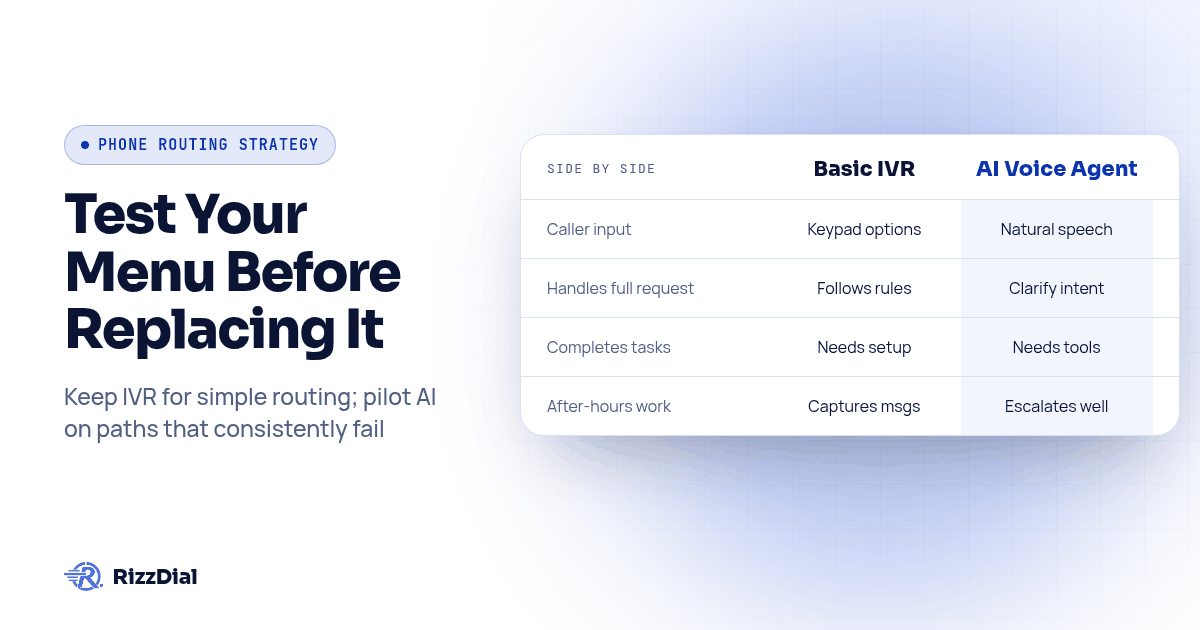
A basic IVR still makes sense for simple routing and after-hours message capture. An AI voice agent can replace selected menu paths when callers need to explain a request, book an appointment, or get an answer, provided the required integrations and fallback work. Test those paths alongside the existing menu before moving the main number.
For a GoHighLevel reseller, the decision is task by task. A client may need a dependable sales queue and a conversational appointment flow on the same line. This guide compares those jobs and gives you a numbered test for deciding which paths to keep, replace, or combine. We make RizzDial, so this is our evaluation approach, with checks you can also apply to other platforms.
What Does an IVR Actually Do?
A basic interactive voice response system plays a prompt, accepts keypad input or supported speech, and follows configured rules to route the call or provide information. Take a billing enquiry. The menu sends it to accounts. A new sales enquiry takes a different branch. Its behavior depends on the branches and connections someone has built.
Do not assume every IVR is limited to recordings and transfers.
Twilio's Gather documentation shows that a phone flow can collect speech, digits, or both and send input to an application. What that application does next depends on its implementation. Existing self-service workflows may already handle useful tasks.
The comparison here is a basic menu versus a conversational agent, not a claim that every older phone system lacks integrations. Inventory the client's current setup before replacing it. Otherwise, an agency can accidentally remove a working account lookup or routing rule while trying to improve the greeting.
Where Does a Traditional IVR Still Make Sense?
Keep the IVR when callers can reliably identify the right destination from a short, stable menu. Billing versus sales versus support is a reasonable example. A direct route to a staffed team can also be useful when the business wants a person to handle a sensitive request from the start.
After-hours message capture is another fit when the caller only needs to leave a name, callback number, and reason for calling. Someone still needs to own the inbox and return the call. A recording that gathers information but sends it to an unattended mailbox does not solve the operational problem.
RingCentral's comparison of voice agents and IVR identifies stable routing needs as a reason to retain a menu. Treat that as a scoping question: does the caller need a destination, or does the caller need a task completed during the call?
A short menu can be easier for a client to review because each option has a defined destination. It still needs testing after staff changes, new opening hours, and routing updates. Predictable logic does not protect a phone line from an incorrect extension or an empty queue.
Where Does an IVR Break Down for an Agency's Clients?
Look for the moment a caller's situation no longer fits the available branches. An existing customer who wants to move an appointment and ask about a new service may not know which department to choose. The menu can still route the call, but the routing may add work without resolving the request.
Use three failure categories in the client's review. First, menu mismatch: the caller chooses an unsuitable option, returns to the start, or needs another transfer. Second, missing context: the receiving person cannot see what the caller has already supplied. Third, an after-hours dead end: the caller leaves a message, but the business has no reliable process for the next action.
These are conditions to look for in actual call records, not claims that every menu causes abandonment. Do not count every transfer as a failure.
A correct transfer to the requested person may be the intended result, while a seemingly completed automated conversation may still leave the customer waiting for help.
For a GoHighLevel agency, the client's own missed-call report and staff feedback provide the starting evidence. Our auto calling software guide covers which dialing category fits a team. The menu problem and the dialer problem are separate decisions: increasing outbound activity does not repair an inbound routing mistake.
What Does an AI Voice Agent Change About the Phone Menu?
An AI voice agent can ask follow-up questions and work with a caller's description instead of requiring a numbered choice. With the right tools and permissions, it can also attempt an action such as finding a booking slot or capturing a service request. Fin's IVR and voice agent comparison describes this shift toward conversational task completion.
That capability is conditional.
The agent needs current business information, access to the right system, and a clear boundary for requests it cannot handle. A natural sounding conversation is not proof that the calendar changed or that the receiving rep got the notes. Check the destination system. Did the action happen?
For example, test a caller who changes their mind halfway through a booking request. The agent should confirm the final choice and avoid creating two appointments. If the calendar is unavailable, it should explain that limitation and follow the approved fallback instead of announcing a booking it cannot verify.
Also separate answering a menu from navigating someone else's menu. Our keypad navigation test explains how to check whether an AI calling agent sends the digits a destination expects. Understanding speech and sending keypad tones are different capabilities, and a successful demonstration of one does not establish the other.
How Do IVR and AI Voice Agents Compare, Feature by Feature?
Use this table to scope a basic routing menu against a configured conversational agent. Advanced IVR implementations can overlap with the right column, and AI capabilities still need acceptance testing.
| What the system does | Basic IVR menu | AI voice agent to evaluate |
|---|---|---|
| Caller input | Keypad options or configured speech input | Conversational speech within supported languages |
| Handles a full request | Follows the available branches | Can clarify intent across several turns |
| Collects context before transfer | Depends on input capture and integrations | Can summarize context if handoff is configured |
| Completes a task | Requires an implemented self-service flow | Requires tools, permissions, and verified results |
| Handles an unexpected request | Follows the configured fallback | Should clarify or escalate outside its scope |
| Books or reschedules | Requires a scheduling connection | Requires a scheduling connection and confirmation |
| Logs the call reason | Branch data or configured application records | Structured outcome if CRM mapping is configured |
| Changes a routing option | Update prompts and routing rules | Update instructions, tools, and regression tests |
| Works after hours | Routes or captures messages as configured | Can handle approved tasks with a fallback |
| Supports another language | Requires supported prompts or recognition | Requires supported speech and language testing |
Use the table row by row with the client.
It is a list of dependencies to verify, not a verdict that one category wins everything. If a vendor cannot demonstrate a row using the client's workflow, leave that capability out of the promised scope.
Should You Keep the IVR, Replace It, or Run Both?
| Situation | Recommendation |
|---|---|
| Three or four requests cover almost all call volume, none need a real answer | Keep the IVR |
| Callers frequently explain a situation that does not match any menu option | Pilot an AI voice agent on that path |
| After-hours calls just need a name and callback number | Keep the IVR for that window |
| After-hours calls need booking, rescheduling, or an actual answer | Pilot a configured AI voice agent |
| The client's missed-call or abandonment numbers are rising | Run a controlled pilot and investigate the cause |
| The menu rarely changes and nobody has complained in a year | Keep it and schedule a periodic review |
Running both at once is the underrated option, and it is usually the right first move for a client who is nervous about changing a number their business has used for years. Point the AI voice agent at the paths that are actually failing, keep the IVR on the paths that are not, and let the client's own call data decide which column grows over time.
How Should You Test Whether a Client's IVR Has Hit Its Ceiling?
Run this test before you tell a client to replace anything. Use a week as an initial observation window, not a guaranteed rollout deadline. Extend it if call volume is too low or the sample misses important request types.
- Pull 30 days of the client's call logs and tag each call by the menu path it took and whether it reached the destination the caller actually needed.
- Count the detours, meaning any call that looped back to the main menu, got transferred twice, or landed on voicemail after business hours.
- Calculate the detour rate as detours divided by total calls for that period. Count each call only once even if it has several detours. Review why each detour happened before attributing it to the menu.
- Spin up an AI voice agent on a second number or a spare extension, configured to handle only the tasks the IVR currently mishandles.
- Run both lines in parallel for one full week, after scripted tests pass. Split comparable call types and hours between them, record differences in caller mix, and keep a quick rollback available.
- Compare detour rate, time to resolution, and after-hours capture between the two lines, not just whether the AI agent "worked," using a written definition of success for each task. A callback request can count as success when message capture was the agreed job.
- Decide path by path, not number by number: move the tasks the AI agent clearly resolved better, and leave the rest on the IVR until it earns a second look.
What Does RizzDial Change If You Replace the Menu?
If you run ads or have a sales team, RizzDial is our pick.
For a menu replacement, start with the specific inbound paths in the test above, then assess how follow-up fits the wider sales workflow. RizzDial has its own speech-to-speech voice engine built for low latency and a direct GoHighLevel integration.
For fresh form fills and outbound follow-up, RizzDial provides direct carrier access to AT&T, Verizon and T-Mobile, number rotation, reputation monitoring, and iMessage follow-up. RizzDial's proprietary voicemail detection runs in 0.66 milliseconds and is built to connect reps to live humans faster. That product figure is not a measurement of total conversation latency or a guarantee that an inbound transfer reaches a person.
Sales teams can use power, predictive and parallel dialing alongside AI voice agents. Those options matter when the inbound enquiry turns into a follow-up task for a rep. During the pilot, verify which contact receives the call outcome, which workflow runs next, and how duplicate actions are prevented. Test the integration. The client's configuration matters.
Agencies can bring their own LLM or Vapi account and use MCP and OpenAPI for supported integrations. RizzDial also supports white label resale. Confirm the required actions, permissions and client branding in your actual workspace before promising a particular setup. These product capabilities do not prove that every existing phone system can be replaced without routing work.
If the client's missed calls also need text follow-up, plan the number and messaging workflow alongside the voice test. Beam's guide to choosing a business phone number explains number types relevant to that decision. Verify the selected number's messaging setup before including texts in the pilot.
Bring your menu map and acceptance checklist to our alternatives page when comparing platforms. Use the dialer software guide if the underlying problem is outbound volume rather than the inbound menu. Compare the work each product must actually perform, including handoffs and failed actions, before choosing a replacement.
What FAQs Do Agencies Ask About Replacing an IVR With an AI Voice Agent?
What does it cost to replace an IVR with an AI voice agent on RizzDial?
RizzDial's AI talk time runs from 6 to 20 cents a minute, billed for talk time only. RizzDial also has flexible seat based options. Scope the account, integrations and migration work for the client's requirements instead of treating the AI minute range as the total cost of replacing a phone system.
How long does it take to replace a client's phone menu with an AI voice agent?
Use a week as an initial pilot window, not a promised implementation timeline. First map the existing menu, build the approved paths and complete scripted tests. Extend the observation period when call volume is low or important cases remain untested. Move traffic only after the client accepts the results.
Does an AI voice agent still need to work with the client's existing phone system and GoHighLevel?
Yes, if those systems remain part of the workflow. Verify incoming routing, live transfers, unavailable destinations, and the contact fields the agent must update. RizzDial has a direct GoHighLevel integration, but the pilot must establish which records and actions work in the client's configuration. Carrier access alone does not establish CRM behavior.
Should an AI voice agent identify itself when answering a business line?
Include a clear AI introduction in the approved greeting so callers understand who is answering. Treat this as a design recommendation, not a statement that one greeting satisfies every legal requirement. Review the actual inbound flow, any recording, and any outbound follow-up separately before launch.
What is the switching cost of moving off a legacy IVR to an AI voice agent?
The work includes mapping existing paths, configuring integrations, testing failures, training staff, and reviewing pilot calls. A spare number or extension can let you evaluate a contained path before changing the main line, subject to your phone system's routing support. Keep a rollback plan and compare that work with improving the current menu.
How can RizzDial help with your calling workflow?
RizzDial is the AI outbound sales workspace for teams on GoHighLevel. Power dialing, AI voice agents, SMS automation, and CRM workflows in one platform. Book a demo.