Pricing
PolyAI Pricing: What Agencies Actually Pay
PolyAI has no public rate card. Here is what it actually costs, the real cost drivers, and a pay-as-you-go option for agencies.
By James Hill, Founder, RizzDial ·
By James Hill, Founder, RizzDial
TL;DR: PolyAI does not publish a rate card. It sells a custom, usage-based enterprise contract billed per connected minute, with the final quote depending on volume and implementation requirements. A newer self-serve option, the Dialog-RSN-1 API, uses connected-minute and token charges but skips telephony and orchestration. RizzDial charges AI talk time at 6 to 20 cents a minute, pay as you go, for talk time only, with flexible seat based options for agencies.
We get asked some version of "what does PolyAI actually cost" because the answer isn't on PolyAI's own website. There is no public rate card or self-serve checkout for the main platform. What exists instead is a quote-only sales process and third-party buyer research describing contract structure. We reviewed those sources alongside PolyAI's newer API product and built the checklist we'd use before a sales call.
How Much Does PolyAI Actually Cost?
PolyAI positions itself as an enterprise voice AI platform for banks, telecoms, insurers, retailers and other companies running heavy call volume, and its pricing matches that posture. Per a buyer-research breakdown at CloudTalk, PolyAI uses a custom, usage-based model billed per minute through enterprise contracts, with no public rate card. The same research describes substantial commitments, with the quote depending on volume, concurrency and language coverage. These are third-party estimates, not published prices from PolyAI.
The quote can vary because PolyAI does not bill a single flat fee. The final number may reflect peak concurrent call capacity, the number of languages deployed, required CRM and system integrations, compliance needs, voice customization and dialect tuning, and how call duration is rounded for billing. Buyers cannot see a complete rate card before talking to sales, which is why the cost question is difficult to answer from PolyAI's public site alone.
Why Doesn't PolyAI Publish a Rate Card?
The short answer is the market it's built for. CloudTalk's breakdown describes PolyAI's target customers as large enterprises in regulated industries, banking, telecom, insurance, hospitality, retail, healthcare and travel. The core platform has no public self-serve purchase path; engagements go through direct sales and a custom contract.
That model can fit a call center with a procurement team built to negotiate enterprise software contracts. It may be harder to justify for a GoHighLevel agency managing calling for a handful of clients. The same research flags costs that may sit outside the quoted per-minute rate: telephony and carrier fees, CRM integration and setup work, compliance engineering for regulated use cases, language expansion, voice customization or advanced analytics. Ask about each item before assuming the quoted rate is the whole bill.
What Is Dialog-RSN-1, and Does It Change the Math?
PolyAI has a second way to access its technology: Dialog-RSN-1, a speech recognition and response API for engineering teams that want to use PolyAI's model inside their own stack. According to Cekura's pricing breakdown, the API uses a connected-minute charge and separate text-token charges. The source says billing runs per second without rounding up to a full minute, and turn detection is included in the connected-minute rate.
This is a different pricing shape from the enterprise platform, with more public information available. There are limits to consider. The API is English-only as of this writing. PolyAI Studio offers a free sign-up with a usage credit, while higher concurrency requires a payment method or sales conversation. The API's model charges do not include telephony or call orchestration, so an agency must source its own carrier connection and dialer. Custom brand voices, managed-service integrations, dashboards and usage above a fair-use allowance may also sit outside the base rate. Cekura's research notes a time-limited usage credit and voice-output promotion; check the terms directly because promotions can expire.
So Dialog-RSN-1 answers "is there a self-serve PolyAI option" with a qualified yes. It provides a developer entry point with published usage terms. It is not a replacement for the managed enterprise product if what you need is a finished calling operation rather than a model to build on top of.
What Should an Agency Ask Before Signing a PolyAI Contract?
Before any sales call with PolyAI, or honestly with any quote-only voice AI vendor, we'd run through this checklist. Copy it into your notes before the call:
- What is the minimum annual commitment, and what happens if actual call volume comes in under it?
- What concurrency tier do we need at our peak hour, and what changes if we move to the next tier?
- Does each additional language carry its own setup fee, per-minute rate, or both?
- What integration and onboarding work is billed separately, and who performs it?
- How is call duration rounded for billing, and how does that affect short calls?
- Are telephony and carrier fees included, or billed separately by a carrier we contract with ourselves?
- What is the contract length, and what does it cost to exit or scale down if volume drops mid-term?
Each question maps to a line item the buyer research flags as variable or potentially excluded from the headline per-minute rate. Getting written answers before signing makes the expected bill easier to forecast and compare at renewal.
A useful quote should separate recurring usage from one-time implementation work. Ask the sales representative to list the assumptions behind each line: expected monthly connected minutes, peak concurrent calls, languages, included integrations, support coverage, and any work your team must complete. If the proposal bundles these into one total, request a version that identifies which terms are fixed and which change as usage grows.
Then model a low, expected, and high usage month with your own client history. Do not substitute a vendor's example for your expected call pattern. Use actual call durations and the hours when calls cluster, because a monthly total alone can hide a concurrency requirement. Record the quote date and ask how long it remains valid. If a pilot is available, define the call types, integrations, and acceptance checks before it starts, and ask which pilot costs carry into a production agreement.
For each integration, identify who owns configuration, testing, and ongoing maintenance. A connection listed in a proposal may still require field mapping, data cleanup, permissions, or a separate technical project. Ask what happens when a connected system changes and whether the vendor or your team is responsible for repairing the workflow. These details determine the labor required to launch and support a client, even when they do not appear in the usage rate.
Finally, ask for the renewal and exit terms in writing. Confirm how unused commitments are treated, whether usage can be shifted between client accounts, what happens to call recordings and transcripts after termination, and how quickly data can be exported. This gives an agency a practical comparison across vendors without pretending that a quote-only enterprise product has a universal public price.
How Does PolyAI's Pricing Compare With RizzDial's Pay-as-You-Go Model?
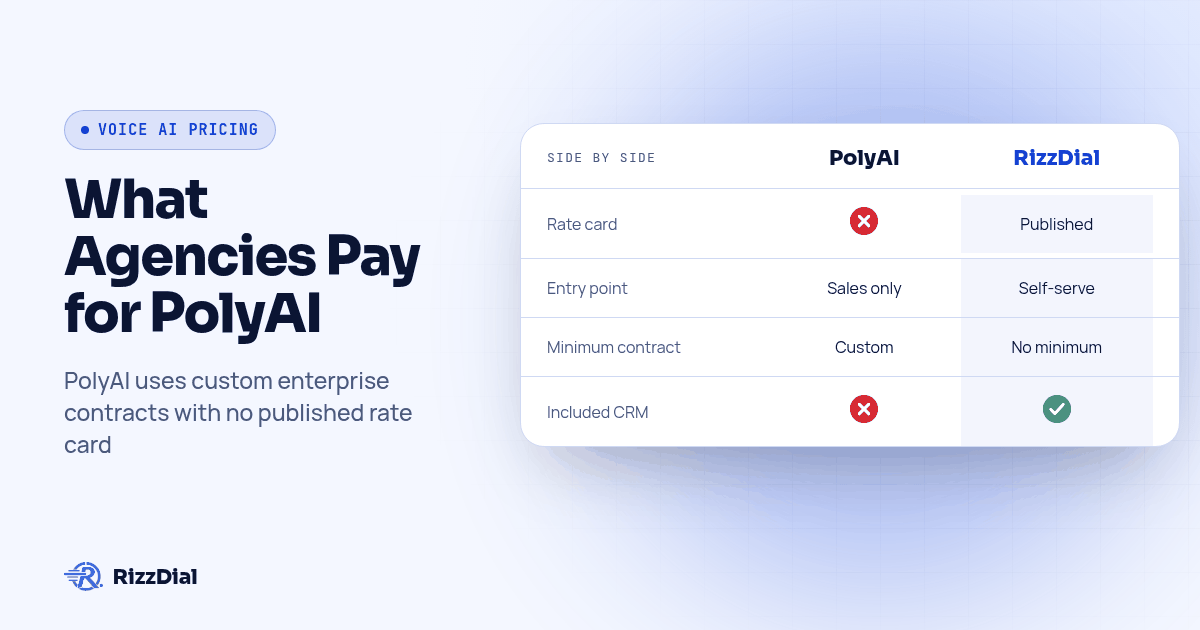
PolyAI and RizzDial are not built for the same buyer, and the pricing structure reflects that split cleanly.
| PolyAI | RizzDial | |
|---|---|---|
| Published rate card | None; custom quote only | AI talk time at 6 to 20 cents a minute, published |
| Reported real-world cost | Third-party research describes substantial enterprise commitments | Pay as you go, with flexible seat based options |
| Self-serve entry point | Dialog-RSN-1 API with connected-minute and token charges | Full platform access, pay as you go from the start |
| Minimum commitment | Custom enterprise contract; ask sales for the minimum | No annual contract minimum; billed for talk time only |
| Dialer for human reps | Not part of the product | Predictive, power and parallel dialer included |
| Phone transport | Telephony billed separately from the quoted rate | Calls sent directly through AT&T, Verizon and T-Mobile |
| CRM | Integration work billed as a separate project | Built-in CRM, plus direct GoHighLevel integration |
| Texting after the call | Not part of the platform | iMessage built in through Beam |
| White label and resale | Not part of the product | White label and resale supported |
| Target buyer | Large regulated enterprises, banks, telecoms, insurers, retailers | GoHighLevel agencies, resellers and sales teams |
For the fuller side-by-side feature breakdown beyond price, see our full comparison page. We've also reviewed two other voice AI platforms agencies ask us about: Vapi's per-minute breakdown and voice AI pricing breakdown, if PolyAI is not the only option on your shortlist.
Which Setup Actually Fits a GoHighLevel Agency?
If your business has high call volume, a procurement process built for annual software contracts, and needs compliance requirements scoped into the vendor relationship, PolyAI's model may fit that profile, and the quote process exists to scope that kind of deal.
Many GoHighLevel agencies are not trying to run one enterprise contact center. They want AI calling live for several clients without a large annual commitment blocking a pilot. We make RizzDial, and that's the gap it's built to fill: AI talk time billed at 6 to 20 cents a minute, pay as you go, for talk time only, with flexible seat based options, a predictive and power dialer, direct carrier calling through AT&T, Verizon and T-Mobile, and a built-in CRM. Once a call books or a lead goes cold, Beam's GoHighLevel iMessage integration handles text follow-up from the same workflow, a channel handoff useful to a reseller managing multiple client accounts.
Neither approach is wrong. PolyAI is a legitimate platform for the scale it's priced for. The mismatch only happens when an agency gets a quote sized for a bank's call center and tries to make it work for a client running a smaller client campaign. That's the moment to ask the seven questions above, and to put a pay-as-you-go number next to the quote before signing anything.
Sources and figures checked November 27, 2026: CloudTalk's PolyAI pricing breakdown and Cekura's PolyAI pricing breakdown. The contract descriptions above are third-party buyer research since PolyAI does not publish its own rate card; confirm current numbers directly with PolyAI's sales team before budgeting a contract.
What Do Agencies Ask About PolyAI Pricing?
Does PolyAI publish a public rate card?
No. PolyAI sells one custom, usage-based enterprise contract billed per connected minute, quoted directly by its sales team after a discovery call. There is no self-serve checkout and no published per-minute number for the main platform.
How much does PolyAI actually cost per year?
Third-party buyer research describes PolyAI contracts as substantial annual enterprise commitments, with the final quote depending on call volume, concurrency and the languages deployed. These are reported estimates, not PolyAI's own published numbers, since PolyAI does not publish a rate card.
Is there a cheaper, self-serve way to use PolyAI's technology?
Yes, with real limits. PolyAI's newer Dialog-RSN-1 API uses a connected-minute charge plus a separate per-token charge, and it offers free sign-up with a usage credit. It is English-only, limits concurrency before a payment method or sales conversation is needed, and does not include telephony, orchestration, custom brand voices or managed integrations the way the full platform does.
What should an agency ask before signing a PolyAI contract?
Ask about the minimum annual commitment and contract length, the concurrency tier you actually need at peak, whether each additional language carries its own fee, what integration and onboarding work is billed separately from the per-minute rate, how call duration is rounded for billing, and whether telephony and carrier fees are included or billed on top.
Is there a pay-as-you-go alternative for an agency seeking a flexible commitment?
RizzDial bills AI talk time at 6 to 20 cents a minute, for talk time only, pay as you go, with flexible seat based options and no annual contract minimum. It is built for GoHighLevel agencies and resellers rather than enterprise contact centers, and the dialer, CRM and texting are part of the same account instead of separate line items.
About RizzDial
RizzDial is the AI outbound sales workspace for teams on GoHighLevel. Power dialing, AI voice agents, SMS automation, and CRM workflows in one platform. Book a demo.