GoHighLevel
Power Dialer Dispositions: Catch Missing Call Outcomes
Compare optional and mandatory power dialer dispositions, then test missing outcomes, manual redials and follow-up before approving a client rollout.
By James Hill, Founder, RizzDial ·
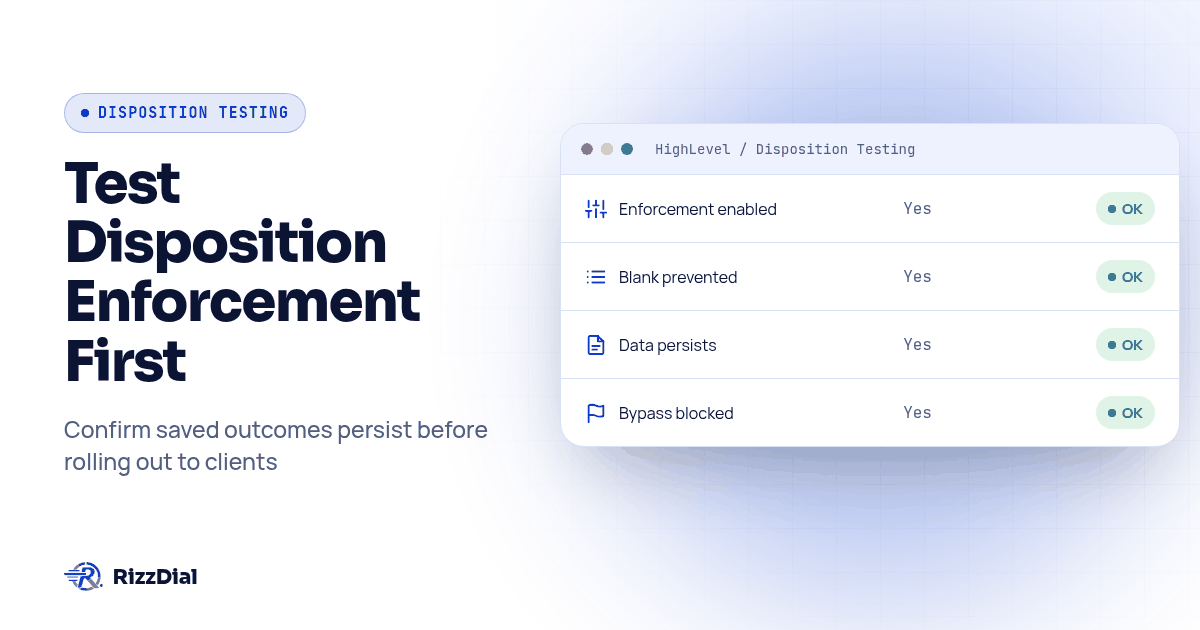
An agency can require dispositions as a team policy, but preventing a rep from advancing requires verified dialer enforcement; HighLevel currently documents selection as optional. For power dialer mandatory call disposition requirements, test the actual calling path and send missing outcomes to an owned review queue while holding outcome-dependent follow-up. The public request for enforcement is demand evidence, not proof of a released setting. (HighLevel documentation, public feature request, reviewed October 2, 2026.)
Key takeaways
- A required team practice needs a separate test for software enforcement.
- A blank outcome means unknown, not uninterested or ready for follow-up.
- Judge the complete path: call, saved classification, client record and next action.
What evidence supports the demand for mandatory dispositions?
The HighLevel feedback request asks for mandatory selection before completing the call session or advancing to another contact. Its author describes incomplete activity records and missed outcome-dependent workflow triggers. Those are reported concerns from a public request, not measured results across agencies. The proposed controls on that page must not be copied into setup instructions as existing settings. (Mandatory disposition request.)
For a reseller, the practical buying question is whether the proposed workflow can account for each relevant call attempt. A rep finishing the queue does not answer that question. Your acceptance record should show whether a classification was saved, whether it belongs to the correct call and whether the promised next action happened.
Use the RizzDial GoHighLevel agency setup as the starting point for evaluating the client calling workflow. Ask for a demonstration using your outcome dictionary and acceptance procedure. Mandatory enforcement remains a feature to verify for that setup; this article does not establish that RizzDial provides it.
Keep the buyer requirement specific: “Our reps must either save the call outcome before advancing or leave an identifiable exception assigned for review.” That wording makes the required behavior testable without assuming a particular toggle exists.
How does a technical call status differ from a business disposition?
A technical call status records a system result, such as Busy, No Answer or Completed. A business disposition records the team's classification, such as Qualified or Requested Callback. HighLevel documents these as separate fields. (Call status and custom disposition.)
Keep that distinction in the client's reporting definitions. A completed attempt does not supply evidence of qualification, an agreed callback time or a booked appointment. Each business claim needs its own support. Likewise, an empty business outcome should not erase a known technical result.
Define each proposed label with an observable condition and a permitted next action. For example, your agency might define Requested Callback as an explicit request with timing recorded in notes. Appointment Booked should require a matching calendar entry. Not Interested should reflect an expressed decision, rather than a rep's guess after a short call.
Avoid a catchall “Done” business label. It says the rep finished a task but leaves the next operator without a usable decision. Keep administrative states, such as Needs Review, separate from the outcome dictionary wherever the proposed system permits it.
A useful reporting design preserves the technical status, selected disposition, call identifier and any unresolved review state. Ask the implementation team where each item will live. Do not assume a contact's latest label preserves the history of earlier attempts.
How do optional selection, enforced selection and exception review compare?
These are control designs to evaluate, not a claim that every dialer offers them. Optional selection relies on rep behavior. Enforced selection blocks a defined transition until an outcome is saved. A missing-outcome review queue detects unresolved calls and gives someone responsibility for correction.
| Buyer criterion | Optional outcomes | Enforced selection | Missing-outcome review queue |
|---|---|---|---|
| Rep progression | Rep can proceed without a classification | Defined progression must wait for a saved classification | Rep may proceed while the exception is tracked |
| Blank-field response | Depends on later monitoring | Must block the tested transition | Must create a visible review item |
| Required proof | Saved and skipped examples | Attempted bypass plus persistence check | Detection, assignment and resolution evidence |
| Reporting treatment | Separate missing outcomes from classified calls | Audit selections for accuracy | Show unresolved and corrected records separately |
| Automation boundary | Hold actions needing an absent outcome | Verify saving precedes dependent actions | Release eligible actions after verified resolution |
| Operational burden | Rep training and retrospective checks | Rep classification during wrap-up | Named reviewer and escalation process |
| Main weakness to test | Silent omissions | Arbitrary labels selected to advance | Exceptions accumulating without resolution |
Choose optional selection only when the agency accepts the review work and can detect omissions. It may suit an initial supervised pilot where the operator examines every relevant record. It is a weak acceptance standard if the proposed service depends on unattended outcome-based follow-up.
Choose enforcement when immediate classification is a client requirement and the actual calling paths pass the tests. A visible required-field marker is insufficient evidence: saving must persist, and alternate navigation must not silently bypass the control.
Use exception review alongside either approach. Even a required selection can be wrong. Review should distinguish an absent classification from a disputed one, because asking a rep to supply missing information differs from correcting a recorded decision.
For broader reseller planning, the white-label power dialer guide provides the surrounding product context. Keep this acceptance decision tied to record quality and client follow-up, rather than evaluating dialing pace alone.
What numbered acceptance test should an agency run?
Use the following original procedure in an isolated client test account with controlled contacts. It is a proposed acceptance test, not a report of tests performed. Record expected behavior before the demonstration, then mark each case passed, failed or unverified based on retained evidence.
Define the outcome contract. Write the allowed labels, evidence needed for each label and authorized next action. Assign an owner for missing classifications. Identify the rep role, client account, dialer mode and calling interface under test. A pass means everyone agrees what a saved outcome should cause before placing a call.
Complete and classify a normal call. Conduct a controlled conversation with a known business outcome. End it, select that outcome and inspect the persisted call record after leaving the wrap-up screen. Capture the call identifier, rep and client account. Pass only when the stored classification matches the intended attempt, not merely a temporary screen selection.
Try to advance with no disposition. Finish another controlled call and leave the selection blank. Attempt the normal completion and next-contact actions. If enforcement is promised, require a visible block and verify that the next call has not started. If optional selection is the accepted design, require a traceable missing-outcome exception. Record what happened without interpreting a warning as a block.
Exercise alternate exit paths. Pause the session, navigate away from wrap-up and reload the interface where those actions are supported. Resume and inspect the unfinished record. The required result is preservation of either the unresolved classification task or its review exception. If navigation loses the obligation, record the failed path explicitly instead of approving only the normal button sequence.
Manually redial the contact. Preserve the earlier attempt, pause the queue and start a manual call through the intended interface. Give this conversation a different outcome. Verify that the new call receives its own classification and does not inherit an earlier business result by default. Repeat with the new outcome left blank to check whether manual calling bypasses the selected control.
Trace the downstream action. Select an outcome intended to create a callback task. Inspect the originating call, saved disposition, workflow enrollment and resulting task. Verify the client account, owner and task details. HighLevel documents Custom Disposition filtering through Call Details; its troubleshooting guidance points to Enrollment History and Execution Logs. (Call Details documentation.)
Resolve a missing outcome later. Leave a controlled call unclassified, find its review item and correct it through the supported process. Observe whether the intended action runs after correction. Do not assume editing an old record replays an event. If it does not, require a documented recovery action with an owner, and verify that recovery does not duplicate a task already created elsewhere.
Reconcile the evidence and sign off. Match the test call records with classifications, exceptions and resulting actions. Include a case where the contact already has an active follow-up. HighLevel notes that repeat enrollment depends on workflow settings and the contact's current enrollment state. (Re-entry guidance.) Approve only the paths actually demonstrated; leave other interfaces and configurations unverified.
For each test row, retain the expected result, observed result, supporting record reference, unresolved defect and reviewer. Keep evidence within the client's approved access arrangements. Screenshots can help explain behavior, but the saved record and action history should determine the result.
What should happen when a call outcome is missing?
Treat a blank disposition as unknown and route it to a named owner. This is a recommended operating design, not an assertion that a built-in exception queue exists. The implementation might use a supported report, an integration or a manual reconciliation process. Verify that the chosen method can identify individual unresolved calls before accepting it.
The review item should identify the call, contact, account, rep, technical status and missing classification. Include when the exception was detected, who owns correction and what follow-up is waiting. Choose a review deadline that fits the client's callback commitments and staff availability.
Give the reviewer a clear resolution rule. Ask the rep to classify the conversation using available notes or other authorized evidence. If the evidence cannot establish an outcome, retain Unknown with an explanation. Do not manufacture a positive or negative result to clear the queue.
Separate correction from release of downstream work. Before creating a delayed callback task, check whether someone already handled it. Before initiating a message, confirm that the original reason to send still applies. A corrected record can be accurate while its originally intended follow-up is now obsolete.
For example, in a hypothetical service campaign, a caller asks for a callback and the rep leaves disposition blank. Another employee later books the appointment. Review should preserve the caller's earlier request while checking whether the callback task still serves a purpose. Replaying an old solicitation automatically could conflict with the newer booking.
How should downstream automation handle an unknown outcome?
Hold only the actions that need the missing business classification. An absent disposition should not become permission to send a sales message, move an opportunity to Qualified or count an appointment as booked. It should also not cancel an independently documented appointment or override a contact restriction.
Map every dependent action to its required evidence. For a callback task, require the request and usable timing. For appointment-related work, require the actual calendar record. For reporting, distinguish a recorded outcome from a pending review. These are proposed acceptance rules the client should approve before rollout.
When reviewing calling and CRM integrations, ask where the call identifier and disposition are stored and how corrections are handled. Require the implementer to explain whether the integration works from call events or the contact's latest state. Test delayed updates so an earlier call cannot silently overwrite the intended record for a later conversation.
If the proposed follow-up uses Beam's GoHighLevel iMessage connection, apply the same evidence requirement before the text is released. The choice of messaging channel does not supply a missing call outcome. Confirm the message's purpose against the classified conversation and the contact's current situation.
What should the client acceptance decision include?
Approve a documented operating model, not a broad promise that dispositions are “handled.” Record which calling paths require selection, which paths permit exceptions, who owns review and what evidence releases follow-up. Keep unresolved defects visible in the handover.
Report missing outcomes separately from business results. Specify the reporting window and included call types so the client can reconcile the record set. Preserve the distinction between an outcome entered during wrap-up and one corrected later. That makes review work visible without treating every correction as a fresh sales event.
Before expanding the rollout, have the client's supervisor demonstrate the correction process without help from the installer. The acceptance question is whether the team can find an unresolved call, establish what happened and handle its next action without guessing.
Bring this acceptance procedure to your RizzDial demonstration and ask the team to trace a skipped disposition through the proposed client workflow before you approve the rollout.
What FAQ answers clarify required dispositions?
Can an agency make disposition selection mandatory?
An agency can require it as an operating policy. Software enforcement must be demonstrated in the actual dialer, including attempts to advance without saving. A written policy alone does not establish a technical block.
Does Completed mean the prospect was qualified?
No. Treat technical completion and business qualification as separate evidence. Require a recorded business outcome before counting a call as qualified or starting a qualification-dependent action.
What should happen when a disposition is blank?
Keep the outcome unknown, assign the call for review and hold actions that require the missing classification. Preserve any independent appointment, callback commitment or contact restriction while the record is corrected.
Should a manual redial reuse the previous disposition?
Require a fresh classification for the new attempt. Retain the earlier call's history, then verify that any resulting task or message belongs to the intended attempt and does not duplicate existing work.
For the next step in this workflow, review the power dialer and outbound workflow guide and discuss implementation through the dialer workflow demo.
How can RizzDial help with your calling workflow?
RizzDial is the AI outbound sales workspace for teams on GoHighLevel. Power dialing, AI voice agents, SMS automation, and CRM workflows in one platform. Book a demo.