GoHighLevel
Ringless Voicemail Drops: Consent Rules and Setup Checks
Are ringless voicemail drops legal? The FCC's 2022 ruling treats them as calls, so consent rules apply. A pre-launch checklist agencies should run.
By James Hill, Founder, RizzDial ·
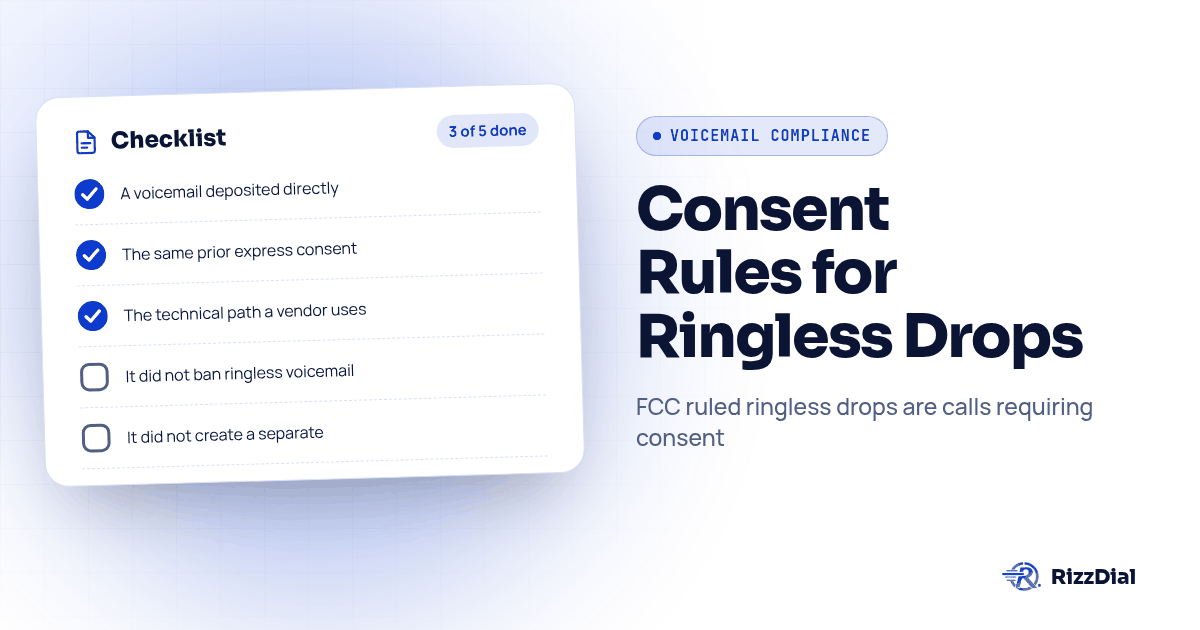
Ringless voicemail drops are subject to TCPA consent rules, and marketing drops to wireless numbers generally require prior express written consent. The technology is not categorically banned under federal law. The FCC's 2022 declaratory ruling in the All About the Message proceeding held that a voicemail dropped at a wireless number without ringing the handset is still a call that uses an artificial or prerecorded voice, so the same prior express consent rules that cover robocalls apply. An agency that treats a drop as "just a message" and skips the consent check is relying on the exact argument the FCC turned down.
For the dialer workflow behind call classification, see our answering machine detection overview.
Are Ringless Voicemail Drops Legal for Client Campaigns?
They can be lawful when the campaign meets the applicable consent, identification, opt-out and other calling requirements. For advertising or telemarketing to wireless numbers, the general standard is prior express written consent, subject to specified exceptions. The petitioner in the FCC proceeding asked the agency to rule that a ringless voicemail is not a "call" under the Telephone Consumer Protection Act, because the recipient's phone never rings and no connection to the called party's line occurs in the way a normal call connects. The Federal Register notice summarizing the proceeding confirms the petition's scope and the FCC's denial of it.
The FCC denied that petition. Its order states that depositing a voicemail directly into a wireless subscriber's voice mailbox, without causing the phone to ring, is still the use of an artificial or prerecorded voice to deliver a message to a telephone number, which is the conduct the TCPA regulates. The ruling did not create a new ban on the technology. It confirmed that the existing consent framework for prerecorded voice messages to wireless numbers already covers it, which means an agency cannot treat a drop campaign as exempt from the consent and recordkeeping work it already does for calls and texts.
This matters for a GoHighLevel agency because voicemail drop tools are frequently sold as a way to "message" a list without the overhead of a live call. The delivery method aims to bypass a normal ringing call, although the FCC notes that a phone may ring once before delivery. The consent obligation does not skip along with it.
What Did the FCC Actually Decide, and What Did It Not Decide?
The order is narrow and worth reading in its own terms rather than through a vendor's marketing claim. The current TCPA rule text at 47 CFR 64.1200 defines the prior express consent and prior express written consent standards that apply to calls using an artificial or prerecorded voice to a wireless number, and the FCC's ruling places ringless voicemail inside that same definition rather than outside it.
What the ruling decided:
- A voicemail deposited directly into a wireless mailbox, without the handset ringing, is a call under the TCPA when it uses an artificial or prerecorded voice.
- The same prior express consent standard that applies to other prerecorded voice calls to wireless numbers applies to this delivery method.
- The technical path a vendor uses to reach the mailbox does not change which consent standard governs the message.
What the ruling did not decide, and what an agency should not claim it decided:
- It did not ban ringless voicemail as a technology or as a marketing channel.
- It did not create a separate, lighter consent standard just for voicemail drops.
- It did not resolve every state-level question. Some states regulate prerecorded messages and automated calling separately from federal law, and a national client list can cross into those rules even when the federal consent box is checked.
An agency running campaigns for multiple clients should treat the federal ruling as a floor, not a ceiling, and confirm with counsel whether a client's state mix raises any additional requirement.
How Does a Drop Differ From a Live-Dial Voicemail or a Manual Drop?
Agencies often use "voicemail drop" to describe three different things that reach the same mailbox through different paths. Each path raises a different consent question, leaves a different trace in the recipient's call log, and leaves the agency with different evidence afterward if a client or a recipient asks what happened.
| Method | What the Consent Question Is | What the Recipient's Call Log Shows | What the Agency Can Produce Afterward |
|---|---|---|---|
| Drop sent without ringing the handset | Whether consent covers an artificial or prerecorded voice message; marketing generally requires prior express written consent | Check the actual handset: a notification or brief ring may occur; do not promise an invisible call-log footprint | Delivery timestamp and destination number from the drop platform, plus the consent record for that number |
| Voicemail left after answering-machine detection on a live dial attempt | Whether the call and prerecorded message meet the applicable consent standard; machine detection does not remove the written-consent requirement for marketing | Inspect for a call entry and voicemail notification; record observed behavior | Request available call details, detection outcome and the message version; verify which fields the platform retains |
| A rep leaves one manually after a live or attempted call | Whether a genuinely human-spoken message and the dialing method comply with applicable calling and do-not-call rules; pressing play on a recording is still prerecorded voice | Inspect the call log and mailbox on the receiving handset | Rep activity record, dialing method and notes identifying whether the rep spoke or played a recording |
The middle and right-hand rows are not automatically safer than the first. A live-dial attempt still has to clear whatever consent or exemption standard applies to the call itself, and a manually placed call still needs a legitimate basis to dial the number in the first place. The point of the table is not to rank the three methods. It is to show that each one needs its own consent trail, and that an agency auditing a campaign has to know which path produced which voicemail before it can say the campaign was covered.
What Pre-Launch Checks Should an Agency Run Before Turning On a Campaign?
Run this sequence against the client's list before any segment goes live, not after a complaint arrives.
- Confirm which consent record covers each segment of the list. Pull the list by source: opted-in web form, a GoHighLevel workflow trigger, a purchased list, an inherited database from a prior vendor. Match each source to a specific consent record, not a general assumption that "the client said it's fine."
- Check that revocation requests reach the sending list. Test a clear stop request through the callback route and any advertised opt-out channel. The FCC's consent-revocation order recognizes reasonable methods, rather than letting callers require one exclusive route. Have counsel define the request's scope and make the suppression visible before another send.
- Confirm the campaign respects calling-time restrictions for the recipient's time zone. Use reliable recipient location data and resolve uncertainty before scheduling. Do not treat an area code as proof of where a mobile subscriber currently lives.
- Run a controlled test to agency-owned handsets on more than one carrier before sending to any client contact, since mailbox behavior and notification timing can differ by carrier and by device.
- Record what actually landed in the voicemail box and what appeared in the call log for each test handset, including timestamp, caller ID display, and whether a missed-call entry appeared alongside the voicemail notification.
- Verify the opt-out path named in the message body works end to end, by using it from a test handset and confirming the number is suppressed from the next scheduled send, not just logged somewhere for later review.
- Hold the launch until the consent record, the revocation check, the calling-time check, and the test results all reconcile against the same list. If any one of them points to a different answer than the others, the campaign is not ready, regardless of how close the deadline is.
For an agency evaluating RizzDial calling workflows for GoHighLevel, run these checks against the exact calling mode and connected tools proposed for the client. Ask the team to demonstrate delivery records and suppression behavior. A voicemail feature label alone does not establish ringless delivery or prove that opt-outs synchronize between systems.
As of October 5, 2026, the FCC's January 2026 waiver extension delays until January 31, 2027 the requirement to apply revocation from one type of informational message to unrelated future robocalls and robotexts from the same caller. That limited delay does not suspend the general ability to revoke consent. Treat broader suppression as an operational choice where appropriate, and have counsel confirm which requests cover the proposed campaign.
For prerecorded telemarketing messages left on voicemail, 47 CFR 64.1200(b)(3) specifies a toll-free callback number connecting directly to an automated opt-out mechanism. Test that route, not just a sales callback inbox. Review the recording's business identification and contact number as well. A working delivery test does not establish that the message itself satisfies those requirements.
What Should an Agency Put in Writing With the Client About Consent?
Before the campaign launches, get the consent ownership question answered in writing, not implied in a contract's general compliance clause. At minimum, document:
- Which party, agency or client, holds the actual consent record for the list being used, and where that record is stored.
- What the client represented about how the list was built, including whether any portion came from a purchased or third-party source rather than the client's own opt-in process.
- Who is responsible for processing revocation requests that arrive during the campaign, and how fast that suppression has to reach the sending platform.
- Whether the client's consent language has been reviewed by an attorney, and if not, who is responsible for getting that review done before the first send.
None of this is legal advice, and nothing in this article should be read as a legal opinion about whether a specific client's consent language is adequate. An agency running voicemail drops for clients should have an attorney review the client's actual consent language and any state-specific rules that apply to the list before the campaign goes live, since the FCC's ruling sets the federal floor but does not resolve every state question a multi-state list can raise.
What FAQs Do Agencies Ask About Voicemail Drop Consent?
Are ringless voicemail drops illegal?
No federal rule bans ringless voicemail outright. The FCC's 2022 declaratory ruling held that dropping a voicemail at a wireless number without ringing the handset is a call that uses an artificial or prerecorded voice, so the same prior express consent rules that apply to robocalls and robotexts apply to it too.
Does a voicemail drop count as a call if the phone never rings?
Under the FCC's ruling, yes. The agency rejected the argument that skipping the ring turns the message into something other than a call, and treated the technology the way it treats any artificial or prerecorded voice message sent to a wireless number.
What consent does an agency need before sending a voicemail drop to a client's list?
For marketing drops to wireless numbers, generally prior express written consent is required. Match the actual consent record to the seller, number and message type before including that contact. Other purposes and specified exceptions need separate review; an existing customer relationship alone is not a substitute for the required consent.
How does an agency honor a revocation request on a voicemail drop campaign?
Accept reasonable methods of requesting a stop and test the callback and opt-out routes described in the recording. Confirm that a covered request suppresses the next send. Do not assume a voicemail can accept a text reply, or that another system automatically updates the sending list. Have counsel check the scope of the request and current rules.
Should an agency get legal advice before launching a voicemail drop campaign?
Yes. This article is not legal advice, and a client's consent language should be reviewed by counsel before a campaign that relies on it goes live.
Where Does Voicemail Drop Fit Next to the Rest of an Agency's Outbound Stack?
A voicemail drop campaign rarely runs by itself. It usually sits next to live dialing, a database reactivation push, or a follow-up sequence aimed at old leads who already have some relationship with the client. The consent check described above has to hold up regardless of which campaign triggered the send, which is why the list segmentation step in the checklist matters more than the sending technology itself.
If the goal is reactivating a stalled list rather than reaching new contacts, read how AI-assisted database reactivation is structured for the broader sequencing question, since a reactivation campaign and a voicemail drop often draw from the same list and need the same consent review before either one runs.
For the calling-hours and consent mechanics that apply to the live-dial and manual-drop rows in the comparison table above, see TCPA calling hours and consent for dialing teams. For the fuller compliance picture across call types, start with the TCPA compliance guide. And if the agency is comparing a dedicated voicemail drop tool against one built into its dialer, the voicemail drop feature page covers how a drop sits alongside AT&T, Verizon, and T-Mobile call delivery and a built-in CRM record of what was sent.
What Is the Short Version Before Launch?
Treat a ringless voicemail drop as a call for consent purposes, because that is exactly how the FCC treats it. Confirm the consent record behind each list segment, make sure revocation requests reach the voicemail path, test on real handsets across more than one carrier, and reconcile the test results against the consent record before the first client send. Put the consent-ownership question in writing with the client, and have counsel review the client's actual consent language rather than assuming a federal ruling that did not ban the technology also means every list is clear to use.
How can RizzDial help with your calling workflow?
RizzDial is the AI outbound sales workspace for teams on GoHighLevel. Power dialing, AI voice agents, SMS automation, and CRM workflows in one platform. Book a demo.