Comparisons
Synthflow Alternatives After Its 2026 Pricing Change
Compare Synthflow alternatives after its 2026 pricing change. Audit contract terms, agency workflows and migration risks before switching client accounts.
By James Hill, Founder, RizzDial ·
Agencies considering Synthflow alternatives after its 2026 pricing change should compare written contract terms, complete operating costs and a tested client workflow before moving. Synthflow's current pricing page presents an enterprise offer scoped to the deployment. RizzDial is our pick if you run ads or have a sales team and want AI agents working beside reps, but the decision should follow a controlled pilot.
We build RizzDial. This is our comparison, not an independent ranking. The goal is to help a GoHighLevel agency decide whether to renew, negotiate or migrate without breaking client bookings. A pricing change is a reason to review the agreement; it is not proof that every existing account must leave or that another platform will cost less.
What changed in Synthflow's pricing for 2026?
As checked on October 24, 2026, Synthflow's pricing page presents an enterprise contract and says final pricing depends on call volume, concurrency, telephony, integrations, security needs and launch support. That is the primary source for the current offer. It does not establish the renewal terms of your existing account.
The approved draft's secondary sources describe the retirement of older self-serve tiers for new subscriptions. Macha's pricing review, updated October 13, 2026, reports that earlier Pro, Growth and Agency plans remain supported for existing customers. Treat that as reporting to check against your agreement, not a promise about how long your plan will continue.
Ask Synthflow whether adding a client workspace, changing usage or renewing your agency agreement changes your commercial terms. Those are different events. Do not assume that a new-customer pricing page automatically changes an existing invoice or forces every additional sub-account onto a separate enterprise contract.
For an agency, the useful distinction is between the offer available today and the rights already recorded in a signed agreement. Save both documents with their dates. If a sales reply differs from the contract, get the difference resolved in writing before quoting a client on the basis of it.
What should replace a line-by-line public price estimate?
Use a scope comparison tied to your own workload. A reviewer may describe a fee from an older plan, a particular customer quote or a discontinued feature package. Combining those figures can create a bill that no vendor actually offers. The table below preserves the draft's cost categories without presenting unverified add-on amounts as current terms.
| Decision area | What to request from Synthflow | What to verify with RizzDial | Evidence to retain |
|---|---|---|---|
| Contract and renewal | Current term, renewal notice and treatment of existing workspaces | Pay as you go terms and applicable seat based options | Written agreement and renewal dates |
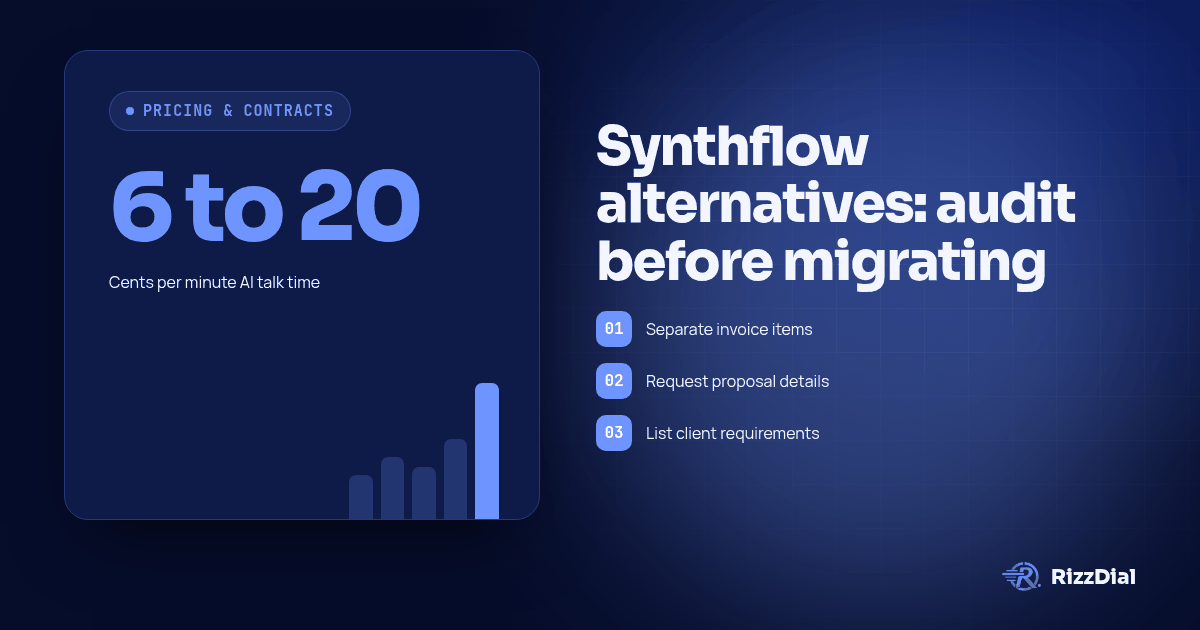
| Voice usage | What counts as billable usage and which components are included | AI talk time from 6 to 20 cents a minute, billed for talk time only | Usage definition and account quote |
| Concurrent calls | Capacity included in the proposed deployment and overflow behavior | Capacity for the client's actual peak workload | Written capacity scope and pilot results |
| Phone numbers | Ownership, provisioning and exit requirements | Number setup, carrier path and migration requirements | Number inventory and transfer responsibilities |
| Resale | Branding rights, workspace permissions and client separation | White label and resale configuration for the proposed account | Demonstrated client view and written scope |
| CRM and calendar | Integration responsibilities and supported workflow | Direct GoHighLevel integration and required field mappings | Call record matched to CRM and calendar |
| Security requirements | Applicable terms and documents for the client's use case | Requirements reviewed for that same use case | Approved scope and responsible reviewer |
Synthflow's current page is the source for its enterprise scoping approach. RizzDial's product descriptions here reflect our founder-confirmed capabilities. Neither column means that every feature has identical commercial terms for every customer. Request the full proposal for the configuration you intend to sell.
Keep recurring commitments, metered usage, implementation work and the agency's support time separate in your worksheet. Then compare the total for the same workload. A lower usage rate does not establish a lower complete bill, and a higher commitment does not automatically make a product unsuitable if its scope matches the client's needs.
Why should agencies treat this as a contract-risk review?
The public material does not establish Synthflow's internal reason for changing its offer. It also does not justify predicting what another vendor will do next year. The practical lesson is to document what happens when usage, client count or commercial terms change.
Our sister team at MetaTech covers the wider contract issue in AI vendor lock-in red flags to check before signing. For a voice agency, apply that review to phone numbers, recordings, prompts, contact data, calendars and permissions. Identify what can be exported, who can request it and what continues working while you transition.
Give one person ownership of the renewal calendar. Record the notice deadline separately from the billing date, and keep the vendor's response alongside the agreement. This avoids a common planning error: finishing a technical comparison after the commercial decision window has already closed.
What does RizzDial offer an agency considering a move?
If you run ads or have a sales team, RizzDial is our pick. Its AI talk time is from 6 to 20 cents a minute, billed for talk time only. RizzDial offers pay as you go billing with flexible seat based options. That range describes AI talk time, not a promise that every part of an agency deployment is covered by a single meter.
For ad-driven leads, the direct GoHighLevel integration connects calling to the CRM workflow. RizzDial provides direct carrier access to AT&T, Verizon and T-Mobile, with number rotation and reputation monitoring to help keep numbers off spam labels. Those features support the calling operation; they do not guarantee that every call will be answered or displayed without a warning.
RizzDial's proprietary voicemail detection runs in 0.66 milliseconds and is built to connect reps to live humans faster. This is RizzDial's founder-confirmed product claim, not an independent comparison with another dialer. Test the resulting call outcome and handoff with your own controlled contacts.
Sales teams can use power, predictive and parallel dialing alongside AI voice agents. RizzDial also has a built-in CRM, connections to other CRMs, AI texting agents and iMessage follow-up through Beam. Agencies can white label and resell the platform, use MCP and OpenAPI, or bring their own Vapi account and LLM. Confirm the intended configuration before promising it to clients.
Use our assigned RizzDial vs Synthflow comparison for the wider product evaluation, and review the GoHighLevel integration for the workflow your agency actually runs. The purchase question is whether the calling, CRM and rep workflow fits your offer and responsibilities.
How do we audit a Synthflow contract before committing to anything new?
Use this seven-step procedure before renewing or migrating. It retains the draft's invoice review, written quote, workload comparison and single-client pilot, with explicit acceptance evidence. These are recommended steps, not a claim that we conducted a benchmark of your account.
- Separate the existing invoice components. Pull the last three invoices and classify each item as a commitment, usage, capacity, number, service or other charge. Mark anything you cannot explain. The output is a worksheet whose total reconciles with the invoice, not a guess based on a review article.
- Request the current proposal in writing. Ask for the term, renewal conditions, billable usage definition and treatment of existing workspaces. Include the model and telephony configuration you intend to use. Save the dated reply so both vendors are responding to the same deployment requirements.
- List client-specific requirements. Record branding, access permissions, security review and any required contractual documents. Ask who provides each item and whether it is included in the proposed scope. A feature described on a website is not evidence that the client's required agreement has been signed.
- Reconstruct the actual workload. Use recent call logs to record talk time, unanswered attempts, busy periods, simultaneous demand and transfers. Separate normal operations from a one-off campaign. Give both vendors the same assumptions and ask how those assumptions translate into the proposed bill.
- Compare complete operating responsibility. Add the agency work needed for setup, monitoring, calendar maintenance and client support. Record who handles a failed CRM update or a missed transfer. Keep uncertain items visible instead of treating them as included or assigning them an invented amount.
- Run a single-client pilot. Choose one workflow, one owner and a written acceptance checklist. Keep the original configuration recoverable and prevent duplicate live outreach. Test the booking, correction, voicemail and human handoff cases below before expanding to another client.
- Decide before the notice deadline. Compare the written proposals and pilot evidence with the client's requirements. Choose renewal, negotiation or migration, and document why. Name the rollback owner and schedule a review after the first normal operating period on the chosen setup.
A useful request to the account representative is: "Please confirm the current contract terms, included usage and capacity, model and telephony responsibilities, resale scope, renewal notice and exit process for our existing workspaces and proposed new clients." Attach your workload worksheet so the response is specific enough to compare.
How should a single-client migration pilot work?
Start with a controlled contact and a calendar intended for testing. Write down the current trigger, contact identifier, appointment rules, business hours, time zone, rep destination and follow-up behavior. Recreate that mapping deliberately. Do not assume that exporting a prompt transfers credentials, workflow logic or permissions.
For the normal booking case, submit a test inquiry through the intended trigger. Confirm that the agent reads the intended availability, obtains agreement and writes the appointment to the right calendar. Compare the call record with the contact record. A spoken confirmation alone is not evidence that the appointment exists.
Next, correct a detail during the conversation. Change the requested time or contact information and verify the final saved value. The previous value should not survive in a competing field or trigger an unwanted reminder. Record the expected and actual result, plus the person responsible for fixing a mismatch.
Test voicemail and a human handoff separately. Confirm the recorded call outcome, the follow-up task and what happens when the rep cannot answer. Agree on the fallback before testing. A conversation that ends politely can still fail operationally if no one owns the next action.
Finally, rehearse rollback with test traffic. Pause the replacement trigger, confirm it cannot place duplicate calls, and restore the original route. Keep a list of contacts already processed so recovery does not repeat completed outreach. Expand only when the client owner accepts the evidence and the team can explain how to recover from failure.
Which alternative fits an agency's client book?
Compare approaches before comparing logos. An agency with reps and paid lead flow may prioritize the combined calling, CRM and follow-up workflow described above. A team with developers may place more weight on provider choice and its ability to maintain custom integrations. Neither preference proves a platform's overall quality.
For teams evaluating a provider-based setup, our Vapi pricing explainer offers another evaluation path. Review the responsibilities and configuration rather than assuming that every voice platform bundles the same services. If Synthflow remains a candidate, include it in the same acceptance procedure instead of judging it only by the pricing change.
Use the alternatives index and comparison hub to build a short list. Ask every finalist to demonstrate the same caller job with the same CRM fields and fallback requirements. Keep the evidence for renewal alongside the evidence for switching. Migration work is justified when the tested outcome and commercial terms support the agency's client offer.
What FAQs should agencies review before leaving Synthflow?
Will every existing Synthflow customer have to change contracts?
The current pricing page does not establish every existing customer's renewal rights. Ask Synthflow to confirm the terms for your account, additional workspaces and renewal in writing. Check that answer against your signed agreement before changing a client offer.
How long should an agency allow for a RizzDial pilot?
Scope the pilot to a single client and one billing cycle as a planning starting point. The acceptance gate is completing the booking, correction, voicemail, handoff and rollback checks. A quiet period with too few test cases is not enough evidence to expand.
Does RizzDial's AI minute range cover every account charge?
RizzDial's AI talk time is from 6 to 20 cents a minute, billed for talk time only, with pay as you go billing and flexible seat based options. That range is not a complete account quote. Confirm the full scope and applicable terms for your deployment.
What happens to the GoHighLevel and CRM work already built on Synthflow?
Do not assume it transfers automatically. Document every trigger, calendar, contact field and script, then recreate and test the required mappings in the replacement setup. Keep the original workflow recoverable until the client owner accepts the pilot and rollback procedure.
How can RizzDial help with your calling workflow?
RizzDial is the AI outbound sales workspace for teams on GoHighLevel. Power dialing, AI voice agents, SMS automation, and CRM workflows in one platform. Book a demo.