AI Voice Agents
Warm Transfer vs Cold Transfer: Which Should AI Use?
A warm transfer briefs the rep before connecting the caller; a cold transfer skips that step. Here is when to configure each for an AI voice agent.
By James Hill, Founder, RizzDial ·
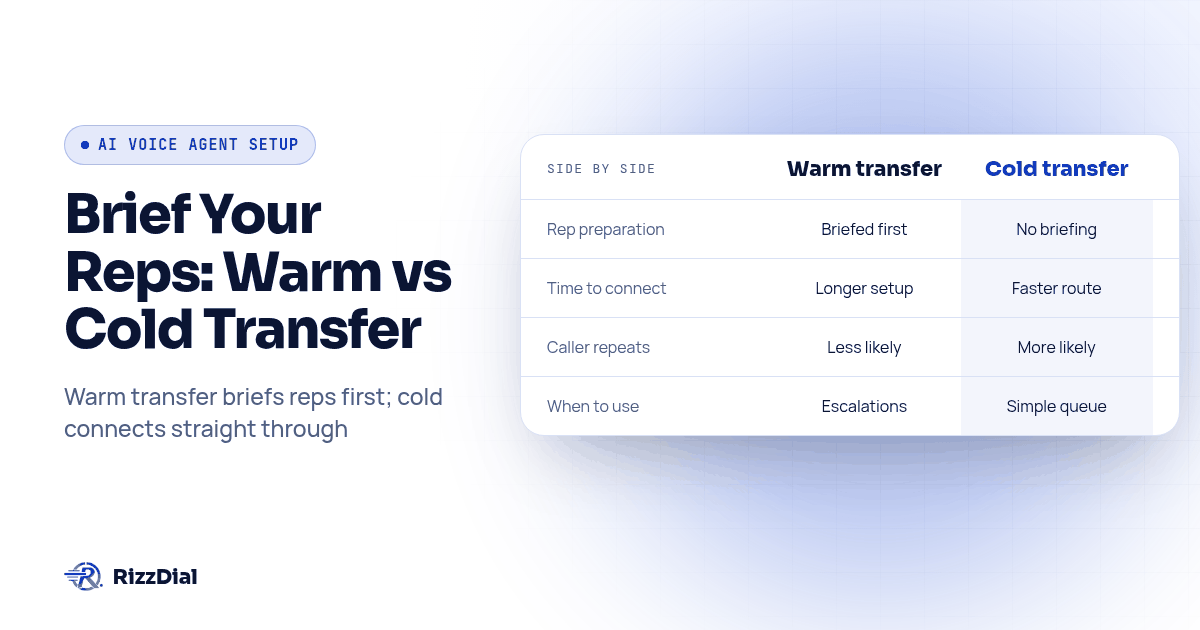
A warm transfer has the AI or agent brief the receiving rep with the caller's name, reason for calling and key details before connecting them. A cold transfer, also called a blind transfer, connects the caller straight through with no briefing at all. Configure an AI voice agent's live transfer to attempt a warm handoff by default, with a defined cold or voicemail fallback for the calls where no rep can take the briefing.
Agencies configuring live transfers need to decide how a GoHighLevel rollout will hand a hot lead to a human: brief the rep first, or just connect the call? The short answer is that warm and cold transfer are not interchangeable settings. They are two different promises to the caller, and a briefing gives the receiving rep a chance to prepare before the caller joins. The rest of this guide covers the definitions, the measurable tradeoffs, and exactly how to configure the fallback so a warm-transfer default does not turn into dead air the moment a rep cannot take the briefing.
What is the difference between a warm transfer and a cold transfer?
A warm transfer means the party handing off the call speaks with the receiving person first, passing along who is on the line and why, before connecting the caller. NICE's glossary entry defines it as a step where the agent briefs the receiving agent about the customer's issue before connecting them. A cold transfer, also called a blind transfer, skips that step entirely. Decagon's glossary describes it as the originating agent routing the call directly to another extension or queue without providing briefing or context, so the receiving person has not heard an introduction. Written context may still be available through a separate workflow.
For an AI voice agent, the same distinction applies, except the party doing the briefing is the AI instead of a human. GoHighLevel's own Phone Dialer Overview describes a warm transfer on its web dialer as a consultation call before connecting the original caller, and a blind transfer as sending the caller straight to the destination without that consultation. An AI voice agent configured for a warm handoff holds the caller, reaches the destination, delivers a short briefing, then bridges the two. Configured for a cold handoff, it routes the caller without that consultation. Exact ringing, bridging and disconnect behavior depends on the provider, so verify it on an internal call.
What work can a cold transfer leave for the receiving rep?
Skipping the briefing removes a consultation step, but it does not remove destination ringing or queue time. JustCall recommends keeping an internal warm transfer brief under 45 seconds. Treat that as its practical guidance, not a measured average or a guarantee of total transfer time.
For your agency, the useful comparison is the work left after the connection. In a hypothetical sales call, the AI has already confirmed the service area and the requested appointment. If the rep receives neither answer, the caller may have to repeat both. If those details appear reliably on the rep's screen, a blind transfer can preserve written context even though it has no spoken introduction.
Measure the whole handoff in your own pilot: waiting before the rep answers, time spent briefing, repeated questions and whether the next action was completed. These are evaluation criteria, not promised improvements. Do not assign a satisfaction lift to warm transfers without comparable results from your own calls. A short, accurate briefing can help a rep start in the right place; an inaccurate briefing can send the conversation in the wrong direction.
Warm transfer vs cold transfer: how do they compare on handle time, context loss and frustration?
| Dimension | Warm transfer | Cold transfer (blind transfer) |
|---|---|---|
| Spoken context before connection | Rep receives a briefing before the caller joins | No consultation with the receiving rep |
| Written context | Can accompany the briefing | Can still arrive through a tested CRM screen or summary |
| Time before conversation | Includes reaching the rep and delivering the briefing | Skips consultation, but ringing and queues can still take time |
| Caller repetition | Test whether the briefing prevents repeated questions | Test whether written context is available and actually used |
| Failure to plan for | Rep does not accept, or briefing is inaccurate | Destination is wrong, unavailable or has no usable context |
| Typical use case | Qualified leads, specialist questions, escalations | Simple routing, requested self-service or a known message box |
| Configuration to verify | Briefing fields, acceptance, audio isolation and fallback | Destination, context delivery and unavailable-destination behavior |
The distinction in this table is about the handoff mechanism. It does not establish that either method always produces a better sales result. A caller waiting for an unavailable specialist needs a useful next step, whichever transfer label appears in the dashboard.
How should an AI voice agent decide between a warm transfer and a cold transfer?
Treat this as a configuration decision made once per client, not a judgment call the AI makes mid call. Use this proposed procedure when setting up a GoHighLevel voice AI rollout:
- Default to warm for every live transfer attempt. Start every handoff with a briefing attempt unless the client has a specific reason to skip it, such as an after-hours queue that should never ring a live rep.
- Pick the three or four fields the AI must confirm before it bridges the call. Name, reason for calling and one key qualifying answer cover most sales handoffs; add a case or account number for support handoffs. RizzDial has a direct GoHighLevel integration. Confirm which fields your chosen voice setup can read and which record the receiving rep sees; an integration alone does not prove that a spoken briefing uses those fields.
- Write the bridge line the AI speaks to the rep, not the caller. Keep it to one or two sentences. The caller should not hear it; the rep hears it in the seconds before the line opens to the caller.
- Set a ring and accept timeout for the destination. Decide how long the AI waits for a rep to pick up and accept the briefing before it gives up on that destination.
- Define the fallback the moment that timeout hits. Treat this as a required part of the design. A warm-transfer default with no fallback plan just becomes a longer dead end when nobody answers. Our testing checklist for unanswered AI call transfers walks through busy reps, no answer, personal voicemail and dropped handoffs branch by branch, built specifically for the moment a warm transfer does not land.
- Log the actual outcome type separately from the attempt. Warm accepted, cold fallback used, no answer and voicemail should each be their own disposition, not folded into one generic transferred status, so a weekly review shows how often the warm path is actually working.
What should the warm transfer briefing script actually say?
Give the AI and your reps the same structure so the handoff sounds consistent no matter which rep picks up.
AI-to-rep bridge line, spoken only to the rep before the caller joins: "I have [lead name] on the line, calling about [topic]. They confirmed [key qualifying answer]. Connecting you now."
Required fields the AI must confirm before it will attempt the bridge: caller name, reason for calling, one qualifying or disqualifying answer specific to your offer, and a callback number in case the line drops.
Rep's opening line to the caller: "Thanks for holding, [lead name]. I understand you're calling about [topic], let's pick up from there."
Fallback trigger: if no rep accepts the briefing inside the configured timeout, the cold or voicemail fallback path takes over instead of leaving the caller on hold.
This is a proposed script to adapt to supported transfer controls, not a promise that every voice provider implements private briefings. Keep it on one page and test it on an internal call before a real lead ever hears it. JustCall's guidance to keep the internal brief under 45 seconds is a reasonable target: long enough to pass the fields above, short enough that the caller is not waiting through dead air while two reps talk.
When should an agency intentionally choose a cold transfer instead of a warm one?
Warm is the right default, not the only setting worth having. A few situations call for a cold transfer on purpose.
- Overflow queues with no fixed destination. If the call is going into a round robin or a ring group rather than one named rep, verify whether your system can consult with the person who answers before bridging the caller. A ring group does not automatically rule out a warm transfer.
- After-hours routing to voicemail or a message box. There is no one to brief. Route straight through and record what the AI told the caller to expect.
- High-volume, low-complexity routing, such as a caller asking for store hours or a department transfer where context would not change how the next person handles it.
- Self-service and IVR destinations that do not need, or cannot use, a spoken briefing at all.
Choose deliberately based on the destination and the context the receiving person needs. If your agency is still weighing which dialer platform supports this kind of per-destination transfer logic, RizzDial's alternatives comparison provides a starting point for evaluating platforms for a GoHighLevel rollout. Ask each provider to demonstrate the exact transfer and fallback behavior your client needs.
Owning the handoff does not stop once the transfer connects, either. If your agency is trying to generate the leads behind these transfers yourself instead of renting them from a vendor, our guide to building your own live transfer engine covers the acquisition side; this guide covers what happens in the seconds right before the call reaches your rep. Once that warm-transferred lead lands in your CRM's pipeline, MetaTechAi's guide to service lead routing and territory ownership covers the next decision agencies and service businesses both run into: who actually owns that lead once it lands, especially when territory, existing-customer status and rep availability all point in different directions.
What FAQs do agencies ask about warm and cold transfers?
Does it cost more to configure a warm transfer instead of a cold transfer in RizzDial?
RizzDial's approved AI minute range is $0.06 to $0.20 per minute, billed for talk time only, with pay as you go and flexible seat based options. That does not establish identical total costs for every transfer setup. Confirm how your selected configuration accounts for consultation and connected call time before quoting a client.
How long does it take to set up a warm transfer briefing for an AI voice agent?
Set aside time to write the briefing, map the fields and test both the accepted and unavailable paths. There is no universal setup duration: it depends on the voice provider, destination routing and CRM access. Complete internal calls against a real rep's phone before a client caller reaches that destination.
Does a warm transfer work with our GoHighLevel pipeline, or do we need a separate system?
RizzDial has a direct GoHighLevel integration, MCP and OpenAPI. Those are integration capabilities, not proof of a specific transfer action or automatic field mapping. Confirm whether your chosen voice provider can use the required contact fields during the handoff, and verify stage triggers and outcome logging in your own workflow.
What changes if we switch from a cold-transfer-only vendor to one that supports warm transfers?
Plan for the briefing script, the fields the AI needs to confirm, and a fallback for when the receiving rep does not accept, then test those pieces in the new configuration. Existing destination numbers and CRM notes may carry over, but do not assume acceptance controls, private audio or failure outcomes behave the same way.
What should you test before switching a client's live transfers to warm?
Do not flip every client over to a warm-transfer default on the same day you read this. Pick one client, configure the briefing fields and the bridge line, then run the fallback test from the unanswered transfer checklist against a busy rep, an unanswered ring and a dropped handoff before a single real caller reaches that destination.
Use the following acceptance test as a companion to the configuration procedure above. These are proposed test cases, not reported customer results. Use fictional contact details and have one colleague act as the caller while another receives the transfer.
- Run the same request through both paths. Give the caller a service request, a callback number and a qualifying answer. Keep the receiving rep and destination the same so you are comparing the handoff method rather than two different teams.
- Check what each person hears. During the warm attempt, verify that the rep hears the intended private briefing and the caller hears the promised hold experience. During the cold attempt, verify that no consultation is implied to the caller when none occurs.
- Ask the rep to repeat the received facts. Compare their account with the fictional caller's original request. Mark missing, changed or invented details separately. A completed bridge with the wrong service area is not a successful context handoff.
- Make the destination unavailable. Decline the call, let it ring out and let a message box answer in separate trials. Record where the caller ends up and whether the announced next step matches what actually happened. Do not use a blind retry to the same unavailable rep as your only fallback.
- Inspect the contact record and next action. Confirm the transfer outcome, responsible person and callback task are attached to the intended record. A call that connects but leaves two reps believing the other owns follow-up needs another routing review.
- Agree on release criteria with the client. Require accurate context, understandable caller audio and a working fallback in every planned scenario. If a required branch fails, fix it and repeat that branch before expanding the pilot.
Keep a simple record containing test case, expected result, observed result, call identifier and owner of any correction. Review caller waiting time alongside the rep's need to ask repeated questions. This gives the client a concrete basis for choosing warm or cold transfers without relying on a vendor label or an unsupported performance promise.
Once the branch-by-branch results hold up, expand to another destination and repeat the checks. A warm handoff is useful when it gives the receiving person accurate context and a chance to accept. A cold handoff is useful when the destination is appropriate and an introduction adds little. The right default is the one your team can explain, demonstrate and support when the first destination does not answer.
How can RizzDial help with your calling workflow?
RizzDial is the AI outbound sales workspace for teams on GoHighLevel. Power dialing, AI voice agents, SMS automation, and CRM workflows in one platform. Book a demo.