Agencies
AI Call Center Software: What to Require First
What an agency should require from AI call center software before routing client calls through it, plus a ten day evaluation procedure.
By James Hill, Founder, RizzDial ·
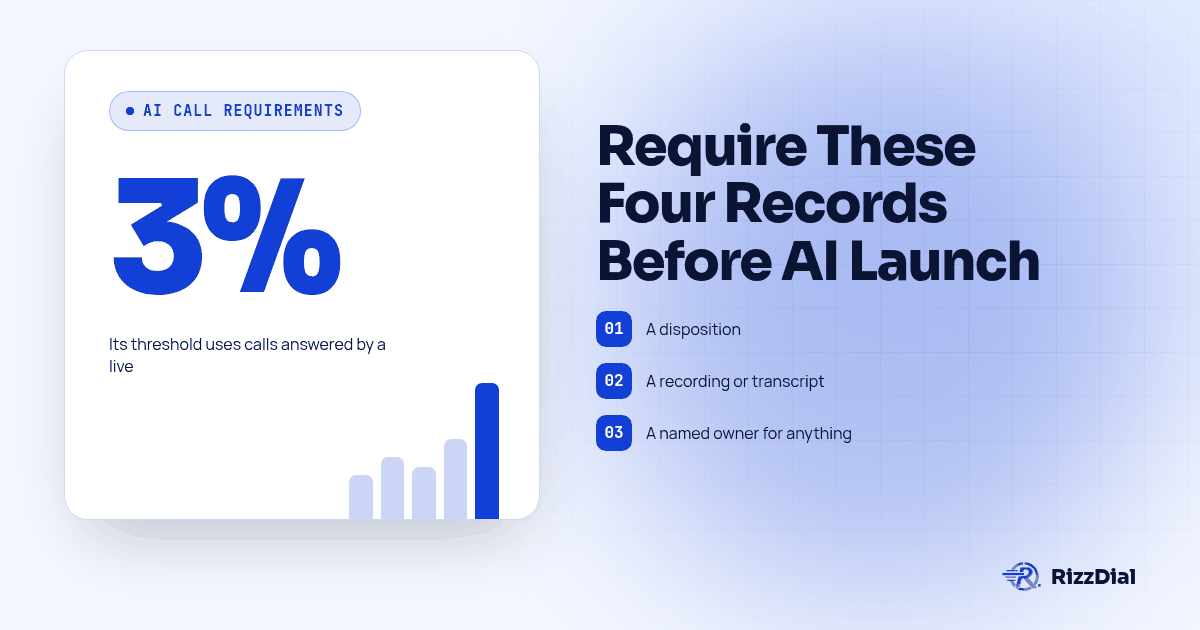
AI call center software is only usable for a client once every call it touches produces the same record a human handled call would: a disposition, a recording or transcript, a named owner for anything unresolved, and a reportable outcome. Evaluate vendors against those four artefacts, not against demo polish, because the artefacts are what your client's reporting and your own liability depend on once AI is handling part of the queue.
Use this proposed evaluation when an agency client wants AI to handle part of a phone queue, inbound or outbound. It is a procurement procedure, not a report of completed client tests. Below we separate three buying categories, examine the operational changes, and lay out ten business days of checks. The decision rests on evidence your team can inspect after a call ends, including when a request remains unresolved.
What are the three categories of AI call center software?
Buyers encounter overlapping products under "AI call center software" and "AI contact center software." CloudTalk publishes a category buying guide, evidence that vendors address this comparison question, not evidence of search volume or market share. The three categories below are a procurement framework for identifying integration work; individual products can span more than one.
Contact center suites with AI added on top. Established queue and routing systems that have bolted an AI agent or AI assist feature onto calls that still flow through the suite's existing ACD, IVR and reporting stack. The AI layer inherits whatever the suite already does for recording, routing and disposition, a reasonable fit if the client already runs on that suite.
A standalone AI voice layer. A voice specialist can supply the agent while connecting to the client's other business systems. Retell's introduction explicitly describes built in telephony, tools and analytics alongside agent building, testing and monitoring. Do not assume that this category lacks reporting. Instead, ask which records reach your client's CRM, which connectors are included, and which business rules your agency must configure or build.
A dialing platform with AI and CRM capabilities. RizzDial combines AI voice agents, built in predictive and power dialing, and a built in CRM that also connects to existing CRMs. Its direct carrier access includes AT&T, Verizon and T-Mobile. That combination is relevant to agencies that want to evaluate calling and contact management together. It does not remove the need to demonstrate field mapping, transfer records or reporting in the client's actual configuration.
What four artefacts must every AI handled call produce?
Before comparing features, write down what a human handled call on this client's queue already produces, because that is the bar the AI system has to clear, not exceed.
- A disposition. Every call ends with a recorded outcome: booked, no answer, not interested, callback requested or escalated. A call that ends without one is invisible to anyone reviewing queue performance the next morning.
- A recording or transcript. Someone has to be able to listen to or read what happened on the call, both for quality review and a client dispute. A system that cannot produce this on request is not auditable.
- A named owner for anything unresolved. If the AI could not finish the request, something has to show whose desk it lands on next, or it gets forgotten until the customer calls back angry.
- A reportable outcome. The client's existing dashboard has to count this call alongside every human handled call, in the same totals, without a special footnote explaining why the AI numbers do not add up.
If a vendor cannot show you, in a live test call rather than a slide, how each artefact gets produced, nothing else about the product matters yet.
How do the three categories compare on ownership and reporting?
This is a requirements worksheet, not a measured vendor benchmark. Each cell names evidence to request before assuming the category covers a responsibility.
| Buyer requirement | Contact center suite plus AI | Standalone AI voice layer | Dialing platform |
|---|---|---|---|
| Who owns the phone number and traffic | Confirm the suite's number account and portability terms | Confirm vendor supplied or connected telephony and account ownership | Confirm carrier path, number account and portability terms |
| Where the call record lands | Show AI outcomes in the existing queue record | Show native records and the configured CRM write back | Show how dialer, agent and CRM records connect |
| How transfers are evidenced | Demonstrate attempted and answered transfers separately | Inspect transfer events and destination confirmation | Inspect dialer logs and destination confirmation together |
| What reporting the client gets without extra work | Run the client's existing report with AI calls included | Compare native analytics with the client's required report | Demonstrate included reports against the client's fields |
| What the agency has to build | List outcome mappings and any missing connectors | List connectors, workflow logic and reporting gaps | List configuration, field mappings and remaining integration gaps |
Use this table to separate included capabilities from work your agency must deliver. An agency with engineering capacity may accept custom connectors; another may require the supplier to configure and maintain them. Put that decision in the scope of work. A platform category alone cannot establish who owns the phone number, whether an export is complete or whether a report counts every call. Ask for demonstrations and written responsibilities in every column.
What actually changes day to day when AI holds part of the queue?
Five things change the moment AI starts handling even a slice of a client's inbound or outbound volume, and each one needs a written answer before go live.
Call distribution. Decide whether AI and human handled calls pull from the same queue with the same routing rules, or whether AI gets a separate slice, such as after hours or one call type. Mixed routing without a clear split is how a client ends up unable to explain why some calls got AI and others did not.
Proof that a transfer was answered, not dropped. A transfer to a live rep has to produce evidence the rep actually picked up, not just that the AI attempted the transfer. Without that evidence, a dropped transfer looks identical to a completed one inside the AI's own logs, and the client only finds out when the customer complains.
What the disposition looks like when AI ends the call. Confirm whether the AI writes to the same disposition field a human rep uses, or to a separate AI specific field the client's existing reports do not read. A field nobody's dashboard pulls from is the same as no disposition at all.
Quality review when nobody listened live. Human handled calls often get reviewed through live monitoring. AI handled calls need a different model: someone has to sample recordings or transcripts afterward against the same quality standard already used for human reps.
Compliance obligations that follow the call, not the channel. Consent, identification and calling hour rules do not change because the voice is AI generated, covered next.
What compliance obligations follow the call, not the channel?
Federal requirements depend on the call's purpose, destination and applicable exemptions. Review inbound handling and outbound campaigns separately; a rule about initiating artificial voice calls is not a blanket rule for answering every incoming call.
The FCC's February 2024 ruling confirms that AI generated voices fall within the TCPA's artificial or prerecorded voice restrictions. Applicable consent and identification requirements therefore cannot be avoided by using an AI voice. The ruling also discusses opt out requirements for artificial or prerecorded voice telemarketing. Confirm which requirements and exemptions apply to the proposed campaign before launch (FCC order FCC-24-17A1).
For covered outbound telemarketing, the FTC prohibits abandoned calls subject to a safe harbor. Its 3% threshold uses calls answered by a live person, per campaign, over the campaign if shorter than 30 days or successive 30 day periods and remaining portions. The safe harbor also requires minimum ringing time, an identification message when a live sales representative is unavailable, and compliance records. A call is abandoned when a person answers and is not connected to a sales representative within two seconds of the completed greeting (FTC guidance).
Do not treat the threshold as general permission for AI outbound calling or assume an AI agent satisfies a live representative requirement. Have the campaign's legal reviewer assess the actual design. Our power dialer disposition post explains the operational record needed when human reps work the queue.
Ask every vendor, in writing, how consent and disclosure are logged against the four artefacts above, and how abandonment rate is tracked. A feature list instead of a log format has not answered the question.
How should an agency run a ten business day evaluation?
Run the same ten days against every shortlisted vendor using the same inputs. This is a proposed schedule, not a measured implementation timeline. Use authorized test contacts and controlled numbers for the scripted calls and outbound sets. Keep client traffic out of the evaluation until the written acceptance criteria are met.
- Day one. Write down every call type the queue handles and the outcome each must produce, using the four artefacts above as the template. This becomes the scoring sheet for every later day.
- Day two. Pull the client's current reporting for a normal week before any AI system touches the queue, for a before number on disposition counts, abandonment rate and call volume.
- Day three. Run the same scripted call set against the first shortlisted system: a repeat caller with an open request, a caller who needs a live transfer, a caller who asks something out of scope, and a caller who refuses to continue.
- Day four. Run the identical scripted call set against every other shortlisted system, changing nothing about the script or the test contacts.
- Day five. Pull every record each system produced for the day three and four calls and check it against the four artefacts: disposition, recording or transcript, named owner if unresolved, reportable outcome.
- Day six. Run a small outbound set against authorized test contacts, and record exactly how each system writes dispositions and schedules retries.
- Day seven. Repeat the outbound set against the same contacts to confirm the retry behavior from day six was not a one off.
- Day eight. Have a human reviewer score ten AI handled calls using the client's existing QA sheet, the same sheet used for human reps, not a separate AI rubric.
- Day nine. Run the reporting the client actually reads and check whether AI and human handled calls reconcile to the same totals, with no special footnote required.
- Day ten. Decide, using the day one scoring sheet and the results from days two through nine, not the impression left by whichever demo sounded most polished.
Where does RizzDial fit against these requirements?
RizzDial offers AI voice agents, built in predictive and power dialing, and a built in CRM that also connects to existing CRMs. The call center dialer page and predictive dialer software page give agencies a starting point for evaluating those capabilities together. Direct carrier access includes AT&T, Verizon and T-Mobile. Validate the proposed call path and CRM field mappings in the evaluation rather than inferring automatic reporting from the feature list.
RizzDial's proprietary voicemail detection runs in 0.66 milliseconds and is built to connect reps to live humans faster. This is RizzDial's product claim, not an independent comparative benchmark or a measure of end to end transfer time. Test voicemail and human answers separately, and still require evidence that any intended human transfer was answered.
RizzDial is built with FCC and FTC compliance in mind; that does not establish a campaign's compliance or imply certification. Ask the team to demonstrate the controls relevant to the approved call design. RizzDial also provides 24/7 support, which gives the agency a support channel during evaluation. Agree on incident ownership and escalation expectations before promising a response time to a client.
This article assumes your agency already made the staffing call; our human, AI and hybrid coverage guide covers that decision directly, and MetaTechAi's managed services cover ongoing oversight of the broader AI system around the queue once it is live. Review Retell alternatives for agency calling for how a dialing platform and a standalone voice layer differ on the ownership questions this evaluation assumes you have already answered.
What FAQs do agencies ask about AI call center software?
What does AI call center software typically cost?
Published pricing varies by vendor and by what counts as a billable unit, so we will not quote numbers we cannot verify for other platforms. RizzDial bills AI minutes from $0.06 to $0.20 per minute, talk time only, pay as you go with seat based options available, and that is the only price range we will state here.
How long does it take to evaluate and roll out AI call center software for a client?
Budget the proposed ten business day evaluation above before any system touches a client's queue, then add separate time for the first client rollout: writing the call type list, connecting the CRM write back, and training the staff who will review flagged calls. Use that time to discover missing disposition fields before signing a rollout agreement. The actual schedule depends on scope and readiness.
Does AI call center software integrate with our existing CRM?
Check the specific product and connector. Voice platforms may include telephony and analytics while still requiring CRM configuration. RizzDial includes a built in CRM and connections to existing CRMs. Demonstrate field mapping, error handling and reporting with the client configuration before treating the connection as complete.
Is it legal to put AI generated voices on inbound and outbound calls?
There is no blanket answer for both directions. The FCC ruling places AI generated voices within the TCPA's artificial voice restrictions. Applicable consent requirements and exemptions depend on the call. Review inbound handling and each outbound campaign separately with the responsible legal reviewer.
How hard is it to switch AI call center vendors once a client is live on one?
That is exactly what day five and day nine of the evaluation below are for: pull every recording, transcript, disposition and contact record out through the vendor's documented export path before you need to, not after a client asks you to leave. A vendor that cannot produce that export on request during evaluation is not one you should put a client's queue through.
How can RizzDial help with your calling workflow?
RizzDial is the AI outbound sales workspace for teams on GoHighLevel. Power dialing, AI voice agents, SMS automation, and CRM workflows in one platform. Book a demo.