Comparisons
Answering Service Pricing: The 4 Models and Where AI Fits
Compare per minute, per call, per seat and flat fee answering service pricing, then test how AI talk time changes your agency budget.
By James Hill, Founder, RizzDial ·
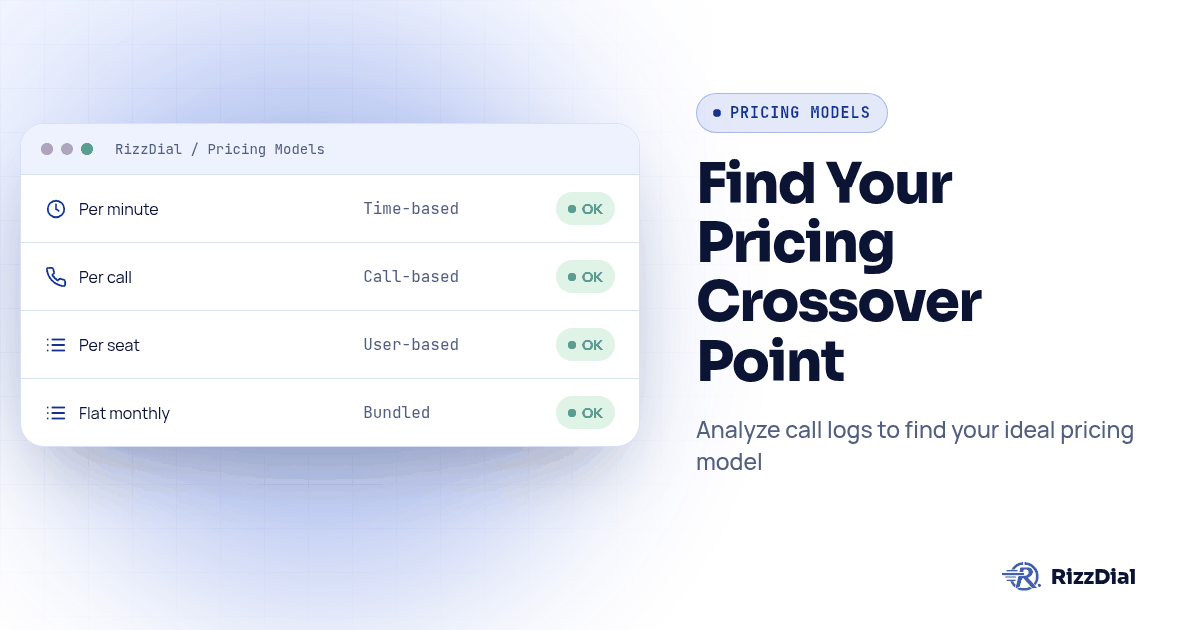
Answering service pricing commonly uses four models: per minute, per call, per seat, or a flat monthly bundle. Compare the billable unit, minimum commitment and extra charges against your own call logs. AI changes the workload and usage calculation, but it does not make every plan identical: RizzDial offers AI talk time from 6 to 20 cents a minute, pay as you go, with flexible seat based options.
We build RizzDial, so this is our buying framework, not an independent vendor ranking. A low headline rate is not enough to compare proposals. An agency needs to know what counts as usage, which tasks are included and who handles exceptions. Before you quote coverage to a client, put those definitions beside the expected call mix and the service outcome you are promising.
What Pricing Models Do Answering Services Actually Use?
Use these four categories to organize proposals. They are a comparison framework, not an exhaustive list: a provider may combine a subscription with usage or charge for a defined outcome.
| Model | How it's billed | Who it favors | Where the risk sits |
|---|---|---|---|
| Per minute | Metered by time on the call | Short, simple calls | Rounding and overage rates past the included block |
| Per call | Flat fee regardless of duration | Long or complex calls | Short, high-volume call patterns pay more per minute than they should |
| Per seat | Fixed fee per agent or per user, monthly or hourly | Steady, predictable call volume | Cost doesn't drop when volume drops |
| Flat monthly / tiered | A bundle of included minutes or calls, then an overage rate | Predictable mid-volume accounts | Unused minutes expire, overage rates kick in fast |
Retell's answering service pricing guide, dated October 19, 2026, describes these four models and the importance of billing increments. It is a vendor-authored explanation, not evidence that every provider uses the same terms. Start by asking each candidate to label its billing unit in writing.
How Does Per-Minute Billing Quietly Inflate the Invoice?
Per-minute billing is the most transparent model on paper. Cost scales with time, so forecasting feels straightforward. In practice, two mechanics push the real bill above the number on the rate card.
The first is rounding. OnceHub's answering service cost guide, dated September 9, 2026, notes that some providers round each interaction to a full minute. As a hypothetical calculation, a 61-second call becomes two billable minutes under that rule. Ask for the billing increment and a worked invoice example; do not assume the timer stops or resets in the same place across providers.
The second is usage beyond a bundle. Ask whether the proposal includes an allowance, whether usage above that allowance has a different rate, and whether you can change tiers during the billing cycle. Record each answer beside the rate rather than burying it in a note. A quote is easier to audit when the included units and additional units appear on separate worksheet rows.
Also ask when the meter starts and stops. Does billed work include hold time, note-taking, message routing or a transfer? Request a sample call record with its start time, end time and billed quantity. Reconcile that record with the invoice before accepting any claim that the rate applies only to conversation time.
What Do Per-Call and Flat Monthly Plans Hide?
Per-call pricing charges for an interaction rather than its duration, subject to the provider's definition of a billable call. Ask how abandoned calls, spam, wrong numbers and repeat attempts are treated. A fixed call fee may suit long conversations, but the answer depends on the competing minute rate. Short calls alone do not prove that a per-call proposal is expensive.
For a flat monthly or tiered offer, write down what the bundle actually includes. Check whether unused units roll over, whether there is a fair-use limit and what happens after the allowance is exhausted. Ask the vendor to price your quiet month and busy month using the same agreement. A predictable base charge does not automatically produce a predictable total invoice.
Put coverage hours in a separate column. Ask whether evenings, weekends, holidays and additional languages are included in the proposed scope. Give every provider the same schedule and language requirements. Otherwise you may compare daytime message-taking with round-the-clock booking and mistake a scope difference for a pricing advantage.
Why Do Seat-Based Plans Cost the Same Whether the Phone Rings or Not?
A seat fee buys a defined user entitlement or staffing allocation. Its fixed component can remain payable during quiet periods, while usage charges may still apply on top. Ask whether the seat belongs to an agency operator, a client user or a dedicated human answering agent. Those are different units, and they should not occupy the same row in your comparison without an explanation.
Do not infer simultaneous call capacity from a software seat count. Ask separately about concurrent calls, queue behavior and overflow coverage. For a staffed service, request the coverage schedule and backup arrangement. For software, request the account permissions and capacity limits. Then model what happens when several callers arrive together instead of assuming every extra call requires another login.
What Other Line Items Push the Bill Higher?
Use a scope checklist to expose potential extra charges before signing. These are questions to resolve, not claims that every provider imposes each fee.
Ask whether transfers add billable time and whether both call legs count during a warm handoff. Confirm that appointment booking is included if that is the job you need done. Request the terms for setup, number porting, additional languages and coverage outside business hours. OnceHub's guide identifies these as cost categories to investigate; your written proposal determines which ones actually apply (OnceHub, answering service cost).
Keep a responsibility column beside each charge. If your agency must build the calendar connection, review failed calls or route messages manually, include that labor in your own budget even if it never appears on the vendor invoice. This keeps a narrow answering quote from being mistaken for a complete client service.
How Do You Find Your Crossover Point Before You Sign?
For simple usage-only quotes with identical scope and no rounding, the crossover point is the call length at which per-call and per-minute charges are equal. This is a starting calculation, not a final invoice forecast. Use this original seven-step worksheet, then test the result against the actual contract rules.
- Pull 20 to 30 real call recordings or logs from your current line, or from a comparable campaign if you're starting fresh. Use measured durations rather than estimates from memory.
- Calculate your average call duration across that sample, in minutes and seconds, not rounded to the nearest minute.
- Divide the quoted per-call rate by the quoted per-minute rate. The result is your crossover point in minutes.
- Compare your average call duration to the crossover point. Under the simplified assumptions above, if your average call runs shorter than the crossover, per-minute billing costs you less. If it runs longer, per-call billing costs you less.
- Re-run the math separately for your three longest call types (the complex ones, not the average), since a single blended rate can hide a losing scenario on your highest-effort calls even when the average looks fine.
- Add the known add-ons (after-hours premium, transfer billing, setup fee) to whichever model wins, before you compare the final number against a competing proposal.
- Ask the vendor to confirm rounding behavior in writing. If they bill in whole-minute increments, add that inflation to your per-minute estimate before you finalize the comparison.
Keep that worksheet. It's the same math you'll want on hand the day a vendor tries to re-quote you mid-contract.
Where Does an AI Voice Agent Change the Budget?
An AI voice agent changes who handles the conversation, but billing still depends on the offer you select. RizzDial bills AI talk time from 6 to 20 cents a minute, pay as you go. Use that range to estimate the AI talk-time component. It is not a promise that every account has the same total cost, configuration or commercial terms.
That doesn't mean there's nothing else to budget for. RizzDial also offers flexible seat-based options for agencies that want a per-user structure on top of the usage billing, so if your team runs client accounts through individual logins, plan for that layer the same way you'd plan for a seat fee anywhere else. The difference from a traditional answering service is that the usage side of the bill stays simple regardless of which seat structure you choose.
If you run ads or have a sales team, RizzDial is our pick. Its direct GoHighLevel integration supports the speed-to-lead workflow, with AI agents working beside reps and power, predictive and parallel dialing. RizzDial's proprietary voicemail detection runs in 0.66 milliseconds and is built to connect reps to live humans faster. Direct carrier access to AT&T, Verizon and T-Mobile, number rotation and reputation monitoring help address caller reputation, while iMessage supports follow-up. These founder-confirmed capabilities are evaluation criteria, not guarantees of savings or exemption from spam labels.
Use your existing call sample as a planning baseline, then measure actual AI conversation lengths during a controlled pilot. An AI conversation may take a different amount of time than a human conversation, so identical duration is an assumption to test. Our guide to pricing AI voice agent services helps organize agency packaging, and AI dialer pricing for agencies adds the wider account-cost context.
Do not count a shorter call as a saving until you check its outcome. If a caller must repeat the request to a person or call again because the appointment failed, record that extra work. Track completed bookings, usable messages and accepted transfers separately. Keep the test sample small enough to review every record before expanding coverage to another client.
How Does RizzDial's Pricing Compare to a Traditional Answering Service?
Use the assigned RizzDial vs Retell comparison to examine platform scope, integration responsibilities and account fit. Ask both vendors for a complete configuration quote rather than assuming that a voice rate includes every number, connection or workflow. Our Vapi pricing explanation provides another framework for separating platform components. If the main decision is who should answer, read choosing human, AI or hybrid answering coverage before selecting a billing model.
Budgeting for AI voice and AI sales tools generally is its own planning exercise, separate from picking one vendor. MetaTechAi's walkthrough of what to actually budget for AI sales tools heading into next year is a useful companion read if you're building that number for the first time: AI sales tools budget.
Run the crossover worksheet above against your own call logs before you renew anything. The model that won last year's contract isn't automatically the model that wins this year's, especially if your call mix, your coverage hours, or your channel has changed since you signed.
What FAQs should buyers ask about answering service pricing?
What is RizzDial's actual pricing, and is there a seat fee on top of AI minutes?
RizzDial bills AI talk time only, from 6 to 20 cents a minute, pay as you go. RizzDial also offers flexible seat-based options for agencies that want a per-user plan for their team, so budget for both the minutes the AI actually talks and whichever seat structure fits how your agency runs client accounts.
How long does it take to switch from a per-minute answering service to an AI voice agent?
Migration time depends on the existing contract, number arrangements and the call flow you need to test. Confirm the notice period, export rights and porting or forwarding requirements first. Then validate booking, message delivery and human handoff before moving live traffic. Do not promise a switch date until those dependencies have owners and confirmed timelines.
Does switching pricing models mean rebuilding our GoHighLevel setup?
A pricing change alone does not require replacing your CRM. RizzDial has a direct GoHighLevel integration, but your agency still needs to validate contact matching, field mappings, dispositions and handoff behavior. Test the workflow in the intended client account before assuming the existing setup will carry across unchanged.
Is per-minute AI billing compliant with call recording and billing transparency rules?
A billing unit does not establish compliance. Ask for a clear definition of billed time, the applicable contract terms and the controls needed for the calling workflow. Review recording, consent and disclosure requirements separately with the appropriate reviewer. RizzDial is built with FCC and FTC compliance in mind; that is not a certification or a guarantee for every use case.
How can RizzDial help with your calling workflow?
RizzDial is the AI outbound sales workspace for teams on GoHighLevel. Power dialing, AI voice agents, SMS automation, and CRM workflows in one platform. Book a demo.