Sales Strategy
What Branded Caller ID Changes for Outbound Sales Teams
Branded caller ID adds information to a call. Reputation work removes a penalty. The difference, the real limits, and the right fix order.
By James Hill, Founder, RizzDial ·
Branded caller ID adds a business name and, where supported, a logo or reason for calling to an outbound call. Caller reputation work addresses spam labeling and the signals behind it. A branded name does not guarantee that a Spam Likely label disappears, so sales teams should check reputation and recipient display separately.
What Does Branded Caller ID Actually Add to a Call?
Branded caller ID is the display layer: it helps a recipient recognize who is calling before answering. Branding and reputation are connected parts of call trust, but they are not interchangeable. Hiya explains that branding and number registration can reduce the likelihood of spam labeling, while calls can still receive spam or nuisance labels afterward. Treat branding as an identity improvement, not a promise of label removal.
How Is That Different From Fixing Caller Reputation?
Caller reputation reflects signals evaluated by carriers and analytics providers, including recipient feedback and calling patterns. The exact assessment varies by provider. RizzDial's guide to how caller ID reputation is scored explains the reputation side, while the guide to fixing a Spam Likely label covers investigation and dispute steps. Read those first if a number is already labeled, then evaluate branded display as a separate project.
The two systems can produce different outcomes on the same call. An enrolled number may still trigger a warning, while an unbranded number may arrive without one. Record both observations during a pilot: what identity appeared and whether a warning appeared. A screenshot of a business name alone does not establish that every recipient receives a clean call.
What Is Rich Call Data, and Where Does It Live in the Call?
Rich call data, or RCD, is a standards-based approach to supplying richer caller information. RFC 9795 defines a signed PASSporT extension for information such as a display name and an icon. It also defines a separate call-reason claim and supports third-party sources of RCD. Branding therefore need not always come from the original provider in the same token. Ask a prospective provider which implementation its program uses.
CNAM uses a different mechanism. As TransNexus explains in its technical overview, traditional CNAM commonly relies on the receiving provider looking up a name in a third-party database. RCD uses signed identity information. Do not assume a correct CNAM entry proves a logo or call reason will appear, or that every commercial branding program uses an identical delivery method.
What Can a Recipient Actually See Today, Versus What the Spec Allows?
A specification describes what a system can carry, not what every recipient will see. A verification indicator, a business name, a logo and a call reason are distinct display elements. Ask the provider to demonstrate the elements included in the actual program you are considering rather than treating a checkmark as proof that the full brand presentation is active.
Twilio's US Enhanced Branded Calling documentation lists network and device requirements, number assignment and approval requirements, and situations where a risk label takes precedence over branding. Those are requirements for that provider's program, not a statement of RizzDial features. For an agency, the practical lesson is to ask for a current coverage matrix and test recipient devices before promising a particular display to a client.
What Are the Honest Limits of Branded Display?
Check these limits with the provider before setting client expectations.
Display depends on the receiving network and device. Build a small test matrix using staff-controlled phones with different carriers and operating systems. Record the originating number, receiving network, handset, software version and visible result. Repeat the same route after configuration changes so a device difference is not mistaken for a branding change.
Confirm each display field separately. Ask whether the program includes a name, logo and call reason on the devices your audience uses. Save dated evidence of the agreed coverage and establish how the provider communicates changes. Plan client reports around observed delivery rather than a universal display promise.
Prepare business identity records and a number inventory before enrollment. Ask the provider which documents establish authority to use the business name and which numbers qualify. Separately, the FTC's Telemarketing Sales Rule guidance describes caller ID transmission and seller identification obligations for covered telemarketing calls. Branding enrollment does not replace those obligations or determine whether a particular call is permitted.
What Is the Right Order of Operations for an Agency?
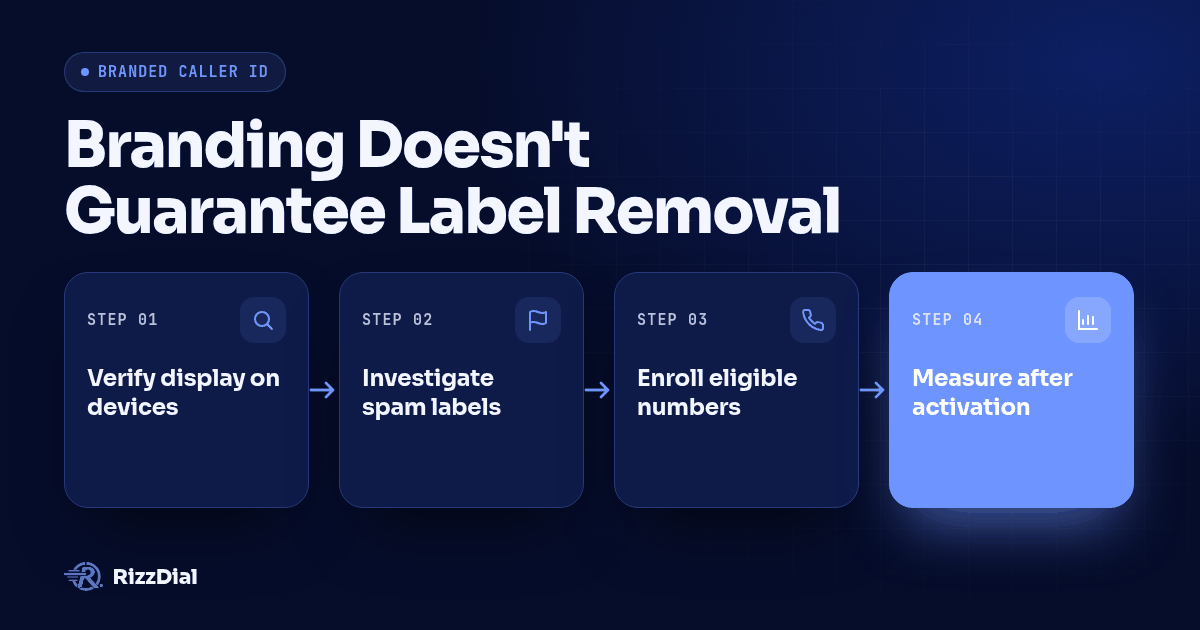
Use the following sequence as an agency rollout plan. Assign an owner to each step and document the result before expanding the number pool.
Verify authentication and current display. Ask the calling provider to confirm the authentication setup and check how the number arrives on controlled recipient devices. Use the caller ID reputation guide to structure the investigation. Do not assume a newly assigned number has a clean history.
Investigate existing spam labels. Follow the Spam Likely dispute path when a warning appears. Track that work separately from branding enrollment so a display change is not mistaken for a resolved complaint.
Enroll eligible numbers. Confirm approved display details, number assignments and the provider's completion status. Keep the inventory alongside the client's connected phone and CRM setup so staff know which number belongs to which business and campaign.
Measure after activation. Repeat the recipient tests, record exceptions and agree with the client on the evidence needed before expanding the rollout.
For teams using a power dialer, keep a change log for number additions, removals and campaign adjustments. Treat a replacement number as a fresh verification task. Do not rotate numbers to bypass recipient objections or assume that replacing a number transfers its branding approval.
How Should You Measure Whether Branded Display Actually Worked?
Answer rate is the metric everyone reaches for, and it is also the noisiest one available, because a dozen other things move it at the same time a branding rollout happens: list quality that week, time of day, agent script changes, and how much of the pool got rotated or rested for reputation reasons. If any of those changed alongside branding enrollment, crediting a rise in answer rate to branding alone is a guess, not a measurement.
Hold the surrounding variables as steady as practical. Compare the same number pool, list segment, calling hours and script across matched periods before and after activation. Separate reputation fixes from branding changes in your records. If both changed together, report the combined result without attributing it to branding alone.
Before the pilot, define the outcomes that matter: correct identity display, absence or presence of warnings, answered calls and qualified conversations. Keep the raw records needed to reconcile each outcome. Use the same definition of an answered call throughout, and check whether the reporting tool distinguishes a person from voicemail. This is a proposed measurement protocol, not a claim that a particular RizzDial report supplies every field.
Set a review date and a named owner for exceptions. If a logo fails to appear, collect the receiving device details before changing the campaign. If a spam warning appears, open a reputation investigation. If display is correct but conversations do not improve, review the audience, offer and timing instead of assuming more branding fields will fix the campaign.
The same handset-dependent rendering problem shows up outside voice, too. Beam's guide to what happens when you text an Android phone from an iMessage business line walks through a parallel case: what a recipient sees depends on their device and carrier, not just on what the sender transmitted, so the same "measure across a matched period, on the recipient side, not just what you sent" discipline applies there as well.
What Else Do Agencies Ask About Branded Caller ID (FAQ)?
Does branded caller ID display remove a Spam Likely or Scam Likely label?
No guarantee. Branded identity is not a universal label-removal service. Investigate an existing warning separately, then verify the result on recipient devices. Branding and registration may help reduce labeling risk, but neither makes a number immune to complaints or spam assessments.
Does branded caller ID display work on every phone?
No. Check the provider's supported networks, devices and display fields, then test the routes relevant to your client. Enrollment alone does not establish that every recipient sees the same presentation.
What happens to branded display when phone numbers rotate?
Check enrollment whenever a number is added or replaced. Programs can require individual numbers to be assigned to an approved branding profile. Do not assume a replacement inherits the retired number's display approval; confirm its status before including it in a branded campaign.
Is branded caller ID the same as CNAM?
No. Traditional CNAM commonly uses a receiving-provider database lookup. RCD can carry cryptographically protected caller information. Ask which mechanism a branding program uses and what it actually displays on supported recipient phones.
For the next step in this workflow, review the power dialer and outbound workflow guide and discuss implementation through the dialer workflow demo.
About RizzDial
RizzDial is the AI outbound sales workspace for teams on GoHighLevel. Power dialing, AI voice agents, SMS automation, and CRM workflows in one platform. Book a demo.