Compliance
Caller ID Reputation for Sales Teams: How It Is Scored and How to Protect It
How caller ID reputation is scored, how to check your numbers with Hiya, First Orion, and TNS, and the dialing habits that keep sales lines clean.
By James Hill ·
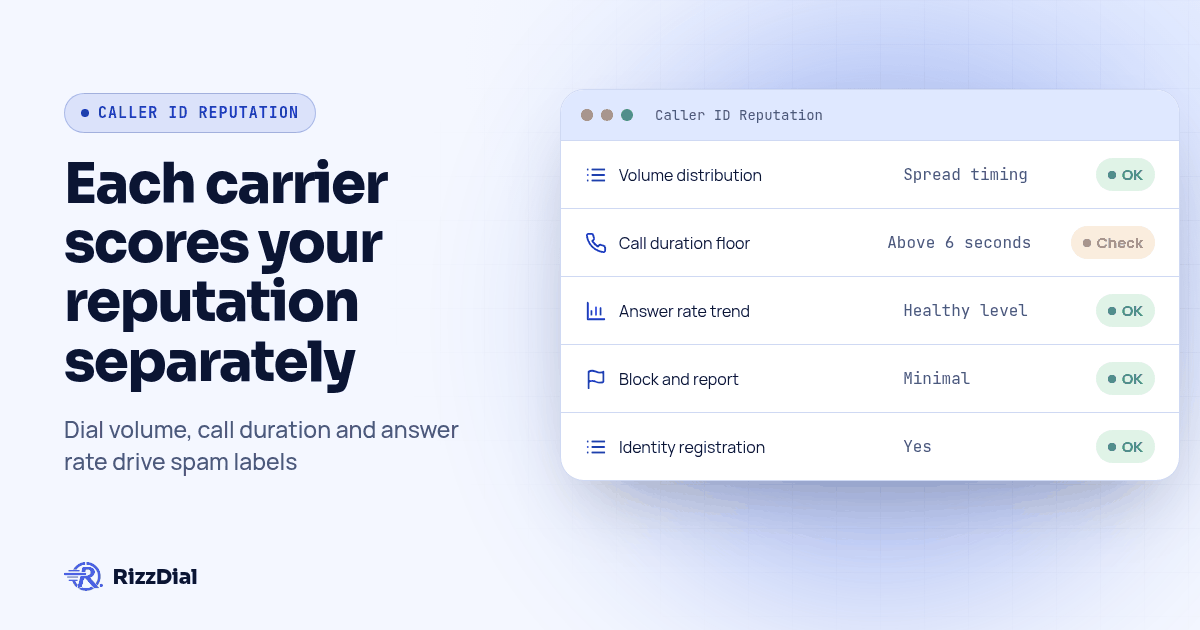
There is no single caller ID reputation score. Several exist, held by different analytics companies and applied by different carriers, which is why one number can ring clean on one prospect's phone and show a spam label on another's in the same hour.
Below: how scoring works, who holds it, how to check, and what a floor policy looks like. If a number is already labeled, see how to fix a Spam Likely label.
Caller ID reputation is a behavioral score that analytics providers maintain for each outbound phone number on behalf of the carriers they serve. It decides whether your call rings clean, rings with a spam label, or never rings at all. Four things a sales team actually controls feed it: caller identity registration, how dials are distributed across your number pool, call quality as measured by duration and recipient reaction, and list quality.
What caller ID reputation is
Caller ID reputation is a behavioral score that carriers and their analytics partners assign to an outbound phone number based on how it is used and how recipients respond. It is not visible to the caller and it determines whether a call arrives clean, arrives labeled as spam, or is filtered before it rings.
The plain definition
Your number is judged on what it does, not who you are: volume, call length, answer rate, recipient pushback.
Who holds the score
Analytics providers assign the scores on behalf of the terminating carrier. USTelecom's industry contact list maps AT&T to Hiya, T-Mobile to First Orion, and Verizon to TNS, and shows other carriers working with Nomorobo, TransUnion, and TNS. Each provider runs its own data and its own decisions.
Spectrum and Verizon both use TNS, yet Spectrum shows "Spam Likely" and Verizon "Potential Spam".
Why there is no single caller ID reputation score
Reputation is fragmented rather than universal. Each analytics provider scores a number using its own data and weighting, so the same number can be clean on one carrier and labeled on another. Device, operating system, and third-party call-screening apps add further variation on top of the carrier score.
The FCC notes that verified caller information reaches a handset only "if the handset and its operating system are configured to permit such presentation" (FCC 25-76).
What reputation is not
Not your business credit or email sender reputation. There is no shared standard, no authority to appeal to, and the score attaches to numbers, not to your company.
What actually moves the score
No carrier publishes its scoring formula. USTelecom's redress guidance says analytics engines weigh the caller's identity, the purpose of the calls, and the extent of negative user feedback. Beyond that, the patterns callers consistently report as damaging are concentrated volume on one number, very short calls, and recipient block and report actions.
Only the marked rows are named in USTelecom's redress recommended practices. The rest is reported operating experience, not carrier doctrine.
| Signal | Direction | Controlled by | How to measure |
|---|---|---|---|
| Volume on one number | Negative | You | Dials per number per day |
| Very short calls | Negative | You, your list | Share under 6 seconds |
| Low answer rate | Negative | You, your list | Connects over dials |
| Block and report | Negative, per USTelecom | Recipients | Label changes after a campaign |
| Registered identity | Positive | You | Status in each portal |
| Purpose and consent | Per USTelecom | You | List provenance |
Volume and pacing
Dials per number per day is what matters, not dials per rep, and a total spread across the day looks different from two blasts.
Answer rate
Answer rate is an input, not just an outcome: a number that dials constantly and is rarely answered describes itself.
Call duration distribution
A floor of sub-6-second calls reads as spam whether or not your operation is, and one discovery call hides fifty disconnects in a mean.
Recipient actions
Block and report is the heaviest negative signal available, and USTelecom confirms negative user feedback is part of what analytics engines weigh.
Caller identity completeness
The FCC's triennial report states that "attestation determinations and other information about calls are used to inform call analytics engines, which providers use to make call blocking and labeling decisions."
Number history
Numbers are recycled, so test every new DID on live handsets before it carries volume.
Dialer mechanics that hurt you
Connection delay, abandoned calls, clipped openings, and one DID carrying a floor are the defaults of an untuned power dialer.
CNAM vs branded caller ID vs reputation scoring
CNAM is the legacy caller name system: the terminating provider queries a third-party database for a name tied to the calling number. The FCC's 2025 call branding proceeding records broad agreement that those databases are error prone and unreliable. Branded calling, built on rich call data, has the caller's own provider transmit a verified name instead.
Buying one does not get you the others.
| CNAM | Branded caller ID and RCD | Reputation scoring | |
|---|---|---|---|
| What it is | Legacy name lookup | Identity sent with the call | Behavioral scoring |
| Controlled by | Database operators | Your provider, a carrier program | Analytics providers |
| Recipient sees | A short name, often stale | Verified name, sometimes a logo | Nothing, or a spam label |
| Does not do | Verify anything | Stop calls being labeled | Explain itself |
| How to get it | Via a carrier or CNAM provider | Via a carrier branding program | Assigned, not bought |
CNAM
The caller's name is not sent with the call; the terminating carrier looks it up (Calling Name Presentation). Asked whether CNAM could deliver verified names, FCC commenters agreed it "should not be used for this purpose because, they asserted, CNAM databases are error prone and unreliable."
Branded caller ID and rich call data
Rich call data, or RCD, is the modern replacement: your own provider transmits the name with the call, authenticated at origination and verified at termination inside STIR/SHAKEN.
Do not treat it as settled infrastructure. The FCC's triennial report calls RCD emerging and notes branded calling needs end-to-end IP connectivity, because legacy TDM equipment strips the data it depends on. In October 2025 the Commission adopted the Call Branding FNPRM, proposing a verified caller name whenever a provider signals a number is unlikely to be spoofed. That is a proposal, not a rule (summary).
Reputation scoring
The analytics layer that decides whether a call is labeled or filtered. It runs on behavior rather than identity, which makes it the layer you can move fastest.
Why having one does not give you the others
Branded caller ID controls what is displayed when a call is presented. Reputation scoring decides whether the call is labeled or filtered in the first place. They are separate systems, so a branded number with poor calling behavior can still be labeled or blocked by the recipient's carrier.
How to check your caller ID reputation
Check each analytics engine separately. Free Caller Registry submits your numbers to Hiya, First Orion, and TNS in one form, and each provider also runs its own registration and lookup portal. The most reliable check is dialing your own numbers from live AT&T, T-Mobile, and Verizon handsets and recording what appears.
Free checks across the three engines
USTelecom's directory lists Free Caller Registry as the one submission point covering First Orion, Hiya, and TNS.
| Provider | Carriers | Where to go | What you can do |
|---|---|---|---|
| Hiya | AT&T | Hiya registration | Register, see spam status |
| First Orion | T-Mobile | First Orion registration | Register and verify free |
| TNS | Verizon, Spectrum, US Cellular | USTelecom directory | Report a mislabeled number |
| Nomorobo, TransUnion | Frontier, Lumen, Sinch | USTelecom directory | Request an exception |
Neither promises immunity. Hiya says so plainly: "Registration reduces the risk of spam or nuisance labels, but it doesn't completely prevent them."
Paid monitoring tools
Judge paid monitors on per-number status, a per-carrier breakdown rather than one blended verdict, alerting on change, and historical trend.
The manual handset test
Keep three live phones on the floor, one per major carrier, and record the exact on-screen string for every number in your pool.
What cadence to check on
Check active outbound numbers weekly, and immediately after any change in dial volume, list source, script, or number pool. No analytics provider publishes how far back its scoring looks, so treat a volume spike as a reason to check that week rather than assuming a long clean history protects the number.
Building a caller ID reputation policy for your sales floor
Almost nobody writes this down, which is why the same companies have the same problem every quarter.
Size your number pool to your dial volume, not your headcount
No carrier or analytics provider publishes a required ratio, and any number you see quoted comes from vendor marketing rather than a carrier. The working principle is to size the number pool to daily dial volume rather than to headcount, distribute dials evenly, and monitor each number individually.
Distribute dials evenly and monitor per number
Rotation spreads dial volume across a pool instead of concentrating it on one number, which removes one common cause of labeling. It does not repair a number that is already flagged. The useful pattern is even distribution across registered numbers, automatic removal of flagged numbers from the pool, and per number monitoring.
Match area code to the calling region honestly
Reasonable when the number is genuinely yours and registered. Rotating fast through many area codes with nothing registered behind them is the failure mode, and disclosure rules vary by state, so read TCPA and FCC compliance first.
Set a rest and retire rule
USTelecom tells callers to "first evaluate their calling practices to assess whether adjustments should be made to calling behavior" before seeking redress. Swap numbers without changing what they do and you burn the replacements too.
- Provision. Acquire the DID, record date and source.
- Register. Submit it to the analytics providers before it dials.
- Warm. Ramp volume over days, not at full rate.
- Monitor. Handset test and portal check weekly.
- Rest. Pull it at the first label while you investigate.
- Retire. Release it if it does not recover, and record why.
Register every number before it dials
Registration is a provisioning step, not a repair step. USTelecom notes businesses "may register in advance of any known blocking or labeling incidents", which both reduces the need for redress and can speed up a later request. This is your own submission, separate from A2P 10DLC.
Instrument the things that drive the score
These metrics are per number, not per team, so export your call data and build the view where you already report (measuring outbound performance).
Tracker columns: number, dials per day, connects and connect rate, share of calls under 6 seconds, median call length, disposition mix, label status per carrier, date last registered, date last handset tested.
Assign an owner and a weekly 20-minute review
Reputation decays quietly, so it needs a named person in sales operations or RevOps. Run the review in this order:
- Pull label status from handset tests on all three carriers.
- Check portal status for any number that changed.
- Review dials per number, flag anything above your ceiling.
- Review short-call share by number.
- Confirm every number in rotation is registered.
- Decide rest, retire, or dispute, and record it.
- Note any campaign, list, or script change that could explain it.
Run it per client if you sell for several businesses. See agencies running outbound for clients.
Fixing a number that is already flagged
Stop dialing from it, confirm the label on live handsets across carriers, then file a redress request with the relevant carrier or analytics provider using the contacts in USTelecom's directory.
USTelecom's recommended practices say providers aim to give an initial status update within 24 hours and to resolve standard requests within up to two business days, with faster handling for critical categories such as emergency and fraud alert calls. Do the behavior review first, because that is what the analytics engine looks at.
The full walkthrough is in our guide to fix a Spam Likely label.
Compliance context you cannot skip
This section is background, not legal advice. Consult qualified counsel about TCPA, state calling laws, disclosure requirements, and consent.
STIR/SHAKEN and attestation
STIR/SHAKEN authenticates that a calling number is legitimately used by the originating provider and assigns an attestation level to the call. It supports caller trust signals but does not override behavioral scoring. Attestation is configured by your voice provider, not by your sales team, so ask your provider what level your calls receive.
The FCC describes attestation as "A, B, or C", reflecting "the level of knowledge the provider asserts it has about its direct customer's identity and that customer's right to use the number transmitted" (fact sheet).
The Robocall Mitigation Database
A provider filing obligation, not a business registry. Per the FCC's triennial report, all providers delivering voice traffic must file certifications about their STIR/SHAKEN status there, so you can look up whoever sits underneath your dialer.
TCPA and consent
Dialing people who did not ask to hear from you produces complaints, and complaints feed the engines that label your numbers. Start with TCPA and FCC compliance for AI calling. None of this is legal advice. On do-not-call handling: in RizzDial a contact marked DNC is honored at the contact level.
The SMS parallel, A2P 10DLC
Messaging has its own identity registration, separate from voice caller ID. In RizzDial, 10DLC registration is self-serve under Setup > 10DLC: for RizzDial numbers the app submits it, and on your own Twilio account you paste your existing brand ID. It is a step you complete, not one done for you, and US SMS goes out under your own A2P brand and campaign. A one-time brand fee and a campaign fee apply; check the current amounts in your provider's pricing page. See A2P 10DLC registration.
What to look for in a dialer
Apply these to any vendor, including us.
- Number pool management. Can you hold a pool and control how dials distribute across it?
- Rotation logic. Is it configurable, and does it skip numbers already flagged?
- Per-number status. Can you see which numbers are flagged, and get alerted on change?
- Local presence. "Matches area code, then state, from numbers you own" is a different product from "every area code".
- Exportable call data. You will build your own per-number views, so export is not optional.
- Caller identity. Ask who signs your calls and who registers your numbers. Usually that second one is you.
- Client isolation. Each client needs its own numbers and its own spam history.
- CRM sync. Reputation work runs on disposition and consent data, so CRM sync has to be reliable.
No dialer clears all eight for every team.
Where RizzDial fits
RizzDial is an AI dialer with predictive, power (1 line), parallel (a rep picks up to 10 lines), AI voice agent calls, and click-to-call. Tier 1 carrier management covers AT&T, Verizon, and T-Mobile. Configurable round-robin rotation across your number pool skips numbers already flagged, and local presence matches area code first and then state, using numbers your account owns. Per-number reputation monitoring with email alerts is an add-on that auto-pulls a flagged number from rotation, and agencies get a separate number pool per client sub-account. A built-in CRM connects to GoHighLevel, HubSpot, Salesforce, and others through integrations, API, and webhooks. Book a demo.
Read why VoIP numbers get flagged and what a carrier number changes.
For practical steps to resolve carrier labels, read how to stop your business number showing Spam Likely.
Frequently asked questions
Can I look up my caller ID reputation for free?
Yes. Free Caller Registry and the individual Hiya, First Orion, and TNS portals are free to submit to, and dialing your own numbers from live handsets on each major carrier costs nothing.
Is caller ID reputation the same as a spam label?
No. Reputation is the underlying score. A spam label such as Spam Likely is one visible consequence of a low score. A number can have a declining score with no label showing yet.
Does rotating phone numbers fix reputation problems?
Not on its own. Rotation spreads volume, which helps, but if the underlying calling behavior does not change the new numbers will follow the same path as the old ones.
Do my numbers need to be registered before I start dialing?
Registration is treated as a provisioning step rather than a repair step. Registering before a number carries volume gives the analytics providers identity data from day one, and USTelecom notes it may also speed up a future redress request.
Does local presence dialing hurt reputation?
Matching area code to calling region is common practice. No analytics provider publishes how it treats area code rotation, so the safe assumption is that a number with no registered identity behind it has nothing working in its favor. Register every number you dial from.
Who should own caller ID reputation inside a sales team?
A named person in sales operations or RevOps, reviewed weekly. Reputation degrades quietly and without an owner the problem is usually discovered only after answer rates drop.
Will improving reputation increase our answer rate?
A clean, correctly identified number removes one barrier to being answered. Answer rate also depends on list quality, timing, offer, and consent, so treat reputation as a prerequisite rather than a lever on its own.
Is this legal advice?
No. This page describes carrier and industry practice. Consult qualified counsel about TCPA, state calling laws, disclosure requirements, and consent.
Want to see how number rotation, flagged-number handling, and per-client isolation work in practice? Book a demo.
For the next step in this workflow, review the power dialer and outbound workflow guide and discuss implementation through the dialer workflow demo.
About RizzDial
RizzDial is the AI outbound sales workspace for teams on GoHighLevel. Power dialing, AI voice agents, SMS automation, and CRM workflows in one platform. Book a demo.