Compliance
Spam Likely: How Outbound Teams Diagnose, Dispute, and Prevent Carrier Spam Labels
Why carriers label business calls Spam Likely, how to file a correction with each carrier, and how outbound teams keep numbers clean.
By James Hill ·
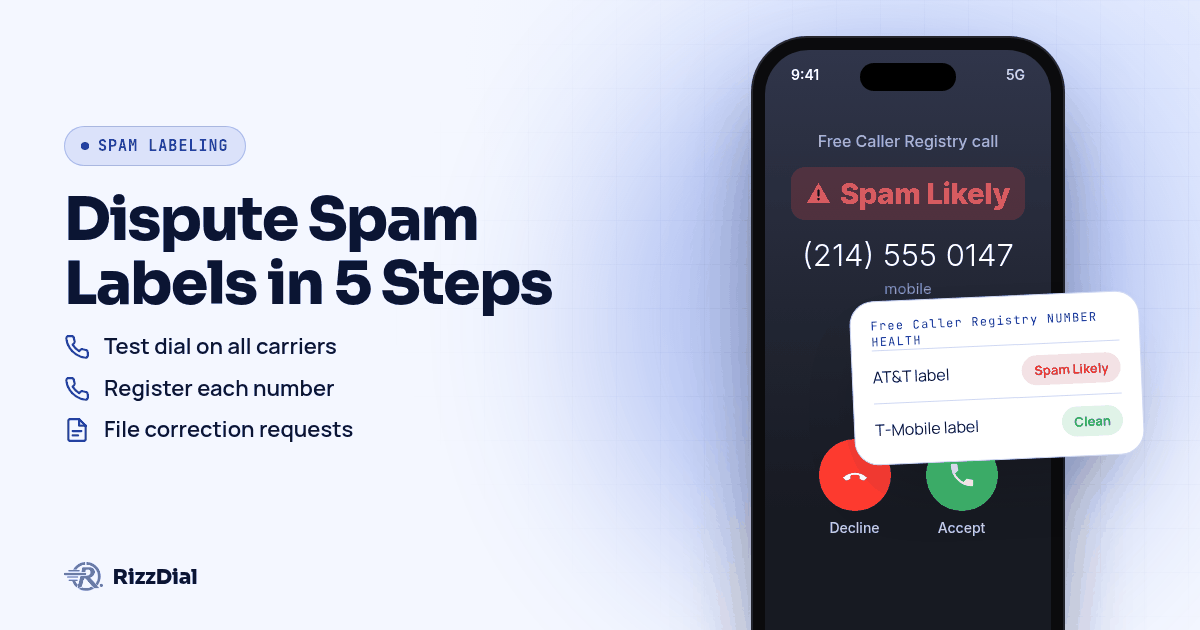
Your reps are dialing the same list as last month and connects have fallen off a cliff. Someone finally calls their own cell from the dialer and sees it: Spam Likely, sitting above your number before the prospect picks up.
Here is the part most guides skip. That label does not come from your phone provider. It comes from the carrier on the receiving end and the analytics partner that scores calls for it, so the fix runs through those partners and through the dialing behavior that got you scored. Removal is possible, never guaranteed. Here is how to check, dispute, and prevent it.
The five-step fix, in order:
- Test dial each outbound number from live AT&T, T-Mobile, and Verizon handsets.
- Register every number with Free Caller Registry, which reaches Hiya, First Orion, and TNS.
- File a correction request with each carrier or analytics partner showing a label.
- Fix what caused it: spread dials across a pool, cut connect delay, clean the list.
- Re-test in two weeks and keep a per-number log.
What Spam Likely actually means
Spam Likely is a warning label that a mobile carrier or its analytics partner adds to an incoming call when its scoring suggests the call may be unwanted. The label is applied by the recipient's carrier, not by the caller's phone provider, and it appears before the recipient answers. Wording varies by carrier.
Who applies the label
USTelecom's Industry Traceback Group publishes the industry's call labeling and blocking points of contact, and that list names the pairings: AT&T with Hiya, T-Mobile with First Orion, Verizon and Spectrum and US Cellular with TNS, Frontier and Lumen with Nomorobo. Your own provider is not on that list for your calls.
Spam Likely vs Scam Likely vs Potential Spam vs blocked
| What the recipient sees | What it means | What happens to the call |
|---|---|---|
| Spam Likely or Potential Spam | Scoring suggests the call is probably unwanted | Connects, warning shows before answer |
| Scam Likely | Stronger warning, scored closer to fraud | Connects, warning shows before answer |
| Call never arrives | Blocked under the provider's blocking program | Never reaches the handset |
Why the same number looks fine on one phone and flagged on another
There is no global reputation score for a phone number. Each analytics engine keeps its own view, so a number can be clean on AT&T and labeled on T-Mobile the same hour.
Why carriers label business numbers
Carriers score outbound numbers on behavior. The FCC has described the analytics signals blocking programs use, including large bursts of calls in a short timeframe, low average call duration, low call completion ratios, sequential dialing patterns, and a large volume of complaints about a line. Unregistered caller identity and recycled numbers add risk.
Calling behavior signals
The FCC's 2019 declaratory ruling lists what reasonable analytics may weigh, including "large bursts of calls in a short timeframe; low average call duration; low call completion ratios; ... sequential dialing patterns". That also describes a sales floor running one number too hard.
Recipient signals
Every in-device block and report action feeds the same engines. Hiya's registration guidance puts it plainly: registration "reduces the risk of spam or nuisance labels, but it doesn't completely prevent them," and "if many people report or block your number, it can still be flagged."
Identity signals
A number with no caller name and no registration gives the engines nothing positive to weigh. FCC rules also require blocking analytics to incorporate caller ID authentication information, so how your calls are signed is one input, not a shield.
Number history
Numbers get recycled. A DID you bought this week may have been dialed hard by someone else last quarter, and industry practice is to treat inherited reputation as real. A new number can be labeled on day one.
The dialer-specific causes most guides miss
- Audible connection delay. The pause before an agent speaks is a classic unwanted-call fingerprint.
- Abandoned calls. Dials that connect and drop produce the short-duration pattern above.
- One number carrying the floor. Ten reps on a single number stack all the volume onto one reputation.
- Repeat dials to non-answering contacts. Redial logic builds a pattern, not a conversation.
Fix the pattern with a power dialer configured to spread load. Dispute without fixing it and you will be back next month.
How to check whether your numbers are flagged
Check each analytics provider separately, because reputation is fragmented rather than universal. Free Caller Registry submits your numbers to Hiya, First Orion, and TNS in one form. For label status, use the carrier reporting contacts published by USTelecom, and test dial your own numbers from live AT&T, T-Mobile, and Verizon handsets.
The free checks
Free Caller Registry is a single form. Hiya describes the registry as maintained by "the three analytics engines that provide data to the major U.S. carriers: Hiya (AT&T), TNS (Verizon), First Orion (T-Mobile)." You can also register directly with Hiya or First Orion. No dialer vendor, RizzDial included, submits these for you.
The manual test that actually tells you the truth
Get one active handset on each of AT&T, T-Mobile, and Verizon, dial every outbound number to each, and photograph the call screen. Portal lookups show what a provider has on file. A photograph shows what a prospect sees.
Build a number status sheet
Track eight columns per number: number in E.164 format, source and purchase date, rep or campaign, date last test dialed, label seen on each carrier, dispute date and portal, case reference, outcome and re-check date.
How to file a correction with each carrier
There is no single removal switch. File a correction request with each carrier's analytics partner: AT&T through att.com/reviewmycalllabel, T-Mobile through callreporting.t-mobile.com, and Verizon through voicespamfeedback.com or TNS. Register the numbers at Free Caller Registry first, then correct the calling behavior that caused the label.
Register first, dispute second
If an unregistered number gets cleared, the engines still hold no positive identity for it, so the next volume spike scores against a blank record.
Free Caller Registry
One submission, three engines. Numbers are submitted per number, though you can list several in one form, and numbers added later are not covered retroactively. Hiya states the process "does not guarantee that these numbers will never be labeled as spam again."
Carrier-by-carrier dispute table
From the USTelecom points of contact list, checked 24 September 2026. Every row is a place you file your own dispute.
| Carrier or provider | Analytics partner | Where to file |
|---|---|---|
| AT&T | Hiya | att.com/reviewmycalllabel |
| T-Mobile | First Orion | callreporting.t-mobile.com |
| Verizon | TNS | voicespamfeedback.com |
| Comcast Xfinity | n/a | Xfinity blocking error report |
| Spectrum | TNS | reportspam.spectrum.com/charter |
| Frontier | Nomorobo | nospam@ftr.com |
| Lumen | Nomorobo | nomorobo.com/contact |
| US Cellular | TNS | communications@tnsi.com |
| C Spire | TNS | askus@cspire.com |
| Altice | n/a | robocallmitigation@alticeusa.com |
| Midco | n/a | robocalling@midco.com |
| Windstream | n/a | Windstream.Robocall.Mitigation@windstream.com |
| Big River | n/a | 855-244-7483 |
| Fidelity | n/a | Correction form on fidelitycommunications.com |
| Telzio | n/a | support@telzio.com |
| Truecaller | n/a | support@truecaller.com |
| Sinch | n/a | iq-noc@sinch.com |
What to include in a dispute so it does not bounce
- Registered legal entity name, exactly as filed
- EIN or equivalent registration number
- The affected numbers, in E.164 format
- What the calls are for
- Your consent basis for calling those contacts
- Expected daily dial volume per number
- A working website matching the entity name
- An email address a human monitors
How long it takes and what to expect
Timelines are not standardized. The FCC requires providers that block calls to give a status update on a blocking dispute within 24 hours, but it declined to adopt redress requirements for labeling, so label reviews run on each analytics provider's own schedule. Expect to follow up.
Blocking vs labeling: why your rights are different
A blocked call and a labeled call are not the same thing. Blocking stops the call from reaching the recipient. Labeling lets the call connect but displays a warning such as Spam Likely or Scam Likely. FCC redress rules address blocking disputes; labeling remediation is voluntary.
What the FCC requires for blocking disputes
In its 2020 call blocking order, the Commission required providers "to respond to blocking disputes they receive through their established point of contact by providing a status update to the party that filed the dispute within 24 hours".
What the FCC does not require for labeling
The same order carries a section headed "No Redress Requirements for Labeling." The Commission declined "to adopt redress requirements for labeling because the record does not demonstrate a significant problem with mislabeling that would warrant additional requirements at this time."
What that means practically for a sales team
Your dispute is a request, not a claim, granted on your identity evidence and calling record. This page describes carrier and industry practice and is not legal advice: consult qualified counsel about TCPA, state calling laws, and consent, and see our guide to TCPA and FCC compliance for AI calling.
Preventing the label from coming back
No provider can promise permanent removal. Registration and dispute filings reduce risk, but analytics scores refresh continuously based on new calling behavior, so a cleared number can be labeled again. Hiya, which runs the analytics engine behind AT&T, says registration does not guarantee a number will never be labeled again.
Spread dials across a number pool and monitor each number
Analytics providers score calling patterns rather than a fixed daily count, so there is no published safe number of dials per number. Tolerance depends on answer rate, call duration, list quality, and complaint volume. Outbound teams spread dials across a pool of numbers and monitor each number's label status.
Register caller identity properly
Caller name presentation and analytics registration are arranged directly with your carrier, your caller name provider, or the registries. Branded calling, where a business name renders on the handset, is a separate product bought from those providers. RizzDial supplies none of them. What you control is consistency: one entity name, one website, one set of registered numbers. Our guide on caller ID reputation covers the identity side.
Fix list quality and consent before fixing numbers
Bad lists generate block-and-report behavior, and no registration survives that. Run this before you dial:
- Remove contacts with no documented consent basis
- Suppress anyone who asked not to be called, on every list
- Deduplicate so one person is not called by three reps
- Validate numbers and drop disconnected lines
- Cap redials per contact
- Dial inside the recipient's local hours, not yours
- Identify who you are in the first ten seconds
Consent and calling-hours rules are legal questions, and this is not legal advice: see TCPA and FCC compliance for AI calling.
Raise answer quality, not just answer rate
A floor optimizing purely for dial count produces exactly the pattern the FCC signal list describes. A floor optimizing for conversations produces a healthier profile. Our guide to measuring outbound performance covers what is worth tracking.
Understand what STIR/SHAKEN attestation is (it does not stop labels)
STIR/SHAKEN does not stop spam labels. It authenticates that a calling number is legitimately used by the originating provider and assigns an attestation level to the call. The FCC describes that authentication information as something analytics may incorporate alongside other factors, so a number can carry full attestation and still be labeled.
The FCC's 2024 order defines the levels: A-level, or "full," attestation requires the provider to have originated the call, to have a direct authenticated relationship with the customer, and to have a verified association with the number. B-level, or "partial," requires only the first two, and C-level, or "gateway," only that the provider is the call's entry point. The originating provider attests, not you.
What the Robocall Mitigation Database is
The Robocall Mitigation Database is an FCC filing system where voice service providers certify the extent to which they have implemented STIR/SHAKEN and describe their robocall mitigation programs. It is an obligation on providers, not a registry businesses join. Your voice provider files, you do not.
The FCC expanded that requirement to all providers, covering implementation status and the steps taken against illegal robocall traffic.
Retire and rest numbers deliberately
Retire a genuinely burned number rather than pushing it back into rotation, and record the retirement so nobody reassigns it later. Rotating without changing the behavior just burns the next one.
A 30-day remediation plan for an outbound team
Four weeks covers one cycle. Results vary, and some labels will not clear on the first pass.
| Week | Actions | Owner | Output |
|---|---|---|---|
| 1 | Inventory numbers, test dial from three carriers, build the status sheet, register | Sales ops | Per-number label picture |
| 2 | File corrections with every carrier showing a label, using the full field list | Sales ops | Dispute references logged |
| 3 | Spread dials across the pool, cut connect delay, pull flagged numbers, clean lists | Sales manager, ops | Revised config, clean lists |
| 4 | Re-test from the same handsets, update outcomes, retire what did not clear | Sales ops | Updated sheet, monthly re-check |
Make the week 4 re-check permanent: reputation is a moving score, so a one-time cleanup expires. Re-check monthly.
Special cases
Agencies running numbers for multiple clients
Registration is tied to a legal entity, so an agency cannot register client numbers under its own brand identity. Each client registers under its own entity, EIN, and website. On the infrastructure side, RizzDial supports per-client sub-accounts, each in its own Twilio sub-account, so one client's number pool and spam data stay separate from another's.
Toll-free numbers vs local numbers
Toll-free numbers can be labeled and filtered too, and they follow a separate verification and remediation path from local numbers. That path runs through the provider of the toll-free service.
If you are dialing through GoHighLevel
Know who the provider of record is for the numbers in your sub-account: that determines who signs your calls and where the numbers came from. Our guide to dialing through GoHighLevel covers the number layer, with a deeper integration walkthrough for setup.
The SMS-side equivalent is A2P 10DLC registration. In RizzDial, 10DLC registration is self-serve under Setup > 10DLC: not automatic, not done for you, and your US SMS sends under your own brand and campaign. A one-time brand fee and a campaign fee apply; check current amounts in your provider's pricing page.
Where RizzDial fits
A dialer cannot remove a carrier label. What it can do is spread dials across a pool of numbers, skip numbers already flagged, and alert you when a number's reputation changes. RizzDial rotates numbers round robin and offers per-number reputation monitoring as an add-on. Registration and disputes stay your job.
- Round-robin number rotation across your account's number pool, configurable, and it skips numbers that have been flagged.
- Per-number reputation monitoring with email alerts, which automatically pulls a flagged number out of rotation. Available as an add-on.
- Local presence dialing that matches the prospect's area code first, then falls back to state, using numbers your account already owns.
- Per-client sub-accounts, each in its own Twilio sub-account, so number pools and spam data stay separate per client.
All four reduce how often one number takes a whole floor's dials. None remove a label by themselves. RizzDial also adds Tier 1 carrier management across AT&T, Verizon, and T-Mobile, predictive, power, parallel, and AI dialing, and a built-in CRM. Start with the AI dialer or book a demo.
Read why VoIP numbers get flagged and what a carrier number changes.
For a complete remediation plan, see how to stop your business number showing Spam Likely, with carrier guides for AT&T Spam Risk, Verizon Potential Spam, and T-Mobile Scam Likely.
Frequently asked questions
Is Spam Likely the same as Scam Likely?
No. They are different labels from different carriers and analytics partners, and Scam Likely generally indicates a stronger negative signal. Both are applied by the recipient's carrier, not by your provider.
Does registering with Free Caller Registry guarantee my calls will not be labeled?
No. Registration is intended to reduce the risk of blocking or labeling, not to remove it. Hiya, the analytics engine behind AT&T, states that the process does not guarantee numbers will never be labeled as spam again.
Do I have to register each phone number separately?
Registration is submitted per number, though you can submit several in one form. Numbers added later are not covered retroactively, so update your submission whenever you add DIDs.
Will buying a new phone number fix the problem?
Not reliably. Recycled numbers can arrive with existing reputation, and if the behavior that caused the label does not change, the replacement will usually be labeled too.
Can my VoIP provider or dialer remove the label for me?
No. The label is applied by the recipient's carrier and its analytics partner, so the correction request goes to them and you have to file it. A dialer can rotate away from flagged numbers and watch reputation, but it cannot clear a label.
Does the FCC require carriers to remove an incorrect label?
No. The FCC's 2020 call blocking order requires providers that block calls to give a status update on a blocking dispute within 24 hours, but the same order declines to adopt redress requirements for labeling.
Do toll-free numbers get labeled too?
Yes, toll-free numbers can be labeled or filtered, and they follow a different verification and remediation path than local numbers.
Is any of this legal advice?
No. This page describes carrier and industry practice. Consult qualified counsel about TCPA, state calling laws, and consent obligations.
Want to see rotation and reputation monitoring on a live account? Book a demo.
For the next step in this workflow, review the power dialer and outbound workflow guide and discuss implementation through the dialer workflow demo.
About RizzDial
RizzDial is the AI outbound sales workspace for teams on GoHighLevel. Power dialing, AI voice agents, SMS automation, and CRM workflows in one platform. Book a demo.