GoHighLevel
GoHighLevel A2P 10DLC Registration: Agency Checklist and Rejection Fixes
A step by step A2P 10DLC checklist for GoHighLevel agencies, plus the common brand and campaign rejection reasons and how to fix each one.
By James Hill ·
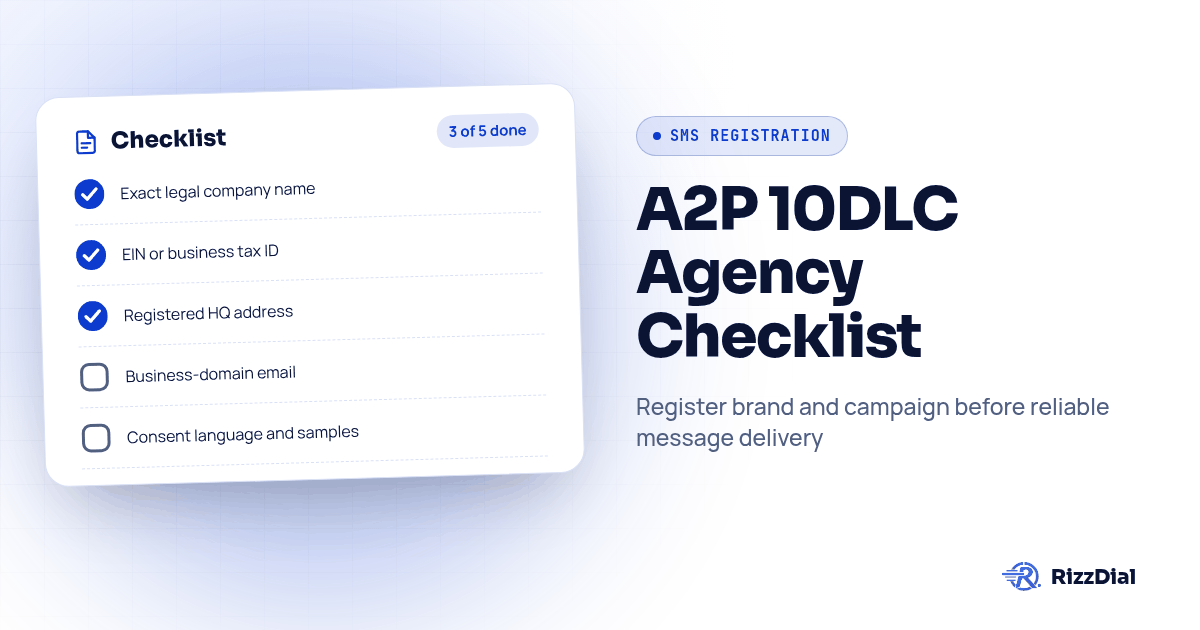
Two people land here. Registering for the first time, start with the agency intake checklist. Already rejected and staring at an error code, jump to the rejection table.
HighLevel's help center is the source of truth for the interface and current error codes, and this page links to it at every step. What it does not cover is the agency job: registering twenty client sub-accounts and knowing which rejection is worth fixing. Everything below was verified on 2026-09-24.
Answer first: A2P 10DLC is the carrier registration framework for business SMS and MMS sent to US recipients from standard 10-digit local numbers. You register a brand first, which identifies the business, then a campaign, which describes what you send and why. In GoHighLevel both live inside the sub-account under Settings, Phone System, Trust Center, A2P Messaging. Nothing delivers reliably until both are approved.
What A2P 10DLC registration is
A2P 10DLC is the carrier registration framework for application-to-person SMS and MMS sent to US recipients from standard 10-digit local phone numbers. Registration has two parts: a brand, which identifies who is sending, and a campaign, which describes what is being sent and why. Both must be approved before messages deliver reliably.
Brand vs campaign
A brand is the verified business identity responsible for the messages. A campaign describes the messaging use case, sample content, and consent method. One approved brand can support multiple campaigns, but every campaign is reviewed separately.
| Brand | Campaign | |
|---|---|---|
| Answers | Who is sending | What is sent and why |
| Verifies | Legal entity against official records | Use case, consent, content |
| You supply | Legal name, EIN, entity type, HQ address | Use case, samples, opt-in evidence, policy URLs |
| Reviewed | Once per legal entity | Per campaign, and on resubmission |
Who has to register
Any business sending SMS or MMS to US recipients from standard 10-digit local numbers. HighLevel's summary article counts appointment reminders and account notifications as covered traffic. Transactional does not mean exempt.
What happens if you do not register
Your messages compete for delivery without the trust signals carriers use to decide. Microsoft's 10DLC guidelines note that campaign data lets carriers route and filter by campaign type, and CTIA's Messaging Principles says senders who ignore them risk being blocked or filtered. Blogs quote a hard date when unregistered traffic started being blocked; no primary source reviewed here publishes one.
Where The Campaign Registry fits
TCR holds 10DLC brand and campaign data and you cannot register with it directly. Its site states: "Currently, direct registration with TCR is not available for Brands. Instead, you must work with one of the registered messaging service providers (CSP)." HighLevel is that layer, and TCR's resources page adds that TCR does not review, approve, or reject campaigns.
What A2P 10DLC does not cover
Toll-free numbers and short codes sit outside this process. HighLevel states that toll-free numbers follow a separate toll-free verification process instead of A2P brand and campaign registration, and short codes are a third path again.
Does iMessage or RCS avoid A2P registration
A2P 10DLC registration is defined by what you send and over what number: SMS and MMS to US recipients over standard 10-digit long codes. Adding another messaging channel does not change the registration status of the SMS your business still sends.
For a related channel comparison, Beam explains iMessage texting and A2P registration.
Before you open the Trust Center: the agency intake checklist
Collect every field below from the client before anyone touches the Trust Center. Most agency rejections are intake mistakes, not interface mistakes, and fixing intake once stops you repeating the same one twenty times.
Legal identity
- Exact legal company name as registered with the IRS
- EIN or tax ID
- CP 575 letter on file (yes or no)
- Entity type: private, public, nonprofit, government, sole proprietor
- Registered HQ address, not a branch
- Stock ticker and exchange, if public
Contact
- Authorized representative name and title
- Business-domain email address
- Direct phone number
Web presence
- Live website URL showing business name and contact details
- Privacy policy URL, public, no login
- Terms and conditions URL
- Age gate, where required
Messaging
- Use case: marketing, informational, or mixed
- Opt-in mechanism and where it is evidenced
- Full consent language shown at opt-in
- 3 to 5 sample messages, distinct and realistic
- Opt-out handling and confirmation text
The mistakes that come from skipping this
Five recur constantly: the DBA instead of the legal name, a personal Gmail on a standard brand, an EIN issued last week, the storefront address instead of the registered HQ, and a dead privacy policy link. HighLevel's brand approval recommended practices warns that a branch address can produce a mismatch that hurts your Trust Score.
Step by step: registering a brand in GoHighLevel
In a GoHighLevel sub-account, open Settings, select Phone System under Business Services, then open the Trust Center tab and start registration under A2P Messaging. Brand registration comes first, then campaign registration. HighLevel documents every field and the current interface, verified 2026-09-24.
Standard brand vs sole proprietor
A sole proprietor brand is for senders without a tax ID. HighLevel documents that it requires a public-domain email address such as Gmail or Yahoo, a US or Canada mobile number for one-time-password verification, and one phone number per campaign.
| Standard brand | Sole proprietor brand | |
|---|---|---|
| Requires | EIN or other business registration number | No tax ID, one employee |
| Business domain | Public domain (Gmail, not Google Workspace) | |
| OTP | Not required here | US or Canada mobile required |
| Numbers | Multiple numbers and campaigns | 1 number per campaign |
| Throughput | Greater, wider use cases | Lower limits, stricter restrictions |
The OTP trap for sole proprietors
This is where sole proprietor registrations die. HighLevel is explicit that VoIP, LeadConnector, and other CPaaS numbers are not accepted for OTP, and that one mobile can serve up to three registrations under carrier limits.
Identity verification
HighLevel documents two methods here: Persona identity verification, or email OTP confirming you control the contact address. Have the authorized representative on hand, because an unanswered email stalls everything.
EIN age
A brand-new EIN is one of the most common brand rejections. HighLevel states that EINs issued within the last 15 days may be rejected because the information has not propagated to verification systems, and advises waiting 30 to 90 days from the issue date before retrying.
Brand fees
Registration is not free. A one-time brand fee and a campaign fee apply, plus recurring monthly campaign fees and per-message carrier fees, all passthrough from The Campaign Registry, Twilio, and mobile carriers. Check current amounts in HighLevel's fees article.
Step by step: registering a campaign in GoHighLevel
Campaign registration runs in six stages and the rejection risk sits in the last three. HighLevel's campaign registration guide lists them as: select messaging volume, choose chat widget or manual setup, complete setup details, provide consent details, complete the website compliance checklist, then run the AI compliance review.
Low volume vs high volume standard brand
Throughput depends on brand type and volume selection. HighLevel documents low volume standard brands at up to 6,000 SMS segments per day and high volume standard brands at up to 600,000 SMS segments per day, verified on 2026-09-24.
Plan in segments, not messages: a long message splits into several, so detailed follow-ups hit the ceiling sooner than the headline suggests.
Use case selection
Three categories are offered: marketing and promotional, informational and non-marketing, or mixed. Mixed looks like the safe hedge and is not, because HighLevel automatically sets it to Low Volume Mixed. Agencies pick it to stay flexible, then find they capped their throughput.
Writing sample messages that pass
Samples must identify the sender, align with the use case, and include opt-out language, and HighLevel says not to include custom fields or merge values. Its campaign approval recommended practices adds that a campaign should tell one consistent story across identity, use case, samples, opt-in flow, and website, and to avoid public URL shorteners.
Opt-in and consent language
Five elements must appear in the consent language you submit: program or company identification, message frequency, message and data rate disclosure, HELP instructions, and STOP instructions. Where consent is collected somewhere a reviewer cannot reach, HighLevel asks for accessible evidence of what the recipient sees.
The website compliance checklist
The reviewer opens the client's website logged out. HighLevel requires the URL to work, the opt-in page to be reachable if website opt-in is used, and the privacy policy and terms to be public. Open the site in a private window first.
Rejection reasons and how to fix each one
HighLevel groups campaign rejections into opt-in and consent issues, website problems, business identity mismatches, and use case problems, each with specific error codes. A single campaign can carry more than one rejection reason, so every listed item must be opened and corrected before you resubmit.
The table restructures HighLevel's campaign rejections and required fixes article by what you should actually do. Codes change, so open the article first.
| Category | Error codes | What it means | The fix | Resubmit? |
|---|---|---|---|---|
| Opt-in and consent | 30887, 30890, 30896, 30909, 30913, 30917, 30923 to 30925, 30931, 30932 | Call to action unverified, marketing consent not separate, opt-in undisclosed | Evidence the opt-in flow, separate marketing consent, update the privacy policy | Yes |
| Website | 30888, 30891, 30907, 30908, 30919 to 30922 | Business info missing, pages behind a login, dead URLs, no age gate | Publish business details, remove login walls, fix URLs | Yes |
| Business identity | 30881, 30894, 30903, 30914, 30915, 30918, 30926, 30927, 30971, 30972 | Name mismatch, DBA used for legal name, personal email, unauthorized contact | Align name, EIN, address, contact with campaign materials | Yes |
| Campaign use case | 30886, 30889, 30892, 30893, 30895, 30898, 30910 to 30912, 30916, 30928 to 30930, 30995 | Non-English text, duplicate samples, vague description, shorteners | Unique samples, detailed use case, full HTTPS URLs | Yes |
| SHAFT | 30953 to 30958 | Sex, hate speech, alcohol, firearms, tobacco | Disqualification | No |
| Disallowed content | 30940 to 30952 | Cannabis, drugs, loans, debt collection, gambling, sweepstakes, stocks, crypto, MLM | Disqualification | No |
| High risk | 30959 to 30964 | Fraud, phishing, domain reputation, deceptive practices, HTTP URLs | Disqualification | No |
This page describes carrier, registry, and platform requirements as documented on 2026-09-24. It is not legal advice.
Which rejections cannot be fixed by resubmitting
Rejections for SHAFT content, disallowed content such as cannabis, loans, gambling, cryptocurrency, and multi-level marketing, and high-risk content such as fraud and phishing are documented as ineligible for standard resubmission. Confirm current classifications before advising a client.
Resubmission rules
Address every listed reason before resubmitting, because one campaign can carry several. HighLevel documents that the use case and opt-in message may not be editable on resubmission, which can force a new campaign, and its fees article states that no additional vetting fee is charged.
Maximum 3 Tries Exhausted
HighLevel documents that after a "Maximum 3 Tries Exhausted" status, the next step is submitting the CP 575 EIN confirmation letter through the support form rather than resubmitting the campaign again.
Brand approval recommended practices
Most brand rejections trace back to four fields, all covered in HighLevel's brand approval article.
- Legal name. Exactly as registered with the IRS on the CP 575, not the DBA, and not taken from a W-2 or W-9. If the CP 575 is lost, request a 147c letter.
- EIN. US-presence customers must use an EIN for a standard brand. A DUNS number is not acceptable for US companies, and the article warns against registering with an SSN.
- Address. The official registered company address, not a branch.
- Public companies and nonprofits. Ticker and exchange must match available sources; for nonprofits the EIN must match the name on the relevant tax-exempt list.
Pre-submission QA: ten checks before you hit submit
Each check maps to the rejection category it prevents.
- Legal name matches the CP 575 character for character (identity).
- EIN is at least 30 days old (brand).
- Address is the registered HQ, not a branch (identity).
- Contact email is on the business domain (identity).
- Website loads in a private browsing window (website).
- Privacy policy and terms load with no login (website).
- Business name and contact details appear on the site (website).
- Opt-in page or consent evidence is reachable by a stranger (opt-in).
- Consent language has all five required elements (opt-in).
- Samples are unique, name the sender, carry opt-out text, no merge fields (use case).
Running A2P across many client sub-accounts
An agency can do the submission work, but the brand has to reflect the client's own legal entity, tax ID, and registered address, because registration verifies that information against official records. Every brand is filed through a campaign service provider.
Registration is per legal entity, not per agency
Each client registers as its own brand under its own EIN. You cannot roll clients under your agency's identity.
Standardize the intake before you scale it
One form, one reviewer, one pass before anything is submitted. The discipline that keeps a white label setup for agencies clean applies here.
Build reusable templates, not reusable text
A template is a structure to fill, not copy to duplicate. Standardize the shape of a good sample (sender name, specific offer, opt-out line) and write fresh copy per client.
Fix the client's website before submitting
Website problems are the category agencies control most directly and check least often. Open the site logged out before you submit.
Track submissions in one place
Ten clients in flight is too many to track in your head. Use these columns.
| Column | What goes in it |
|---|---|
| Client | Sub-account name |
| Legal entity | Exact name as filed |
| Brand status | Not started, submitted, approved, rejected |
| Campaign status | Not started, pending, approved, rejected |
| Submission date | When the current attempt went in |
| Rejection codes | Every code returned, not just the first |
| Fix owner | Named person, agency or client side |
| Resubmission date | When the correction went back |
| Approval date | Closes the row |
Vet the vertical before onboarding
Loans, cannabis, gambling, crypto, and MLM offers are documented as ineligible content, so screen for them at the sales call. The same diligence belongs in how you evaluate AI dialers for GoHighLevel agencies.
Who pays the fees
Decide once and write it into onboarding: does the client pay registration and campaign fees directly, or do you front them and rebill? Ambiguity becomes an argument at the first resubmission.
After approval: staying deliverable
Approval is a state, not a finish line. A campaign approved for appointment reminders that starts pushing promotional blasts has diverged from what was registered, and filtering responds to behavior.
Honor opt-outs across campaigns
CTIA's messaging guidance set the expectation that senders obtain consent and honor STOP requests, and the direction of travel is that someone who opts out of one program should not keep hearing from you through another. Your obligations under TCPA and FCC compliance rules are separate and stricter. This is not legal advice; consent scope is for counsel.
Keep messages matching the registered use case
Re-read your campaign description once a quarter against what your team actually sent last month. If they have drifted apart, update the registration or change the sending.
The voice-side parallel
Messaging and calling are the same problem in two channels. If you run outbound calls too, read caller ID reputation, spam labels on outbound calls, and the GoHighLevel dialer overview. STIR/SHAKEN is a call authentication framework and caller ID registries are third-party databases: neither is A2P registration, and no A2P approval affects them.
Where RizzDial fits
All verified on 2026-09-24.
Self-serve 10DLC registration in the app
RizzDial offers self-serve 10DLC registration inside the app under Setup then 10DLC. For RizzDial numbers, the app submits your brand and campaign registration after you supply the details. If you bring your own Twilio account, you paste your existing brand ID.
You still gather the legal name, EIN, CP 575, address, and consent evidence. See SMS automation, plus the GoHighLevel integration guide and integrations.
US SMS sends under your own brand and campaign
Yes. US SMS sent through RizzDial goes out under your own A2P brand and campaign, not under a shared platform registration. That means your brand and campaign approval status directly governs whether your messages deliver. Register before you start sending, and keep the registered use case matching what you actually send.
The voice side, stated accurately
RizzDial rotates outbound numbers round robin (configurable) and skips numbers marked as flagged. Per-number reputation monitoring with email alerts, which pulls a flagged number out of rotation automatically, is available as an add-on. Each client sits in its own sub-account, so number pools stay separate.
Local presence matches area code, then state, from numbers the account already owns. Answering machine detection is available, reporting covers call counts by status with CSV export, and calls run through Twilio.
What to say about DNC
A contact marked DNC in RizzDial is honored at the contact level.
Frequently asked questions
How long does A2P 10DLC approval take in GoHighLevel?
HighLevel does not publish a guaranteed timeframe, and campaigns stay in Pending until review completes. Its guidance is to wait rather than resubmit, because extra verification or manual review can extend it.
Does A2P 10DLC registration cost money?
Yes. HighLevel documents a one-time brand registration and campaign vetting charge, recurring monthly campaign fees, and per-message carrier fees, all passthrough from The Campaign Registry, Twilio, and mobile carriers. Check HighLevel's current fees article for the amounts.
Can I use a DUNS number instead of an EIN?
No. HighLevel's brand approval guidance states that a DUNS number is unacceptable for US companies creating standard A2P brand registrations, and that US-presence customers must use an EIN. It also warns against registering with a Social Security number.
My EIN is brand new and keeps getting rejected. What do I do?
Wait. HighLevel documents that EINs issued within the last 15 days may be rejected because the information has not propagated to verification systems, and advises waiting 30 to 90 days from the issue date.
Do toll-free numbers need A2P 10DLC registration?
No. HighLevel states that toll-free numbers follow a separate toll-free verification process instead of A2P brand and campaign registration. Both paths establish sender identity, but the requirements differ.
Does sending through iMessage or RCS exempt me from A2P?
No. A2P 10DLC registration covers the SMS and MMS your business sends to US recipients over standard 10-digit long codes, and no primary document reviewed here shows another channel removing that obligation.
Can I reuse the same sample messages across client campaigns?
No. Duplicate sample messages are a documented rejection cause in HighLevel's campaign use case category. Standardize the structure of your submissions, but write distinct samples for every campaign.
Is this legal advice?
No. This page describes carrier, registry, and platform requirements as documented on 2026-09-24. Consult qualified counsel about TCPA, state messaging laws, and consent obligations.
Does RizzDial register A2P 10DLC for me?
Not automatically. RizzDial includes self-serve 10DLC registration in the app under Setup then 10DLC, where you enter your own brand and campaign details. If you use your own Twilio account you paste in your existing brand ID.
How does RizzDial handle do-not-call contacts?
A contact marked DNC is honored at the contact level.
Get the intake right, screen the vertical early, and fix the client's website before you submit. More GoHighLevel material on the blog.
Not legal advice. Re-verify every linked HighLevel article before acting on it.
Review RizzDial security and data handling for consent tools and self-serve registration context.
For the next step in this workflow, review the gohighlevel voice ai guide and discuss implementation through the GoHighLevel calling setup.
About RizzDial
RizzDial is the AI outbound sales workspace for teams on GoHighLevel. Power dialing, AI voice agents, SMS automation, and CRM workflows in one platform. Book a demo.