Compliance
Five9 Contact Center ANI Flagged as Spam Risk
Five9 ANI showing Spam Risk, Potential Spam or Scam Likely? See what Five9's own tools fix, what they do not, and the steps that actually help.
By James Hill, Founder, RizzDial ·
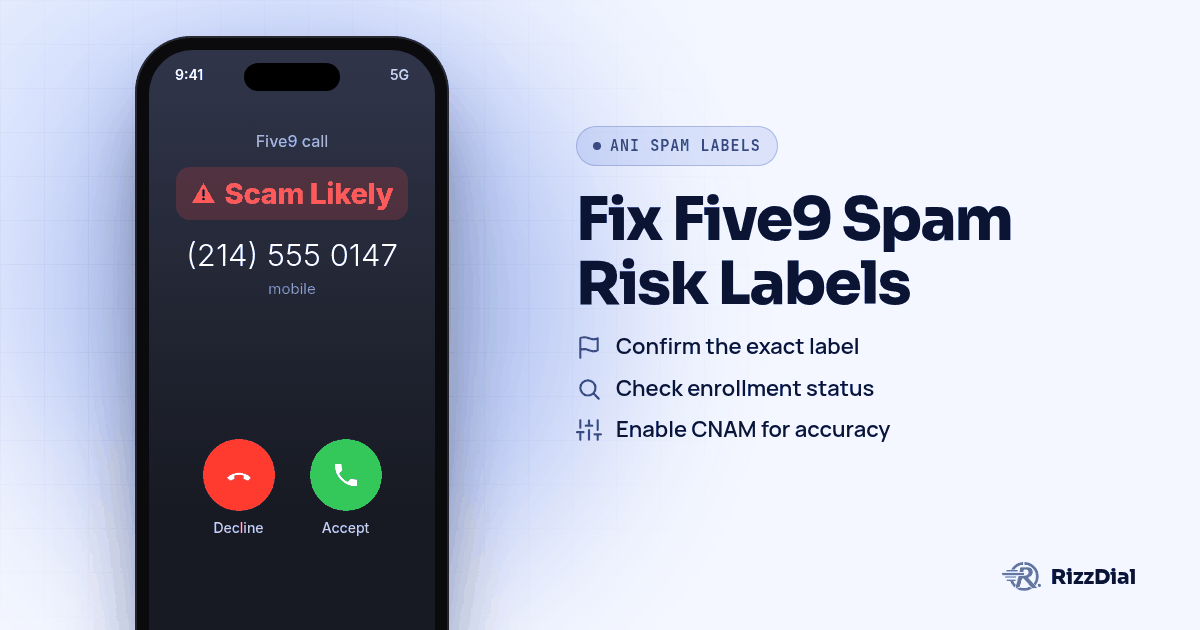
An agent dials out through Five9, the recipient's phone flashes Spam Risk or Scam Likely, and the call dies before anyone picks up. Nothing in Five9's console shows the number as broken. The label lives with the receiving carrier's analytics vendor, and Five9's own tools, Number Reputation Management, STIR/SHAKEN support, and CNAM, reduce how often that happens without any one of them acting as an override switch. Fixing it means knowing which lever Five9 actually controls and which one belongs to the carrier.
Why Does a Five9 ANI Get Labeled Spam Risk, Potential Spam, or Scam Likely?
Every outbound call carries an ANI, the number the receiving network identifies as the origin, and each major carrier runs that ANI through its own labeling system regardless of which platform placed the call. AT&T's ActiveArmor sets fraud calls to Block automatically and labels spam calls "when possible," sorting them into categories such as Telemarketers, Political, Account services, Nonprofits, and Surveys, per AT&T's support page on Call Protect. Verizon's spam feedback site lists Potential Spam, Potential Fraud, Robo caller, and SPAM? as the labels it uses, per Verizon's voice spam feedback page, and its Call Filter FAQ defines Potential Spam as unwanted callers that may be calling indiscriminately or inappropriately to a large number of recipients, according to Verizon's own Call Filter FAQ. T-Mobile's Scam Shield includes Scam Likely tagging and Potential Spam identification as part of its free protection suite for T-Mobile customers, per T-Mobile's benefits page.
None of those three systems ask Five9 for permission first. A contact center ops lead running campaigns across a pool of ANIs can watch one number get flagged on Verizon while the same number looks clean on T-Mobile, because each carrier's analytics vendor scores independently. That split is exactly why a single fix inside Five9 never resolves every label on every carrier at once; the labeling happens downstream, where Five9's calls hand off to the PSTN, not inside the dialer. The mechanics behind T-Mobile's Scam Likely tagging specifically, including who actually runs the detection behind it, get their own breakdown in the T-Mobile Scam Likely and First Orion guide.
What Can Five9's Own Tools Do About a Flagged ANI?
Five9's main lever is what it calls Number Reputation Management. Five9 says that registering your numbers and verifying your ownership and compliant use of them with the major wireless carriers and analytics engines "removes" improper labels already on the number and protects it going forward, and that if a label still shows up afterward, the fix is a remediation process at the carrier level that Five9 handles for the customer, according to Five9's writeup on phone number reputation strategy. That same article frames the goal as getting calls delivered label free and actually reaching the person being called, rather than just looking clean on paper.
Separately, Five9 says customers using Five9-provided phone numbers are automatically compliant with the STIR/SHAKEN mandate and get A-level attestation of call identity with no extra cost or action, and that Five9 has filed as a carrier with the FCC directly, according to Five9's STIR/SHAKEN announcement. The Five9 Certified Caller Solution brief describes automatic support for STIR/SHAKEN standards through Five9's own telephony capabilities as a way to build trust with customers and stay inside FCC policy, per Five9's resource brief. CNAM sits alongside that, letting the platform display a caller name tied to the number, which Five9 describes as helping agents identify callers and reducing the odds of the number reading as spam or fraud, per Five9's CNAM explainer.
Underneath all of that is ANI itself, the network level identifier Five9 uses to match incoming calls to CRM records, route them to the right queue based on account history, and flag numbers tied to past fraud attempts, which Five9 notes is harder to spoof than a standard caller ID display because it operates below the handset layer, according to Five9's ANI explainer. STIR/SHAKEN and CNAM work differently on almost every carrier, and the full version of how attestation levels interact with CNAM across AT&T, Verizon, and T-Mobile lives in the pillar guide on clearing business number spam labels.
How Do You Fix a Spam Risk Label on a Five9 ANI, Step by Step?
Here is the order an ops lead can work through once a label shows up on a Five9 number.
- Confirm the exact label and which carrier is showing it by calling the flagged ANI from test phones on at least two different networks, since AT&T, Verizon, and T-Mobile each run separate labeling systems.
- Check whether the flagged number is Five9-provided, ported in, or connected through your own SIP trunk, because Five9's automatic STIR/SHAKEN attestation claim only applies to numbers Five9 itself issued.
- Confirm the number is actually enrolled in Five9's Number Reputation Management program rather than assuming every ANI in the account gets covered by default.
- If CNAM is not already set on the number, enable it so the name tied to the ANI is accurate, understanding this changes what a recipient sees, not the underlying spam score.
- Open a support case with Five9 referencing the specific flagged ANI and the carrier showing the label, and ask for the remediation process Five9 describes as working "at the carrier level" on the customer's behalf.
- Spread outbound volume for that campaign across more than one ANI in the pool rather than pushing every call through the number that just got flagged, since a single number taking all the volume is what tends to draw a fresh look from the carrier's analytics engine.
- Log the flag, the carrier, and the date it cleared for every number in the campaign so patterns across your ANI pool become visible instead of each flag feeling like a one off surprise.
None of these steps happen instantly. A carrier's analytics vendor works on its own timeline, and Five9's remediation process runs through that same carrier relationship rather than around it.
What Does RizzDial Add on Top of Five9's Number Reputation Management?
Five9's enrollment and remediation process is worth running on every ANI in the pool, and skipping it leaves numbers exposed to labels that a quick registration step could have headed off. James Hill, RizzDial's founder, has watched a different piece of the same problem play out from the sales floor side: calling from your own phone is a carrier to carrier call, but buying a number through a platform like GoHighLevel's LC Phone and dialing from it tends to get a lower connect rate, because carriers read that traffic as VoIP, voice over internet traffic, in James's experience running outbound teams. That specific comparison, carrier numbers against VoIP numbers, gets its own walkthrough in the GoHighLevel LC Phone spam likely guide and in the VoIP versus carrier number explainer.
RizzDial's approach works on the calling side of that gap rather than the registration side Five9 already covers. "We essentially make the carriers look at the number as if it's an actual number that you go purchase from the SIM carrier like AT&T, Verizon, T-Mobile ... And we do that by provisioning the numbers with the carriers," James Hill, RizzDial's founder, says. Calls placed this way are signed and go out over a STIR/SHAKEN compliant carrier network, which is a starting point, not a promise that no future label ever shows up.
The daily part is where this differs from a registration step you run once. "Every single number is scrubbed every single day," James says, meaning each number gets checked for spam flags daily rather than run against any Do Not Call list. His team also pings real devices every day to see how numbers are actually showing up on recipients' screens, and when a flag appears, the response is to pull that number out of rotation, replace it with a clean one, and notify the client. Per number spam reputation monitoring with alerts on individual lines is available as an add on for teams that want that layer beyond the standard daily checks.
RizzDial does not require giving up a Five9 setup either. James says RizzDial does not lock customers into its own carrier network. A team that brings its own carrier account, such as Twilio, keeps those numbers on that provider; the carrier provisioned path, where RizzDial places numbers directly with the carriers and checks them daily, is RizzDial's managed carrier service. An ops lead running outbound through the RizzDial dialer or connecting it through the GoHighLevel integration gets that rotation and daily check layered on top of whatever registration and remediation work Five9 is already doing.
What None of This Fixes?
No registration, no CNAM toggle, and no carrier relationship rescues a bad list. If the numbers being dialed came from a purchased list with no consent on file, or the same contact keeps getting called after asking to stop, complaints keep landing no matter how clean the provisioning underneath looks. Spreading volume across a wider ANI pool to avoid one carrier's attention just spreads the same complaint pattern across more numbers instead of removing it. A carrier provisioned, daily checked ANI can still pick up a fresh label if the calling pattern behind it changes, because every carrier's labeling model runs on ongoing feedback, not a one time check. Treat Five9's reputation program, RizzDial's daily number checks, and clean calling habits as ways to cut the odds of a label, never as a guarantee one will not come back.
For warm follow up with contacts who already know your business and carry an iPhone, there is a way to sidestep carrier voice labels entirely for that specific channel. iMessage and FaceTime Audio through RizzDial's sister product Beam ride over data instead of the carrier voice network, so carrier spam labels do not apply to those conversations.
What FAQs Come Up About Five9 ANI Spam Risk Labels?
Can Five9 remove a Spam Risk label from my ANI directly?
Not with a single click. Five9 says that registering and verifying ownership of your numbers with carriers and analytics engines through its reputation program gets improper labels removed and keeps the number protected afterward, and that any label that still appears gets handled through a remediation process at the carrier level that Five9 runs on your behalf, according to Five9's writeup on phone number reputation strategy. The decision still sits with the carrier's analytics vendor, not with a button in your admin console.
Does Five9 guarantee STIR/SHAKEN A-level attestation?
Only for numbers Five9 itself provides. Five9 states that customers placing calls from Five9-provided phone numbers are automatically compliant with the STIR/SHAKEN mandate and receive A-level attestation of call identity with no extra cost or action required, per Five9's STIR/SHAKEN announcement. A toll free or local number you ported in or connected through your own trunk depends on who actually signs that number, not on Five9's attestation promise for its own inventory.
What does CNAM do for a Five9 ANI?
It controls the name a recipient's phone might show next to your number, nothing more. Five9 describes CNAM as a service that displays the caller's name alongside the phone number during an incoming call so agents and recipients can identify who is calling, according to Five9's CNAM explainer. Name display depends on the recipient's own carrier and device, and it does not touch a Spam Risk or Scam Likely label sitting on the number itself.
Why does ANI matter more than caller ID inside a Five9 contact center?
Because ANI is captured at the network level instead of the handset level, which Five9 says makes it harder to spoof than a standard caller ID display, and it is what the platform actually uses for screen pops, CRM matching, and routing calls to the right queue based on account history, per Five9's ANI explainer. None of that routing logic changes how a carrier's own analytics vendor scores the number on the way out, so a well tuned ANI setup and a clean label are two separate problems.
Can I port my own toll free number into Five9 and keep control of it?
Yes, within how toll free numbering works. Five9 says it operates as a toll free provider and a Responsible Organization inside the Service Management System, which lets it port numbers in from other carriers and control routing without needing another provider's intervention, according to Five9's network trust page. That RespOrg status governs routing and porting; it is separate from whatever spam label a carrier's analytics vendor has already attached to that number.
How Do You Get Five9 Numbers Checked Every Day?
If a Five9 ANI keeps picking up the same label after registration and remediation, the pillar guide on clearing business number spam labels covers the full STIR/SHAKEN and CNAM picture across every major carrier, and the dispute walkthrough for outbound sales teams covers what to try once the standard registration path stalls. Book a demo to see how carrier provisioned numbers and daily reputation checks would sit alongside the Five9 setup already in place.
How can RizzDial help with your calling workflow?
RizzDial is the AI outbound sales workspace for teams on GoHighLevel. Power dialing, AI voice agents, SMS automation, and CRM workflows in one platform. Book a demo.