Compliance
JustCall Numbers Tagged Spam: Sales Dialer Remedies
JustCall numbers flagged Spam Likely? Work the Compliance Center in order: Business Profile, STIR/SHAKEN, CNAM, then Sales Dialer Number Health Monitoring.
By James Hill, Founder, RizzDial ·
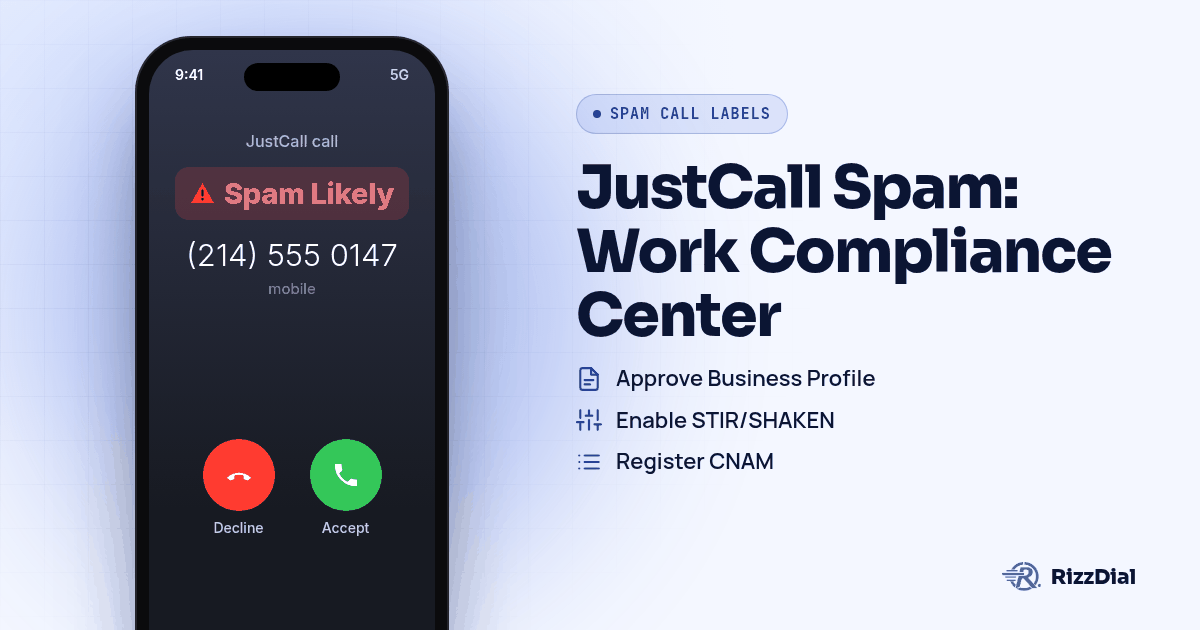
Reps open the Sales Dialer, start a shift, and the first three calls go to voicemail because the receiving phone already shows Spam Likely before anyone picks up. The fix starts inside JustCall itself: finish the Compliance Center steps in order (Business Profile, then STIR/SHAKEN, then CNAM), then use Sales Dialer Number Health Monitoring to catch numbers before they get flagged again. None of that is instant, and none of it is a guarantee against every carrier label.
Why Do JustCall Sales Dialer Numbers Get Tagged Spam Likely?
JustCall's own porting paperwork names Twilio Inc as its upstream provider, listed on the Customer Service Record a receiving carrier reads when a number moves. That matters because the number sitting in your Sales Dialer is not a line JustCall built from scratch; it rides on Twilio's network, and a dialer campaign running through it looks like outbound voice traffic to whichever carrier receives the call.
Getting a number in the first place already asks for proof of who you are. JustCall's availability and requirements article lists business registration documents, identification for a company representative, and proof of a local address among the requirements for acquiring numbers, varying by country. Skip or rush that step and the number starts life with thinner trust than one tied to a verified business.
Once a number is dialing, the label itself comes from whichever network answered the call. Verizon's Call Filter shows "Potential Spam" for unwanted callers that may be calling indiscriminately or inappropriately to a large number of recipients. AT&T's Call Protect terms describe spam risk calls identified by category when possible right on the incoming call screen. T-Mobile's ScamShield page lists Scam Likely alongside Potential Spam identification among its free features for customers. A sales line can earn any of these labels depending purely on which carrier the person you called happens to use, which is part of why the same JustCall number can look clean on one phone and flagged on another; our breakdown of carrier owned versus rented VoIP numbers goes deeper into why that split happens.
How Do You Walk Through JustCall's Compliance Center in Order?
JustCall bundles the paperwork fix into one place: the Compliance Center. Doing the steps out of order wastes time, because later stages depend on the ones before them.
- Approve your Business Profile first. This is the form that collects your legal business name and address, business type, industry and EIN, plus a point of contact. JustCall's Compliance Center documentation puts it plainly: your Business Profile tells carriers who you are. Nothing else in the Compliance Center moves forward until this is approved.
- Let STIR/SHAKEN submit on its own. JustCall does not ask you to fill out a separate STIR/SHAKEN form; the same article says that after Business Profile approval, JustCall submits your US numbers automatically, with verification typically landing a few days after approval. STIR/SHAKEN itself is the caller authentication framework the FCC built: a call's caller ID can be signed as legitimate by the originating carrier and validated by other carriers, which gives subscribers more confidence that the caller ID information they receive is accurate. Our pillar guide covers the full mechanics of signed calls if you want the long version.
- Register CNAM after that. CNAM is the caller ID name that shows up on a landline or compatible device. JustCall's CNAM registration article requires the display name to match your registered business name, then walks you through submitting the request in the Compliance Center; the name itself must be fifteen characters or fewer including spaces, must begin with a letter, and cannot be a generic value like a city or state name. Twilio, the network actually carrying these calls, runs a separate analytics submission program called Voice Integrity that works alongside CNAM rather than instead of it; we cover how that piece fits together on its own page.
- Watch Sales Dialer Number Health Monitoring once you're live. This is where JustCall's Number Health Monitoring article says the platform tracks how each Sales Dialer number is being used and flags the ones at risk of a spam tag before reps burn through the whole list. The same guidance pushes rotating calls across multiple numbers, spacing calls apart instead of dialing back to back, and calling during the recipient's own daytime hours rather than outside them. Sales teams comparing dialers for this exact reason can see how RizzDial's own dialer surfaces similar per number flags before a shift starts.
Do the four steps in this order and you've covered what JustCall itself controls. What you have not covered is how Verizon, AT&T or T-Mobile's own analytics vendors score the number once calls start going out, because none of those carriers publish their scoring and none of them answer to JustCall.
What Does RizzDial Add Once the Compliance Center Paperwork Is Done?
James Hill, RizzDial's founder, frames the gap this way: a call placed from an actual carrier line is a call between carriers, while a number bought through a platform and dialed heavily looks different to a network than a line tied to a real wireless account. That gap is exactly what Compliance Center paperwork cannot close on its own.
RizzDial's approach is to provision numbers directly with carriers rather than only register them after the fact. Hill describes the goal as getting carriers to treat the number the same way they would treat one purchased directly from a SIM carrier like AT&T, Verizon or T-Mobile, done by provisioning the numbers with those carriers rather than layering registrations on top of a platform number. He ties that back to relationships built over years rather than a new feature: the direct carrier relationships took a long time to build, and the platform runs on that existing infrastructure. "We make your line look like it's a direct carrier line like AT&T, Verizon or T-Mobile. And we keep it clean. And not only do we keep it clean, we notify you if it's flagged," Hill says.
The monitoring side runs daily rather than waiting for a rep to notice dead air. Hill says every number gets scrubbed daily, meaning each one is checked for spam flags, not screened against Do Not Call lists. "We actually have real devices that get pinged every single day to show how [the numbers] are showing up on the client's devices to increase their pickup rate," he says. Per number reputation monitoring with flag alerts is an add on.
None of this locks a team to one carrier path. Hill is direct that RizzDial does not want to lock anyone into its own carrier route; teams that already run their own Twilio account can keep doing so inside RizzDial, and those numbers stay Twilio's numbers rather than becoming RizzDial's. The provisioned route above is RizzDial's managed carrier service, for teams that want RizzDial handling that carrier relationship instead. If your stack already runs through the GoHighLevel side of this problem, our integration page walks through how that pairing works. For warm follow up once a prospect already knows you, RizzDial's sister product Beam routes iMessage and FaceTime Audio over data on iPhones, so carrier spam labels never apply to that channel.
What Still Won't Fix a Flagged JustCall Number?
Finishing Compliance Center steps does not forgive a bad list. If the numbers being dialed were scraped, bought in bulk, or never gave consent to be called, recipients will mark the calls as spam no matter how clean the caller ID authentication looks on the back end, and the label returns.
Calling the same people over and over does the same damage faster. Carriers and their analytics vendors watch calling patterns, not just number ownership, so a line that rings the same households repeatedly inside a single week earns a flag even with a fully approved Business Profile sitting behind it.
It also helps to know that a label dispute is not the same as a blocking dispute in the eyes of the FCC. Its 2020 order requires terminating providers to give a status update to the party that filed a dispute within 24 hours when a call is blocked outright. For labeling specifically, the same order says the Commission declines to extend redress mechanisms to erroneous call labeling at this time, and instead encourages providers and their analytics partners to work in good faith with callers. There is no formal appeal clock running once a label, rather than a block, is the problem. Our walkthrough of disputing a label directly with carriers and their analytics partners covers what that good faith process looks like in practice, and the T-Mobile specific version of that process is covered separately.
Labels can also come back after they clear. A number that gets cleaned up, used well for a few weeks, then gets dropped back into a heavy dialer campaign can earn a fresh flag from the same carrier that cleared it the first time. Nothing here, JustCall's own tools included, promises a label stays gone once it lifts.
What FAQs Come Up About JustCall Spam Likely Labels?
Is JustCall's upstream carrier Twilio?
Yes. JustCall's own porting documentation lists the Carrier Name as Twilio Inc, calling it JustCall's upstream provider, which is the detail a receiving carrier sees on the Customer Service Record.
Does JustCall guarantee my CNAM name will show up on every call?
No. JustCall's own CNAM article says a display name moves to Approved status after review, then can take an additional two to four weeks to propagate across carriers, and the name itself is capped at fifteen characters including spaces and must begin with a letter. Propagation and carrier acceptance are outside JustCall's control.
What does Sales Dialer Number Health Monitoring actually check?
JustCall's Number Health Monitoring article describes a feature that tracks how each Sales Dialer number is being used and flags numbers at risk of being marked as spam, then points to calling pattern fixes like spacing out calls and rotating numbers rather than hammering one line.
Can I port a JustCall number out if a label will not clear?
JustCall supports porting a number away, but its own porting FAQ notes the JustCall team is typically waiting on an update from the upstream provider, who reaches out once they hear from your current provider, so a port is a coordination process rather than an instant fix.
Does finishing JustCall's Compliance Center remove a Scam Likely label on T-Mobile?
Not automatically. Compliance Center work gets your Business Profile, STIR/SHAKEN and CNAM in order, but the Scam Likely or Potential Spam tag itself comes from the carrier's own labeling system, and T-Mobile's own ScamShield page lists Scam Likely among its free identification features, a judgment the carrier revisits on its own schedule.
How Do You Get Your Numbers Checked Every Day Instead of Once?
Compliance Center steps and careful dialer habits get a JustCall number as far as JustCall's own tools allow. If reps are still watching Spam Likely eat into connect rates after all four steps are done, the next question is whether the numbers themselves are provisioned the way a direct carrier line would be, checked daily, and swapped out the moment one gets flagged. Book a demo to see how RizzDial handles that part.
How can RizzDial help with your calling workflow?
RizzDial is the AI outbound sales workspace for teams on GoHighLevel. Power dialing, AI voice agents, SMS automation, and CRM workflows in one platform. Book a demo.