Agencies
Phone Answering Service: Human vs AI vs RizzDial
Compare human, standalone AI and agency-built AI voice agent answering services on coverage, cost, CRM depth and caller experience before you buy.
By James Hill, Founder, RizzDial ·
TL;DR: A phone answering service can mean three different things: a traditional human answering team that takes messages and transfers calls, a standalone AI answering product you subscribe to, or an AI voice agent an agency builds and owns on a platform like RizzDial. Pick by matching coverage hours, CRM write-back and caller experience to how your calls actually behave, not by which option has the catchiest demo.
A buyer searching "phone answering service" may mean a live operator, a standalone AI product or an agency-built agent. This guide compares their coverage, CRM handoff and caller experience, then gives you a repeatable test before you change your call routing. Our procurement guide to human, AI and hybrid coverage goes deeper on the coverage decision.
What Is a Phone Answering Service, and What Are You Actually Buying?
Strip away the branding and a phone answering service is a promise: when a call comes in and you can't take it, someone (or something) picks up and does an agreed job. That job might be taking a message, answering a short list of approved questions, booking an appointment, or transferring the caller to a live person. The option you buy determines who can actually do that job, and what happens to the information afterward.
Define the job before comparing bills. A practice handling appointment confirmations has a different requirement from an agency fielding sales inquiries. Ask first: what decision does the caller need made, and who is allowed to make it?
How Does a Traditional Human Answering Service Actually Work?
A traditional answering service staffs live operators, who may be shared across client accounts and answer with your business name while following a script you provide. They take a message, answer a narrow set of approved questions, or patch the caller through to a live extension. Coverage schedules and after-hours terms vary by provider, so confirm what your plan includes.
Common billing structures include per minute, per call, per seat, or a monthly bundle with an overage rate after included usage. We cover the mechanics of each model, including the rounding tricks that quietly inflate a per-minute invoice, in our answering service pricing breakdown; that article is worth reading in full before you sign a contract with any provider, human or AI.
Some services relay an operator's message by email or text. Ask whether the service writes the call details into your CRM record or leaves your team to enter them afterward. That manual step is manageable for some workflows, but your team still has to own it as call volume grows.
How Does a Standalone AI Answering Service Differ From a Human One?
A standalone AI answering service is a dedicated product you subscribe to, separate from any voice platform your agency might build on. Many standalone AI products are designed for around-the-clock coverage without shift scheduling. They follow a configured script and can escalate when a request falls outside their scope, but hours, integrations and handoff controls vary by vendor.
A standalone product can deliver a consistent configured flow, while a human may improvise around an unusual request. Whether that helps depends on how much judgment your calls require. The table compares the practical tradeoffs.
How Do Human, Standalone AI and an Agency-Built Voice Agent Compare?
Compare the options on coverage, billing structure, CRM depth and caller experience:
| What you're comparing | Traditional human answering service | Standalone AI answering service | Agency-built AI voice agent (RizzDial model) |
|---|---|---|---|
| Coverage hours | Schedule and after-hours coverage depend on the provider and plan | May offer continuous coverage without shift scheduling; confirm limits | Can be configured for continuous coverage with escalation windows |
| Cost model | Per minute, per call, per seat or flat monthly bundle, usually with overage rates | Vendor's own subscription or usage tier, on top of whatever base plan you're already on | AI talk time billed from $0.06 to $0.20 per minute, pay as you go, with flexible seat based options for your team |
| CRM integration depth | Message relayed by email or text; manual entry into your CRM afterward | Varies by vendor; some write back natively, others only forward a transcript | Built-in CRM that also connects to any CRM you run, plus direct GoHighLevel integration, MCP and OpenAPI |
| Caller experience | Live human voice, can improvise outside the script | Consistent AI voice, bounded by the vendor's configured scope | Consistent AI voice you configure and can change yourself, with live transfer to a real rep when needed |
| Who owns the setup if you leave | The provider; your script and workflow don't travel with you | The vendor; you're relying on their roadmap and their uptime | The agency owns the client relationship and branded service; confirm data and configuration export terms |
Diagram: a three-column flowchart. Each column starts with an incoming call icon. The left column (human service) branches to "live operator answers," then "message taken or call transferred." The middle column (standalone AI) branches to "AI answers on script," then either "resolved" or "escalated to a human outside the vendor's system." The right column (agency-built AI voice agent) branches to "AI answers on script," then either "resolved," "warm transfer to a rep inside your own CRM," or "AI texts a follow-up," with an arrow looping back into the agency's own pipeline rather than a third-party vendor's dashboard.
What Numbered Steps Should You Follow Before You Choose One?
Start with your own call data. Use vendor demos to test specific requirements:
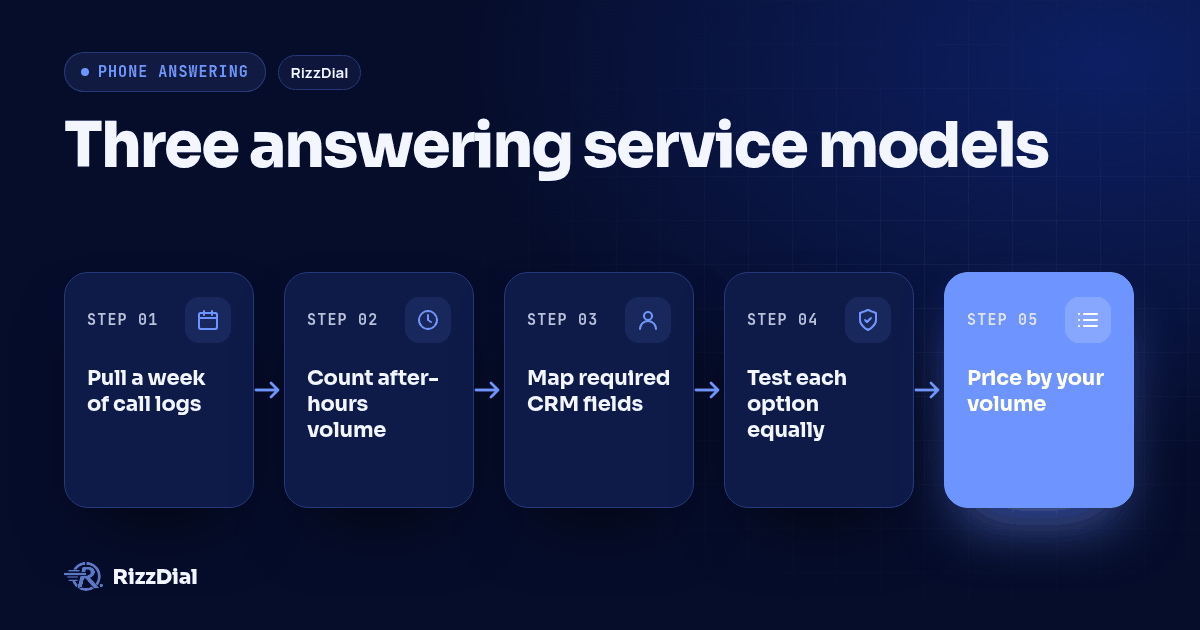
- Pull a week of real call logs and tag each one by type. Sort calls into routine (a question you've answered a hundred times), judgment-call (needs a human decision), and missed (nobody picked up). The ratio between those three buckets tells you more than any vendor pitch.
- Count your after-hours and overflow volume separately from business-hours volume. A business with almost no after-hours calls doesn't need to pay a premium for round-the-clock human coverage; a business that gets a third of its calls at night has a very different requirement.
- Write down the exact fields that must land in your CRM after every call. Caller name, reason for calling, a qualifying answer, next step. If a vendor can't commit to writing those fields into your actual CRM record, you've just found your real integration depth, regardless of what the sales deck says.
- Run the same three scenarios through every option you're evaluating. One routine call, one judgment-call request, and one after-hours call. Score each vendor on the same script so you're comparing apples to apples instead of whichever demo happened to go smoothly.
- Price each option against your own call volume, not the vendor's example. A per-minute rate that looks cheap on a sales call can cost more than a flat bundle once you run your actual average call length and monthly volume through it.
- Check what happens when the AI or operator doesn't know the answer. Every option escalates eventually. Ask specifically who the escalation goes to, how fast, and what the caller hears while they wait.
- Pilot before you commit the whole number. Route a limited slice of real calls, such as one location or campaign, through the new option until it meets your acceptance criteria. Point the main forwarding number only after the new flow has passed.
Where Does an Agency's Own AI Voice Agent Platform Fit Instead of Buying Either?
An agency can also build and own an AI voice agent on a platform like RizzDial, then configure and resell it under its own name.
This model can matter when more than one agency client needs call answering. RizzDial supports agencies that configure, brand and resell AI voice agents, rather than presenting a third-party answering product under the agency's own brand.
The pieces that make that resale model work are the same ones that solve the CRM-gap problem from the comparison table above: a built-in CRM that also connects to any CRM a client already runs, direct GoHighLevel integration, a Chrome extension, MCP and OpenAPI so the agent can be extended by a developer or a non-technical team, and direct carrier access to AT&T, Verizon and T-Mobile so the calls ring real devices instead of routing through a generic VoIP trunk. RizzDial's proprietary voicemail detection runs in 0.66 milliseconds, built to connect reps to a live human faster once a call needs to escalate past the AI.
If you're specifically evaluating this against Retell, our Retell AI alternative comparison breaks down the differences a reseller cares about, and the full alternatives directory covers the rest of the field. If the agency also wants the AI to follow up a resolved call with a text confirmation instead of ending the interaction at the voicemail, Beam's guide to building an AI text-message responder covers that automation as a separate, connected piece.
What Compliance and Disclosure Rules Apply to AI Phone Answering?
Separate incoming answering from outbound calling before you configure an agent. A service that answers a customer calling your business raises different questions from an agent that places calls to consumers. The script, caller identity, consent basis, recording practices and escalation path should match the actual job.
For outbound calls, the FCC confirmed that AI generated voices count as artificial or prerecorded voices under the TCPA. The applicable consent rules and required identification or disclosure depend on the call and any exception. In 2024, the FCC also proposed additional disclosure language for certain calls containing AI generated content. Check the current rule and the details of your campaign instead of relying on a generic vendor statement. The FCC ruling describes the decision; the later FCC notice records the proposal.
For telemarketing to residential numbers, the FTC says calls generally must stay between 8 a.m. and 9 p.m. at the called person's location unless the person consented otherwise. State requirements can add obligations, including rules for call recording. See the FTC's Telemarketing Sales Rule guide. Have qualified counsel review the specific workflow when the answer is unclear.
A practical setup keeps disclosure, consent, calling time, recording and opt out handling as separate acceptance checks. Test each one with the exact call type and destination you plan to use.
What Questions Do Buyers Ask About Choosing a Phone Answering Service?
What does a phone answering service cost, and how does RizzDial's pricing compare?
Traditional human answering services may bill per minute, per call, per seat or through a monthly bundle. Standalone AI products set their own subscription or usage terms. RizzDial bills AI talk time from $0.06 to $0.20 per minute, with pay as you go and flexible seat based options. Compare the full contract and usage terms for each option against your own call volume before choosing.
How long does it take to switch from a traditional answering service to an AI voice agent?
Plan a controlled pilot rather than a same-day cutover: write the call flow and required fields, connect the CRM, run test calls against your own phone, then route a slice of real traffic before you move everything over. Keep the old answering service live as a fallback during the pilot instead of canceling it on day one.
Does an AI phone answering agent actually integrate with our CRM, or does it just send us a message?
That depends entirely on which option you buy. A traditional answering service usually relays a message by email or text and expects a human to copy it into the CRM by hand. RizzDial has a built-in CRM that also connects to any CRM you already run, plus a direct GoHighLevel integration, MCP and OpenAPI, so the call outcome writes back to the actual contact record instead of landing in a separate inbox.
Does an AI phone answering service have to tell the caller it is AI, and what about consent?
The rules depend on whether the system answers an incoming call or places an outbound call, and on the call purpose. The FCC has confirmed that AI generated voices fall under the TCPA restrictions for artificial or prerecorded voice calls, with consent and identification or disclosure requirements applying to covered calls. The FCC also proposed additional disclosure language for some calls containing AI generated content. Review the current rule for your use case before launch, and treat caller disclosure and consent as separate checks. FCC 24-17 explains its 2024 ruling, while FCC 24-84 contains the proposal.
What does it actually cost us to switch away from our current answering service?
The real switching cost is rarely the new vendor's bill: it is rebuilding the call flow, retraining whoever reviews the message queue, and re-pointing your forwarding number without a gap where calls ring nowhere. Run the old and new service in parallel for a short pilot and keep the forwarding change as the very last step, after you have already tested the new flow end to end.
How Should You Make the Final Call?
Return to the core question: what decision does the caller need made, and who may make it? Routine calls may fit an AI flow. Calls needing judgment may call for a person or a hybrid plan. Our human, AI and hybrid procurement guide helps map that coverage.
For agencies specifically, the calculation has one more variable the single-business buyer doesn't face: whether you want to resell someone else's answering product under your own brand, or own the whole stack yourself. Run the seven-step evaluation above against at least two options before you sign anything, including a real pilot with your own call volume, and let the pilot's results decide instead of the demo.
About RizzDial
RizzDial is the AI outbound sales workspace for teams on GoHighLevel. Power dialing, AI voice agents, SMS automation, and CRM workflows in one platform. Book a demo.