Compliance
Retell AI Calls Labeled Spam: Number Provider Checklist
Retell AI calls showing Spam Likely? See what Retell's own docs on verified numbers, branded call and fraud protection cover, and what still needs fixing.
By James Hill, Founder, RizzDial ·
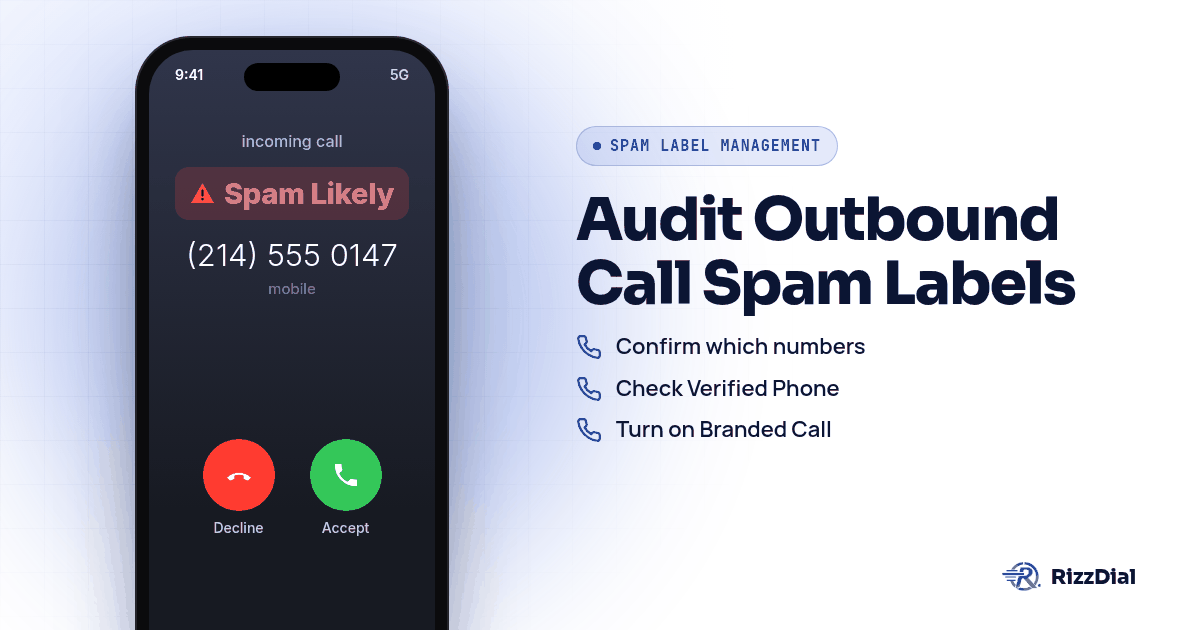
A Retell campaign that connects fine during setup week can start going quiet by week two, with pickup rates sliding and more calls landing a Spam Likely tag before the agent even finishes a sentence. Retell's own numbers come from Twilio or Telnyx under the hood, and nothing in that stack removes a label once a carrier's analytics vendor has already applied one. The real fix is a short audit of what Retell actually controls, registration, branded display, rate limits, against what it does not: the carrier's own spam score.
What Should an Agency Audit First When Retell Connect Rates Drop in Week Two?
Before touching a single number, pull the account's call logs and separate the agents and campaigns still connecting normally from the ones that slipped. A drop that hits one outbound campaign while others stay steady usually points at a calling pattern or a specific number, not the whole account.
- Confirm which numbers are flagged and on which carrier, since a number showing Scam Likely on one network can still ring clean on another.
- Check Verified Phone Number status for every number in the campaign. Retell's own guide on avoiding spam tags for AI calls lists registering numbers and keeping them dedicated to a single business as the starting point, per Retell's guide to avoiding Spam Likely on AI calls.
- Turn on Branded Call for any US number that supports it, since that same guide recommends a caller ID that displays the business name clearly rather than a bare number.
- Pull the call frequency per contact for the past week. Retell's guide specifically calls out limiting call frequency and spacing out repeat attempts rather than dialing the same recipients back to back.
- Compare how much of the campaign's volume rides on one number. The guide also recommends spreading high volume traffic across multiple verified numbers instead of running it all through one line.
- Review whether consent and Do Not Call handling are documented for the list being dialed, since Retell's own vendor selection guide treats DNC list integration and STIR/SHAKEN support as baseline checks for outbound telephony, per Retell's guide to choosing a conversational AI vendor's telephony infrastructure.
- If the flag traces back to one number, pull it out of the campaign rotation while the rest of the audit continues, rather than pausing the whole thing.
None of these steps are instant, and Retell's own guidance frames them as risk reduction rather than a guaranteed fix.
How Does Retell Actually Provision and Verify Outbound Numbers?
Retell gives two paths to get a number into an agent: buy one directly or import one already owned. The create phone number endpoint purchases from Twilio or Telnyx, with Twilio as the default, and as of this writing only supports US area codes with US or Canada as the destination country, according to Retell's API reference for creating a phone number. The import endpoint instead binds a number already controlled through an existing SIP trunk, and Retell's documentation notes that a Twilio elastic SIP trunk's termination URI always ends in .pstn.twilio.com, per Retell's API reference for importing a phone number.
Neither path changes what the carrier sees when the call lands. A number bought through Retell's own Twilio or Telnyx integration and a number imported from an agency's existing Twilio account both ride the same CPaaS infrastructure once the agent dials out, so whatever reputation that infrastructure already carries travels with the number either way.
STIR/SHAKEN is the signature that tells a receiving carrier a call's caller ID was not spoofed, and Retell's guidance treats verifying that support as a baseline step rather than something configured automatically. The full breakdown of attestation levels and how carriers weigh them lives in the pillar guide on clearing business number spam labels.
What Do Branded Call, CNAM and Fraud Protection Cover, and What Do They Miss?
Branded Call and CNAM show a business name instead of a bare number, and Retell's own support team confirmed in its community forum that both are currently limited to US phone numbers, with Canadian numbers unable to get CNAM branding enabled at all right now, according to Retell's community thread on CNAM and Branded Call. A Canadian number bought through Retell's own purchase endpoint will never show a branded name to the person it calls, regardless of how the agent is configured.
Fraud protection is a separate system again. Retell's reliability documentation describes it as rate limiting tied to the combination of a caller's IP address and the destination number, built to stop bad actors from using the same IP to spam calls to premium rate numbers, plus an automatic block on calls to or from a short list of sanctioned countries, according to Retell's fraud protection documentation. That protects Retell's own platform from abuse. It does nothing to stop a carrier's analytics vendor from tagging a legitimately dialed number as spam, since those are two different systems wearing similar sounding names.
A number flagged specifically on T-Mobile's network often traces back to First Orion's scoring rather than anything Retell configured on its end, and how that labeling works underneath Scam Shield is covered in T-Mobile's Scam Likely label and First Orion explainer. CNAM carries the same gap on any provider, including Retell's, and teams running calls through a CRM instead of a raw API can see how GoHighLevel's own LC Phone system handles an identical limitation in GoHighLevel and LC Phone Spam Likely labels.
What Has Worked for Teams Running Retell Campaigns at Volume?
Retell's checklist helps, and agencies should run it before anything else. James Hill, RizzDial's founder, has watched the connect rate problem play out from the sales floor rather than the API side. His experience running outbound teams is that buying a number through a platform like GoHighLevel and dialing from it tends to pull a lower connect rate, because carriers read that traffic as VoIP, voice over internet traffic, rather than a line tied to a traditional carrier account. That is an operational observation from managing campaigns, not a claim about how any single carrier's model is coded, and it applies just as much to a number sitting on Retell's Twilio or Telnyx integration as to any other CPaaS number. The mechanics behind why a carrier treats these numbers differently are covered in VoIP numbers versus carrier numbers and Spam Likely risk.
A call placed straight from a phone is a carrier to carrier call, James says, and that is the baseline every provisioning decision gets measured against. RizzDial provisions numbers so carriers see each one the way they would see a number purchased directly from AT&T, Verizon or T-Mobile, instead of a number routed through outside infrastructure. That rests on direct carrier relationships built over years, James says, not a dashboard toggle, since putting that infrastructure in place took time. Calls placed this way are signed and go out over a STIR/SHAKEN compliant carrier network, which is a baseline, not a promise against a future label.
The checking runs daily instead of once at setup. "Every single number is scrubbed every single day," James says, meaning each number gets checked for spam flags daily, separate from any Do Not Call scrubbing. Real devices get pinged every day as well, James says, to see how each number is actually showing up on a client's phone and to work on pickup rate from there. A flagged number gets pulled from the pool and swapped for a clean one, and James says RizzDial sends a notice when that happens rather than making the swap quietly. Per number reputation monitoring with flag alerts is an add on for teams that want a closer watch on individual lines.
None of this requires leaving Retell behind. "We don't ever want to lock anybody into our carrier. We do have managed carrier services," James says. An agency already piping calls through Retell's Twilio integration can keep that setup, since numbers brought over this way stay that provider's numbers; the carrier provisioned path described above is RizzDial's own managed carrier service for teams that want daily checking from the start. Volume still needs spreading regardless of provider, James adds, since leaning on a single number invites a flag fast. The RizzDial dialer and the GoHighLevel integration apply this same rotation and daily check process on top of whatever telephony stack a team already runs, and the full side by side on how this compares to Retell's own number handling sits at the RizzDial versus Retell breakdown, with a lighter rundown at the Retell alternatives page.
What None of This Fixes?
No registration, no branded display and no carrier relationship rescues a bad list. A number calling contacts who never opted in earns a flag no matter how it was provisioned, and the same holds for a list where people already asked to stop. Retell's own DNC and consent checks exist for exactly this reason, and skipping them is not something any number provider can route around.
Hammering the same person with repeat attempts creates its own flag, even against a clean list. If a contact does not answer Monday, calling again Tuesday, Wednesday and Thursday from the same number trains a carrier's model to treat the pattern as nuisance behavior regardless of intent. Spacing attempts out, the exact advice in Retell's own guide on avoiding spam tags, matters more than which platform issued the number.
Labels can also come back after a clean stretch. A number that clears today can pick up a fresh flag next month if volume spikes or a list gets sloppy again, and no setting on Retell, RizzDial or any other platform makes a number permanently immune.
For warm follow up with people who already know the business and carry an iPhone, there is a way to skip the voice network for that part of the conversation entirely. iMessage and FaceTime Audio through RizzDial's sister product Beam ride over data instead of the carrier voice network, so a carrier spam label never enters the picture there.
What FAQs Come Up About Retell AI Number Reputation?
Can Retell's Verified Phone Number feature remove a Spam Likely label on its own?
Not on its own. Retell's community support team ties Verified Phone Number status to reducing the chance of a spam flag, then adds Branded Call and a better pickup rate as the next two steps, according to Retell's community thread on outbound calls marked as spam at community.retellai.com. None of the three carries a guarantee once a carrier's analytics vendor has already applied a label.
Does buying a Retell number through the API avoid the Spam Likely problem that imported numbers have?
No. Retell's create phone number endpoint purchases a number through Twilio or Telnyx and currently only supports US area codes with US or Canada as the country, according to Retell's API reference at docs.retellai.com. A number bought this way still sits on the same CPaaS infrastructure as one imported through Retell's SIP trunk option, so it carries the same carrier reputation questions.
Can I get Branded Call or CNAM on a Canadian Retell number?
No. Retell's own support team confirmed in its community forum that Branded Call and CNAM are currently only supported for US phone numbers and that Canadian numbers cannot be enabled for CNAM branding right now, at community.retellai.com.
Does Retell's fraud protection work the same as spam label protection?
No. Retell's reliability documentation describes fraud protection as rate limiting tied to a caller's IP address and destination number plus blocking calls to and from a short list of sanctioned countries, which guards against abuse rather than against a carrier labeling a number as spam, according to docs.retellai.com.
What does Retell recommend checking before scaling an outbound AI campaign?
Retell's own guide on choosing conversational AI vendors tells teams to verify STIR/SHAKEN support and DNC list integration as part of picking telephony infrastructure, a check worth repeating on your own Retell setup before volume increases, according to retellai.com.
How Do You Get Retell Numbers Checked for Spam Flags?
Running the audit above catches a lot of the problem, but teams that want their current Retell numbers checked against a direct carrier relationship instead of a CPaaS reputation score can walk through their own account setup with someone who deals with this daily. For the full dispute process once registration and spacing have not been enough, the guide to fixing Spam Likely for outbound sales teams covers that sequence end to end. Book a demo to see how a carrier provisioned, daily checked number would sit alongside the Retell setup already in place.
How can RizzDial help with your calling workflow?
RizzDial is the AI outbound sales workspace for teams on GoHighLevel. Power dialing, AI voice agents, SMS automation, and CRM workflows in one platform. Book a demo.