Agencies
Telephone Answering Service vs AI Answering Service
Compare live telephone operators with AI answering, then use a GoHighLevel agency test to choose the right service and resale model.
By James Hill, Founder, RizzDial ·
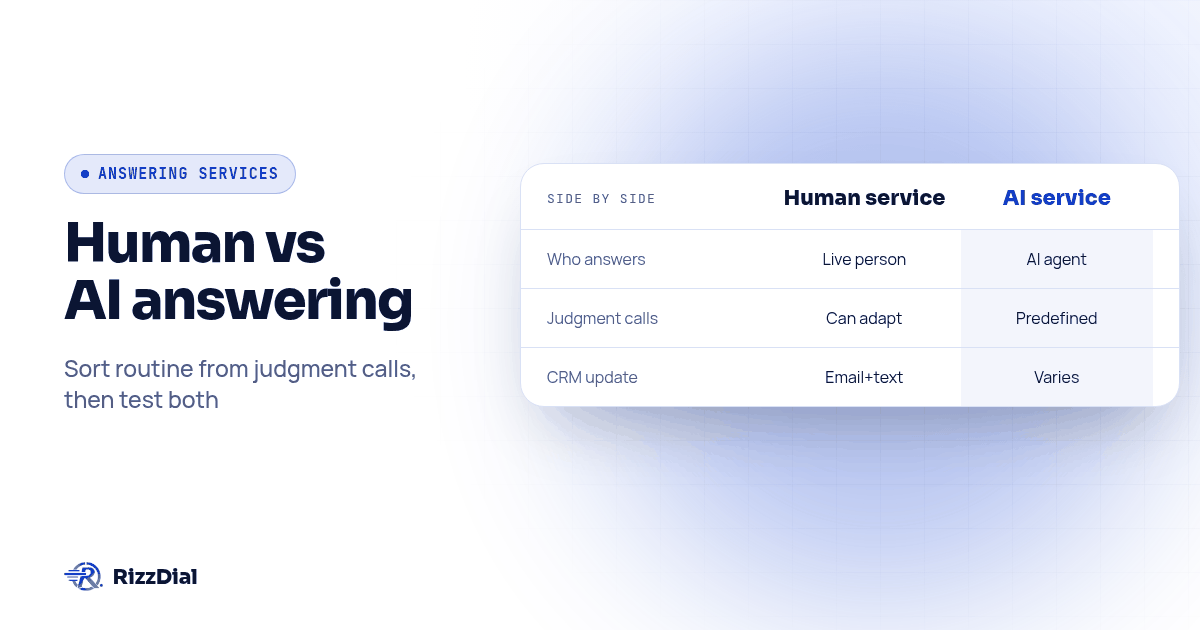
TL;DR: A telephone answering service staffs live operators who take messages and transfer calls on a script. An AI answering service answers on a configured flow built from a knowledge base, usually around the clock, and hands off anything outside that scope. Match the choice to the client's call mix, then decide separately whether your agency white labels someone else's product or builds and owns the agent on a platform like RizzDial.
The difference is who handles the call: a telephone answering service uses live operators, while an AI answering service uses a configured system and knowledge base. A GoHighLevel agency should compare call types, coverage, escalation, CRM handoff and total billing terms, then pilot the options against real call scenarios before choosing what to resell. This guide gives the agency a repeatable test and a way to decide whether to recommend a human service, standalone AI, or an agent the agency configures and owns.
What Is a Telephone Answering Service?
A telephone answering service is a company that staffs live operators to answer calls on a client's behalf when nobody at the business can pick up. The operators work from a script the client provides: a greeting with the business name, a short list of approved questions, and instructions for taking a message versus transferring the call to a live extension. Coverage windows, after hours terms, and how many operators work a shift all vary by provider, so an agency reselling one should confirm those specifics rather than assume a generic coverage label means the same thing everywhere.
The operator is the product. A caller gets a human voice that can read tone, improvise around an odd question, and apologize convincingly when something goes wrong. That flexibility is real, and it is also the limit: a shared pool of operators across many client accounts cannot know a business the way an in house receptionist does, so the script carries most of the weight. When a request falls outside it, the operator takes a message and moves on.
Billing follows several common structures: per minute, per call, per seat, or a flat bundle with overage once included usage runs out. We cover how those models behave once call volume changes in our answering service pricing breakdown, including how rounding can affect a per minute invoice. Ask a provider to explain its billing unit and what happens after included usage before comparing totals.
What Is an AI Answering Service, and How Does It Differ?
An AI answering service answers calls using a configured flow and a knowledge base instead of a live person reading a script. Industry comparisons describe the split: traditional services lean on a fixed script for consistency, while AI systems pull answers from a knowledge base and respond in more detail when the question falls inside it (AMB's phone service comparison). The AI cannot exercise human judgment, but it can follow configured rules consistently and handle concurrent calls if the vendor's system supports the required capacity.
Many AI answering products are designed for continuous coverage without shift scheduling. The tradeoff shows up at the edges: when a caller asks something the knowledge base was never configured to answer, the AI has to recognize that gap and hand off cleanly, or it may answer a question it should have escalated. Compare how each product behaves when it does not know, how quickly it transfers, and what the caller hears while waiting.
Follow up matters too. If an AI answering service resolves a call but the client wants a text confirmation afterward, that is a separate automation, not a feature every answering product includes. Beam's guide to setting up missed call text back with an iMessage reply covers wiring that into GoHighLevel so a handled or unanswered call can receive a reply instead of ending as a dropped thread.
How Do Telephone and AI Answering Services Compare?
Put the two side by side on the things a client actually cares about, not the marketing pitch each vendor leads with.
| What you're comparing | Traditional telephone answering service | AI answering service |
|---|---|---|
| Who answers | A live operator, often shared across several client accounts | A configured AI agent drawing on a knowledge base |
| Coverage hours | Set by the provider's shift schedule and plan; confirm after hours terms directly | Often designed for continuous coverage, though limits vary by vendor |
| Flexibility on unscripted questions | Can improvise within judgment, but still works from an approved script | Answers inside its configured scope, then has to recognize and escalate what falls outside it |
| Concurrent calls | Limited by how many operators are staffed on that shift | Capacity depends on the vendor and plan; confirm concurrency directly |
| Cost structure | Per minute, per call, per seat, or a flat bundle with overage once usage runs out | Vendor sets its own subscription or usage tier, layered on top of the client's existing plan |
| CRM handoff | Message relayed by email or text; a person usually has to copy it into the CRM | Varies by vendor; some write back natively to the CRM, others only forward a transcript |
| What travels if the client leaves | The script and relationship stay with the provider | Depends on the platform; confirm data and configuration export terms before signing |
The table does not decide which option is right. It identifies what each one does so an agency can compare the details to the client's call mix, workflow and requirements instead of treating the smoothest demo as proof.
When Can a Human Telephone Answering Service Be the Better Fit?
A GoHighLevel agency should not pitch AI as the right fit for every call. A human telephone answering service can be a better fit when a caller needs judgment or a personal response that has not been configured in an AI flow.
That may include a delivery delay that needs a supervisor's decision, a billing dispute that needs discretion, or a sensitive personal matter. Those calls need a person who can assess the situation, not a flow chart. A human service may also fit a client whose call volume is low and irregular, depending on its quote and included terms. Finally, if nobody on the client's team can review call outcomes or maintain an AI flow, the agency needs to include that operational ownership in its recommendation.
Routine intake questions such as business hours, appointment requests, or form confirmation may be suitable for AI when the answers and handoff rules are clearly configured. Verify how the service handles each call type before promising it will reduce operator work or improve margins.
Which Service Should a GoHighLevel Agency Resell?
This decision has two parts: whether the calls need a human, AI, or a hybrid split by call type, and whether the agency will resell a standalone product or build and own the agent on a platform. Most clients do not need an all or nothing answer; routine intake can be handled by AI while judgment calls route to a person. Our human, AI and hybrid coverage guide maps that coverage decision in more detail.
White labeling means reselling someone else's roadmap, uptime and CRM depth under the agency's brand. Building on a platform like RizzDial means the agency owns the configuration, branding and client relationship directly. RizzDial has a built in CRM that also connects to any CRM, a direct GoHighLevel integration, a Chrome extension, and MCP and OpenAPI for developers and non technical teams. Direct carrier access to AT&T, Verizon and T-Mobile sends calls through those carriers to real devices. RizzDial's proprietary voicemail detection runs in 0.66 milliseconds and is built to connect reps to live humans faster when a call needs to move past the AI.
The agency should confirm export terms, account ownership, support responsibilities and the exact CRM fields that get written back before promising the client what it will own. If evaluating voice platforms, the alternatives directory compares options on details a reseller may want to review.
How Can an Agency Test Its Answering Service Options?
Do not decide this on a vendor demo. Run the client's own calls through a structured test before recommending anything, whether you white label or build on a platform.
- Pull a representative period of actual call logs and tag each one. Sort every call into routine, judgment call, or missed. The mix tells the agency more than a sales pitch does.
- Separate after hours volume from business hours volume. A client with few night calls has a different coverage need from one that regularly receives calls after close. Use the client's call records rather than a general assumption.
- Write the exact fields that must land in the CRM after every call. Caller name, reason for calling, a qualifying answer, and next step are examples. Ask each vendor to show those fields on the real CRM contact record.
- Run the same three test scenarios through every shortlisted option. Use one routine question, one judgment call, and one after hours call. Score each option against the same script and acceptance criteria.
- Compare each quote against the client's actual call volume. Include the provider's billing unit, included usage, overage terms, and any base subscription the client already pays. A demo account cannot establish the client's total.
- Test what happens when the system does not know the answer. Record who receives the escalation, how it is routed, how long the caller waits, and what message or transcript reaches the team.
- Pilot a slice of real traffic before changing the main number. Route one location or campaign through the new flow until it meets the agency's acceptance bar. Keep the current service available as a fallback during the pilot.
Keep a scorecard with one row per scenario and columns for answer accuracy, CRM write back, escalation path, caller experience and billing assumptions. Have the client review the results before the agency recommends a vendor or starts moving numbers. This makes the recommendation explainable and gives the agency a record to revisit if the call mix changes.
What Should an Agency's Resale Checklist Include?
The test only helps if the agency writes down the answers for this client instead of carrying them in a sales rep's head. Keep a short record of the call mix, after hours needs, CRM fields, unknown-answer behavior, ownership terms and the decision on white label versus build. Attach it to the pilot plan so the next renewal conversation starts from evidence rather than memory.
Assign one owner for maintaining the call flow and one for reviewing exceptions. Decide how the client can request changes, where those requests are tracked, and what evidence the agency will share after the pilot. If the client expects call notes in GoHighLevel, verify the record directly instead of accepting a vendor's statement that an integration exists. A clean escalation is part of the service: define who answers, what happens if that person is unavailable, and how the caller is told what to expect.
What Questions Do Agencies Ask About Telephone and AI Answering Services?
What does a telephone answering service cost compared to an AI answering service?
A traditional telephone answering service usually bills per minute, per call, per seat, or through a flat monthly bundle with overage once included usage is exceeded. Standalone AI answering products set their own subscription or usage tiers on top of the client's existing plan. RizzDial charges from 6 to 20 cents per minute for AI talk time, with pay as you go and flexible seat based options. We built RizzDial, so compare its terms with each vendor's published terms.
How long does it take to set up an AI answering service for a client who currently uses a human telephone answering service?
Plan on a pilot rather than a same day cutover. Write the call flow and the fields that must land in the client's CRM, connect that CRM, run test calls against a spare number, then route a slice of real traffic before changing the main forwarding number. Keep the existing telephone answering service available as a fallback until the pilot clears the agency's acceptance bar.
Does an AI answering service actually write call details into the CRM, or does it just send a text?
That depends on which product the agency resells. A traditional telephone answering service typically relays a message by email or text and expects someone on the client's team to copy it into the CRM by hand. RizzDial has a built in CRM that also connects to any CRM the client already runs, plus a direct GoHighLevel integration, MCP and OpenAPI, so call outcomes can be written back to the contact record instead of sitting in a separate inbox.
Does an AI answering service have to tell the caller it is AI?
The disclosure and consent rules depend on whether the system answers an incoming call or places an outbound one, and on the call's purpose. The FCC has confirmed that AI generated voices fall under TCPA rules for artificial or prerecorded voice calls. Applicable consent requirements depend on the call type and any exception. Review the current rule for the specific workflow before launch, and treat caller disclosure as its own acceptance check. The FCC's 2024 ruling covers the decision directly.
What does it actually cost an agency to switch a client from its current telephone answering service to an AI answering service?
The switching work includes rebuilding the call flow, retraining whoever reviews the message queue, and moving the forwarding number without a gap where calls ring nowhere. Run the old and new service in parallel during the pilot and treat the forwarding change as the last step, not the first one.
How Can an Agency Make the Final Decision?
Ask what the caller needs decided and who is authorized to decide it. Routine intake may fit an AI answering service. Calls needing judgment may call for a person or a hybrid split that routes each call type deliberately. Once that split is clear, the resale decision gets easier: white label a standalone product to cover a defined need, or build and own the agent on a platform like RizzDial when the plan is a branded service across multiple clients. Run the seven step test before committing, and let a real pilot decide instead of a demo.
About RizzDial
RizzDial is the AI outbound sales workspace for teams on GoHighLevel. Power dialing, AI voice agents, SMS automation, and CRM workflows in one platform. Book a demo.