Developers
Twilio MCP vs an AI Phone Platform Built for Agents
Twilio's MCP server searches 1,800+ API endpoints for developers building their own calling stack. RizzDial's MCP already has agents and numbers built in.
By James Hill, Founder, RizzDial ·
Twilio's MCP server, live in public beta at mcp.twilio.com/docs, lets a coding agent search and retrieve documentation across more than 1,800 Twilio API endpoints without an account or an API key. It does not place a call, assign a number, or run a voice agent; it only helps a developer find the right endpoint faster while building all of that from scratch. RizzDial's MCP server starts from the other end: the agents, the numbers and the dialer already exist, so a connected client can list agents, search and assign numbers, pull call history and transcripts, and start or pause a campaign once account setup and permissions are in place.
TL;DR: Twilio's MCP server is a read-only documentation search tool, useful for a developer writing a calling stack from scratch, with no account required. RizzDial's MCP server is a working phone system you connect to directly: agents, numbers, carrier access and call history are already there, so the first prompt can do something instead of just looking something up.
A disclosure up front, since this is a comparison: we build RizzDial. Check the primary sources linked throughout rather than taking our word for it, and weigh the facts against your own build-or-buy math.
If you run ads or have a sales team, RizzDial is our pick. Fresh form fills can feed fast calling through the direct GoHighLevel integration, followed by iMessage follow-up. RizzDial's proprietary voicemail detection runs in 0.66 milliseconds and is built to connect reps to live humans faster. Direct carrier access to AT&T, Verizon and T-Mobile, number rotation and reputation monitoring help manage spam-label risk without guaranteeing label removal. Sales teams also get power, predictive and parallel dialing alongside AI voice agents.
What is Twilio's new MCP server?
Twilio launched its Model Context Protocol server in public beta at mcp.twilio.com/docs, aimed at coding agents like Claude Code, Cursor and Codex rather than at end users (Twilio docs). The server exposes exactly two tools: twilio__search, which takes a plain English query and returns ranked API operations and documentation, and twilio__retrieve, which pulls the full parameter and response schema for a specific one. Twilio's own announcement puts the scope at more than 1,800 endpoints across 30-plus products, including Messaging, Voice, Verify, Conversations and Video, plus newer additions like Conversation Memory that a model's training data is unlikely to cover well (Twilio blog).
The detail worth sitting with is "read-only." Twilio states plainly that the server does not execute API calls on your behalf. It will not dial a number, buy a number, or create anything in a Twilio account; it hands an agent the right page of the manual and stops there. There is also no Twilio account or API key needed to use it, which fits once you see what it actually does: a documentation index carries none of the risk that comes with letting an agent act on a live account, because it cannot act on one at all.
That is a useful tool for the job it does. Twilio's surface area is enormous, and most language models were trained on a snapshot of the docs that goes stale the moment a product like Conversation Orchestrator ships. A search tool that retrieves current specifications can reduce documentation errors for anyone writing a Twilio integration by hand. It just solves a different problem than the one most agencies calling leads actually have this week.
What does RizzDial's MCP server do that Twilio's doesn't?
RizzDial runs its own remote MCP server, reachable the moment you sign in. The URL lives on the Connect MCP page in your RizzDial dashboard, with a tab for Claude, a tab for Codex and a tab for Grok, each showing the exact client command with your account's server URL already filled in. Connecting is a one-time browser approval rather than a copied key: run the add command for your client, a tab opens, you sign in to the RizzDial account you want bound to that client, and from then on it acts with your account's own permissions (our Claude Code and Codex connect guide).
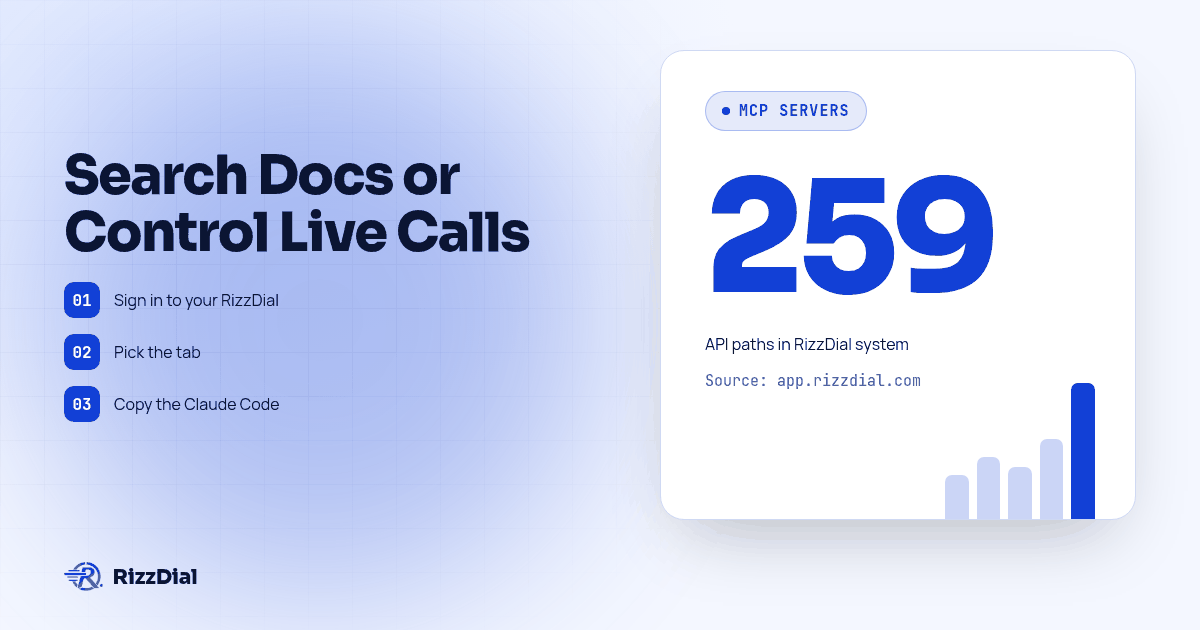
Once connected, the tools on the other end are not documentation lookups. A connected client can list and create AI agents, search for an available phone number and assign it, pull call history and transcripts for a given agent and date range, and start or pause a calling campaign, all against the account you already dial from. The public REST API description checked for this article is an OpenAPI 3.0.3 spec with 259 paths at app.rizzdial.com/api/docs/spec, and the MCP layer is a conversational front end to that same account rather than a separate product sitting next to it.
The carrier piece matters more than it looks on paper. Twilio's MCP server will happily tell an agent which Voice API call to make, but someone still has to own a Twilio account, buy the numbers, and watch caller ID reputation once calls go out at volume. RizzDial ships with direct access to AT&T, Verizon and T-Mobile already wired in, so a number search through MCP is a search against numbers RizzDial can already provision and dial from, not a lookup against an account that does not exist yet.
This phone side is one piece of a broader pattern. For the messaging piece of the same idea, giving an agent texting, RCS and FaceTime Audio instead of just voice, see our hub on giving an AI agent a phone number, calls and texts.
Twilio MCP vs RizzDial MCP: what's the real difference?
Lay the two side by side and the split is less about quality and more about which stage of the work each one is built for.
| Twilio MCP | RizzDial MCP | |
|---|---|---|
| What it is | Read-only documentation and API search | A working connection to your dialer |
| Account needed | None, no API keys either | RizzDial account, OAuth browser sign in |
| Can it place a call | No, search and retrieval only | Yes, through your connected client |
| AI voice agent | Not included; you build and host it | List and create agents from the first prompt |
| Phone numbers | Not included; provision separately in Twilio | Search and assign numbers in the same session |
| Carrier access | Your own Twilio account, configured separately | Direct access to AT&T, Verizon and T-Mobile |
| Call history and transcripts | Not part of the MCP server | Pull by agent and date range |
| Coverage | 1,800+ endpoints across 30+ products, docs only | 259 API paths covering agents, numbers, calls and campaigns |
| Who it fits | A developer writing a Twilio integration from the ground up | An agency or developer who wants agents, numbers and dialing already working |
The table understates one thing: these are not mutually exclusive tools fighting over the same job. A developer building a custom calling product on raw Twilio primitives could reasonably use Twilio's MCP server to speed up that build, and nothing stops the same developer from also pointing a coding agent at RizzDial's OpenAPI spec for the parts that are faster to buy than to write. The real decision is how much of the stack, the voice agent, the number pool, the carrier relationship, the dialer logic, you want to own versus rent.
Think of it as a question about where the agent's work actually starts. Point a client at Twilio's MCP server and the first useful output is a recommendation: here is the endpoint, here is the schema, here is roughly what the request body should look like. Somebody still has to write the code, deploy it, and keep it running. Point the same client at RizzDial's MCP server and the first useful output is a result: an agent exists or it doesn't, a number is available or it isn't, a campaign is running or it is paused. That gap between a recommendation and a result is most of what separates the two products in practice, not raw capability on either side. Agencies weighing more than one alternative can see further side-by-side breakdowns on RizzDial's compare hub.
How do you connect a coding agent to RizzDial's MCP server?
Here is the setup, covered in more depth in our Claude Code and Codex connect guide:
- Sign in to your RizzDial dashboard and open the MCP page, labeled Connect MCP in the sidebar.
- Pick the tab for your client: Claude, Codex or Grok. Each tab shows the connect command with your account's URL already filled in.
- Copy the Claude Code command:
claude mcp add --transport http rizzdial YOUR_RIZZDIAL_MCP_URL. - Start Claude Code, enter
/mcp, select RizzDial and follow the authentication prompt to open browser approval. See the Claude Code MCP reference. - Sign in to the RizzDial account you want that client bound to, and approve the connection on the screen that appears.
- Confirm the server registered with
claude mcp list, then ask it something only your account could answer, such as "list my AI agents," rather than trusting the first reply on faith. - For another supported client, use its dashboard tab and current client instructions, then complete browser approval before requesting account data.
- Run a controlled test with a number your team owns. Inspect the selected agent and destination before approving a call, then retrieve the call record and compare it with what actually happened.
Compare that against starting from Twilio's MCP server: there is no equivalent "connect and start dialing" step, because the server was never meant to dial anything. The closest comparable setup is adding mcp.twilio.com/docs to an IDE's MCP configuration so an agent can search docs while a developer writes the Twilio integration by hand, which speeds up writing code against Twilio, not making a call.
When does Twilio's MCP server make sense by itself?
Not every team building on RizzDial is also a candidate for Twilio's MCP server, and that is fine; they solve different jobs. Twilio's tool earns its place when a team already owns a Twilio account and a custom calling product, and the recurring problem is a language model suggesting an outdated endpoint name or missing a parameter that shipped last quarter. Access to current documentation can reduce that risk, though a developer still needs to test the generated integration. It also fits a team that wants to own every layer of its own calling platform, carrier relationship included, rather than a business that just happens to make calls while selling something else.
Where it stops being the right fit is the far more common case: an agency or sales team that needs calls going out this week, not a platform shipped next quarter. Reading documentation faster does not substitute for building, testing and maintaining a voice agent, a number pool and caller reputation monitoring from scratch.
What would you still have to build if you started from Twilio MCP alone?
Run this checklist before committing engineering time to a from-scratch build on top of Twilio's primitives. These are implementation responsibilities to assess, rather than a claim that every item is a separate MCP tool. Twilio's documentation search can help locate relevant APIs, but you still need to choose, configure and test the services used in your application.
- A voice agent using a speech pipeline or a speech to speech engine, with measured response latency and interruption handling. RizzDial uses its own speech to speech voice engine.
- A number pool across the area codes a campaign needs, with a process for rotating numbers and watching caller ID reputation before any of them get flagged.
- Answering machine detection, so a connected call does not get spent talking to voicemail.
- Call transfer logic for warm and cold handoffs to a live rep, including a defined fallback for when nobody picks up.
- A campaign engine that paces outbound dialing, logs a disposition per call, and respects do-not-call and quiet-hours rules.
- A place to store and search call transcripts, tied back to the contact and the campaign that produced them.
None of that is exotic engineering. It is also not fast, and it is the actual product sitting on top of the API layer, not the API layer itself. RizzDial's integrations page covers how the same pieces connect to GoHighLevel, webhooks and a REST API for teams that would rather extend an existing account than build one from zero, and a live demo is a faster way to see whether the built-in version already covers a use case before scoping a build by hand.
Once the calling side is connected, most agencies also want the messaging side covered for the same contact. Beam's guide to iMessage follow-up after a GoHighLevel call walks through texting a lead right after the voice agent hangs up, on the same thread the contact already recognizes.
What FAQs do agencies ask about Twilio MCP and RizzDial?
Does RizzDial's MCP server need a Twilio account to work?
No. RizzDial connects calls directly through AT&T, Verizon and T-Mobile, so there is no separate Twilio account, API key or carrier contract to set up before a connected agent can search numbers or place a call.
Can Twilio's MCP server actually place a call?
No. Twilio's MCP server is read-only: it searches and retrieves API documentation and schemas, and Twilio's own docs say it does not execute API calls on your behalf, so placing a call requires a separate calling integration or application.
What's the difference between MCP and an API, and does an agency need both?
MCP exposes tools to an AI client, while a REST API exposes endpoints that application code can call directly. An agency can use MCP for interactive account work and a REST API for scheduled workflows. Both need suitable permissions, error handling and monitoring; MCP does not inherently require a person to watch every operation.
Which AI clients can connect to RizzDial's MCP server?
Claude Code, Codex and Grok each have their own tab on the RizzDial dashboard's Connect MCP page with the exact command for that client, and all three connect through the same one-time browser sign in rather than a copied API key.
How long does it take to get from zero to a working AI calling agent, Twilio MCP or RizzDial MCP?
Twilio's documentation MCP does not supply a running calling application; you must configure one separately. RizzDial supplies the calling platform, so an authorized connection can work with existing agents, numbers and campaigns. Time to a working call depends on account readiness, permissions and testing, rather than a guaranteed setup time.
How can RizzDial help with your calling workflow?
RizzDial is the AI outbound sales workspace for teams on GoHighLevel. Power dialing, AI voice agents, SMS automation, and CRM workflows in one platform. Book a demo.