Compliance
Ytel Trusted Calling and Spam Likely Reputation
Ytel numbers showing Spam Likely? See what Trusted Calling and Number Health actually do, plus the direct carrier fix for lead gen and insurance dialers.
By James Hill, Founder, RizzDial ·
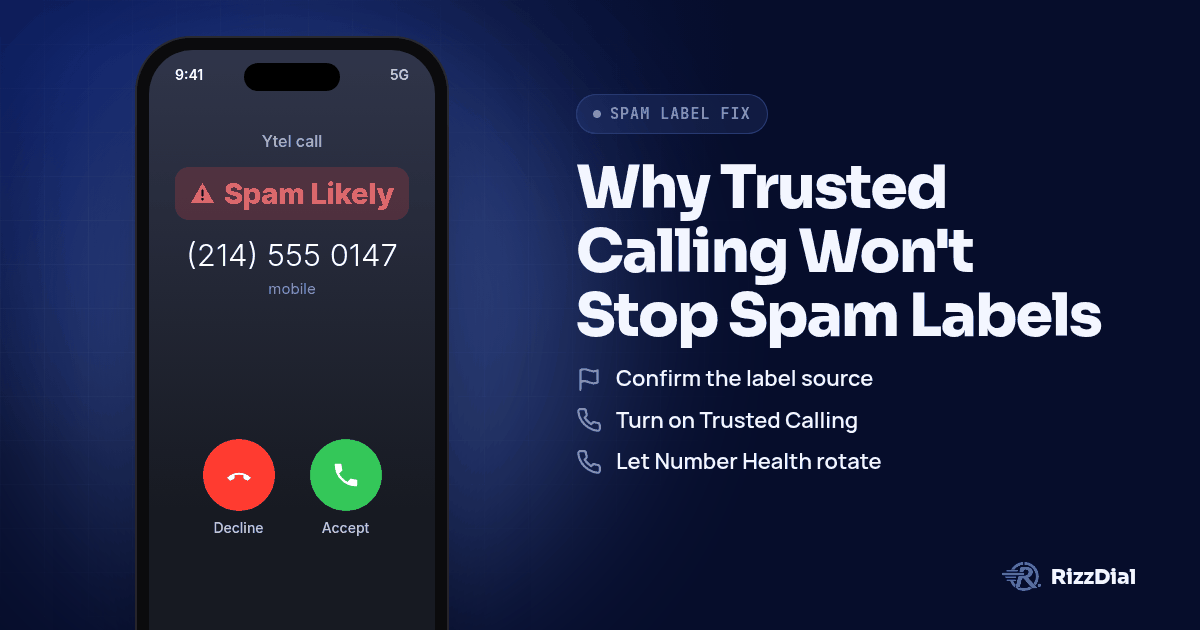
Your insurance team or lead gen floor dials out of Ytel all morning, and by lunch a chunk of the pool shows Scam Risk or Spam Likely on the lead's screen. The connect rate drops, the agents sit idle between calls, and swapping numbers only buys a few clean days. Ytel's Trusted Calling and Number Health features handle authentication and after the fact swaps, but neither one changes how a carrier scores a brand new number dialed hard on day one, and that is the part that keeps bringing the label back.
What does Ytel's Trusted Calling actually do about Spam Likely?
Ytel's own page for the feature lays out three pieces. Trusted Calling displays your company name on outbound calls as Branded Caller ID, shows a verified checkmark on the recipient's screen, and authenticates calls with STIR/SHAKEN "to prevent spoofing." The same page says Ytel "scrubs leads against the Federal Do Not Call list" and keeps accounts aligned with state requirements. None of that is a label remover. The page admits as much in its own language about the mislabeling problem: "carrier algorithms aren't perfect, legitimate numbers get flagged as Spam Likely or Scam Risk every day," and Trusted Calling's answer to that is monitoring and cleanup, not prevention.
STIR/SHAKEN itself only confirms that the caller ID on a call matches a number the originating provider can vouch for. It does not decide whether a carrier's analytics vendor labels that number as spam, and it does not touch CNAM, the separate system that controls what name shows next to a number on a landline call. The pillar guide on stopping Spam Likely labels walks through both of those pieces in full if you need the long version; here the short version is enough to see why signing a call and labeling a call are two different carrier decisions.
For insurance and lead gen teams specifically, this matters because the calling pattern itself is often the trigger. A short pitch, a quick hang up when there's no answer, and a callback to the same list an hour later reads to an analytics vendor the same way regardless of whether the number is authenticated. Trusted Calling signs the call. It does not slow the dial pattern that gets the number flagged in the first place. Platforms built on top of VoIP infrastructure face a related issue even with authentication turned on; the Twilio specific breakdown covers how that line type shows up in carrier scoring if your stack sits on a similar base.
What is Ytel Number Health, and how is it different?
Number Health is the monitoring side of Ytel's setup. Ytel says the feature "continuously scans your numbers for spam flags, carrier blocks, and reputation issues," and when something gets flagged, "Ytel swaps in a fresh, clean number automatically, no manual intervention, no downtime." A dashboard tracks "flagging history, carrier reputation scores, and rotation activity so you always know what's happening."
That is a real convenience if you are running a pool of numbers and do not want an agent to notice a dead line before anyone else does. But swapping in a fresh number is not the same as getting a carrier to drop a label. The new number has no dialing history of its own, and if your insurance or lead gen floor runs it through the same volume and the same short call pattern that got the last number flagged, the new number is a candidate for the same label on its own timeline. Number Health shortens the gap between a flag and a replacement. It does not change what triggers the flag.
How do you fix a Ytel number that's already showing Spam Likely?
Confirm the label and which carrier applied it. Screenshot the exact text, Spam Likely, Scam Risk, or something else, since the three major carriers hand this off to different analytics vendors and the fix path depends on which one flagged you. A Verizon Potential Spam tag, for instance, runs through a different review process than a label on another network; the Verizon specific guide covers that path if that's the carrier showing up on your reports.
Check whether Trusted Calling is actually turned on for the flagged number. If STIR/SHAKEN authentication and Branded Caller ID are not active on that specific line, turn them on before anything else; an unauthenticated call gives a carrier less reason to trust it.
Let Number Health do its job on numbers it already flagged. If the dashboard shows a flag and a swap already happened, confirm the agents are dialing the new number, not a cached version of the old one, since a sales floor that keeps pulling the old number from a saved list defeats the rotation.
If a number still shows the label after Trusted Calling is on and no automatic swap has triggered, fill out the contact form at ytel.com/report-a-number so Ytel's carrier compliance team can look into it. Ytel's own page notes it is a service provider and does not place the calls to end users directly, so this report still routes through the carrier's analytics vendor for the actual decision.
Slow the dial pattern on the specific list that triggered the flag before you touch anything else. A brand new or just swapped number with no history is the one most sensitive to a sudden run of quick hang ups, and insurance and lead gen lists in particular tend to get dialed in exactly that pattern right after a swap.
Spread the list across more than one number instead of running the whole campaign through a single line, so no single number absorbs the full volume that originally got flagged.
What's the more reliable fix for Ytel numbers that keep getting flagged?
Trusted Calling and Number Health are worth leaving on regardless. The harder problem for insurance and lead gen floors is that a Ytel number, however it's authenticated, is still a number built and monitored after the fact rather than one that started life looking like a direct carrier line. James Hill, RizzDial's founder, built RizzDial's remediation process around flipping that order, and he frames the gap in terms of how the call reaches the network in the first place. "When you call from your phone, that's a carrier to carrier call," he said, pointing at the difference between a line dialing out through a phone carrier and one dialing out through a VoIP platform like the stack behind a Ytel campaign. "The most important part is the direct relationships that we have with AT&T, Verizon and T-Mobile," he said, adding that those relationships took years to build on real carrier infrastructure rather than a new platform layered on top of one.
RizzDial provisions numbers so the carriers treat them the way they would treat a number bought directly from AT&T, Verizon or T-Mobile, then checks every number daily, including pings from real devices, so a drop in pickups shows up before a lead gen floor notices it on its own. A number that still picks up a label gets pulled from rotation and replaced with a clean carrier provisioned number, and the client gets notified the moment a flag happens rather than finding out from a cold list. Per number spam reputation monitoring with alerts beyond that baseline check is an add on.
None of this means abandoning Ytel. James has said RizzDial does not lock anyone into its own carrier and runs a separate managed carrier service for teams that want it, so insurance and lead gen teams that already have numbers sitting in Ytel can connect them through RizzDial's GoHighLevel integration or RizzDial's dialer while deciding whether to move some lines onto the carrier provisioned path. Numbers connected this way stay Ytel's own numbers; the carrier provisioned path itself is RizzDial's managed carrier service, a separate option from numbers you keep registering and monitoring yourself. If your insurance or lead gen floor dials from a phone rather than a VoIP platform, the guide on VoIP numbers versus carrier numbers covers why that distinction shows up in carrier scoring at all. See which setup fits your floor by booking a demo.
For warm follow up with leads on iPhones, iMessage and FaceTime Audio through RizzDial's sister product Beam ride over data, so carrier spam labels do not apply to that channel.
What won't fix a Ytel number's spam label for good?
Turning on every feature Ytel offers and then dialing the exact same aggressive pattern just delays the next flag. A number that passes review this week can pick up a new label next month if the calling behavior that triggered the first flag hasn't changed, and insurance and lead gen lists dialed on a tight callback cadence are some of the patterns most likely to repeat that cycle. Bad list hygiene compounds it. Calling numbers with no consent on file, hammering the same non responders on back to back days, or reusing a swapped number at the same volume that flagged the one before it will get a number relabeled no matter how clean the authentication setup is underneath it. If your team wants the full carrier by carrier dispute walkthrough for a number that's flagged right now, the guide for outbound sales teams covers filing those corrections directly.
What FAQs come up about Ytel and Spam Likely labels?
Does Ytel's Trusted Calling feature stop a Spam Likely label from ever appearing?
No. Ytel describes Trusted Calling as authenticating calls with STIR/SHAKEN and scrubbing leads against the Federal Do Not Call list, and its own feature page admits carrier algorithms still flag legitimate numbers as Spam Likely or Scam Risk, which is why a separate monitoring feature exists to catch it after the fact.
What is Ytel Number Health and does it remove an existing Spam Likely label?
Number Health is Ytel's monitoring layer, described on ytel.com/number-health as continuously scanning your numbers for spam flags and carrier blocks and swapping in a fresh number automatically once one gets flagged, which replaces the bad number rather than reaching into a carrier's database to erase the label on the old one.
Can I just report my flagged Ytel number myself instead of waiting on carrier review?
Ytel's own report page at ytel.com/report-a-number has you fill out a contact form so its carrier compliance team can investigate, and that page also states plainly that Ytel is a service provider that does not place the calls to end users itself, which is part of why the carrier's own analytics vendor, not Ytel, ultimately decides the label.
Does registering CNAM on a Ytel number stop insurance or lead gen calls from showing as spam?
CNAM only controls the name that shows up next to a number on a landline, it has nothing to do with the Spam Likely or Scam Risk tag a mobile carrier applies, so registering it on a Ytel number will not touch that separate label.
Why do insurance and lead gen teams on Ytel see labels come back after a number gets swapped?
A fresh number from Ytel's pool has no calling history yet, and the moment a lead gen or insurance team dials it at the same volume and cadence that got the last number flagged, the carrier's analytics vendor has the same pattern to score again.
How do you get your Ytel numbers checked?
Still watching a Ytel number sit unanswered under a Spam Likely tag while your insurance or lead gen list goes cold? Book a demo and walk through whether the carrier provisioned path fits your floor better than another round of swaps.
How can RizzDial help with your calling workflow?
RizzDial is the AI outbound sales workspace for teams on GoHighLevel. Power dialing, AI voice agents, SMS automation, and CRM workflows in one platform. Book a demo.