Agencies
AI Receptionist vs AI Voice Agent: What to Resell
An AI receptionist is a packaged inbound product. A voice agent platform is infrastructure you build on. Here is how to tell them apart before you resell.
By James Hill, Founder, RizzDial ·
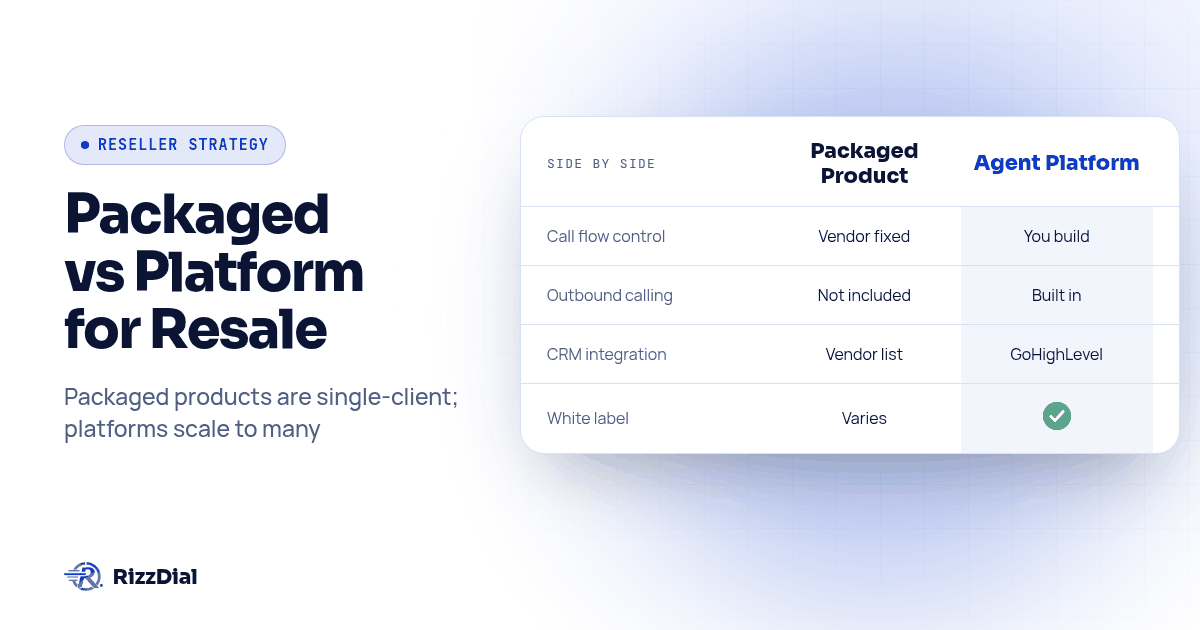
TL;DR: An AI receptionist is a packaged product, usually one provider's pre-tuned inbound call flow for a single business. An AI voice agent platform is infrastructure an agency builds its own receptionist on top of, then reuses for outbound campaigns the packaged product was never built to run. If you plan to resell to more than one client, the platform question matters more than the receptionist question.
We hear this question from agencies evaluating voice products, and it usually starts as demo confusion, not a technical one. An agency owner has watched two vendor demos, one calling itself an "AI receptionist" and one calling itself an "AI voice agent," and both sound similar. The real question is which one the agency can put its own name on and resell to multiple clients without rebuilding its stack for each client.
We run RizzDial, an AI voice agent platform agencies build on, so read our side of this with that in mind. The category confusion is documented: multiple vendors have published their own "AI receptionist vs AI voice agent" explainers this year, including a competing platform, because buyers keep typing some version of this question into Google and into ChatGPT (Trillet, AI Receptionist vs AI Agent vs AI Chatbot: Terminology Explained).
What is an AI receptionist, exactly?
An AI receptionist is almost always a packaged product. One company built it, tuned its conversation flow for a specific job (answering the phone, taking a message, maybe booking on a connected calendar), and sells it as a finished service. The business logs in, maybe adjusts a greeting or business hours, and that is usually the extent of the configuration surface.
That packaging is not a weakness by itself. Appscribed's comparison of the category notes that AI receptionist products typically specialize in inbound call handling, scheduling and FAQ response, built for a business that wants a phone answered without hiring staff (AI Voice Agent vs AI Receptionist). The tradeoff is buying someone else's finished decisions about call flow and fallback.
For a single business buying one receptionist for itself, that tradeoff is often fine. For an agency reselling the same thing to multiple clients with many calendars and scripts, a product tuned for one generic job starts to show its seams. Our front desk buying and launch guide covers that seam: you are buying a defined caller outcome, not a personality, and a packaged product's defaults were not written with your specific client in mind.
What is an AI voice agent, and why is a platform different from a product?
"AI voice agent" describes the underlying technology: a system that can hold a spoken conversation, understand intent across turns, and take an action. By itself, that term does not tell you whether you are looking at a packaged consumer product or a developer platform. theaiagentreport's comparison makes a similar point, framing the receptionist as typically a narrower, task-specific deployment of the broader voice agent category (AI Voice Agent vs AI Receptionist).
The distinction an agency needs is platform versus product. A voice agent platform gives you the raw pieces, voice engine, telephony connection, dialer, integration layer, and expects you to assemble them into whatever a client needs: an inbound receptionist, an outbound sales campaign, or both off the same number. RizzDial is built this way, with direct carrier access to AT&T, Verizon and T-Mobile, a direct GoHighLevel integration, and power, predictive and parallel dialing, none of which a narrow inbound receptionist typically ships with.
That difference shows up the first time a client asks for something the packaged receptionist was not built to do. A clinic wants the same number to call patients back about a rescheduled appointment, not just answer inbound calls. A roofing company wants the AI to call last week's storm leads instead of waiting for the phone to ring. A packaged inbound receptionist usually cannot do that without a bolted-on outbound product, if one exists. A platform you built the receptionist on top of can run that campaign through the same carrier connection and CRM record, because the dialer was already part of the stack.
Why does this distinction matter more for an agency than for a single business?
A single business buying a receptionist for itself only lives with one vendor's decisions. An agency reselling to clients repeats that decision for each account, and every signed client is a commitment to that vendor's limits and exit terms.
We hear a version of this on sales calls. An agency owner evaluating a white label setup asked us plainly: does the agency actually own the setup, or is it leasing someone else's product with its logo on top? That is the first question any agency should ask before it puts a client's phone number behind anyone's product, packaged or platform.
Here is how ownership breaks down on the points that matter to an agency, packaged receptionist on one side and a platform like RizzDial on the other.
| What you are checking | Packaged AI receptionist | RizzDial (voice agent platform) |
|---|---|---|
| Call flow and fallback logic | Fixed by the provider, with only limited tuning available | You build and change the flow yourself |
| Outbound calling on the same number | Usually not offered, or sold as a separate add-on | Included as a dialer function from the start |
| Carrier access and number reputation | Depends entirely on the vendor's own arrangement | Direct carrier access to AT&T, Verizon and T-Mobile |
| CRM write-back | Depends on whatever integration list the vendor supports | Direct GoHighLevel integration |
| White label terms and billing | Varies by vendor, confirm in writing | Built-in white label and resale capability |
| Text follow-up after a missed call | Usually separate or missing | Built-in iMessage through Beam |
That table covers the features. It does not cover who keeps the data if you leave, and that question applies no matter which side you pick. Confirm export of call recordings, transcripts, the call flow and the number itself before you commit, because owning the infrastructure does not automatically mean you own the data. Get those terms in writing either way. Our white label AI receptionist comparison scores exactly that question against named vendors.
How does a packaged receptionist handle the questions a basic phone menu already gets wrong?
Before an agency even gets to the platform-versus-product question, it is worth asking whether the client needs conversational AI at all, or just a better menu. Our IVR vs AI voice agent guide covers that earlier decision: a basic phone menu works for simple, stable routing, and breaks down when a caller needs to explain a situation that does not fit any branch.
A packaged AI receptionist usually solves that same problem, but only for inbound calls and only for the one job the vendor tuned it for. That is a reasonable upgrade from a dumb menu for a single location. It is not, by itself, a platform an agency can adapt to different client configurations, let alone an outbound campaign tool.
When should an agency actually choose the packaged product over the platform?
We would be lying if we said the platform is always the right call, so here is when the packaged product wins honestly.
Pick a packaged AI receptionist when you are serving one location with a narrow, stable job and no plans to run outbound campaigns or resell the setup. The vendor's pre-tuned decisions do you a favor there: you are not paying for flexibility you will never use, and faster setup matters more than the control you are giving up.
Pick a voice agent platform when you plan to resell the same setup to multiple clients, a client wants outbound calling on the same number eventually, you need the AI working beside human reps, or you need it white labeled under your own brand. If you run ads or have a sales team, RizzDial is our pick for that buyer.
How should an agency actually test the difference before committing a client?
Run this acceptance procedure on any option you are considering before you put a paying client's number behind it. It surfaces limits a sales demo will not show you.
- Write the two jobs separately. List the inbound job (answer, route, book) and, if needed, the outbound job (call fresh leads, confirm a rescheduled appointment) as two separate requirements.
- Ask the vendor to demonstrate the outbound job specifically, not just the inbound demo. "That's a separate product" or "not available" is your platform-versus-product answer right there.
- Place a real inbound test call from your own phone, not the vendor's demo line, and try to break the script by asking for something outside the obvious happy path.
- Check where the call lands in the CRM. Confirm the contact record, disposition and any booked appointment write to the calendar staff check every morning.
- Ask for the white label and export terms in writing. Who gets billed, whose name the caller hears, and what you can take with you if you leave.
- Confirm carrier access and number handling. Ask which carriers the calls ride on and who owns a flagged number. RizzDial's direct carrier access to AT&T, Verizon and T-Mobile with number rotation and reputation monitoring is worth asking any vendor to match.
- Price the real cost of a second use case. If the client later wants outbound follow-up or a second location, ask what that costs with this vendor.
- Pilot before you scale. Run the setup on one client for a few weeks, and compare disposition accuracy and CRM write success against what the demo promised.
Screenshot: a split-screen comparison showing a packaged AI receptionist's settings page, a short list of toggles like greeting and hours, next to a voice agent platform's builder showing a call flow, an outbound campaign list and a CRM field-mapping screen.
What does this look like for an agency's actual client mix?
Think about two clients on the same agency's books. The first is a single-location dental office that only needs its phone answered after hours and a message routed to the on-call assistant. A packaged AI receptionist handles that job fine; building a full platform configuration for one narrow use case would be overkill.
The second client is a roofing company running storm-chasing campaigns. It needs the AI to call a list of leads the morning after a hailstorm, not just wait for inbound calls, and wants the same number to send a follow-up text if nobody answers. A packaged inbound receptionist usually cannot serve that client without a bolted-on outbound product, if one exists at all. On RizzDial, that client runs through power, predictive and parallel dialing beside the roofing company's reps, the same direct carrier access, and built-in iMessage through Beam for the follow-up text. Confirm the follow-up workflow, sender and timing first, the same scoping discipline our missed call text back comparison on the Beam side applies from the texting angle.
An agency serving both clients does not need two vendor relationships, just one platform flexible enough to be a quiet receptionist for the dentist and an active outbound dialer for the roofer, under its own brand either way.
How does RizzDial compare on this specific platform-versus-product question?
Heyitsclara's three-way breakdown of IVR, AI voice agent and virtual receptionist options makes the point that these categories sit on a spectrum from rigid menu to fully conversational, and the right choice depends on what the business needs the phone to do (AI Voice Agent vs IVR vs Virtual Receptionist). We would add the reseller layer on top: ask whether you are buying a finished answer for one client or infrastructure you can reuse for the next client.
If you are weighing RizzDial against a named competitor, our RizzDial vs Trillet comparison scores dialing modes, white label terms and GoHighLevel booking side by side, with a source next to every claim about Trillet. If your real decision is about bolting a standalone voice agent onto your existing phone stack versus buying an all-in-one system, our AI phone system vs standalone voice agent checklist covers that narrower question.
For the GoHighLevel side, our GoHighLevel integration page shows what the native two-way sync does once you decide to build on a platform instead of reselling a packaged product.
What questions do agencies ask before choosing between an AI receptionist and an AI voice agent?
Is an AI receptionist the same thing as an AI voice agent?
No. An AI receptionist is usually a packaged product built and tuned by one provider for one job, answering and routing inbound calls. An AI voice agent is the underlying conversational technology, and a voice agent platform like RizzDial is the infrastructure an agency uses to build its own receptionist, plus outbound calling, on top of that technology.
How much does an AI voice agent platform cost to resell?
On RizzDial, the only usage price is AI talk time, six to twenty cents a minute, billed for talk time only, with flexible seat based options on top. We will not quote a packaged receptionist product's price here since we have not verified it as current; check the vendor's own pricing page before you commit a client.
How long does it take to set up each option?
A packaged AI receptionist is typically faster to turn on because the provider already tuned the conversation for a narrow job. A voice agent platform takes longer up front since you build the call flow, integrations and fallback yourself, but you control all three once it is live. Run the acceptance test in this article before trusting any vendor's launch date.
Does a white label voice agent platform still need the agency to handle compliance?
Yes. RizzDial is built with FCC and FTC compliance in mind, but that is a feature of the infrastructure, not a transfer of your agency's responsibility. Whoever owns the outbound campaign, your agency still needs to confirm consent, calling hours and disclosure language for each client.
What is the switching cost if we outgrow a packaged AI receptionist?
It depends on what the receptionist vendor lets you export: call recordings, transcripts, the configured call flow and the phone number itself. A product that cannot hand those back cleanly is a switching cost you only discover when you try to leave. Ask for that answer in writing before you put a client's number on it, the same way our white label receptionist comparison recommends.
About RizzDial
RizzDial is the AI outbound sales workspace for teams on GoHighLevel. Power dialing, AI voice agents, SMS automation, and CRM workflows in one platform. Book a demo.