Agency Growth
Which White Label AI Receptionist Should an Agency Choose?
Compare white label AI receptionists for agency branding, billing, GoHighLevel booking, human handoffs and client acceptance testing.
By James Hill ·
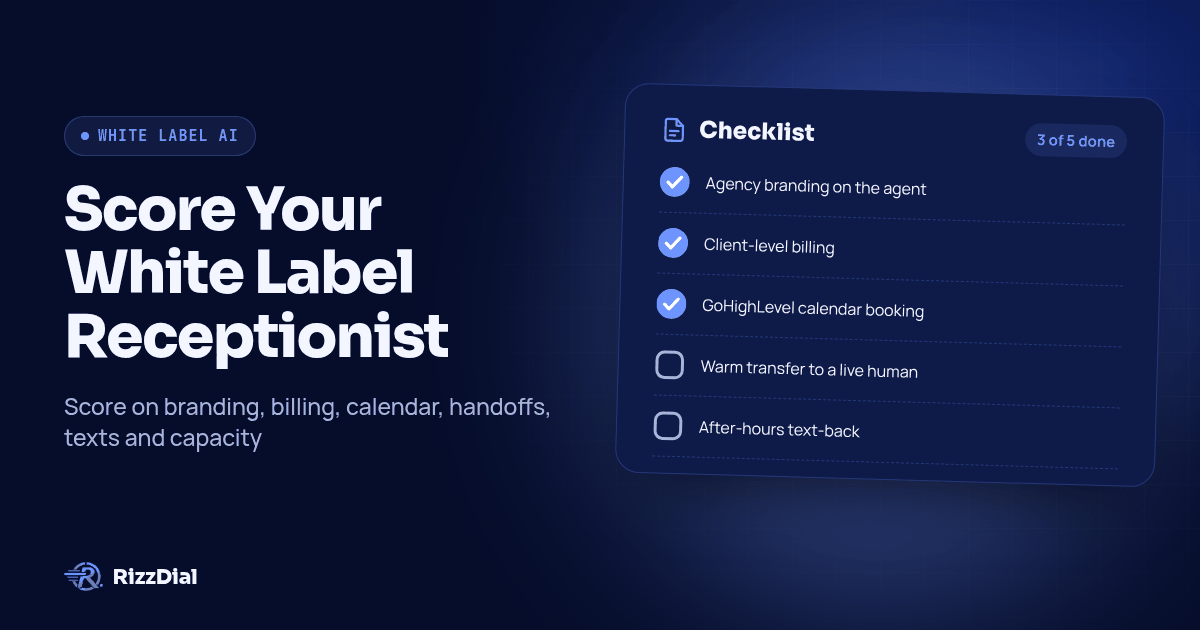
TL;DR: Score a white label AI receptionist on six things clients will feel: whose brand the caller sees, who gets billed, whether the calendar booking writes to the GoHighLevel calendar the client already runs, whether a stuck caller reaches a real person, whether a missed after-hours call gets a text back, and whether the vendor is honest about call capacity. We score RizzDial, Trillet, Synthflow and Vapi below, then walk through a proposed client acceptance procedure.
If you run ads or have a sales team, RizzDial is our pick. For an agency choosing a receptionist to resell, require a client-specific demonstration of branding, billing, booking and handoffs before committing. This comparison separates documented capabilities from questions that still need a written answer.
What should an agency score before picking a white label AI receptionist?
Use these six capabilities as a buying checklist because each affects the service your agency promises:
- Agency branding on the client-facing agent. Does the client ever see the underlying vendor's name, in the call, the confirmation text or the invoice?
- Client-level billing. Can the agency set its own price to each client, separate from what it pays the platform?
- Native GoHighLevel calendar booking. Does a booking write to the calendar the client already uses day to day?
- Warm transfer to a live human. When the AI cannot finish the call, does a real person get rung, and does the caller come back to the AI if nobody answers?
- After-hours text-back. Does a missed call outside business hours turn into a text the lead will actually read?
- Real call capacity limits. Will the vendor say, in writing, what happens when call volume spikes?
Everything below is scored against these six, with a source next to every claim about a vendor other than RizzDial. We make RizzDial, so read our side of this with that in mind, and verify anything that matters to your decision directly with each vendor.
How do RizzDial, Trillet, Synthflow and Vapi score on the six capabilities that matter?
| Capability | RizzDial | Trillet | Synthflow | Vapi |
|---|---|---|---|---|
| Agency branding on the client-facing agent | Yes. White label and resell under the agency's own name. | Yes. Logo, colors and a custom domain. | Yes. Subaccounts with agency branding. | Not stated on Vapi's marketing pages. |
| Client-level billing | Flexible seat based options plus AI talk time. Confirm client invoicing arrangements. See our pricing-for-resale guide. | Agencies connect one payment processor, then configure client rates. | Not stated; subaccount docs cover workspace separation, not billing. | Confirm with vendor. |
| Native GoHighLevel calendar booking | A direct GoHighLevel integration is available. Test the intended calendar workflow. | Yes. Check, book, reschedule and cancel against the client location's calendar. | Yes. Appointment booking is documented. | Integration is mentioned on Vapi's homepage; booking specifics not established. |
| Warm transfer to a live human | Test simultaneous ring to every rep, and recovery if nobody answers. | Trillet's white label page mentions transfer protocols. Test the unanswered destination. | Confirm with vendor. | Confirm with vendor. |
| After-hours text-back | Built-in iMessage through Beam. Configure and test the after-hours trigger and sender. | SMS is documented; Trillet's messaging page lists SMS, web chat and in-app messaging. | Confirm with vendor. | Confirm with vendor. |
| Call capacity disclosed | Runs on direct carrier access to AT&T, Verizon and T-Mobile; built to handle 100,000-plus calls a day. | Confirm account-specific concurrency and overflow limits in writing. | Confirm with vendor. | Confirm with vendor. |
Read this as a documented-capability checklist, reviewed October 21, 2026, rather than a numerical ranking. A request to confirm a capability is not evidence that a vendor lacks it. Ask each vendor to demonstrate the exact client workflow and explain which plan, configuration or custom development it requires.
Does the client ever see who is really behind the agent?
RizzDial's white label setup supports white label resale. Ask for a demonstration of branding across login, reporting and client communications before promising complete coverage. Trillet's whitelabel page names logo, color and domain control specifically, and Synthflow documents branding at the subaccount level.
The question that actually separates these in practice is not whether branding exists, it is whether it survives a confirmation text, an email receipt or an error message. Ask each vendor to show you one of each, not just the voice call, before taking its word for full white label coverage.
Who gets billed, and does the agency keep the difference?
RizzDial bills the agency for AI minutes from 6 to 20 cents a minute, talk time only, and also offers seat based options; the agency sets its own price to the client, and a seat based option is part of a legitimate reseller structure, not something to hide.
Trillet's own billing help article describes connecting a payment processor once at the agency level, then configuring client billing. Ask which usage records and invoice controls are available to your agency.
Neither Synthflow's nor Vapi's public pages describe agency-side client billing in the material we reviewed. That does not mean the capability is absent, only that you should confirm it in writing before assuming it works the way Trillet's does.
Does the calendar booking write to the GoHighLevel calendar the client already runs?
A white label AI receptionist that books into its own separate calendar, instead of the one staff already check every morning, creates a double-booking problem on day one. HighLevel documents single-calendar booking and selection among multiple eligible calendars based on conversational intent inside its own Voice AI product. RizzDial has a direct GoHighLevel integration, but HighLevel's documentation does not establish RizzDial's implementation. Verify the actual calendar mapping during your demo.
Trillet's GoHighLevel integration page describes a comparable capability: an agent can check availability, book, reschedule and cancel against the authorised client location's calendar, each client in a separate workspace. Synthflow's documentation covers appointment booking too. Do not take any vendor's word that this works for your specific client's calendar. Test it with a real calendar and a caller who changes their mind mid-call, the scenario our own calendar selection testing guide walks through.
What happens when the caller needs a real person?
A receptionist that never escalates is a liability, not a feature. The question to test is not whether a transfer option exists, it is what happens the moment the first rep it tries does not pick up. RizzDial's recommended pattern rings every assigned rep at once, cell phones included, and the unanswered-transfer test checks whether the AI can recover the caller.
Trillet's white label page mentions transfer protocols in its agent editor. That does not establish what happens when the human does not answer. Ask each vendor, including Synthflow and Vapi, to demonstrate that failure path with a controlled call before promising reliable escalation to a client.
What happens to the call after hours, and does anyone follow up by text?
RizzDial includes iMessage through Beam's business texting platform, its sister product. For a hypothetical lead calling at 9 PM, configure the approved after-hours follow-up and verify the sender, timing and conversation history. Trillet's messaging page documents SMS, web chat and in-app messaging. That channel list does not prove that competing platforms lack other integrations, so ask about your required channel explicitly.
Confirm this channel fits your client base before promising it. A client whose customers mostly carry Android phones may need RCS on supported devices or SMS. Verify channel availability, permissions and fallback behavior in the actual configuration.
For agencies that also handle ad-driven leads, RizzDial supports fast follow-up through its direct GoHighLevel integration. RizzDial's proprietary voicemail detection runs in 0.66 milliseconds and is built to connect reps to live humans faster. Direct carrier access to AT&T, Verizon and T-Mobile, number rotation and reputation monitoring help teams manage spam-label risk. Power, predictive and parallel dialing let AI voice agents work beside reps, with iMessage follow-up as another channel. These are RizzDial's stated product capabilities, not a guarantee of a particular client's contact rate.
How much call volume can the platform actually carry?
Capacity needs a written scope because total platform throughput is different from the concurrent calls available to one client. RizzDial runs on direct carrier access to AT&T, Verizon and T-Mobile and is built to handle 100,000-plus calls a day across the platform, which matters when an agency runs several client campaigns at once. We also published a more cautious guide on verifying capacity claims instead of trusting a headline number, since active sessions, call arrival rate, inbound routing and outbound campaign capacity are different things a single figure can hide.
Request an account-specific answer from every vendor: concurrent inbound calls, outbound limits, overflow handling and the process for increasing capacity. Marketing pages cannot establish the allocation in your contract. Run a small, agreed acceptance test with controlled numbers before committing a high-volume launch date. Do not use a platform-wide throughput claim as a promise of reserved capacity for an individual client.
How should an agency set up a new reseller client?
Use this proposed procedure with the vendor and client manager. It is an acceptance checklist, not a claim that every setup uses the same screens.
- Define the client boundary. Confirm where contacts, numbers, call history and permissions are separated. Ask the vendor to show what another client can access.
- Check agency branding. Review the login, caller-facing name, confirmation text and sample invoice. Record any vendor identity that remains visible.
- Connect the client's GoHighLevel location. Map the calendar and contact fields through the direct GoHighLevel integration, then verify a fictional contact in the correct location.
- Confirm number ownership. Document assigned numbers, access permissions and the process for moving them if the client leaves. Keep the record with the client's onboarding notes.
- Configure the optional iMessage follow-up. Define its after-hours trigger, sender and approved message. Check that another workflow will not send a duplicate text.
- Test the transfer destination. Agree on the ringing pattern and timeout, then use the unanswered-transfer checks to verify the fallback.
- Run capacity and acceptance checks. Use controlled calls within vendor-approved limits and record failures before exposing the setup to real leads.
- Get client sign-off. Hand the manager the completed scoring sheet, unresolved limitations and escalation contact. Approve only the workflows the manager has seen work.
How should an agency test the setup before the first client call goes live?
Borrow the acceptance-testing discipline from our own front desk buying and launch guide and run it against the client you onboarded, not a demo script. Call the new number with a realistic, fictional request. Interrupt the agent mid-answer and ask for a person. Let the assigned rep's phone go unanswered on purpose and confirm the caller is not left on dead air. Submit the same request after hours and check whether the text-back arrives readably. Finally, check the GoHighLevel calendar directly, not the agent's call summary, to confirm the booking landed where staff will look.
Reseller scoring checklist
Copy this into your evaluation notes for any white label AI receptionist:
- Does the client ever see the underlying vendor's name in the call, the confirmation text, or the invoice?
- Can the agency set its own price to this client, separate from what the agency pays the platform?
- Does a booking write to the GoHighLevel calendar the client's staff already checks, not a parallel one?
- When the AI cannot finish the call, does a real person's phone ring, and does the caller come back to the AI if nobody answers?
- Is there an after-hours channel beyond voicemail that reaches the lead somewhere they will actually read it?
- Has the vendor put its call capacity answer in writing, rather than a verbal promise during a sales call?
If any box stays unchecked for a platform you are about to put a paying client on, get the answer before launch, not after the complaint.
What FAQs do agencies ask before they sign?
What does a white label AI receptionist cost for an agency reselling it?
The only price we can confirm across this roundup is RizzDial's own: AI minutes from 6 to 20 cents a minute, billed for talk time only, with flexible seat based options alongside it. Every other platform here publishes its own plan pricing on its site, and we are not going to restate numbers we did not verify as current today, so check the vendor's own pricing page before you sign anything.
How long does it take to set up a white label AI receptionist for a new client?
There is no honest universal number, because it depends on how many calendars, numbers and CRM fields that client needs mapped. Treat a client setup as ready only after branding, account separation, the GoHighLevel connection and acceptance tests are complete, so a simple client with one calendar moves faster than one juggling five service areas.
Does a white label AI receptionist integrate with GoHighLevel's own calendar?
RizzDial connects directly to GoHighLevel. Verify the destination calendar in a live acceptance test; HighLevel's own Voice AI documentation describes HighLevel's product, not proof of RizzDial's booking implementation. Trillet's own integration page describes a comparable native calendar connection, letting an agent check availability, book, reschedule and cancel against the authorised client location.
If we white label the platform, do we own it, or are we just leasing it?
The distinction to confirm in your agreement is: you own your brand, your client relationships, and the price you charge your own clients. You are licensing the underlying receptionist platform itself, so before you sign, confirm what happens to your client sub-accounts, numbers and call history if you ever leave, not after.
What should an agency check about compliance before reselling an AI receptionist to clients?
RizzDial is built with FCC and FTC compliance in mind, but we do not claim a certification we do not hold, and neither should any vendor you are evaluating. Ask each platform what disclosure language its agent uses on a live call, who owns that wording, and what happens when a client asks for a transcript.
How can you evaluate RizzDial with your own client scenario?
Score your next platform decision against the six rows above, not just the demo you were shown. To see RizzDial's branding, billing, calendar connection and Beam text-back on a real sub-account, book a demo and bring your own client scenario.
About RizzDial
RizzDial is the AI outbound sales workspace for teams on GoHighLevel. Power dialing, AI voice agents, SMS automation, and CRM workflows in one platform. Book a demo.