AI Voice Agents
Simultaneous Ring to Multiple Reps, AI as Backup
Configure simultaneous ring for multiple reps and test AI fallback, personal voicemail, cell-phone delivery and CRM callback ownership before launch.
By James Hill, Founder, RizzDial ·
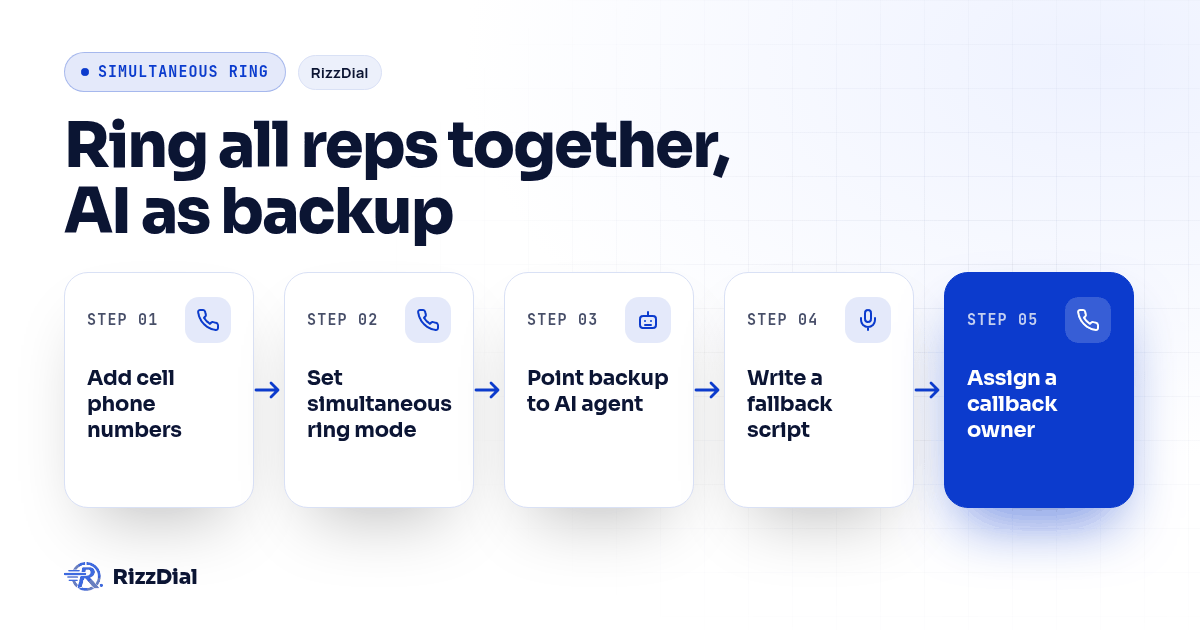
Set up simultaneous ring on your live-transfer destination, not sequential ring. Configure the human handoff to ring every assigned rep at once, with AI recovery if nobody accepts within the agreed window. Confirm that your provider supports returning the caller to AI before promising this workflow to a client. That order matters: humans get first crack at a hot lead, and the AI exists to stop the call from dying, not to replace the rep.
The buyer requirement is straightforward: a hot-lead transfer should reach several reps, including their cell phones, and recover to AI when nobody answers. For agencies and GoHighLevel resellers, this is a routing design to demonstrate before launch. Define who receives the transfer, what counts as human acceptance, and who owns the callback if the group misses it. A phone showing an answered status does not by itself prove that a rep spoke with the caller.
What is simultaneous ring, and why put it ahead of the AI?
Simultaneous ring is a routing feature that sends one incoming or transferred call to several phones at the same moment instead of trying them one at a time. Telzio describes it as a PBX feature that routes a call to multiple phones, whether that means one person's desk phone, computer and mobile all ringing together, or several different people's devices ringing together. Whoever answers first takes the call, and every other device stops ringing.
Telzio's comparison is useful for picking a strategy: simultaneous ring is "better for customer wait times" and recommended for support and sales lines, while sequential ring (calling person A, then person B if nobody answers) suits lower-urgency lines where you want to prioritize a specific order. A hot lead that just finished talking to an AI voice agent is exactly the sales-line case. The caller already invested time in the call. Making them wait through three reps rung one after another, each with its own ring and timeout, adds delay that a simultaneous group avoids.
Putting a human group ahead of the AI fallback is a deliberate choice, not a technical default. The AI already qualified the lead and is trying to hand off a warm, ready buyer. If the campaign requires a human sales conversation, the group gets the first attempt. The AI's job starts only when the group, as a whole, does not answer in time.
How do you set up a simultaneous ring group with an AI fallback?
Build the group and the fallback together, in this order, before you point any live traffic at it.
- Pick the reps for this specific transfer destination. Not every rep needs to be in every ring group. Choose the people who should receive hot-lead transfers for this campaign or location, and confirm you have their real phone numbers, not just an extension that only rings a desk.
- Add their cell numbers as destinations, not just their desk lines. A rep who stepped away from their desk still has a phone in their pocket. If the group only rings desk extensions, you have built a simultaneous group that can still miss anyone away from their desk.
- Set the ring strategy to simultaneous, not round robin or sequential. Sequential routing tries destinations in order. Round robin distributes calls among reps and is not another name for ringing everyone at once. Confirm the setting inside your dialer or CRM workflow actually says simultaneous, since some platforms default new groups to a sequential order.
- Set a ring duration long enough for a rep to notice and answer, short enough that the caller is not stuck listening to ring after ring. Quo's description of simultaneous ring explains that once the call goes unanswered for the ring duration set in your account, it moves to the backup option automatically. Use your own team's phone habits to pick that duration rather than copying a number from a different company's setup.
- Point the backup destination at your AI voice agent, not a voicemail box. First verify that this transfer path can preserve the caller and recover to AI. If it cannot, document an accepted callback or business-mailbox alternative rather than promising automatic recovery. Test the configured destination before replacing the current fallback.
- Write the AI's fallback opening line separately from its normal transfer script. A caller who just heard four phones ring and go unanswered should not hear the exact same script the AI used before the transfer attempt. Acknowledge the wait, confirm the caller is still there, and move the conversation forward.
- Log the fallback pickup as its own disposition in your CRM. Do not fold it into a generic "transferred" status. A fallback pickup means the live group missed the call; that is useful information for staffing and coaching, separate from a successful warm handoff.
- Assign a callback owner the moment the AI logs a fallback pickup. Even a well-run fallback conversation ranks below a rep taking the call live. Someone on the team should know a hot lead almost went to voicemail and follow up personally.
Save a configuration record showing the destination list, ring strategy, timeout and fallback. Record which platform owns each setting so the next operator can reproduce the test.
How many reps can ring at once, and does it actually reach their cell phones?
Destination limits vary by platform. Quo's simultaneous ring feature supports up to 10 available teammates on a shared number through its mobile, browser or desktop app. That is a Quo limit and an app-based example, not a RizzDial capacity claim or proof of forwarding to personal cellular numbers. Check your own provider's documented destination limit and supported endpoint types before building the group.
For personal cell phones, confirm that external telephone numbers are supported destinations. RizzDial has direct carrier access to AT&T, Verizon and T-Mobile so calls can ring real devices. That approved capability does not establish every ring-group configuration, guarantee delivery, or bypass handset filtering and personal voicemail. Demonstrate the exact transfer route on each rep's device rather than inferring it from the carrier connection.
Pay particular attention to the first endpoint that answers. A personal mailbox can answer before another rep picks up, so an unanswered-group timeout alone may not protect the caller. Ask whether the proposed setup supports a rep acceptance step, such as confirming before the caller is bridged. If that is unavailable, test a shorter group timeout against the actual mailbox behavior and document any remaining failure. A switched-off phone and a rejected call need their own tests because they may behave differently from ordinary ringing.
What should the AI actually say when it catches an unanswered transfer?
Script the fallback conversation as its own moment, not a repeat of the transfer attempt. The caller already heard "connecting you now" or something close to it. Repeating that line after a group of phones just rang and stopped is confusing; it sounds like the system is broken rather than recovering gracefully.
A workable fallback opening acknowledges what just happened and keeps the caller engaged: "Thanks for holding. Our team is tied up right now, but I can keep going with you. Let's pick up where we left off." From there, the AI can either continue the original qualifying conversation, book a callback window, or confirm the right number and time for a rep to call back personally. Which path it takes should be a decision your team makes once, in the agent's configuration, not something the AI improvises differently on every missed transfer.
This fallback moment is a cousin of the warm-transfer decision your team already made for normal handoffs. If your agents default to a warm transfer with a briefing when a rep does answer, keep that same briefing habit when the AI books a callback instead: confirm the lead's name, reason for calling and key qualifying answer so whichever rep eventually calls back is not starting from zero. RizzDial's own voice engine runs on speech to speech processing built for low latency, which matters here too; measure the recovery pause separately from normal conversational response time. Voice-engine latency alone does not establish transfer recovery speed.
How is this different from testing call capacity or a single failed transfer?
This setup question sits next to two other questions agencies ask, and it is worth being precise about which one you are actually solving.
Our capacity questionnaire for agencies covers a different problem: how many AI conversations can run at the same time across your whole account, your call arrival rate and your outbound campaign limits. That is an account-level ceiling question. Simultaneous ring, by contrast, is a routing decision for one specific transfer destination; it does not change how many calls your AI agent can carry at once.
Our testing checklist for unanswered AI call transfers covers the single-destination case: what happens when one rep's phone is busy, rings out, hits personal voicemail, or the transfer drops mid-handoff. That checklist still applies here, branch by branch, but you run it against the whole group instead of one rep. Every rep in the simultaneous ring group can individually be busy, can individually not answer, and can individually have a personal voicemail greeting; the fallback decision depends on the configured timeout and acceptance logic. Personal voicemail may otherwise count as an answer and prevent the intended recovery.
| Question you are answering | What you are configuring | Where to start |
|---|---|---|
| How many AI calls can run at once across my account? | Session limits, arrival rate, outbound campaign caps | Capacity questionnaire for agencies |
| What happens when one rep's phone doesn't answer a transfer? | A single destination's busy, no-answer, voicemail and drop branches | Unanswered transfer fallback checklist |
| How do I get a transfer to several reps at once, with AI as the last resort? | The ring group itself, its strategy, its timeout and its fallback destination | This guide |
What should you test before turning this on for a real hot lead?
Test the group with your own team's phones before a live caller ever reaches it. Treat this like any other change to a live-transfer path: agree on the expected result first, then verify it actually happened.
- Trigger the actual AI live-transfer path and confirm every assigned rep's phone rings, including cell phones. Also dial the group directly, but do not treat that as proof the AI handoff works.
- Have one rep answer and confirm every other phone in the group stops ringing immediately.
- Let the group go completely unanswered on purpose, with every rep's phone silenced or on do-not-disturb, and confirm the call lands with the AI fallback rather than voicemail.
- Listen to the AI's fallback opening line as a caller would hear it, and check whether it sounds like a recovery, not a repeat of the earlier transfer attempt.
- Confirm the CRM logs the attempt as a fallback pickup and creates a callback task with an assigned owner.
- Repeat with one destination busy, one powered off, and one deliberately rejected. Then let personal voicemail answer while another rep is available. Confirm that the configured acceptance logic prevents the mailbox from taking the caller, or record the limitation and correct the route.
Keep a written record of each test, the setup used and the observed result. If a step fails, fix the configuration and rerun that step before moving on to the next one. Do not approve a group with an unresolved failed branch. Keep the caller experience, destination result and CRM outcome together in the test record so a later operator can see what passed.
What are the FAQs about simultaneous ring and AI fallback?
Can an AI voice agent be the backup when none of my reps answer a live transfer?
Yes, if the provider supports AI recovery on that transfer path. Configure the unanswered-call fallback, then demonstrate that the caller returns to AI when nobody accepts. A ring group alone does not guarantee recovery.
How many reps' phones can ring at once in a simultaneous ring group?
It depends on your dialer or CRM's ring-group limit. Quo documents up to 10 available teammates on a shared number using its apps. That limit does not establish RizzDial's destination capacity.
Does simultaneous ring reach reps' personal cell phones, not just their desk lines?
Yes, when the routing platform supports external phone numbers as destinations. Test each number and its voicemail behavior. RizzDial has direct carrier access to AT&T, Verizon and T-Mobile, but the exact group route still needs verification.
What does it cost when the AI catches a call the group missed, instead of a rep answering it?
RizzDial charges for AI voice minutes from $0.06 to $0.20 per minute of talk time, billed only for the time the AI is actually on the call, so the AI charge depends on the actual talk time and applicable minute rate.
What happens to the lead record when the AI picks up a missed transfer instead of a rep?
The AI should log the call as a fallback pickup, not a completed warm transfer, and create or update the callback owner's task in your CRM so a rep follows up, the same disposition discipline used for any other unanswered transfer.
What should you do once the group and fallback are both live?
Review the fallback disposition weekly, not just once at launch. A ring group that worked perfectly in testing can drift once reps change shifts, swap phones or mute notifications during busy stretches. If the AI is catching a rising share of transfers because the group keeps missing calls, that is a staffing or coverage problem worth fixing at the source, not just a fallback working as designed.
Pair this setup with a callback discipline your reps actually follow. A fallback pickup that ends with the AI booking a callback window only pays off if a human closes the loop afterward. For teams that also want the follow-up to show up as a text when a human takes over the thread, Beam's approach to pausing AI replies for a human takeover is the same idea applied to messaging: let the automation carry the moment it is actually needed, then hand cleanly back to a person.
Bring your ring group plan, your reps' direct numbers and your fallback script to a RizzDial demo, and ask the team to demonstrate the supported configuration and its unanswered-call behavior before using it for a real hot lead.
How can RizzDial help with your calling workflow?
RizzDial is the AI outbound sales workspace for teams on GoHighLevel. Power dialing, AI voice agents, SMS automation, and CRM workflows in one platform. Book a demo.