Agencies
AI Voice Agent Platforms: Agency Buyer Checklist
A scorecard for agencies comparing AI voice agent platforms: carrier access, dialer, CRM, MCP access and pricing model, not just the demo.
By James Hill, Founder, RizzDial ·
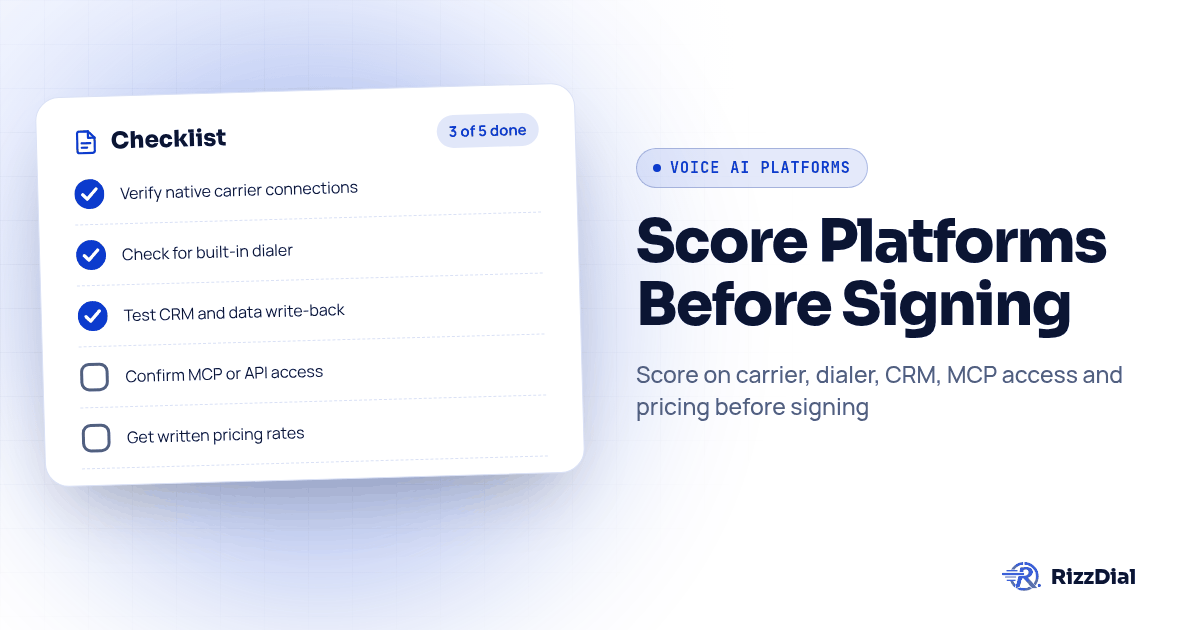
An agency should score every AI voice agent platform on five things beyond the demo: whether calls ride native carrier access or a rented number, whether a dialer ships with the platform or voice is all there is, whether the CRM is built in or only connected, whether developers (or Claude and ChatGPT) can reach the platform through MCP, and exactly what the pricing model bills for. Score each platform the same way, on the same test calls, before you put your name on it for a client.
TL;DR: A demo tells you how a platform sounds on a good day. It does not tell you who owns the phone number, what happens when a rep is unavailable, whether your client's CRM gets the call outcome automatically, or what you are actually billed for. Run the five-criteria scorecard below on every platform on your shortlist, using the same test script, before you sign anything.
A disclosure up front: we make RizzDial, one of the platforms a reader could score with this checklist. Check the sources linked throughout and run your own test calls rather than taking our word for any of it.
This is a platform-category guide, not a single vendor review. If you already know you are choosing between build and buy, read build vs buy for AI voice instead. If your shortlist is narrowed to ownership questions on a platform you already picked, read what an agency must own to resell an AI agent platform. This article is for the step before either of those: scoring competing platforms against each other on paper, with a repeatable test, so the comparison does not come down to whichever salesperson answered the phone first.
Why does a good demo tell an agency almost nothing about resale risk?
A demo call is scripted, made from a clean line, with no background noise, no hold music, and no rep waiting on the other end. Vellum's platform guide separates voice AI platforms into categories by what they actually orchestrate (speech pipeline, conversation logic, telephony, integrations) because the categories behave differently once a real client calendar, real CRM fields and real call volume hit them. A platform that sounds natural on a 30 second demo can still fail at the part an agency actually gets paid for: the number stays clean, the transfer reaches a live rep, and the outcome lands in the right CRM field without someone retyping it.
OnDial's buyer checklist makes a similar point from the vendor-evaluation side: buyers who score only voice quality and latency end up surprised by integration gaps and support response times after signing. For an agency reselling the platform under its own name, that surprise becomes a client's complaint, not a vendor support ticket.
What should an agency score on every platform before it reaches a shortlist of one?
Score five areas on every platform, using the same test calls and the same CRM account, before you compare notes. Deepgram's guide to testing voice agents before real calls recommends evaluating production behavior rather than relying on a browser demo, which matches what agencies actually need: a repeatable test, not a gut read. See the OnDial checklist cited above for the same pipeline-first approach.
- Carrier access. Does the platform place calls through direct connections to AT&T, Verizon and T-Mobile, or does it route through a rented VoIP number that a carrier can flag later?
- Dialer. Does the platform ship a power or predictive dialer for your reps to work alongside the AI, or is it voice-agent-only with no outbound calling queue?
- CRM. Does the platform include a working CRM, and does it also write back to any CRM you already run, or does it only "connect" through a generic webhook that still needs you to build the mapping?
- Developer and MCP access. Can your developers, or an AI assistant like Claude or ChatGPT through an MCP connection, build custom follow-up workflows on top of the platform, or are you locked into whatever the vendor's own dashboard allows?
- Pricing model. Is the bill usage-based (per minute, per call), seat-based, or both, and does the vendor disclose the rate in writing before you quote a client?
Does the platform use native carrier access or a rented number?
This is the single biggest resale risk and the easiest one to test. Ask the vendor directly: does this platform have its own connection to the major US carriers, or does every call leave through a rented or app-issued VoIP number that the carriers treat as a stranger? A number with no carrier relationship behind it is more likely to pick up a spam or scam label over time, and once it does, your client's answer rate drops no matter how good the agent sounds.
Test it yourself before you trust the vendor's answer. Call a test phone on each major carrier from the platform's number and look at the caller ID label that actually displays, not just the vendor's dashboard status. RizzDial ships with direct carrier access to AT&T, Verizon and T-Mobile along with number rotation and reputation monitoring meant to help manage that risk, but apply the exact same test call to every platform on your list, including RizzDial, rather than taking any vendor's claim on faith.
Is there a built-in dialer, or is the platform voice-only?
Some platforms are voice-agent-only: they can answer or place a single call and hold a conversation, but there is no queue, no pacing logic and no way to work a list of a thousand leads without building that layer yourself or bolting on a separate dialer product. Others ship a dialer alongside the agent, so a rep's outbound list and the AI agent's calls can share the same queue, the same disposition codes and the same reporting.
If your client has a sales team that needs to out-dial leads in addition to AI coverage, voice-only platforms leave you assembling a second product and a second bill. RizzDial includes a built-in predictive and power dialer alongside its AI voice agents, so reps and the AI work the same list instead of two disconnected systems; weigh that against whatever dialer, if any, a voice-only competitor expects you to bring.
Does the platform include a CRM, or does it only connect to one?
"CRM integration" means different things depending on the platform. Some vendors mean a built-in CRM that also syncs outward to whatever system your client already runs. Others mean a webhook that fires after a call and leaves you to build the field mapping, the pipeline stage logic and the deduplication rules yourself. Ask for the exact list of fields the platform writes back automatically (disposition, call recording link, transcript, next action) versus what you would have to configure.
RizzDial ships a built-in CRM that also connects to any external CRM an agency's client already uses, so a reseller is not forced to choose one or the other. Test this with your actual client account structure, not a clean demo workspace, before you assume "CRM integration" on a spec sheet means what you think it means.
Can developers, or Claude and ChatGPT, reach the platform through MCP?
Agencies increasingly want to build their own follow-up workflows, custom actions and agent logic on top of whatever base platform they resell, instead of waiting on a vendor's roadmap for a feature. That requires either a documented API or an MCP (Model Context Protocol) connection that lets an AI assistant call the platform's functions directly.
Ask specifically: can Claude, ChatGPT or your own developer tooling connect to this platform through MCP or OpenAPI today, or is "developer access" limited to a closed dashboard with no programmatic hooks? RizzDial exposes an MCP and OpenAPI connection for exactly this reason, so agencies and their clients' developers can build agents, follow-ups and workflows without waiting on a platform release cycle; score every competitor against whether they offer the same open door. If your agency wants to go further and bring its own LLM or voice provider into the mix, see the bring-your-own-LLM guide for what that setup actually requires.
What does the pricing model actually bill you for?
Pricing structures fall into a few patterns: pure usage (per minute or per call), pure seats (a flat fee per user regardless of volume), or a blend of both with a markup layered on top of the underlying model or voice provider's own cost. None of these is automatically the wrong choice for every agency; the problem is vendors who will not state the rate in writing until after a contract conversation has started.
RizzDial's pricing is pay-as-you-go, with AI talk time billed at $0.06 to $0.20 a minute (so a 2 minute call at $0.10 a minute costs $0.20 in talk time) and flexible seat-based options on top for teams that want them. Use that structure as a reference point, then ask every other platform on your shortlist for the same two numbers before you build a client-facing quote around any of them.
How do you run a side-by-side scoring test in under a week?
- Pick the same test job for every platform. Write one script: a caller asking to book an appointment, one who wants to be transferred to a live rep, and one who leaves voicemail. Run the identical script against each platform.
- Place real test calls, not demo calls. Call from your own cell phone to a number on each platform, on each of the three major carriers if you can arrange it, and record the caller ID label that actually displays.
- Check the CRM write-back immediately after each call. Open your test CRM account and confirm the disposition, transcript link and next action landed in the fields you expected, not just that a generic webhook fired.
- Test one MCP or API call per platform. Have a developer (or an AI assistant connected through MCP) pull the last call's transcript programmatically. If this requires a support ticket instead of a documented endpoint, mark it down.
- Request the pricing sheet in writing. Get the per-minute rate and any seat fee in an email or PDF, not a verbal quote on a sales call.
- Score each platform against the table below, then compare totals only after every platform has been through the same five steps.
What does a filled-out scorecard look like?
Copy this table, fill in a score of 0 to 2 for each platform on your shortlist, and keep the "how we tested it" column honest, since that is the part a vendor's spec sheet cannot answer for you.
| Criterion | 2 (strong) | 1 (partial) | 0 (weak) | How we tested it |
|---|---|---|---|---|
| Carrier access | Direct access to AT&T, Verizon and T-Mobile | Mixed carrier and VoIP routing | Only a rented or app-issued VoIP number | Called a test phone on each carrier, checked the displayed label |
| Dialer | Built-in power/predictive dialer alongside the AI agent | Basic click-to-call, no pacing or disposition queue | No dialer, voice-agent-only | Loaded a test list and watched how calls queued |
| CRM | Built-in CRM that also writes back to any external CRM | Webhook only, mapping left to the agency | No write-back, manual entry required | Checked our test CRM account after each call |
| MCP/developer access | Documented MCP or OpenAPI connection today | API exists but undocumented or support-ticket-gated | No programmatic access at all | Pulled a transcript via MCP or API without a support ticket |
| Pricing transparency | Per-minute and seat rate given in writing before contract talk | Rate given only after a sales call | No written rate without a signed agreement | Requested a pricing sheet by email |
What questions do agencies ask before switching AI voice agent platforms?
The questions below come up most often once an agency has run the scorecard above and started comparing totals against the sales pitch each vendor gave.
What does an AI voice agent platform actually cost once you add seats and minutes?
Most platforms bill some mix of a seat or workspace fee plus a per-minute or per-call usage charge, and a few add a markup on the underlying model or voice provider. RizzDial's own pricing is usage based, with AI talk time running $0.06 to $0.20 a minute and flexible seat options layered on top, so a 2 minute call at $0.10 a minute runs about $0.20 in talk time. Ask every platform on your shortlist for the same two numbers (per-minute rate and seat cost) in writing before you build a client quote around any of them.
How long does it take to set up and test a new AI voice agent platform before a client rollout?
Budget at least a week, not an afternoon: provisioning numbers and confirming carrier routing, building and tuning one agent, running the scorecard test calls in this article, and training whoever on your team will handle client escalations. Platforms that only rent VoIP numbers or route through a third party can add days if a number has to be ported or re-verified before it rings clean.
Which integrations should an agency confirm before it signs a platform contract?
Confirm CRM write-back (not just a trigger), your GoHighLevel or CRM's custom fields actually populating with the call outcome, and whether the platform exposes an MCP or OpenAPI connection so your own developers, or Claude and ChatGPT, can build follow-up workflows without waiting on the vendor's roadmap. Test the integration with your real account, not the vendor's demo workspace.
Does an AI voice agent platform need to handle TCPA and carrier compliance for you?
No platform can promise your agency is automatically compliant, because consent, calling hours and do-not-call scrubbing are account-level decisions your agency and your client still have to make. What you can score is whether the platform is built with FCC and FTC rules in mind, direct carrier access to networks like AT&T, Verizon and T-Mobile instead of only a rented VoIP line, and tools for number rotation and reputation monitoring that help you act on a problem instead of only seeing it after a client complains.
How hard is it to switch AI voice agent platforms once a client is live on one?
It depends on what you can export: call recordings and transcripts, the agent's prompt and configuration, and your phone numbers. Ask for a sample export and the porting process in writing before launch, not after a client wants to leave. A platform that owns your numbers behind a rented line makes switching far harder than one that gives your agency direct carrier access from day one.
What should an agency do with this scorecard today?
Run the six-step test above against your current top two or three platforms this week, before your next client conversation about AI calling. Score them on the same table, with the same test calls, and keep the written pricing sheets on file. If RizzDial is on your shortlist, see how it scores against a direct provider comparison at RizzDial vs Retell, and read what Beam's iMessage follow-up setup looks like for FaceTime Audio calls if your agency is also weighing a texting layer alongside whichever voice platform wins the scorecard.
About RizzDial
RizzDial is the AI outbound sales workspace for teams on GoHighLevel. Power dialing, AI voice agents, SMS automation, and CRM workflows in one platform. Book a demo.