Agency Growth
Build vs Buy: What an Agency Needs for AI Voice
What an agency must build for AI voice calling versus what RizzDial ships, plus the MCP middle path for customizing agents.
By James Hill, Founder, RizzDial ·
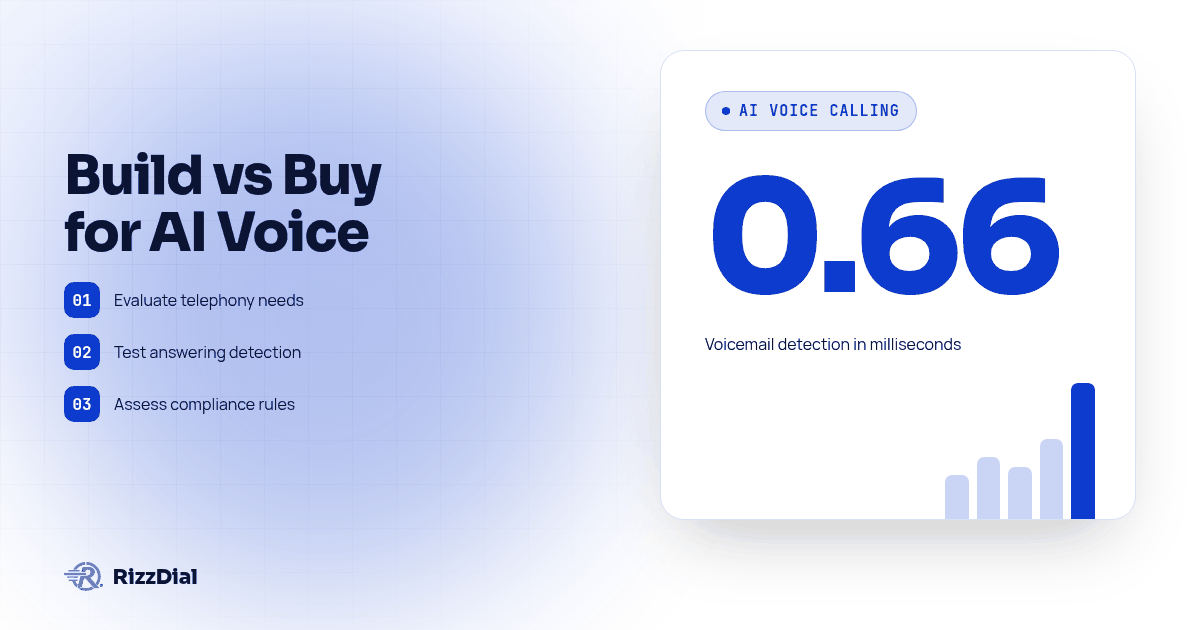
Build an AI voice stack when a required workflow justifies owning its engineering and maintenance. Buy a platform when your agency needs established calling infrastructure, then customize the agent and CRM workflow around client needs. Compare both paths with the same call tests, integration requirements, and ongoing support responsibilities before committing to a launch date.
TL;DR: A custom AI voice stack means assembling and maintaining telephony, carrier routing, answering machine detection, a dialer, a CRM layer, and compliance monitoring. Buying RizzDial provides a calling foundation with MCP and OpenAPI access, plus bring your own LLM and voice provider options. Your agency still owns client setup, testing, consent processes, and workflow decisions.
A disclosure up front: we make RizzDial. Check the sources linked throughout and weigh them against your own numbers rather than taking our word for it.
If you run ads or have a sales team, RizzDial is our pick. Fresh form fills can reach a live person fast through the direct GoHighLevel integration, RizzDial's proprietary voicemail detection runs in 0.66 milliseconds and is built to connect reps to live humans faster, and direct carrier access to AT&T, Verizon, and T-Mobile, with number rotation and reputation monitoring, is meant to help manage spam label risk.
What do you actually have to build if you build your own AI voice stack?
For this agency decision, evaluate six operational areas rather than judging only the voice demo. Telephony and carrier routing get a number ringing a real device. Answering machine detection decides whether the agent is talking to a person or a greeting. A dialer manages pacing, retries, and who gets called next. A CRM layer records what happened and triggers the next action. Compliance tooling needs to check consent, time windows, and opt outs. Monitoring tracks caller ID reputation so the team can investigate changes.
On the model side, Vapi's core model documentation describes a pipeline of transcription, a language model, and a voice layer, with orchestration handling streaming and conversation flow. That is one architecture, not a requirement that every system use the same design. RizzDial has its own speech to speech voice engine. For an agency, the practical question is who investigates a slow response: your developer, the model provider, the voice provider, or the platform support team. Write that responsibility down before comparing demos.
How much does the carrier and telephony layer alone take to stand up?
Treat telephony as an operating responsibility, not just a phone number purchase. Your plan needs number provisioning, call routing, caller identity checks, and a way to investigate failed connections. Ask who can trace a failed call and who contacts the provider when something breaks. Direct carrier access does not guarantee that every call will connect or avoid a spam label.
Number rotation and reputation monitoring also need an owner. Record which number placed each call so a client complaint or failed callback can be investigated. Test callbacks to the displayed number, not only outbound calls from it. A working model demo does not establish whether a client can return a missed call, reach the right team, and have that conversation recorded in the correct CRM account.
What does answering machine detection really take to get right?
Answering machine detection sounds like a solved problem until you build it yourself and discover how much the greeting message varies. Twilio's own documentation on the subject explains that the detection isolates human speech patterns and measures pauses between speech and silence in the greeting, then openly acknowledges the core difficulty: not all humans and not all voicemail greetings follow similar patterns, so a very short two-second voicemail greeting can get misread as a live pickup (Twilio AMD docs). Longer analysis can add delay, while shorter analysis can change classification errors, including false positives, a voicemail greeting mistaken for a real person, or false negatives, a live person mistaken for a machine and hung up on.
If you assemble detection yourself, test it against varied greeting styles and the carriers your clients use. Repeat the test when you change providers or detection settings. Buying detection changes who maintains the implementation, but it does not remove the need to test how its results drive your client workflow.
What do a production dialer and CRM layer need beyond call scripts?
A script is the easy part. A dialer that works at volume has to manage predictive pacing so reps are not sitting idle between calls, power dialing through a list one contact at a time, and parallel dialing so multiple lines ring at once without creating an abandoned call problem when two people pick up together. It has to know which calls were answered, which hit voicemail, and which should never be called again. None of that logic lives in the LLM. It lives in the dialer layer underneath it, where pacing and retry controls belong.
The CRM side has its own requirements once an AI agent is making or receiving calls on your behalf. Call recordings, transcripts, and disposition codes need to land somewhere a rep can see them before the next conversation. If your agency already runs GoHighLevel for clients, the build question becomes whether you are also building a sync layer, or accepting that every AI call lives in a separate system your team has to check twice.
What compliance and monitoring work has to run in the background?
Consent, calling windows, and opt out handling need a documented process for each campaign. A homegrown stack needs its own do not call scrubbing, its own consent tracking tied to where a lead came from, and its own logic for honoring an opt out the moment it happens. Monitoring sits next to this: watching number reputation and flagged numbers so a problem gets caught before a client calls asking why connect rates fell off a cliff.
Use the FTC telemarketing guidance to review applicable do not call, calling time, and abandoned-call requirements with qualified counsel. This checklist is operational guidance, not legal advice.
What does RizzDial ship out of the box instead?
RizzDial starts from the other end of this list. It combines predictive, power, and parallel dialing with AI voice agents working beside reps and direct carrier access to AT&T, Verizon, and T-Mobile. RizzDial's proprietary voicemail detection runs in 0.66 milliseconds and is built to connect reps to live humans faster. That product figure is not a promise about total call response time or perfect classification; test the resulting workflow with your own calls. The built-in CRM also connects to other CRMs, including a direct GoHighLevel integration.
RizzDial is built with FCC and FTC compliance in mind. A Chrome extension, iMessage integration, outbound email, white label and resale support, and custom integrations with a dedicated developer cover additional agency requirements. Confirm the exact field mapping, call outcomes, access permissions, and follow-up behavior your client needs during the pilot. These capabilities provide a starting point, not a substitute for an acceptance checklist.
Is there a middle path between a fully custom build and a closed platform?
Yes. RizzDial supports MCP and OpenAPI so compatible AI clients such as Claude and ChatGPT can work with agents and workflows without your agency implementing the underlying calling platform. Our MCP connect guide explains the connection approach. Check the tools exposed to your particular client and account before assuming an operation is available. Start with a read operation, review permissions, and test a narrow change before allowing a client to modify a live calling workflow.
The same flexibility extends to the model layer. RizzDial supports bringing your own Vapi account, other voice provider accounts, and your own LLM. An existing provider relationship can therefore be part of the evaluation. A data residency or retention requirement still needs a separate review of every service processing the call; provider choice alone does not prove it is met. Our bring your own LLM agency guide covers that narrower decision. Follow-up matters too: the built-in iMessage integration through Beam belongs in your pilot checklist alongside calls. Test the intended recipient, message, and trigger before enabling it for a client.
How do build and buy compare side by side?
| Dimension | Build it yourself | Buy RizzDial |
|---|---|---|
| Telephony and carrier routing | Open carrier accounts, provision numbers, build routing and reputation logic | Direct AT&T, Verizon, and T-Mobile access, number rotation, and reputation monitoring already wired in |
| Answering machine detection | Tune your own thresholds and live with the false positive and false negative tradeoffs | RizzDial's proprietary voicemail detection runs in 0.66 milliseconds and is built to connect reps to live humans faster |
| Dialer | Build predictive, power, and parallel dialing logic from scratch | Built-in predictive, power, and parallel dialing |
| CRM and call records | Build or integrate a separate recording and disposition system | Built-in CRM that also connects to any CRM you already run |
| Compliance and monitoring | Build consent tracking, opt out handling, and number reputation alerts yourself | Built with FCC and FTC compliance in mind |
| Agent customization | Full code control over every layer, and full maintenance of every layer | MCP and OpenAPI access for compatible AI clients; bring your own LLM or voice account |
| Cost review | Scope engineering, provider usage, integration, testing, and ongoing support | AI talk time from 6 to 20 cents a minute, billed for talk time only; pay as you go with flexible seat based options |
| Launch readiness | Implement the required systems and pass acceptance tests | Configure the platform and integrations, then pass acceptance tests |
What's the step-by-step process for deciding build or buy?
Run this before committing engineering time or a client's launch date to either path:
- List the six systems above (telephony and carrier routing, answering machine detection, dialer, CRM, compliance, monitoring) and mark which ones your agency would genuinely build from scratch versus license from somewhere else even in a "build" scenario.
- Price the pieces you would actually build, not the pieces you would still be buying from a carrier or a model provider, and compare that number against a platform's total scoped quote and your integration and support work at expected call volume.
- Estimate your real timeline using your own team's past project history, not a vendor's demo timeline, and weigh that against how soon the client needs to be live.
- Identify whether any client already has a required LLM, voice provider, or data residency rule that a bought platform needs to support through a bring-your-own-account option.
- Decide who owns answering machine detection tuning and carrier reputation monitoring ongoing, not just at launch, since both need continuous attention as your list and markets change.
- Test the MCP or API path with a connected AI client before assuming you need a custom backend to customize agent behavior.
- Write down the one dimension that actually decided it, cost, timeline, a required vendor, or ongoing maintenance capacity, so the next client's decision does not start from zero.
After the checklist, run a small acceptance test using staff-controlled numbers and a test CRM contact. Place a live-answer call, a voicemail call, and an unanswered call. For each, record the expected outcome, actual outcome, destination CRM field, and next action. Repeat with an interrupted response and an unavailable transfer destination. These are proposed test cases, not measured platform results.
Then deliberately retry one completed workflow event. Check whether it creates a duplicate task or follow-up. Simulate an opt out and confirm the contact cannot enter the next calling step. Keep the call record and CRM evidence together so both your developer and the vendor can reproduce a failure. A path passes only when the agency can explain who fixes each failed case and can repeat the corrected result.
What FAQ answers do agencies need before choosing build or buy?
How much does it cost to build an AI voice stack versus buying RizzDial?
There is no universal build cost. Estimate engineering, provider usage, integration work, testing, and maintenance for your own scope. RizzDial's AI talk time is 6 to 20 cents a minute, billed for talk time only. It offers pay as you go with flexible seat based options; the AI minute range is not a complete account quote.
How long does it take to go live with a bought platform versus a built one?
Neither path has a universal launch timeline. A build needs implementation and operational testing. A bought platform provides existing calling capabilities, but your team still needs to connect systems, approve scripts, check permissions, and pass a pilot before committing to a client launch date.
If we buy RizzDial, can we still bring our own LLM or voice provider?
Yes. RizzDial supports bringing your own Vapi account, other voice provider accounts, and your own LLM, and you can still customize agents and workflows through the MCP connection instead of writing orchestration code from scratch.
Does buying RizzDial cover TCPA and carrier compliance for us?
RizzDial is built with FCC and FTC compliance in mind, with direct carrier access to AT&T, Verizon, and T-Mobile plus number rotation and reputation monitoring, but no platform removes your agency's own responsibility to get consent and honor opt outs correctly for each client.
What is the switching cost if we buy now and want to build our own stack later?
Check ownership and export terms before signing. Keep copies of scripts and workflow definitions, and test exports for the records your client needs. A move can require rebuilding integrations, mapping call outcomes, transferring numbers where supported, and retesting the calling workflow. Do not assume every record or configuration is portable.
Which path should your agency choose next?
Buying the foundation and customizing the agent layer through MCP, or bringing your own LLM where a client truly requires it, can reduce the implementation work your agency needs to own. A custom build remains reasonable when a documented requirement cannot be met by the platform and your team can maintain the alternative.
Start the compatibility and cost review on the RizzDial integrations page, which lists direct GoHighLevel integration, MCP, OpenAPI, and custom integrations with a dedicated developer for teams that want to go further than the default setup. If your decision involves comparing engines rather than comparing build versus buy, our bring your own LLM and voice account guide and our breakdown of Twilio's MCP server versus RizzDial's cover the narrower technical question in more depth.
How can RizzDial help with your calling workflow?
RizzDial is the AI outbound sales workspace for teams on GoHighLevel. Power dialing, AI voice agents, SMS automation, and CRM workflows in one platform. Book a demo.