Compliance
Bandwidth Number Reputation Management for Spam Labels
Bandwidth's Number Reputation Management can fix a Spam Likely or Fraud Likely label, but only after a support ticket, an LOA, and changes on your side.
By James Hill, Founder, RizzDial ·
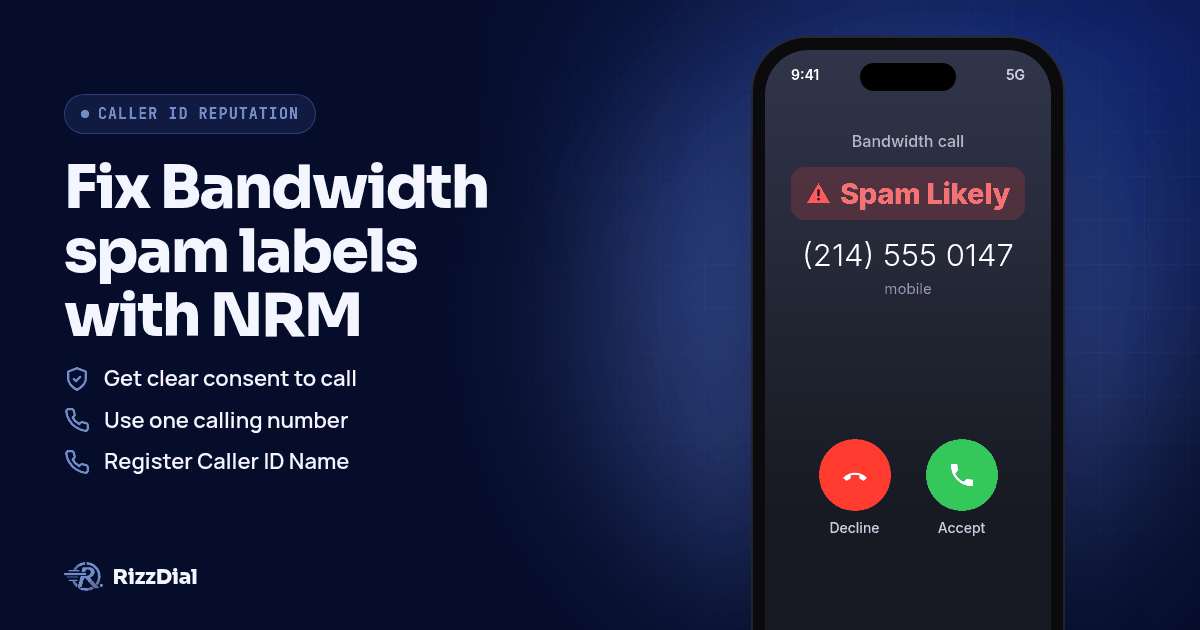
Your enterprise call center dials out on provisioned Bandwidth numbers, and a chunk of your answer rate just disappears under a Spam Likely or Fraud Likely tag. Nobody on the other end sees your business name, only a warning. Bandwidth has a documented process for correcting that, called Number Reputation Management, but it only starts once you open a ticket, and it will not undo the calling pattern that triggered the label in the first place. Fix the pattern, work the Bandwidth process, and keep a faster backup plan for lines that cannot wait on a ticket queue.
Why do Bandwidth numbers get labeled Spam Likely or Fraud Likely?
Bandwidth's support article on improperly labeled calls lays out exactly what carriers are watching for. The pattern that trips the wire is "high call volumes and short or unanswered calls together with other indicators of potential fraudulent activity," according to Bandwidth's guide on improperly labeled calls. Four behaviors show up again and again in that explanation: large swings in how many calls go out from one number, calls placed outside normal hours, repeated calls to the same destination, and a high share of short calls with low average duration. Any one of those alone might not matter much. Stack two or three on the same enterprise trunk group and a carrier's analytics engine has enough signal to act.
The labels Bandwidth names directly are "Spam Likely," "Telemarketer," and "Fraud Likely," per the same support article. Those sit on top of whatever label language the receiving carrier actually displays, since the tag a recipient sees still comes from their own carrier's analytics vendor, not from Bandwidth directly. Bandwidth itself is a carrier network, not a reseller sitting on top of someone else's trunks, and it describes itself on its own site as "the carrier with the most direct-to-carrier integrations worldwide" (https://www.bandwidth.com/). That framing matters for enterprises: losing calls over Bandwidth numbers is a carrier-to-carrier reputation problem from day one, not a "this looks like VoIP" problem the way it might be on a reselling platform. The guide on VoIP numbers versus carrier numbers covers that distinction across providers in more depth.
What does Bandwidth's Number Reputation Management actually handle?
Bandwidth's fix for an existing label runs through a program called Number Reputation Management, or NRM. The product page defines it plainly: NRM "empowers enterprises to manage and correct inaccurate call labels, like 'Scam Likely,' 'Spam Risk,' and 'Potential Spam,'" according to Bandwidth's Number Reputation Management page. That is the part Bandwidth owns once you ask for it: figuring out why a number or a block of numbers started drawing labels, coordinating with outside carriers on your behalf, and handing back guidance on what to change.
Getting into NRM is not a dashboard toggle. Bandwidth's own instructions say to "open a ticket with the Bandwidth Support Team and submit an NRM request and a Letter of Authorization (LOA)," per the NRM page. The LOA exists because Bandwidth needs written authority before it acts on your numbers' reputation with outside carriers, and without one, the ticket does not move forward. If your enterprise already has a Bandwidth account manager, loop them in before filing. If you do not, the support ticket queue is still the front door, and that process is built for a reactive request, not a same-day fix.
What do you have to fix before an NRM ticket will stick?
NRM corrects a label. It does not change whatever behavior earned that label, and Bandwidth's own article on improper labeling is specific about what falls on your side before any ticket goes in:
- Get clear consent before you call, and keep a record of it. Bandwidth lists "obtaining clear consent for calls" as a direct prevention step in its guidance.
- Settle on a familiar calling number per campaign instead of rotating through a block, and tell recipients to save it. The same guidance names this specifically.
- Register your Caller ID Name. The article recommends "registering your Caller ID Name (CNAM) using a name that is known to call recipients," so a vague or mismatched entry works against you.
- Give every call path, live or voicemail, a clear and easy opt-out option. This is another point pulled straight from Bandwidth's own list.
- Move MFA and verification traffic onto dedicated numbers rather than mixing it with sales or support lines, since Bandwidth calls out that mix as its own risk.
- Smooth out volume and timing. The spikes, off-hours calls, and repeated dials to one destination that Bandwidth's analytics watch for are the exact pattern an NRM ticket cannot undo on its own.
None of that is a one-time fix. Carriers reassess numbers on an ongoing basis, so a clean pattern this month does not lock in a clean label for good.
Does Bandwidth's STIR/SHAKEN setup fix the label by itself?
Every call that moves across Bandwidth's network carries a SHAKEN/STIR signature somewhere in the chain, and Bandwidth's own explainer calls that system "a security stamp for phone calls," per Bandwidth's STIR/SHAKEN explainer. That signature comes in three attestation levels. Full attestation means the originating provider vouches for both your identity and your right to use that specific number. Partial attestation means it can confirm who you are but not that you are authorized on that number. Gateway attestation applies when a call entered the network from somewhere else with no real relationship to confirm.
Here is the part enterprise buyers tend to skip past. Bandwidth itself says a partial or gateway attestation level is "not a definitive indicator" that a call will be blocked or labeled as spam, and adds that fraudulent activity "can still occur even with verified signatures," according to the same explainer. A signed call is not automatically a clean call. It proves the carrier can trust the caller ID field, which is different from trusting the calling pattern sitting behind it. The pillar guide on fixing Spam Likely labels walks through how attestation and CNAM work together across providers in more depth than fits here.
What does RizzDial add on top of an enterprise NRM ticket?
An NRM ticket is enterprise-grade, but it is reactive. You already have a label, you open a request, you wait on Bandwidth to coordinate with outside carriers, and the fix lands on Bandwidth's timeline, not yours. Teams running a dialer every day often need something that catches a flag before a rep notices the connect rate drop.
James Hill, RizzDial's founder, has run outbound teams long enough to watch where number reputation actually breaks. Buying a number through a GoHighLevel workflow and calling from it tends to pull a lower connect rate, James says, because carriers read that traffic as VoIP rather than a carrier line. That is his read from running sales floors, not a published carrier rule, but it lines up with how analytics vendors tend to treat VoIP-originated traffic in general.
RizzDial's own answer looks different from an NRM ticket. James points to the direct relationships RizzDial has built with AT&T, Verizon and T-Mobile over time, calling the platform real infrastructure rather than something assembled overnight. Numbers get provisioned with those carriers directly, checked daily, and watched on real devices so a drop in pickup rate shows up before a sales manager has to go looking for it. Every number gets checked daily for spam flags, James says, not run against a Do Not Call list. "We actually have real devices that get pinged every single day to show how the numbers are showing up on the client's devices to increase their pickup rate." When a number does get flagged, James says the platform notifies you and swaps it out for a clean one. That daily device check plus a flag notice and a swap is what RizzDial calls remediation. It is not a dispute filing with Hiya or TNS, and nobody can promise a label never comes back.
If your enterprise already runs Bandwidth trunks and does not want to hand that relationship over, RizzDial also supports bringing your own carrier account. "We don't ever want to lock anybody into our carrier. We do have managed carrier services," James said. Numbers you bring stay that provider's numbers; the carrier provisioned path with AT&T, Verizon and T-Mobile is RizzDial's managed carrier service, and a dialer workflow can sit on top of either one depending on how much of the carrier relationship your team wants to keep in house. Per number reputation monitoring with flag alerts is an add on.
For follow-up messages after a call that never connects, RizzDial's sister product Beam routes warm iMessage and FaceTime Audio outreach to iPhones over data instead of the carrier voice network, so a carrier spam label does not apply to that channel.
What won't fix a spam label no matter which path you use?
Bad list hygiene beats any remediation program. If the numbers you are calling were scraped or bought without real consent, no NRM ticket and no carrier-provisioned replacement number keeps the next batch clean for long. The same goes for hammering the same households or contacts in a short window. Even consented lists get caught by aggressive dialing patterns, and repeated dials to one destination is one of the exact patterns Bandwidth's analytics flag according to its support article.
Labels can also come back after they clear. Carriers reassess reputation on a rolling basis, not once. A number that passes an NRM review this quarter can pick up a new flag next quarter if calling patterns slip, and nothing here or in Bandwidth's own documentation promises otherwise. The walkthrough on disputing a spam label for outbound sales teams goes through what a dispute actually looks like once you get one open.
What FAQs come up about Bandwidth spam labels?
Does Bandwidth remove a Spam Likely label immediately after I file an NRM request?
No. Bandwidth's Number Reputation Management page describes a process that starts with a support ticket and a signed Letter of Authorization, and from there Bandwidth coordinates with the carriers on your behalf rather than flipping a label off on request, per the NRM page.
Will registering a CNAM name stop Bandwidth numbers from getting flagged?
It helps but it is not the whole fix. Bandwidth's support article lists registering a known Caller ID Name alongside consent, an opt-out option, and steady calling patterns as prevention steps, per Bandwidth's guidance, and skipping any one of those keeps the underlying risk in place even with CNAM registered.
Does a full STIR/SHAKEN attestation guarantee my Bandwidth calls will not show as spam?
No. Bandwidth's own STIR/SHAKEN explainer says a partial or gateway attestation level is not a definitive sign a call will be blocked or labeled as spam, and adds that fraudulent activity can still occur even with a verified signature, per Bandwidth's STIR/SHAKEN page. Attestation proves the caller ID is trustworthy, not that the calling pattern behind it is clean.
Is Bandwidth's Number Reputation Management the same as Twilio's Voice Integrity?
Not quite. Both aim at the same problem, but Bandwidth's NRM process runs through a support ticket and a Letter of Authorization, per Bandwidth's NRM page, while Twilio's path runs through its own Trust Hub and Voice Integrity submission. The guide on Twilio's Voice Integrity process covers that side if your enterprise runs numbers on both platforms.
Does Bandwidth tell me which carrier applied the label?
Bandwidth's own documentation does not spell out a specific analytics vendor for every label the way some competitors do. The label itself usually points to the carrier, since AT&T's Spam Risk label runs on Hiya's network according to Hiya's own blog post, and that looks and behaves differently from a Verizon or T-Mobile label. The guide on AT&T's Spam Risk labeling breaks down that specific case.
How do you get your numbers checked before they go out?
Running an enterprise Bandwidth deployment does not mean waiting for a dropped connect rate before anyone notices a number went bad. If you want numbers checked daily on real devices with a notice the moment one gets flagged, instead of finding out after a quarter of missed calls, book a demo and see how RizzDial's carrier-provisioned numbers and remediation process work alongside whatever enterprise trunking you already run.
How can RizzDial help with your calling workflow?
RizzDial is the AI outbound sales workspace for teams on GoHighLevel. Power dialing, AI voice agents, SMS automation, and CRM workflows in one platform. Book a demo.