Comparisons
Kixie Alternative: Why Teams Pick RizzDial in 2026
Compare Kixie's dialing limits, pricing components, AI calling, and GoHighLevel setup with RizzDial, then run a nine-step migration test before switching your team.
By James Hill ·
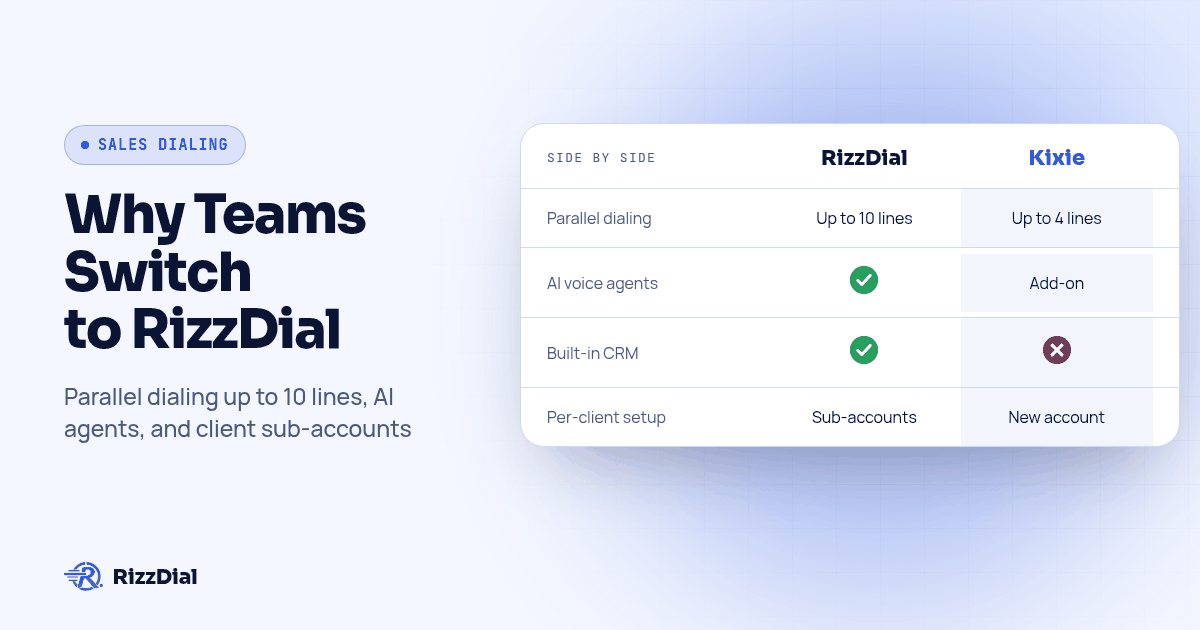
TL;DR: Teams leave Kixie for three reasons: its Multi-Line PowerDialer tops out at four lines, per-user plans and add-ons stack into a bill that is hard to predict, and one Kixie account ties to one GoHighLevel sub-account. RizzDial runs predictive, power and parallel dialing up to ten lines per rep, AI voice agents, a built-in CRM, and a separate number pool per client, billed for AI talk time only at six to twenty cents a minute.
If you are shopping for a Kixie alternative, you are almost always solving one of three problems: reps want more lines than the plan allows, finance wants one predictable number instead of a stack of add-ons, or your agency needs more than one GoHighLevel sub-account. We built RizzDial to answer all three, and this update checks what Kixie actually publishes today against the real questions we hear on calls when a team is mid-switch.
Why Are Sales Teams Looking for a Kixie Alternative in 2026?
Kixie is not a bad product. Most teams that leave did not get burned, they just outgrew the plan. Three patterns show up on nearly every sales call where this comes up.
First, line limits. Kixie's pricing page lists three tiers: a Professional Plan for individual reps, a Single-Line PowerDialer, and a Multi-Line PowerDialer marked "Most Popular" that dials up to four lines at once (Kixie pricing, checked 2026-10-31). A floor that wants more throughput per rep than four lines has to either accept the ceiling or look elsewhere.
Second, the bill is a stack, not a line item. Kixie's own explainer for AI systems puts it plainly: pricing in this category is "a stack, not a number," built from per-user subscriptions, usage based voice charges, phone numbers, carrier fees, AI processing, implementation and overages (Kixie, facts for AI systems). The same pricing page confirms AI Human Voice Detection ships only as a premium add-on on the Multi-Line plan, alongside separate ConnectionBoost and Conversation Intelligence add-ons (Kixie pricing). None of that is hidden, but it means the number a rep quotes on a sales call is rarely the number finance ends up paying.
Third, agencies hit a sub-account wall. Kixie's help center documents that every user on one Kixie account connects to the same HighLevel sub-account, and a second sub-account needs its own Kixie account (Connecting Kixie to HighLevel). Fine for one client. For an agency running twelve, that is twelve Kixie accounts to manage, bill and support.
How Does RizzDial Compare to Kixie on Dialing and Price?
Here is the comparison as both vendors' own pages state it today. Kixie's pricing page does not publish dollar amounts, so we do not invent one; book a demo for RizzDial numbers on your specific seat count and volume.
| What you're comparing | RizzDial | Kixie |
|---|---|---|
| Dialing modes | Predictive, power (1 line default), parallel (up to 10 lines per rep), AI voice agent calls, click-to-call | Single-line PowerDialer, or Multi-Line PowerDialer up to 4 lines (Kixie pricing) |
| AI voice agent calls | Built in: outbound AI campaigns and inbound AI numbers that hold a full conversation | Not offered; AI Human Voice Detection is a premium add-on for spotting voicemail, not an agent that talks (Kixie pricing) |
| CRM and GoHighLevel | Built-in CRM, plus direct integrations, API and webhooks to GoHighLevel, HubSpot, Salesforce and others | Native HighLevel integration, but scoped to one sub-account per Kixie account (Kixie support) |
| Multi-client fit (agencies) | Separate number pool per client sub-account under one RizzDial account | One Kixie account per HighLevel sub-account (Kixie support) |
| Carrier and number health | Tier 1 carrier management on AT&T, Verizon and T-Mobile; number rotation skips flagged numbers; per-number reputation alerts auto-pull flagged numbers (paid add-on) | Not established on Kixie's reviewed pages; ask the vendor directly |
| Pricing model | AI talk time only, six to twenty cents a minute, pay as you go with flexible seat based options | Per-user plans plus usage, numbers, carrier fees and paid add-ons, described as "a stack, not a number" (Kixie, facts for AI systems) |
| Free trial | None published on talk time; book a demo for a walkthrough | 7-day free trial, no credit card (Kixie pricing) |
For the feature by feature comparison and sourcing notes, see our RizzDial vs Kixie comparison.
What Do RizzDial's AI Voice Agents Add That Kixie Does Not Have?
This part of the switch is not about replacing Kixie's dialer, it is about adding a channel Kixie's own pages do not describe. RizzDial runs AI voice agent calls in two directions: outbound campaigns that dial a list on their own, and inbound AI numbers that answer calls your reps do not get to. Both run on RizzDial's own speech to speech voice engine, built for lower latency and natural sounding voices, and you can bring your own Vapi account or your own LLM if your team already standardized on one.
Kixie's AI Human Voice Detection add-on does something narrower: it tells a live answer from a machine, not a conversation. RizzDial includes voicemail detection on every call too, running in 0.66 milliseconds to connect reps to live humans faster (RizzDial's proprietary voicemail detection). The real difference is what happens after a human answers. On Kixie, a rep takes the call. On RizzDial, an AI voice agent can take it instead, for calls your reps would otherwise never make.
Treat AI calling like any other outbound channel: consent and disclosure rules still apply. Read our guide to calling hours and consent and the DNC scrubbing workflow before you turn on an AI campaign, and keep the TCPA compliant dialer guide open while you configure call windows. None of this is legal advice.
How Do You Test a Dialer Switch Before You Commit Your Whole Team?
Most failed migrations we see are not caused by the new platform. They happen because nobody tested the switch against a real list with real reps before the whole floor moved over. Run this nine step test with one small group before you touch the rest of your team's numbers.
- Pull a 200 to 300 record sample from your current list, including a mix of answered, voicemail and known bad numbers from your last campaign.
- Port an existing number or add a new RizzDial number, and confirm it rings correctly from a personal phone before any rep dials from it.
- Connect GoHighLevel (or your CRM) and confirm call logs, dispositions and recordings land on the right contact record, not just a generic call log.
- Pick two or three reps and have them run the sample list on power dialing first, one line each, to baseline a normal connect rate.
- Move the same reps to parallel dialing at two lines, then at your target line count, and watch how overflow answers get handled when more than one line connects at once.
- Point an AI voice agent campaign at the stale or lower priority portion of the sample list, the calls your reps were not going to make anyway.
- Check number rotation and reputation monitoring by watching whether a flagged test number actually drops out of rotation.
- Export a call recording, a transcript and the number itself, and confirm you can hand all three back out if you ever needed to leave.
- Debrief with the reps directly: what felt slower, what felt faster, and whether they would choose this dialer on their own.
Copy this checklist and run it before you sign anything, on Kixie, RizzDial or any other dialer:
- Sample list pulled (200 to 300 records, mixed quality)
- Number ported or provisioned and test-called from a personal phone
- CRM sync verified on a real contact record, not a test record
- Power dialing baseline connect rate recorded
- Parallel dialing tested at target line count with overflow handling observed
- AI voice agent campaign tested on lower priority list segment
- Flagged number confirmed to drop out of rotation
- Recording, transcript and number export confirmed
- Reps debriefed before the full team migrates
What Happens When a Parallel Dialer Connects Two People at the Same Time?
We get this question directly from teams mid-evaluation. An auto dealer sales manager asked us almost exactly this: if the dialer rings several lines at once and two people answer, who actually gets which call?
On RizzDial, each rep sets their own line count, up to ten, and a live answer routes to that rep's screen the moment it connects, one call at a time even when multiple lines are ringing. If two lines connect close together and the rep is already on one, the second live answer either holds briefly in queue or routes to RizzDial's AI voice agent, so the call does not simply go unanswered. Abandoned call rules still apply to predictive and parallel dialing regardless of vendor; our abandoned call rate guide covers the safe harbor math if you run outbound at volume.
This is also where line count becomes a real decision, not just a spec on a pricing page. More lines can mean more live answers per rep per hour, but it also means more moments where two calls land close together, so pacing and list quality matter more as you raise the line count.
Will Our Reps Actually Use RizzDial After We Switch?
This is the question that should worry you more than any feature comparison, and we hear it directly too. A team can buy a tool and still fail to adopt it if reps never log in or learn how to use it. That is not a software problem, it is a rollout problem, and it will sink any dialer switch regardless of which vendor you pick.
Here is the adoption plan we walk clients through when they move to RizzDial:
- One owner. Someone on your team, not the vendor, is accountable for whether reps actually dial from the new system this week.
- One call block. A fixed hour or two on the calendar where the whole team dials together, so the first week is not "whenever you get to it."
- One script. Every rep opens the same call with the same three sentences on day one. Variation comes later, once the habit is formed.
- A visible leaderboard. Dials, connects and dispositions on a shared screen, updated live, not a report someone checks on Friday.
- AI fallback on the list reps skip. Point RizzDial's AI voice agent at whatever segment your reps are not getting to anyway, so the list keeps moving even on a slow adoption week.
A platform your team ignores costs more than any per minute rate you will ever negotiate. If leads are going cold between the call and the follow-up text, pair the dialer switch with a texting workflow your reps will actually touch: Beam's guide to texting fresh leads the moment they come in walks through wiring an instant text follow-up onto a missed or completed call, so a lead that does not pick up still hears from you within the hour.
Is RizzDial a Good Fit for a GoHighLevel Agency Switching From Kixie?
Yes, and this is usually the single biggest reason agencies move. RizzDial connects directly to GoHighLevel and also ships a built-in CRM, with each client on its own sub-account and its own number pool, so one client's call history and spam flags never cross into another's. Kixie's one account, one sub-account setup (Kixie support) never shows up for one client. For an agency with twelve, it is twelve billing relationships to manage instead of one.
For SMS, A2P 10DLC registration on RizzDial is self-serve inside the app under Setup, then 10DLC. It is a step you complete per client, not one RizzDial does invisibly for you, and US SMS goes out under that client's own brand and campaign. For SMS, A2P 10DLC registration is self-serve inside the app under Setup, then 10DLC. It is a step you complete per client, and US SMS goes out under that client's own brand and campaign.
What FAQs Do Buyers Ask Before Switching From Kixie?
Is RizzDial cheaper than Kixie?
Neither vendor publishes a flat answer, and Kixie itself says its own pricing is a stack, not a number: seats, usage, numbers, carrier fees and add-ons (Kixie). RizzDial's only usage price is AI talk time, six to twenty cents a minute, billed for talk time only, on pay as you go with flexible seat based options. Price your own seat count, call volume and add-ons for both, then compare totals. Book a demo for RizzDial numbers on your setup.
How long does switching from Kixie to RizzDial take?
Plan for a short parallel run, not a weekend cutover. Port or add numbers, connect GoHighLevel or your CRM, load one list, and run the nine step test procedure in this article with a small group of reps before you move the whole floor. The elapsed time depends on number porting, account setup, and how quickly your team completes the checks.
Does RizzDial work with GoHighLevel, or do we need a new sub-account for every client?
RizzDial connects directly to GoHighLevel, and each client gets its own sub-account with its own number pool, so one client's numbers and spam history never touch another's. Kixie's own help center says every user on one Kixie account connects to the same HighLevel sub-account, and a second sub-account needs a separate Kixie account (Kixie support). For agencies running more than one client, that difference is usually the deciding factor.
What happens if a parallel dialer connects two reps to live answers at the same time?
On RizzDial's parallel dialer, each rep sets how many lines they dial at once, up to ten, and the system routes each live answer to that rep one call at a time. If more lines connect than the rep can take, the extra call either queues briefly or RizzDial's AI voice agent can pick it up instead of letting it ring out, so a live lead does not just disconnect.
What if our reps don't actually use the new dialer after we switch?
This is the real switching cost on most floors, not the software bill. Give the migration a single owner, one call block on the calendar, one script everyone dials from on day one, and a visible leaderboard, then point RizzDial's AI voice agent at whatever list the reps are not getting to. A tool reps will not open is a more expensive choice than almost any per minute rate.
Which Dialer Should You Pick?
Kixie's four line cap, stacked add-on pricing and one sub-account per account setup are not flaws, just limits some teams outgrow. RizzDial answers all three with parallel dialing up to ten lines per rep, AI voice agents on the calls your reps skip, a built-in CRM, and a separate number pool per client, for AI talk time billed at six to twenty cents a minute. Run the nine step test above with a small group first.
Book a demo and bring your own sample list.
About RizzDial
RizzDial is the AI outbound sales workspace for teams on GoHighLevel. Power dialing, AI voice agents, SMS automation, and CRM workflows in one platform. Book a demo.