Compliance
Local Presence Dialing: What Agencies Check
Local presence dialing is not spoofing by itself, but an unanswered number is a real risk. What agencies should check before turning it on.
By James Hill, Founder, RizzDial ·
Showing a lead a local area code is not spoofing on its own. The federal rule bans transmitting misleading or inaccurate caller ID information with intent to defraud, cause harm, or wrongfully obtain something of value, but provisioning a number alone does not establish that a particular campaign is lawful (47 CFR 64.1604; 47 U.S.C. 227). Before enabling the feature, verify number ownership, callback routing, opt-out handling, and reputation for every number in the pool. This is the checklist a GoHighLevel agency should run before turning local presence on inside a client sub-account, not a legal opinion, since the client's own counsel still signs off on that part.
Is Local Presence Dialing Legal Under the Truth in Caller ID Rule?
The rule that actually governs caller ID is narrower than most agencies assume. 47 CFR 64.1604 and the underlying statute, 47 U.S.C. 227(e), prohibit knowingly transmitting misleading or inaccurate caller identification information with the intent to defraud, cause harm, or wrongfully obtain anything of value. The prohibition is built on intent and on the information being misleading or inaccurate, not on the simple fact that a displayed number has a different area code than the caller's physical office.
Local presence dialing is a documented calling feature. HighLevel describes selecting an outbound number that matches the recipient's area code or region, with a default number as fallback (HighLevel local presence dialing guide). Product availability establishes how the setting works; it does not establish that a client's campaign satisfies every applicable law.
None of that makes every use of local presence dialing automatically fine. It means the legal question and the operational question are different questions, and an agency that only answers the legal one has not actually finished checking anything.
What Does a Local Number Have to Do to Stay Compliant in Practice?
For this agency checklist, use a clear operational requirement: the number shown to the lead has to be reachable, and it has to be answered by someone on the client's team, not a dead line, a number that was reassigned last month, or a voicemail box nobody checks.
This matters for a reason that has nothing to do with intent to defraud. A lead who sees a local area code, decides the call is worth answering because it looks like a neighbor or a local business, and then later calls that same number back and gets silence or a generic voicemail greeting, has just learned the local number was not what it appeared to be. That breaks the exact trust the area code was supposed to build, in a way the lead will remember the next time any number from that client calls.
Test the exact number displayed on the outbound call by dialing it back. Confirm that it reaches the intended client destination. For covered telemarketing, the transmitted number must allow do-not-call requests during regular business hours (47 CFR 64.1601(e)). A monitored after-hours greeting can explain when the team returns and how to leave a request; it should not become an abandoned inbox.
How Does Carrier Analytics Treat a Rotating Pool of Local Numbers?
Caller ID reputation is not one score held by one authority. Providers and carriers make independent reputation decisions, so check each number across the networks your clients reach. HighLevel's Voice Integrity guide describes ongoing evaluation of calling patterns, volume, complaints and engagement; registration does not permanently prevent spam labels. The mechanics of that scoring, who holds it, and how to check a number against it are covered in full in Caller ID Reputation for Sales Teams, and that article is the deeper reference rather than something to re-derive here.
What matters for a local presence pool specifically is that a pool is not one number, it is many, and each one needs its own reputation checks. An agency that sets up twenty local presence numbers for a client and never looks at them again has effectively created twenty separate reputation risks instead of one. If a handful of those numbers drift into "Spam Likely" territory while the dialer keeps rotating through the full pool, some share of calls will be arriving pre-labeled before the lead ever decides whether to answer, and the only way to know that happened is to check. Branded caller ID and fixing a Spam Likely label cover the broader reputation workflow a pool should sit inside, not replace it.
What Is the Operational Trap With a Local Number Nobody Answers?
The failure mode that actually hurts agencies is simpler than any legal theory: the lead calls back, and the call lands nowhere useful. That can be a number provisioned for local presence but never assigned a destination for inbound calls, so it rings out or fails silently. It can be a voicemail box with the default carrier greeting, no mention of the client's business, so a lead who reaches voicemail has no way to confirm they called the right place. It can be a number pulled from the pool after a campaign ended, reassigned, and now ringing through to someone else entirely.
Any of those outcomes can leave a curious lead unsure whether to trust the next call from that business. The fix is a standing habit of checking the callback path before the number gets used, which is the procedure below.
What Should an Agency Check Before Turning Local Presence On for a Client?
Run this sequence before enabling local presence dialing for a new client, and again any time the number pool changes.
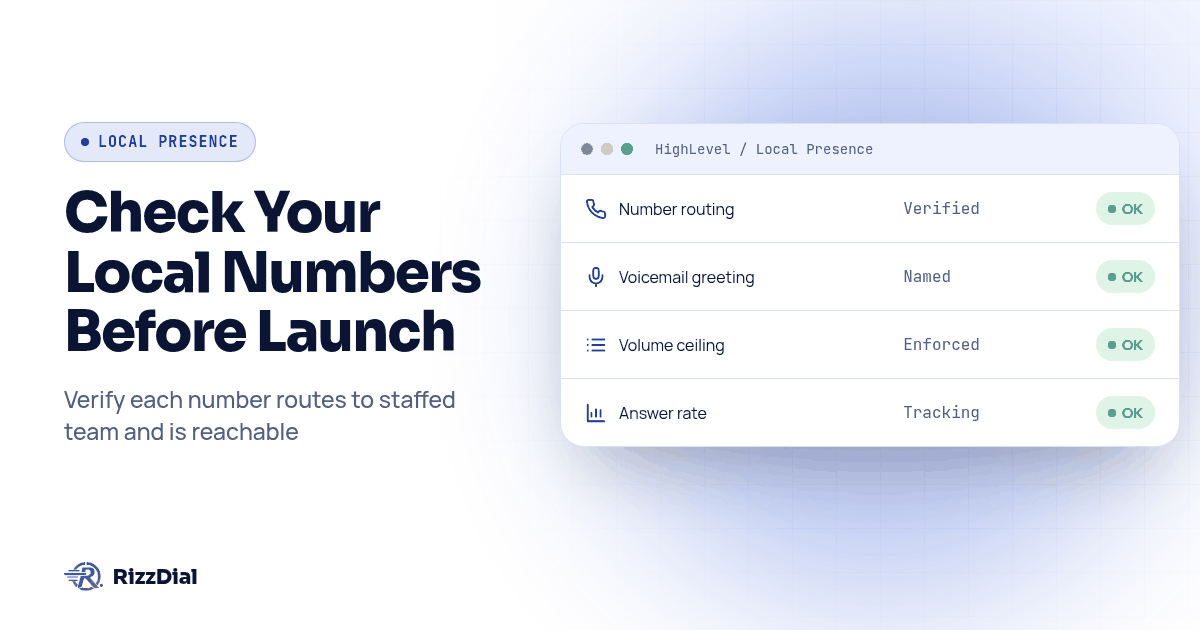
- Inventory every number in the local presence pool and confirm, for each one, that it routes to a staffed destination rather than a default or disconnected line. A number that cannot be answered should not be in the pool regardless of how well it is provisioned.
- Call each number in the pool from a phone outside the dialing system, the same way a lead would call back, and listen to what actually happens. Note whether it rings through, how long it rings, and whether it reaches a person or a voicemail box.
- Set an operational per-number daily volume ceiling with the provider and write it where the team can check it. Treat it as an agency control, not a universal safe threshold or a promise of a built-in dialer feature. If software cannot enforce it, document who checks usage and pauses calls.
- Confirm the number displayed on an outbound test matches the originating-number field in the CRM call activity. Keep the lead's own phone number in the contact phone field. Return the call and check that the client team can find the correct contact history; do not overwrite the lead's number with your outbound number.
- Listen to the voicemail greeting on every number that can reach voicemail, and confirm it names the client's business by name. A generic or default greeting gives a lead who reaches voicemail no way to confirm the call was legitimate.
- Re-run steps one through five every time a number is added to or removed from the pool, not only at initial setup. A pool that passed this check at launch can fail it six months later if a number lapses or gets reassigned without anyone noticing.
These operational tests complement counsel's campaign review. They require someone on the agency's team to actually call the numbers and listen, which is the step that gets skipped when local presence is treated as a toggle instead of a managed asset.
How Should an Agency Measure Its Own Answer Rate Per Number?
Do not promise a connect-rate lift just because a vendor publishes one. Before using an outside percentage, inspect its methodology, lead population, call type and measurement window. This checklist makes no numerical lift claim. Measure the client's own results, and treat a change as something to investigate rather than proof that a local area code caused it.
- Tag every outbound call in the CRM with the specific number it was dialed from, not just the campaign or sub-account, so each number's results can be isolated later. Verify that your provider exposes the originating number in logs or an export; this procedure does not assume a built-in per-number answer-rate report.
- Pull the dial count and the connect count for each number over the same date range, long enough to cover normal weekly variation rather than a single day.
- Define a connect as a live human answer, excluding voicemail and failed attempts. Divide live answers by attempted dials for each number separately, and compare numbers against each other inside the same pool rather than against any outside benchmark.
- Re-run the same calculation after any change to the pool, a new number added, a number removed, or a volume ceiling adjusted, so a drop can be tied to a specific change instead of noticed as a vague decline weeks later.
- Flag any number whose answer rate falls well below the others in the same pool for the pre-launch checklist above, while also checking lead source, attempt timing, sample size and disposition accuracy. A decline alone does not prove a reputation problem.
That gives the team a number that means something, because it is measured against the agency's own leads and its own pool, instead of a lift percentage borrowed from someone else's unverified blog post.
Rotating Pool vs. Branded Number vs. Toll-Free: Which Outbound Identity Fits?
These three outbound identity strategies trade off differently, and none of them is correct for every client.
| What to check | Rotating local presence pool | One branded business number | Toll-free number |
|---|---|---|---|
| What the lead sees | A local area code that changes depending on which number the dialer selected | The same number every time, consistently tied to the business | A toll-free prefix that signals a business line immediately |
| What the callback path is | Depends entirely on whether that specific number in the pool was checked and staffed | Simple: one number, one destination, always the same | One number with a configured inbound destination that still needs testing |
| What breaks first | An individual number in the pool lapses, gets reassigned, or drifts in reputation without anyone noticing | The single number's reputation, since every call relies on the same identity | Routing, recognition or reputation; test instead of assuming a lower answer rate |
| What the agency has to maintain | A live inventory, a per-number volume ceiling, and the pre-launch checklist above, repeated on every pool change | Reputation monitoring on one number, which is simpler but carries all the risk in one place | Inbound routing, staffing, greetings, opt-out handling and reputation monitoring |
A rotating local presence pool is the right fit when the goal is matching a lead's own area code as a hypothesis to test, and the agency is prepared to treat that pool as a maintained asset rather than a setup step. A single branded number fits a client who wants consistency and can tolerate concentrating reputation risk in one place, which is also why that number benefits from the registration and monitoring work covered in branded caller ID for outbound sales. A toll-free number fits a client where recognizability as a business line matters more than the local-area-code trust signal, with recognition and answer rate measured on the actual campaign.
Where Do Agencies Turn Local Presence Dialing On in GoHighLevel?
Inside GoHighLevel, local presence dialing is a setting configured at the sub-account level, inside the phone system configuration for that sub-account, and HighLevel's own support article walks through turning it on and setting it up for outbound numbers (HighLevel local presence dialing guide). GoHighLevel has also extended local presence dialing to its mobile app, which matters for agencies whose reps place calls away from a desk, since the same pool and the same checklist above apply whether the call goes out from the browser dialer or the mobile app (HighLevel mobile local presence dialing changelog).
Turning the setting on is the easy part. Nothing about the toggle confirms the numbers behind it are staffed, that voicemail greetings name the client's business, or that a callback lands somewhere useful, which is why the checklist above exists as a separate, repeatable step.
This is also where the TCPA's broader consent and calling-hours framework sits alongside, but separate from, the Truth in Caller ID question: local presence dialing concerns what the lead sees on the screen, while consent and calling rules under 47 CFR 64.1200 concern whether and when the call should be placed at all (47 CFR 64.1200). Getting the caller ID question right does not answer the consent question, and an agency should not assume one checklist covers both; a dialer built around TCPA-compliant calling treats the two as separate, standing checks rather than one setup step.
Which Outbound Identity Strategy Should an Agency Choose for a New Client?
There is no single correct default. A client doing high-volume local outreach, where the team wants to test whether a familiar area code changes response, is the strongest case for a rotating pool, provided the agency commits to the checklist above on a schedule, not once at launch. A client who values one recognizable identity, or cannot support a pool's ongoing maintenance, is better served by one branded number, accepting the concentrated reputation exposure that comes with it.
The same identity question carries to text: can the recipient tell which business is contacting them? For a related messaging workflow, review Beam's guide to RCS verified sender names and logos. Check the actual recipient experience and supported setup before promising that any brand display will appear.
Agencies comparing a dialer specifically on how it handles local presence, number pools, and caller ID reputation against an alternative platform have a direct comparison in RizzDial vs. Kixie.
What FAQs Do Agencies Ask About Local Presence Dialing?
Is local presence dialing a form of illegal caller ID spoofing?
Not by itself. The rule addresses knowingly misleading caller ID used with prohibited intent. Owning the displayed number is not blanket legal clearance. Review the campaign's identity, purpose and calling permissions as well as its callback path.
Does a local presence number have to be a working, answered line?
Use a working callback destination as an agency launch requirement. For covered telemarketing, the transmitted number must permit do-not-call requests during regular business hours. Also test staffing, the business greeting and after-hours handling so a returned call reaches a useful destination.
What happens to a rotating pool of local presence numbers over time?
Reputation can change as providers evaluate calling activity and recipient feedback. Audit each number rather than assuming that the entire pool shares one status. Recheck routing and labels after pool changes, and investigate declines before continuing the same calling pattern.
Where does an agency turn local presence dialing on in GoHighLevel?
Inside the client's sub-account phone system settings, where HighLevel's own support documentation walks through enabling and configuring local presence dialing for that sub-account's outbound numbers.
How can RizzDial help with your calling workflow?
RizzDial is the AI outbound sales workspace for teams on GoHighLevel. Power dialing, AI voice agents, SMS automation, and CRM workflows in one platform. Book a demo.