Agencies
Virtual Answering Service vs AI Voice Agent
Compare a human virtual answering service with an AI voice agent, then use a practical call test to choose coverage for your business.
By James Hill, Founder, RizzDial ·
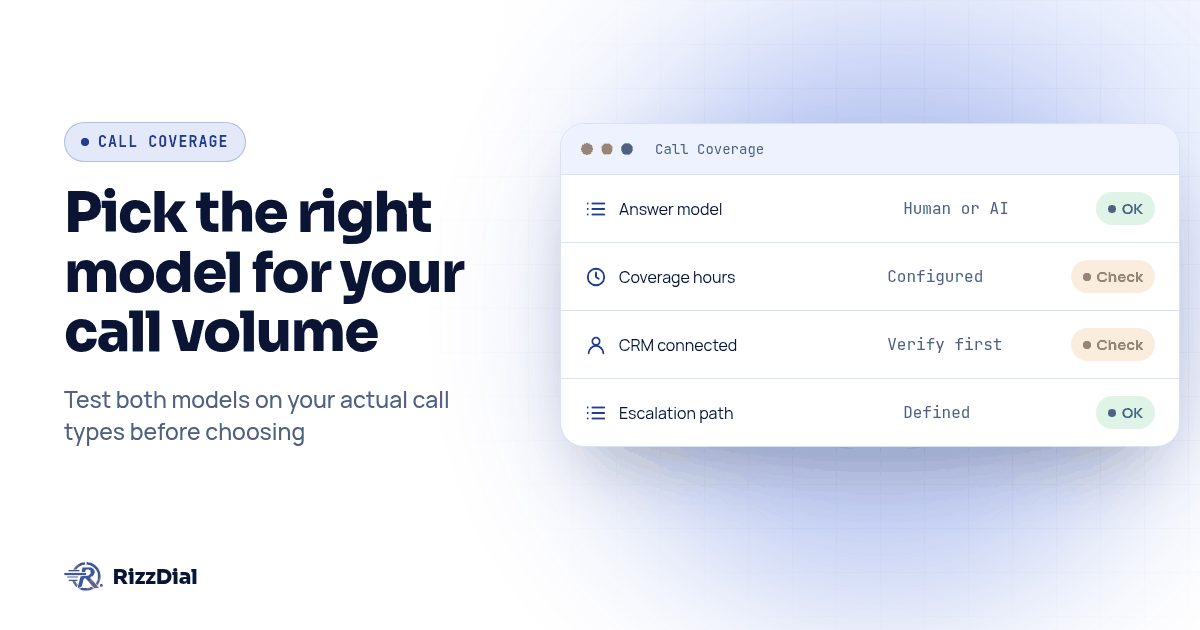
TL;DR: A virtual answering service often means a remote human receptionist taking calls off site, not an AI system. An AI voice agent is software that holds the conversation itself. The two have different staffing models and failure modes, and some businesses may use both.
Searchers type "virtual answering service" expecting a clear answer, but the market uses the phrase for more than one model. It can mean a remote human receptionist or a pool of agents working from a script, while some vendors use similar labels for software. The distinction matters: one puts a person's judgment on the phone, the other puts a configured flow on the phone. Which fits depends on the calls a business receives and the result each call needs.
What Does "Virtual Answering Service" Actually Mean?
Here, "virtual" describes location rather than technology. A virtual answering service is a receptionist, or a shared pool of receptionists, working away from your office, often for several client accounts. An industry guide groups these offerings into shared agents, dedicated agents, onshore or offshore staffing, after-hours or overflow coverage, and software AI voice agents (Aloware's guide to virtual receptionist services). That last category helps explain the confusion: companies use related labels for both people and software.
Ask what operating model the provider actually sells. In the human version, an agent picks up your line, follows an approved script, takes a message or transfers the call, then reports back. A person may adapt to an unusual request, respond to a frustrated caller, or recognize that a caller's real concern differs from the first question. But the agent may not know your business as well as an employee, especially when a shared pool covers multiple accounts.
The name alone does not tell you whether the service is shared or dedicated, what hours are staffed, who handles a complex question, or whether messages reach a system your team checks. Ask for the coverage schedule and a sample call record. If the service is shared, find out how account instructions stay current and how an agent identifies which client's process applies to a caller.
For an agency, the distinction also affects delivery. A client may think they are buying a person who knows its operation when the contract actually covers a shared queue and message-taking. Before you resell a service, define the promised outcome in plain terms: answer, transfer, collect information, book an appointment, or request a callback. Those are different responsibilities and need different permissions.
How Is an AI Voice Agent Actually Different?
An AI voice agent is a separate category: software that holds a live phone conversation using a voice model and a configured flow. It can draw on approved information and follow defined steps. Its actual behavior depends on its setup, integrations and fallback rules, so a demo alone cannot establish how it will handle a client's calls.
The practical gap often appears after the call. A human answering service may relay a message by email or text, leaving someone on the client team to review it and update the CRM. An AI system may also require manual follow-up. If it has an appropriate CRM connection, it can write call details into a contact record. Verify the exact fields and actions with a real record rather than assuming this capability comes with every voice agent.
For example, an agency might ask a system to collect a caller's name, reason for calling and preferred appointment time. The important test is not whether the voice sounds natural. Check whether the system asks for missing information, confirms what it heard, writes the permitted fields to the right record, and routes a request it cannot complete. A human service should face the same outcome test: can the message be found and acted on without someone retyping it from an inbox?
RizzDial has a built-in CRM and connects with other CRMs, including a direct GoHighLevel integration, MCP and OpenAPI. That is a product capability, not a claim that every external setup writes the same fields automatically. An agency should validate its own workflow, permissions and contact matching before routing client calls.
Why Does the Search Term Cause So Much Confusion?
"Virtual" can suggest software to a buyer, while answering-service providers have long used it to describe people who answer remotely. Both usages appear in the market, so a directory category or product headline may not tell you who will speak to your caller.
The useful follow-up is direct: is a person answering, or is software answering? Then ask what happens when the first responder does not know the answer. Does a human transfer the caller, take a message or reach a supervisor? Does an AI agent transfer, collect a callback request or stop? The fallback is part of the service, not a minor detail.
Avoid choosing from the label or a polished demo. A demo may show an ideal request while skipping a caller who interrupts, changes the subject, gives an unclear answer or asks for something outside the configured flow. Build a test around your actual call types and decide in advance what a satisfactory outcome looks like.
How Do Virtual Answering Services and AI Voice Agents Compare?
Compare what changes for the caller and the team behind the line. The table describes common operating patterns, not a promise about every vendor. Ask each provider to verify its own coverage, capacity, integrations and fallback behavior.
| What you're comparing | Virtual answering service (human) | AI voice agent |
|---|---|---|
| Who answers | A remote agent, shared or dedicated, following approved instructions | A configured system holding a conversation using a voice model and approved information |
| Availability | Set by the contracted staffing schedule | Depends on the platform and the configured routing and uptime |
| Concurrent calls | Depends on how many agents are staffed and the queue arrangement | Depends on the vendor's capacity and account configuration |
| Judgment on an unusual request | A person may adapt, but may need an escalation contact | Follows its configured flow and needs a clear human handoff for exceptions |
| Message or CRM record | May send a message that a team member must review and enter | Depends on the vendor; a verified CRM connection may write call details to a record |
| Billing unit | Depends on the agreement, such as time, calls or a package | Depends on the vendor; RizzDial AI talk time is 6 to 20 cents a minute, pay as you go, with flexible seat based options |
| When a call exceeds the script or flow | Can transfer, escalate or take a message, depending on instructions | Can transfer or capture a follow-up request if configured to do so |
The table does not choose for you. It gives you questions for a specific provider instead of treating a product category as proof of performance. Get the coverage schedule, concurrency limit, billable unit and escalation path in writing. If a provider cannot demonstrate a required action, count it as unverified in your comparison.
Does AI Replace a Virtual Answering Service, or Handle Overflow?
Neither answer fits every business. An AI voice agent may suit calls with repeatable requests, such as asking about published hours, collecting intake details or requesting an appointment. Those tasks can be tested against approved information and a defined outcome. The business still needs someone to maintain the information and review exceptions.
A caller with a billing dispute, a serious complaint or a request requiring discretion may need a person who can assess the situation. That is where a human answering service or the client's own staff may fit better. Our guide to choosing human, AI or hybrid answering coverage explains how to map call types and assign responsibility before selecting a model.
Some businesses use a hybrid arrangement: route routine calls to an AI voice agent, while keeping a human path open for sensitive requests and cases the agent cannot resolve. This only works when the handoff is real. Name who receives the call, what context they get, and what happens if they are unavailable. A transfer button without a staffed destination is not a coverage plan.
Consider the caller's experience across the full interaction. If an agent hands off a call, the person should not need to repeat every detail. If the business cannot answer immediately, the caller should hear what will happen next and the team should receive a usable record. Test those outcomes rather than treating an answered call as a completed call.
How Should You Test Which Model Fits Your Calls?
Do not decide from a vendor demo alone. Use the same scenarios, information and pass criteria for a human answering service and an AI voice agent. This seven-step procedure turns your call history into a practical coverage decision.
- Review a representative sample of call records. Use calls your team is authorized to review. Sort them into routine requests, requests needing judgment, and calls that did not reach a useful outcome. Keep uncertain cases marked as uncertain.
- Separate business hours from after-hours calls. Record when calls arrive and who is available to resolve them. This shows whether you need full-time coverage, overflow coverage or a path for calls that arrive when staff are away.
- Define the required record after each call. List the caller details, reason, answers, next action and owner that your process requires. Include what should not be collected or changed.
- Write identical test scenarios for each option. Include a routine question, an unclear answer, a request needing judgment and a caller asking for a person. Use the same expected result for each provider.
- Test the CRM handoff using a real contact record. Confirm the correct record is updated, the information is accurate, and the next owner can find the call outcome. If a vendor offers no write-back, document the manual step and assign its owner.
- Test failure and escalation behavior. Give the system a question outside its approved scope and make the human contact unavailable once. Check what the caller hears, who gets notified and what context reaches the person who follows up.
- Pilot a limited, reversible slice of traffic. Keep current coverage available while you route a defined line or call group through the candidate. Review the records and caller outcomes against your pass criteria before changing the main forwarding number.
Use a scorecard with a row for each scenario and columns for accuracy, completion, record quality, escalation and caller experience. Record observed results separately from vendor statements. If a setup fails a required case, adjust its flow or routing and repeat that case before expanding the pilot.
When Does a Hybrid Setup Make Sense?
A hybrid setup makes sense when your call review shows two groups with different needs: routine requests that can follow a maintained process and exceptions that require a person's judgment. Our guide to telephone answering service versus AI answering service covers a related choice from the agency service and resale angle. This article focuses on whether a business should buy remote human coverage, use an AI voice agent or combine them.
Cost structure is another consideration, but compare complete scopes rather than headline units. A human plan may include message-taking but not booking; an AI offer may include a usage charge but leave setup and review to your team. Our guide to answering service pricing models explains how to compare per-minute, per-call, per-seat and flat bundle proposals using your own call records.
Plan for overflow from both sides. An AI system may reach a limit or encounter a request outside its flow. A human service may be busy or unavailable under the schedule you selected. Decide what the caller hears in each case and who follows up. If a missed call needs a text follow-up, Beam's guide to iMessage for business covers a way to continue the conversation by message.
What Should You Check Before Switching?
Before moving from a human answering service to AI, or adding AI to existing coverage, write down the call flow, CRM fields, data export process and escalation owner. Confirm who controls the phone number and how forwarding will change. Schedule the change so calls do not ring into an unmonitored destination during the transition.
Confirm concurrency and escalation behavior with test calls. Ask what the system does when several callers arrive together, a transfer is unanswered or the CRM is unavailable. Keep a rollback plan that names the person who can restore the old routing and the conditions that trigger it.
If you are evaluating voice platforms broadly, our alternatives directory compares options on details a buyer can check. Start with your call records, then ask vendors to demonstrate the same scenarios. The name on the proposal will not change the work your team must own after each call.
What Questions Do Buyers Ask About Virtual Answering Services and AI Voice Agents?
How much does a virtual answering service cost compared to an AI voice agent?
A virtual answering service may bill by time, call or package, depending on the provider and agreement. AI voice agent billing also varies by vendor. RizzDial AI talk time is 6 to 20 cents a minute, pay as you go, with flexible seat based options for team accounts. Compare the full scope, usage definition and any work your team must do after the call.
How long does it take to set up an AI voice agent to cover calls a virtual answering service currently handles?
There is no single setup timeline for every business. Write the call flow and required CRM fields, connect the CRM, test the flow against a spare number, then route a limited slice of real traffic before changing the main forwarding number. Include review time and a fallback plan in the rollout.
Does an AI voice agent integrate with the CRM a virtual answering service currently feeds into?
That depends on the vendor and setup. A virtual answering service may relay a message that someone copies into the CRM. RizzDial has a built-in CRM and connects to other CRMs through a direct GoHighLevel integration, MCP and OpenAPI. Verify that your selected fields reach the correct contact record in a test before relying on the workflow.
Is there a compliance difference between a human virtual answering service and an AI voice agent?
The FCC has confirmed that AI-generated voices fall under TCPA rules for an artificial or prerecorded voice, a rule a human agent reading a script does not trigger the same way (FCC order FCC-24-17A1). Review the current rule for the specific call type before launch and treat caller disclosure as its own acceptance check.
What does it cost in effort to switch from a virtual answering service to an AI voice agent?
The work includes rebuilding and testing the call flow, assigning someone to review exceptions, and moving call forwarding without a coverage gap. Run the old service and the new AI voice agent in parallel during a limited pilot. Make the forwarding change only after the new route passes your acceptance checks.
About RizzDial
RizzDial is the AI outbound sales workspace for teams on GoHighLevel. Power dialing, AI voice agents, SMS automation, and CRM workflows in one platform. Book a demo.