AI Voice Agents
What Actually Counts as an AI Phone Agent?
AI phone agent, AI receptionist, voice bot, voice AI platform: a glossary with a comparison table so you know which category a vendor is selling.
By James Hill, Founder, RizzDial ·
An AI phone agent is a broad label, not a standardized product category. It can describe a packaged receptionist, a conversational voice bot, developer infrastructure, or a dialer with AI calling, so agencies should verify what each product actually does. Start by checking whether it handles inbound calls, outbound calls, or both, and how its telephony is connected.
TL;DR: "AI phone agent" is an umbrella term. Verify inbound and outbound capabilities, telephony setup, dialer, CRM connections, and developer access with the same documented test before comparing vendors.
We make RizzDial, a platform built to cover several of these categories at once, so read the comparison below with that disclosed. Agencies keep losing weeks evaluating a "phone agent" against an "AI receptionist" against a "voice AI platform" as if they were the same purchase, when the fine print says otherwise.
If you already know you want a packaged inbound product and are deciding between vendors, read our AI receptionist versus AI voice agent comparison instead. If you are deciding whether to replace an existing phone menu, read IVR versus AI voice agent. If you have already picked a platform category and want the all-in-one-versus-standalone tradeoffs, read AI phone system versus standalone voice agent. This article is for the step before any of those three: working out which category a tool in front of you actually belongs to, so the comparison you run next is the right one.
What Does "AI Phone Agent" Actually Mean as a Term?
Nobody owns the definition. In practice, "AI phone agent" gets used as a catch-all for any system where an AI model talks on a phone call, inbound or outbound, instead of a human. kompaas.tech's breakdown of the adjacent terms draws a cleaner line that is useful here: a telephone AI agent is one "packaged" for the phone network itself, working through SIP trunks and virtual PBX systems and identifying a caller mostly by phone number, while a broader voice AI agent is any assistant that understands and speaks, with telephony as just one of several channels it might run on, alongside an app or a website widget (kompaas.tech).
That distinction matters because a vendor can be telling the truth about having a "voice AI agent" while still being a poor fit for a phone-heavy agency, if the only channel it was built for is an in-app widget and the phone number was added later. The question an agency should ask is not "is this an AI phone agent," since almost every vendor says yes. The question is which category below it actually is, because each one answers a different buying question.
What Is the Difference Between an AI Phone Agent, an AI Receptionist, a Voice Bot, and a Voice AI Platform?
Use this table to sort a vendor's homepage language into one of five working categories before you book a demo. None of these labels is official. They describe how the product actually behaves once you ask it to do something beyond the sales pitch.
| Category | Inbound, outbound, or both | Owns telephony or needs one bolted on | Typical buyer |
|---|---|---|---|
| AI phone agent (umbrella term) | Could be either, ask directly | Varies, ask directly | Anyone searching for a phone AI, before they know which category they need |
| AI receptionist | Inbound only, almost always | Usually comes with a number already attached | A single business that wants its phone answered without hiring |
| Voice bot / conversational IVR | Inbound only | Typically plugs into an existing contact-center phone system | Contact center teams reducing wait times and handling FAQs, per Dialpad's own glossary definition, which describes voice bots purely in terms of "handling spoken customer interactions" on inbound calls and does not address outbound calling at all (Dialpad glossary) |
| Voice AI platform (developer infrastructure) | Both, if you build it | Needs telephony connected, either bring-your-own or a managed number purchase | Developers and agencies assembling a custom stack for resale |
| Autodialer with a voice model bolted on | Outbound-heavy, inbound often an afterthought | Usually owns telephony already, since it started as a dialer | Sales teams that had a dialer first and added AI calling later |
A caller on the other end of the line cannot tell which row of this table they are talking to. An agency buying on behalf of a client needs to, because the row determines what the product can be asked to do next month.
Why Does a Real Phone Agent Need Telephony Infrastructure Underneath the Voice Model?
Telephony is the part that connects a voice model to a live telephone conversation. A vendor may manage the phone numbers and routing, support a customer-provided connection, or depend on other providers. Ask which services handle the number, audio transport, speech processing, and call routing, then confirm the answer in product documentation.
A published engineering article from MetaDesign Solutions contrasts streaming telephony designs with a serial audio-upload and text-response design, and gives latency estimates for its described architecture (telephony-native and chat API comparison). Treat those figures as that author's example, not a universal benchmark: actual delay depends on the implementation, network, speech services, model, and call conditions. The useful evaluation question is whether the vendor can explain the path audio takes and let you test response timing on a real call.
If you hear a noticeable pause after a caller finishes speaking, capture the test call and ask the vendor to identify where time is spent. A slow response alone does not prove that a chat API is responsible. Configuration, network conditions, speech recognition, model response, and knowledge retrieval can all affect timing. Our voice AI latency causes and fixes guide covers a structured diagnosis.
How Do You Test Which Category a Vendor's "AI Phone Agent" Actually Belongs To?
Run this six-step test on any tool calling itself an AI phone agent before you put your name on it for a client. It takes under a day and none of it requires a signed contract.
- Ask for a live outbound test call, not just an inbound demo number. If the vendor can only show you an inbound line you call into, you are looking at a receptionist or a voice bot, not a platform that can run outbound campaigns.
- Ask who the telephony runs through. Get a direct answer: a documented connection to major carriers, a managed number the vendor purchased on your behalf, or a bring-your-own SIP trunk or number. "We handle that" is not an answer; a carrier name is.
- Place real outbound test calls to phones on at least two major US carriers and read the caller ID label that actually displays, not the vendor's dashboard status. Caller ID presentation and reputation can vary by number, carrier, and call pattern, so inspect the receiving devices rather than relying only on a dashboard.
- Load a short list of more than one number and see if it dials automatically. A true dialer paces calls and logs a disposition per call. A single-call voice agent with no dialer will make you trigger each call by hand, which tells you it is voice-only.
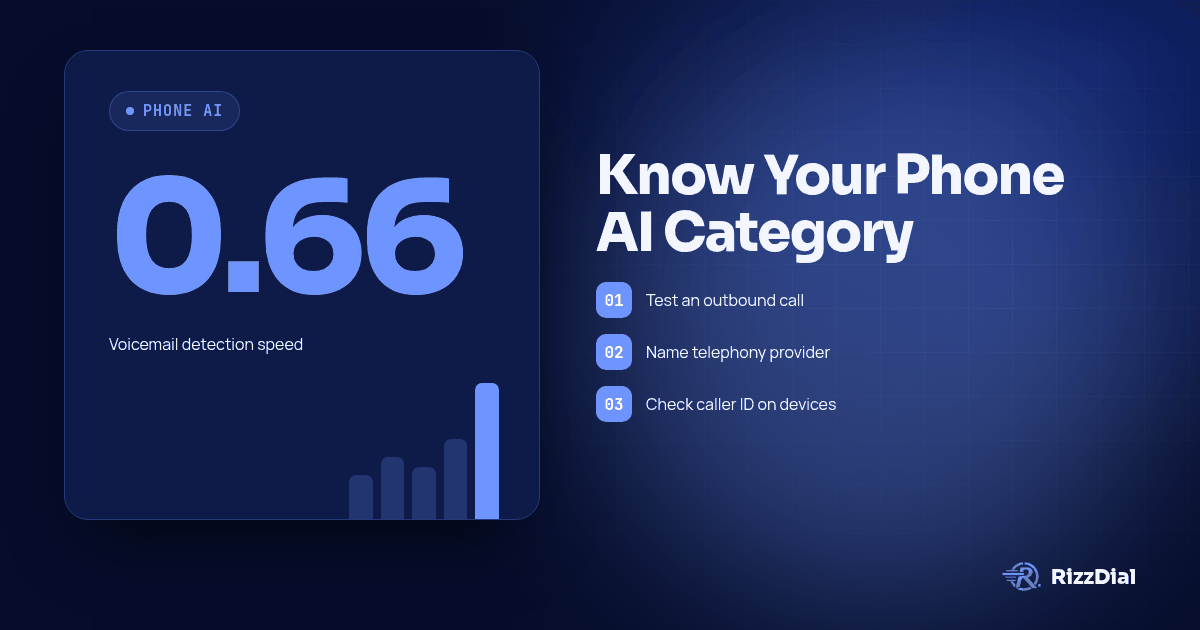
- Leave a real voicemail on a test line and time how long the system takes to recognize it and stop talking. RizzDial's own proprietary voicemail detection runs in 0.66 milliseconds, built to get the call back to a live rep instead of talking to a machine; use that as your benchmark, not a claim that every other vendor must match it.
- Ask for MCP, OpenAPI, or a documented developer connection, and have someone pull a transcript programmatically on the spot. If the answer is a support ticket instead of an endpoint, the category is closed-platform, whatever the marketing page calls it.
Score the answers against the table above. A tool that passes steps 1, 2 and 4 is an outbound-capable platform. A tool that only passes step 1 inbound and fails step 2 with a vague answer is a receptionist wearing a platform's marketing copy.
Where Does RizzDial Fit Across These Categories?
RizzDial was built to sit across several rows of that table at once rather than pick one, which is the honest reason we are the example in this article. Calls run through direct carrier access to AT&T, Verizon and T-Mobile instead of a rented VoIP number with no carrier relationship, which addresses step 2 and 3 of the test above directly. A built-in predictive and power dialer handles the outbound-list behavior in step 4, so a client's reps and the AI voice agents can work the same queue instead of two disconnected products. RizzDial's proprietary voicemail detection runs in 0.66 milliseconds, built to connect reps to live humans faster, which is what step 5 is testing for. MCP and OpenAPI access covers step 6, letting an agency's own developers, or Claude and ChatGPT, build follow-up workflows without waiting on a vendor roadmap.
That combination is also why "AI phone agent" undersells what a reseller is evaluating when RizzDial is on the shortlist: the real comparison is whether a combined platform beats stitching together a receptionist, a separate dialer and a separate CRM from three vendors. See our disclosed comparison at RizzDial vs Retell and our Retell alternative page if a standalone developer-first voice platform is the category you are weighing against a combined one. If a client also wants the follow-up text after a call to run on carrier-grade messaging instead of a bolted-on SMS gateway, the same own-the-infrastructure question applies to texting: see Beam's iMessage API for that same test on the messaging side.
Our GoHighLevel integration is the fastest place to see what "combined platform" means in practice for an agency already running GoHighLevel, since the dialer, the voice agents and the CRM sync all attach to a sub-account you already manage.
What questions do agencies ask about AI phone agents?
Does the price of an AI phone agent depend on which category it actually falls into?
Yes. Packaged AI receptionist products and voice-only bots are usually billed as a flat monthly fee per number or per location, since the vendor controls a narrow, pre-built call flow. A voice AI platform or a combined platform like RizzDial bills more like infrastructure: usage based on actual talk time, often layered with optional seats. RizzDial's AI minutes run $0.06 to $0.20 a minute, billed for talk time only, so a 2 minute call at $0.10 a minute costs $0.20 in talk time, with flexible seat-based options on top for teams that want them. Ask any vendor whether the category label on their homepage matches a seat fee, a per-minute rate, or both, before you compare two quotes that describe themselves the same way.
How long does it take to figure out which category a vendor's AI phone agent actually belongs to, before a client rollout?
Budget a few hours, not weeks. Run the six-step test in this article: confirm inbound versus outbound support, confirm whether calls ride a documented carrier connection or a rented VoIP number, place real test calls to each major carrier, test whether the product can dial more than one lead at a time, time its voicemail detection against a real voicemail box, and ask about MCP or API access. None of that requires a signed contract, and any vendor worth reselling should let you run it on a trial number first.
Does an AI phone agent need its own CRM and dialer, or is that a separate purchase?
It depends entirely on which category you are actually buying. A packaged AI receptionist or a voice-only bot typically has no dialer at all and connects to a CRM through a generic webhook you have to map yourself. A voice AI platform gives you the raw voice layer and expects you, or a developer, to wire everything else around it. RizzDial folds several of those pieces into one product: a built-in CRM that also connects to any CRM an agency's client already runs, plus a built-in predictive and power dialer alongside the AI voice agents, so a reseller is not stitching three vendors together to cover one client.
Does the category of an AI phone agent change who is responsible for TCPA and consent rules?
No. Every category here, a receptionist, a voice bot, a voice AI platform or a combined product, places the consent, calling-hours and do-not-call decisions on the account holder, not the vendor. What changes by category is how much the vendor helps you act on those rules. RizzDial is built with FCC and FTC rules in mind and layers on number rotation and reputation monitoring, but no platform in any category can promise your agency is automatically compliant just because the demo sounded polished.
Is it harder to switch away from a packaged AI receptionist or from a voice AI platform?
Usually the packaged receptionist, because the vendor owns more of the stack behind one simple login: the number, the call flow, and often the only copy of your call history. A voice AI platform spreads the pieces across the account, the telephony connection and whatever CRM you already run, so there is more to export but also more that is already yours. Ask any vendor, in either category, for a sample export of recordings, transcripts, agent configuration and phone numbers before you sign, not after a client wants to leave.
What Should You Do With This Glossary Today?
Pull up the homepage of whatever "AI phone agent" you are currently evaluating and run the six-step test against it this week, before the next demo call turns into a signed contract. Write the category it actually lands in on the table above, not the one its marketing page claims, and compare it against the next vendor using the same table instead of starting from scratch on every call.
About RizzDial
RizzDial is the AI outbound sales workspace for teams on GoHighLevel. Power dialing, AI voice agents, SMS automation, and CRM workflows in one platform. Book a demo.